Change in Momentum and Impulse
Введено| English | Значение |
|---|---|
| impulse/ˈɪmpʌls/ | импульс силы |
Why an airbag saves you — the physics of a soft landing
- In a crash your momentum must drop to zero. That change is fixed; you cannot avoid it.
- But you can choose how long it takes to happen — and that changes the force.
- Stop in a split second and the force is huge; stop over half a second and it is gentle.
- Airbags, crumple zones and bent knees all work by stretching the stopping time.
Impulse changes momentum
- For a constant force, impulse 冲量 is force multiplied by the time it acts: $\vec J = \vec F\,\Delta t$.
- The impulse–momentum theorem: impulse equals the change in momentum, $\vec J = \Delta \vec p$.
- For net force (or its average over the interval), $\vec F_{net,avg}\,\Delta t = m\vec v_f - m\vec v_i$.
- Impulse is measured in $\text{N}\cdot\text{s}$, which equals $\text{kg}\cdot\tfrac{\text{m}}{\text{s}}$.
The impulse–momentum theorem says impulse equals the change in ____.
Сложность 1/5 · 100 монет + небольшой бонус за первое завершение сегодня
$\vec J = \Delta \vec p$ — impulse equals the change in импульс.
A force of $20\ \text{N}$ acts for $0.5\ \text{s}$. What is the impulse, in $\text{N·s}$?
Сложность 2/5 · 140 монет + небольшой бонус за первое завершение сегодня
$J = F\Delta t = 20 \times 0.5 = 10\ \text{N·s}$.
Impulse is the area under a force–time graph
- When the force varies, the impulse is the area under the force–time curve.
- A short, sharp spike and a long, gentle push can deliver the same impulse.
- Same area ⇒ same change in momentum, whatever the shape.
- This is why we care about the whole interaction, not just the peak force.
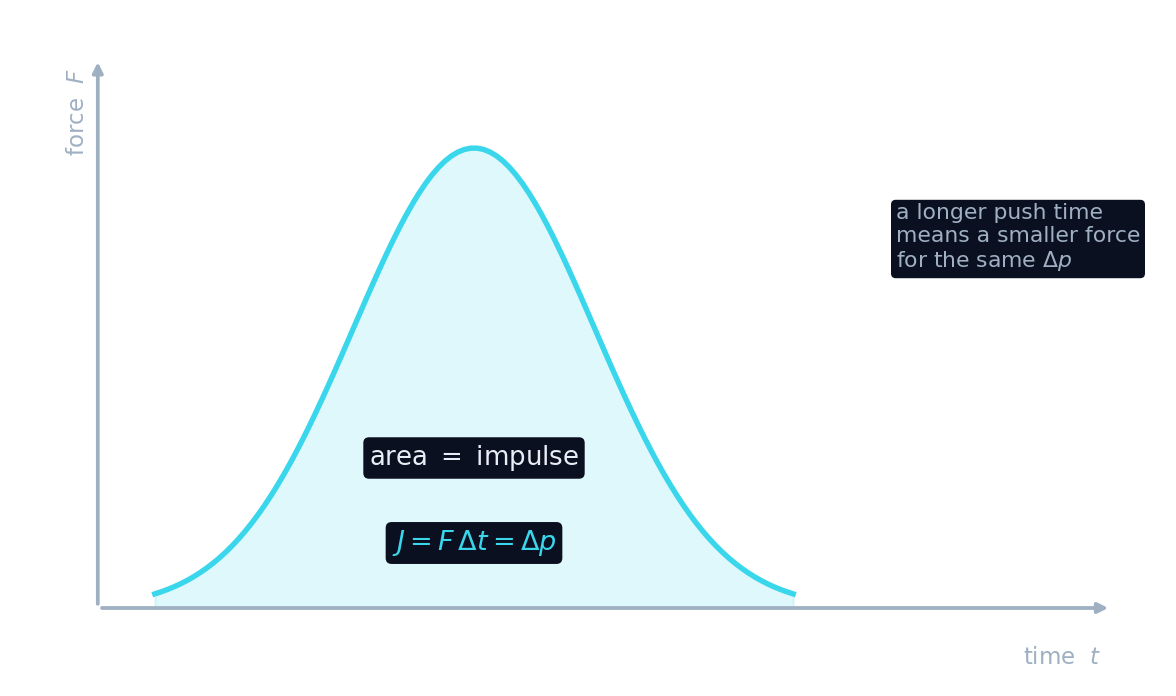
The impulse delivered by a varying force equals the area under its force–time graph.
Сложность 1/5 · 100 монет + небольшой бонус за первое завершение сегодня
Impulse is the accumulated $F\,\Delta t$ — exactly the area under the force–time curve.
Trade force for time
- For a fixed change in momentum, $F$ and $\Delta t$ are inversely related: $F = \dfrac{\Delta p}{\Delta t}$.
- Longer contact time ⇒ smaller average net force. Shorter time ⇒ bigger average net force.
- A caught cricket ball hurts less if you move your hands back as you catch.
- Follow-through in sport does the opposite — a longer push builds more momentum.
Impulse and momentum change
Impulse is force times time and equals the change in momentum. Sort each case.
How does an airbag reduce the force on a passenger in a crash?
Сложность 1/5 · 100 монет + небольшой бонус за первое завершение сегодня
The change in momentum is fixed. A longer stopping time $\Delta t$ makes $F = \Delta p/\Delta t$ smaller.
For the same change in momentum, a longer contact time means the force is:
Сложность 1/5 · 100 монет + небольшой бонус за первое завершение сегодня
$F = \Delta p / \Delta t$: a bigger $\Delta t$ gives a smaller force.
The change in momentum in a crash is fixed by the speeds involved — an airbag does not reduce it. What the airbag reduces is the force, by making the stop take longer ($F = \Delta p / \Delta t$). Same $\Delta p$, longer $\Delta t$, smaller $F$.
A $0.5\ \text{kg}$ ball hits a wall at $6\ \tfrac{\text{m}}{\text{s}}$ and bounces back at $4\ \tfrac{\text{m}}{\text{s}}$. What is the size of the impulse from the wall, in $\text{N·s}$?
Сложность 2/5 · 140 монет + небольшой бонус за первое завершение сегодня
$\Delta p = 0.5(-4) - 0.5(6) = -5$, so the impulse has size $5\ \text{N·s}$ (away from the wall).
A $0.5\ \text{kg}$ ball hits a wall at $6\ \tfrac{\text{m}}{\text{s}}$ and bounces straight back at $4\ \tfrac{\text{m}}{\text{s}}$.
- Taking "toward the wall" as positive: $\Delta p = m v_f - m v_i = 0.5(-4) - 0.5(6) = -5\ \text{kg}\cdot\tfrac{\text{m}}{\text{s}}$.
- The impulse from the wall is $5\ \text{N}\cdot\text{s}$, directed away from the wall.
Impulse $\vec J = \vec F\,\Delta t$ equals the change in momentum: $\vec F\,\Delta t = \Delta \vec p$ (the impulse–momentum theorem). It is the area under a force–time graph. For a fixed $\Delta p$, a longer time means a smaller force — the secret of airbags.
Write from the data: find the impulse
- A force of 15 N acts for 0.40 s.
- Find the impulse and the change in momentum.
A constant net force of 15 N acts for 0.40 s. What impulse does it give, and what is the change in momentum?
For a constant force, $J=F\Delta t=(15\ \text{N})(0.40\ \text{s})=6\ \text{N}\cdot\text{s}$. By the impulse-momentum theorem, $\Delta p=J=6\ \text{kg}\cdot\tfrac{\text{m}}{\text{s}}$, in the force direction if this is the net force.
A constant 15 N force acts for 0.40 s. What impulse does it deliver?
Сложность 1/5 · 100 монет + небольшой бонус за первое завершение сегодня
For a constant force, $J=F\Delta t=(15\ \text{N})(0.40\ \text{s})=6\ \text{N}\cdot\text{s}$. By the impulse-momentum theorem, $\Delta p=J=6\ \text{kg}\cdot\tfrac{\text{m}}{\text{s}}$, in the force direction if this is the net force.