Theories of Development
Введено| English | Значение |
|---|---|
| Rostow's stages of growth/ˈrɒstəʊz ˈsteɪdʒɪz ɒv ɡrəʊθ/ | Этапы роста по Розтоу |
| Wallerstein's world-systems theory/ˈwɒləstaɪnz wɜːld ˈsɪstəmz ˈθɪəri/ | Теория мировая системы Уоллерстайна |
| core/kɔː/ | Ядро |
| periphery/pəˈrɪfəri/ | Периферия |
| semi-periphery/ˈsemi pəˈrɪfəri/ | Полупериферия |
| dependency/dɪˈpendənsi/ | Зависимость |
Two big theories
- Two famous theories explain why some regions are rich and others poor.
- Rostow's stages of growth 罗斯托发展阶段 is optimistic: every country can climb.
- Wallerstein's world-systems theory 沃勒斯坦世界体系理论 is critical: the system keeps some poor.
Rostow's ladder
- Rostow says every country climbs five stages to mass consumption.
- Traditional → preconditions → take-off → drive to maturity → mass consumption.
- Critics say it ignores global inequalities and assumes one path fits all.
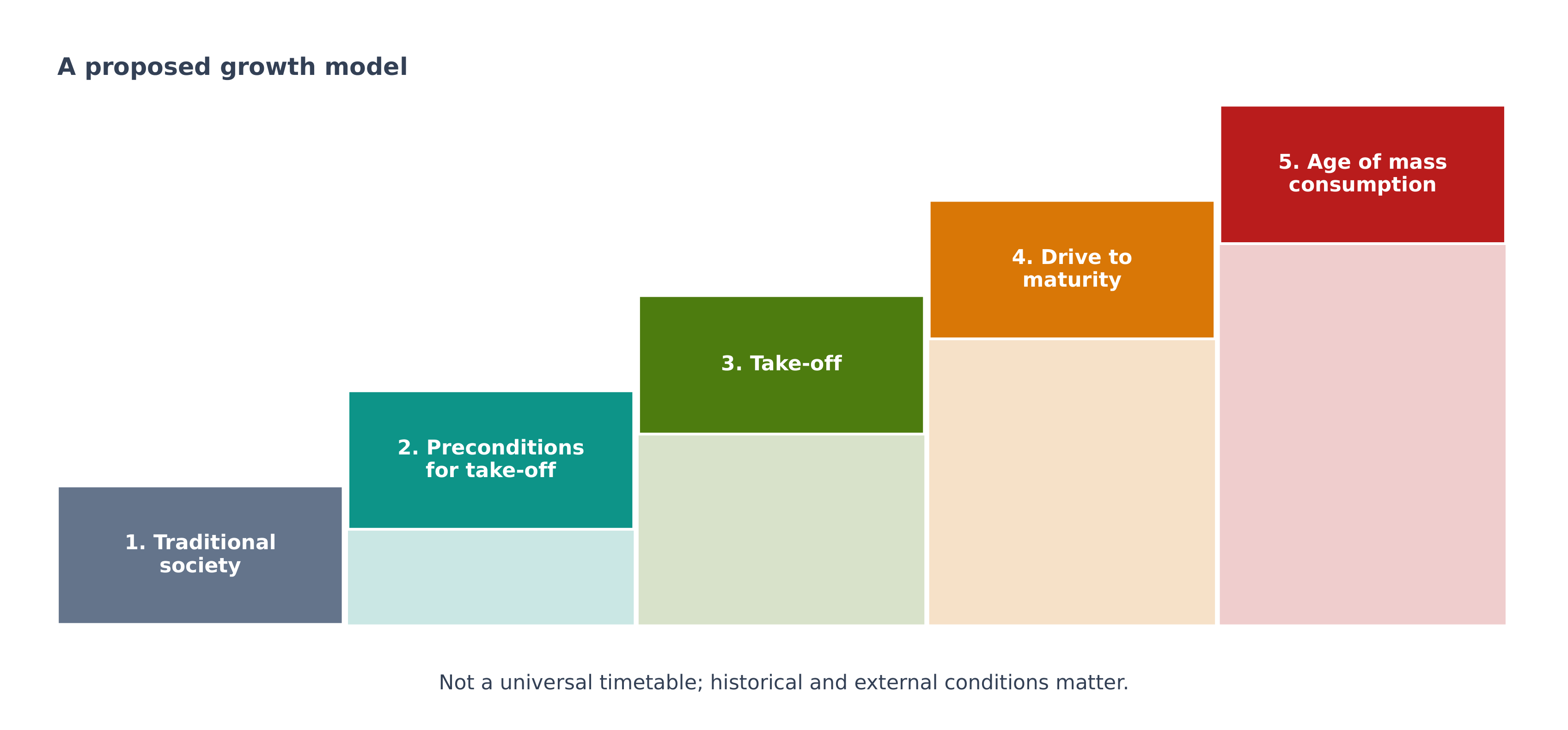
Five stages proposed within Rostow’s model, not every country’s inevitable path
Which theory divides the world into core, periphery, and semi-periphery?
Сложность 1/5 · 100 монет + небольшой бонус за первое выполнение сегодня
Wallerstein's world-systems theory uses core/periphery/semi-periphery.
Rostow says every country climbs ____ stages to mass consumption.
Сложность 1/5 · 100 монет + небольшой бонус за первое выполнение сегодня
Rostow's model has five stages of growth.
Order Rostow's stages of growth.
Сложность 3/5 · 200 монет + небольшой бонус за первое выполнение сегодня
Rostow: traditional → preconditions → take-off → maturity → mass consumption.
Wallerstein's world-system
- Wallerstein divides the world into core 核心, periphery 边缘, and semi-periphery 半边缘.
- The wealthy core stays rich by using the periphery's cheap labour and resources.
- This dependency 依附 view challenges Rostow's optimism.
Rostow or Wallerstein?
Sort each idea by which development theory it belongs to.
Wallerstein's theory argues the global system keeps the periphery poor.
Сложность 1/5 · 100 монет + небольшой бонус за первое выполнение сегодня
It is a dependency view: the core stays rich by exploiting the periphery.
Match each region to its role in Wallerstein's theory.
Сложность 2/5 · 140 монет + небольшой бонус за первое выполнение сегодня
Core = rich; periphery = poor; semi-periphery = middle.
Rostow and Wallerstein disagree fundamentally. Rostow says any country can climb the ladder with the right steps; Wallerstein says the global system is structured to keep the core rich and the periphery poor. Know both — the exam often asks you to contrast them.
A poor country exports cheap raw materials (periphery) to a rich country that turns them into expensive goods (core). Rostow would say the poor country just needs to take off; Wallerstein would say the system is designed to keep it dependent — the same facts, two opposite readings.
Rostow's stages (optimistic): every country climbs five stages to mass consumption. Wallerstein's world-systems theory (critical): a wealthy core stays rich by exploiting the periphery and semi-periphery — a dependency view that challenges Rostow.
Write from a country in the periphery
- A country exports raw copper and imports machinery and clothing.
- High-profit design and finance stay in richer countries.
Where does world-systems theory place this country?
Peripheral countries sit at the raw-material end of the world economy.
Where is this copper exporter placed?
Сложность 1/5 · 100 монет + небольшой бонус за первое выполнение сегодня
Raw exports and manufactured imports mark the periphery.