Economic Sectors and Patterns
Введено| English | Значение |
|---|---|
| primary sector/ˈpraɪməri ˈsektə/ | первичный сектор |
| secondary sector/ˈsekəndəri ˈsektə/ | вторичный сектор |
| tertiary sector/ˈtɜːʃjəri ˈsektə/ | третичный сектор |
| quaternary/kwəˈtɜːnəri/ | четвертичный сектор |
| Weber's least-cost theory/ˈwebəz liːst kɒst ˈθɪəri/ | теория наименьших издержек Вебера |
Four kinds of jobs
- Jobs fall into sectors, and the mix shifts as a country develops.
- Primary sector 第一产业 extracts raw materials (farming, mining, fishing).
- Secondary sector 第二产业 manufactures raw materials into goods.
Services and knowledge
- Tertiary sector 第三产业 provides services (retail, transport, healthcare).
- Quaternary 第四产业 handles information and research; the quinary sector is top decision-making.
- Poorer economies lean on the primary sector; richer ones on the tertiary and quaternary.
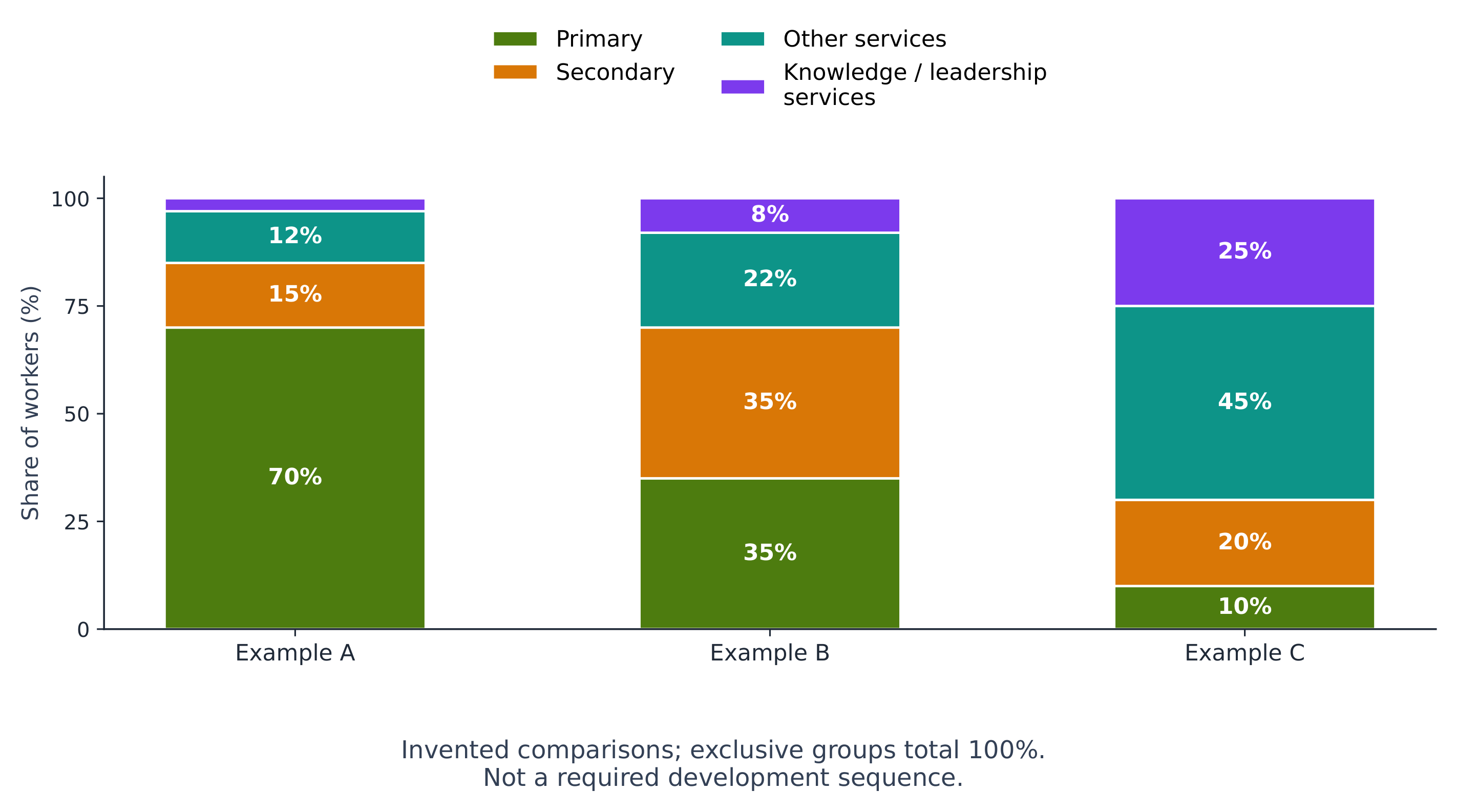
Illustrative exclusive employment groups sum to 100%; these are invented comparisons, not an inevitable sequence
Which economic sector?
Sort each job into its economic sector.
A software researcher works mainly in the ____ sector.
Сложность 1/5 · 100 монет + небольшой бонус за первое выполнение сегодня
Information and research jobs are quaternary.
A less-developed economy usually has most workers in the primary sector.
Сложность 1/5 · 100 монет + небольшой бонус за первое выполнение сегодня
Poorer economies lean on farming and extraction (primary).
Order the sectors a worker typically shifts through as a country develops.
Сложность 3/5 · 200 монет + небольшой бонус за первое выполнение сегодня
Development shifts jobs primary → secondary → tertiary → quaternary.
Match each job to its sector.
Сложность 2/5 · 140 монет + небольшой бонус за первое выполнение сегодня
Miner = primary; factory = secondary; nurse = tertiary.
Where industry locates
- Weber's least-cost theory 韦伯最小成本理论 explains where factories locate.
- It balances the cost of transport, labour, and agglomeration (clustering).
- Firms choose the spot where total cost is lowest.
The theory that factories locate to minimise transport, labour, and agglomeration costs is ____'s least-cost theory.
Сложность 1/5 · 100 монет + небольшой бонус за первое выполнение сегодня
Weber's least-cost theory finds the lowest-total-cost location.
The sector mix is a strong clue to development level. A country with most workers in the primary sector is usually less developed; one dominated by tertiary and quaternary jobs is usually more developed. Read the sector balance, not just total output.
In a poor economy, most people farm (primary). As it develops, workers move to factories (secondary), then to shops and offices (tertiary), and finally to research and IT (quaternary). The shifting sector mix tracks development.
Jobs fall into primary (raw materials), secondary (manufacturing), tertiary (services), and quaternary (information) sectors. The mix shifts from primary to tertiary/quaternary as a country develops. Weber's least-cost theory explains where industry locates.
Write from a designer in the quaternary sector
- One person designs software.
- Another assembles phones in a factory, and a third mines the metal ore.
Which sector is the software designer in?
Quaternary work is information and specialised knowledge.
Which sector fits the software designer?
Сложность 1/5 · 100 монет + небольшой бонус за первое выполнение сегодня
Designing software is information work.