The Internal Structure of Cities
Введено| English | Значение |
|---|---|
| Central Business District/ˈsentrəl ˈbɪznəs ˈdɪstrɪkt/ | центральный деловой район |
| concentric zone model/kənˈsentrɪk zəʊn ˈmɒdl/ | модель концентрических зон |
| sector model/ˈsektə ˈmɒdl/ | секторальная модель |
| multiple nuclei model/ˈmʌltɪpl ˈnjuːklɪi ˈmɒdl/ | модель множественных ядер |
Three classic models
- Three models describe how North American cities are arranged inside.
- All are built around the Central Business District 中央商务区 (CBD).
- Each explains land use in a different way.
The commercial heart of the city that all three models centre on is the Central Business ____.
Сложность 1/5 · 100 монет + небольшой бонус за первое выполнение сегодня
The Central Business District (CBD) is the commercial core.
Select все classic North American urban models.
Сложность 2/5 · 140 монет + небольшой бонус за первое выполнение сегодня
Concentric, sector, and multiple nuclei are city models; rank-size is about city sizes.
Concentric zone and sector
- The concentric zone model 同心圆模型 (Burgess) has rings around the CBD.
- The sector model 扇形模型 (Hoyt) grows in wedges along transport routes.
- Both put the CBD at the centre but organise the rest differently.
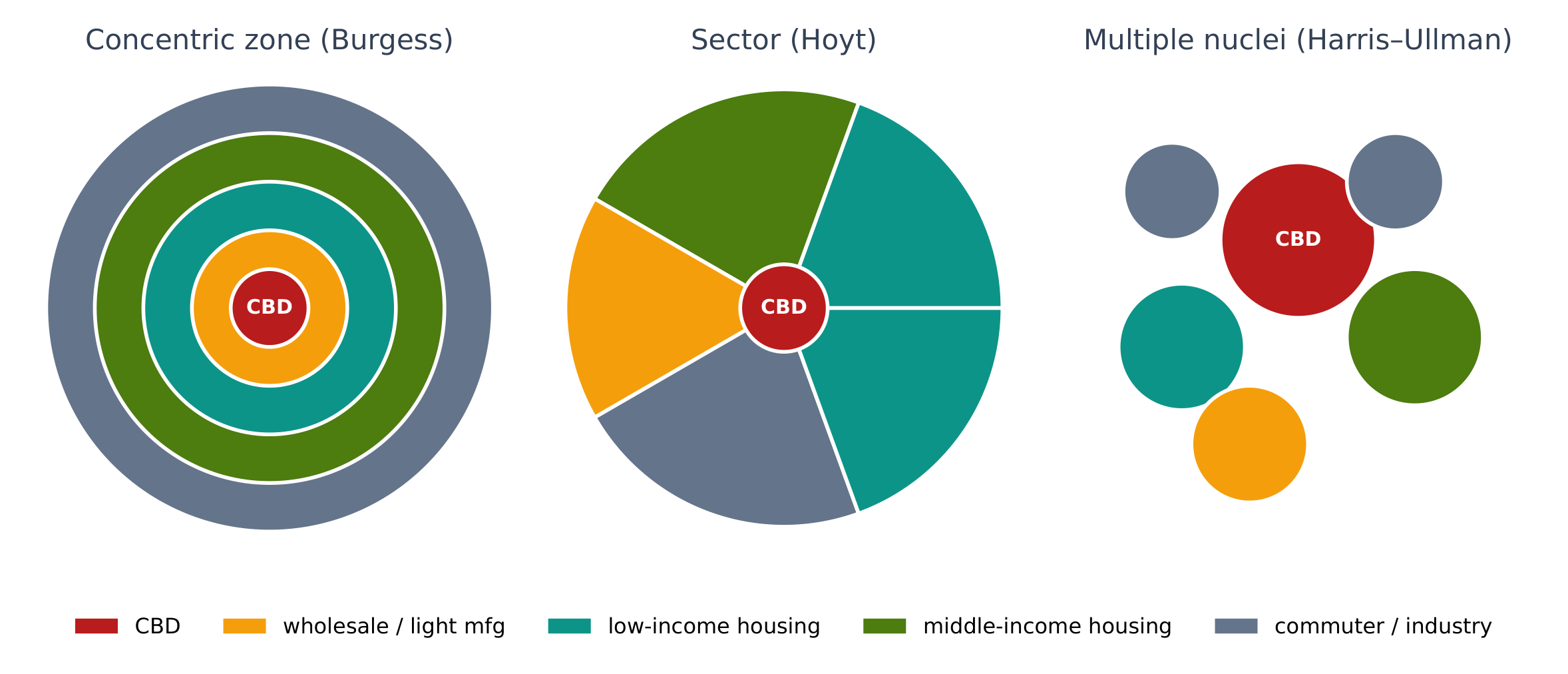
Three models of city structure: concentric zone, sector and multiple nuclei
Which urban model?
Sort each description by its urban model.
The urban model with several separate centres, not one CBD, is the...
Сложность 1/5 · 100 монет + небольшой бонус за первое выполнение сегодня
The multiple nuclei model has several hubs.
The sector model grows in wedges along transport routes.
Сложность 1/5 · 100 монет + небольшой бонус за первое выполнение сегодня
Hoyt's sector model organises land into transport-aligned wedges.
Match each model to its creator/idea.
Сложность 2/5 · 140 монет + небольшой бонус за первое выполнение сегодня
Concentric = Burgess rings; sector = Hoyt wedges; multiple nuclei = Harris-Ullman.
Multiple nuclei
- The multiple nuclei model 多核心模型 (Harris-Ullman) has several centres, not one.
- As a city grows and specialises, new hubs (an airport, a university) form.
- Developing-world cities have their own models too (e.g. the Latin American model).
These are models of North American cities, and each highlights one idea: rings (Burgess), wedges (Hoyt), or many centres (Harris-Ullman). They simplify reality — real cities mix all three, and developing-world cities follow different models. Use them to compare, not to describe every city.
A city where an airport district and a separate university town each grow their own cluster of hotels and shops, rather than everything radiating from one downtown, fits the multiple nuclei model — several centres, not a single CBD ringed by zones.
Three North American city models centre on the CBD: concentric zone (rings, Burgess), sector (wedges along transport, Hoyt), and multiple nuclei (several centres, Harris-Ullman). They simplify reality; developing-world cities follow different models.
Write from the sector model
- High-income housing forms a wedge along a rail line from the centre to the edge.
- The wedge stays in one direction rather than a full ring.
Which classic urban model fits this wedge?
Sectors are wedges of similar land use along routes.
Which model shows a wedge of housing along a rail line?
Сложность 1/5 · 100 монет + небольшой бонус за первое выполнение сегодня
The wedge follows the route instead of circling the centre.