Style and Irony
Введено| English | Значение |
|---|---|
| Irony/ˈaɪrəni/ | Ирония |
"The style is formal" is not an analysis
- Style is not one property a text either has or lacks.
- It is a mix, and naming the mix is what analysis means.
- Saying a style is formal names the result while skipping every component.
“Formal” names the outfit; style analysis asks about the fabric, the cut and why the writer wore it.
What style is made of
- A writer's style is the mix of word choice, syntax and conventions that writer employs.
- Three components, each analysable on its own.
- An analysis that names all three has explained the style; one that names the result has labelled it.
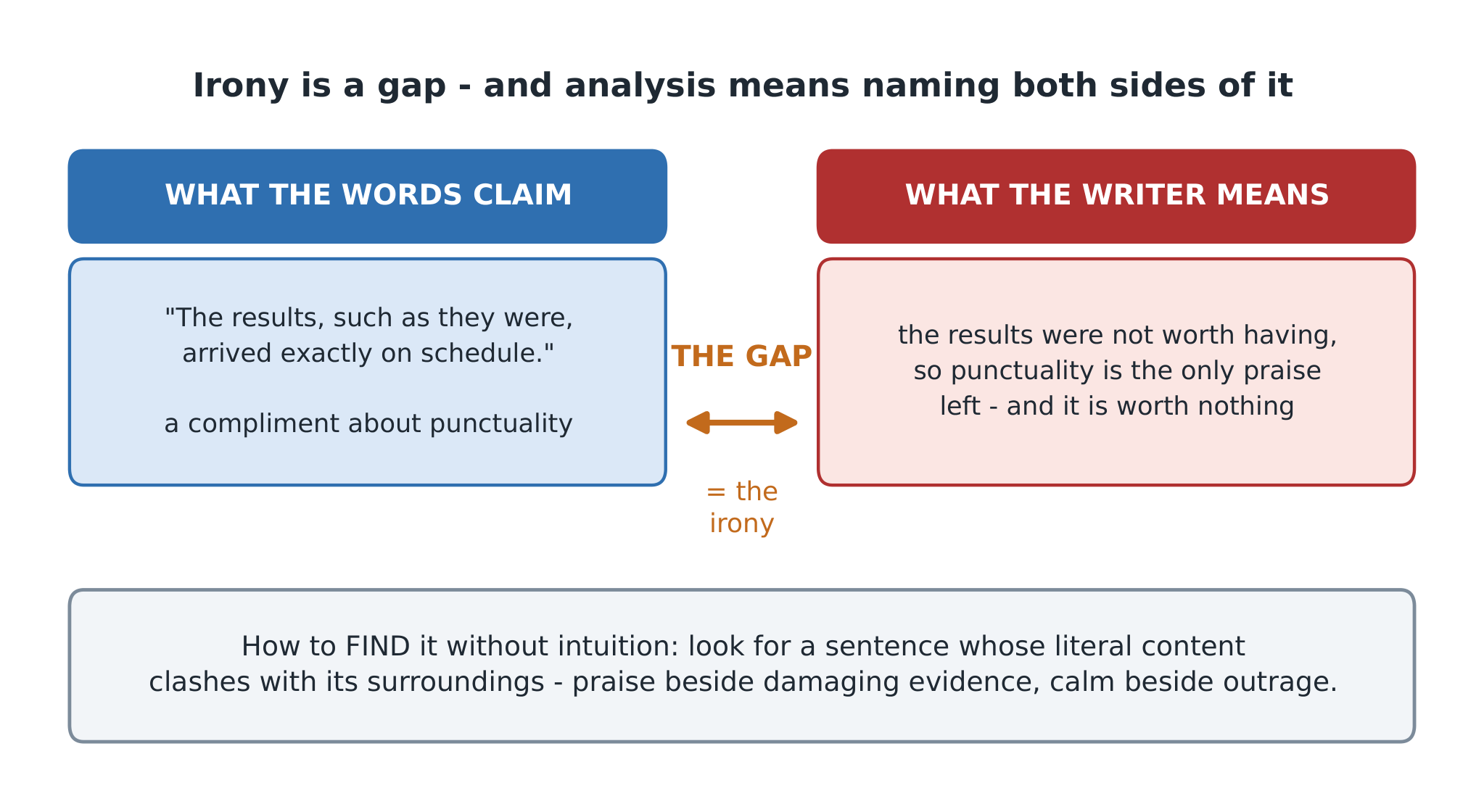
Say what the words claim, say what the writer means, and the gap is the argument
Component, result, or gap?
Sort each statement by what it identifies.
Select все the components of style the CED names.
Сложность 2/5 · 140 монет + небольшой бонус за первое выполнение сегодня
Style is the смесь of the first three; length is not a component.
Irony as a signal
- Writers may signal a complex or ironic perspective through stylistic choices.
- Irony 反讽 emerges from the difference between what is said and what is meant, or between what is expected and what occurs.
- So irony is always a gap, and analysis means naming both sides of it.
Irony emerges from...
Сложность 1/5 · 100 монет + небольшой бонус за первое выполнение сегодня
Or between what is expected and what occurs — either way, it is a разрыва.
Irony is a gap, so an analysis must name both sides of it. Saying "the writer is being ironic" identifies that a gap exists without saying what is on either side — which is the whole of the analysis.
To find irony structurally, look for literal content that ____ with its surroundings.
Сложность 1/5 · 100 монет + небольшой бонус за первое выполнение сегодня
Excessive praise beside damaging evidence is the classic signal.
Finding irony without intuition
- Irony cannot be looked up, which makes it hard for a second-language reader.
- Use a structural method: find a sentence whose literal content clashes with its surroundings.
- Excessive praise beside damaging evidence, or a calm register beside an outrageous fact, is the signal.
Saying "the writer is being ironic" is a complete analysis.
Сложность 1/5 · 100 монет + небольшой бонус за первое выполнение сегодня
Irony is a gap; an analysis must name both sides of it.
Match each step of an irony analysis to what it delivers.
Сложность 2/5 · 140 монет + небольшой бонус за первое выполнение сегодня
Two sides and an effect — the same three-part shape as claim, evidence, commentary.
Writing about irony
- Say what the words claim. Say what the writer means. Then say what the gap does to the reader.
- The reader who sees the gap is being invited into an understanding the text never states.
- That invitation is often the point — irony makes an ally of a reader who catches it.
"The results, such as they were, arrived exactly on schedule." Said: a compliment about punctuality. Meant: the results were not worth having, so punctuality is the only praise left — and it is worth nothing.
Style is the mix of word choice, syntax and conventions — name the components, not the result. Irony is a gap between what is said and what is meant, or between expectation and outcome. Find it structurally: literal content clashing with its surroundings. Then name both sides.
Write from a style that is more than formal
- A student writes 'the style is formal' and stops.
- Say what an analysis has to name instead.
A paragraph ends with the sentence 'the style is formal' and names no word choice, no sentence pattern and no convention. Why is that not an analysis of style?
The components are the analysis. The label is only the result.
What does a style analysis have to name?
Сложность 1/5 · 100 монет + небольшой бонус за первое выполнение сегодня
Style is a mix, and the mix has parts.