Проектирование и разработка программ
Введено| English | Значение |
|---|---|
| process/ˈprəʊses/ | процесс |
| development process/dɪˈveləpmənt ˈprəʊses/ | процесс разработки |
| iterative/ˈɪtərətɪv/ | итеративный |
| prototype/ˈprəʊtəʊtaɪp/ | прототип |
| test/test/ | тест |
| incremental/ˌɪŋkrɪˈmentl/ | инкрементальный |
| program requirement/ˈprəʊɡræm rɪˈkwaɪəmənt/ | требование программы |
| Pseudocode/ˈsuːdəʊkəʊd/ | псевдокод |
| comment/ˈkɒment/ | комментарий |
| Refining/rɪˈfaɪnɪŋ/ | уточнение |
Coding is a process, not one burst
- Writing a program is a process 过程, not a single burst of typing.
- Skipping design and coding right away usually wastes time.
- Experienced programmers follow a repeatable development process 开发流程.
- Best of all, the process loops — you improve a little each time around.
Хорошей практикой является немедленное начало написания кода, пропуская этап проектирования.
Сложность 1/5 · 100 монет + небольшой бонус за первое выполнение сегодня
Пропуск проектирования обычно тратит впустую время — сначала планируйте, потом пишите код.
The iterative cycle
- A common cycle has four stages: investigate, design, prototype 原型, test 测试.
- Investigate: understand the problem and the users — what inputs and outputs matter?
- Design the structure, build a rough prototype, then test it with many inputs.
- The process is iterative 迭代的 and incremental 增量的: repeat, improving a little each pass.
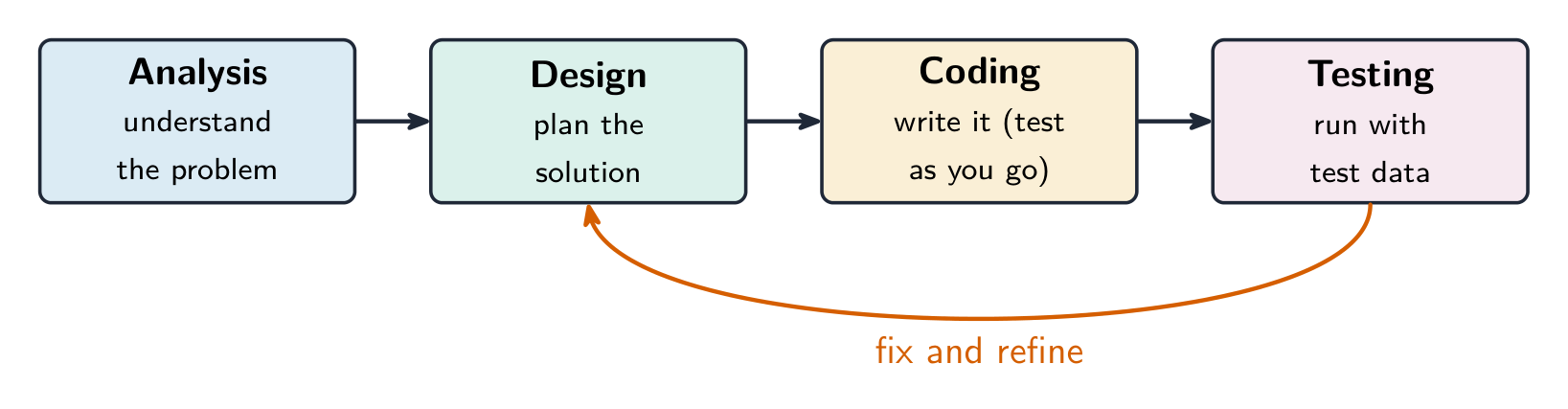
The stages of program development, with testing feeding back to fix and refine
Цикл итеративной разработки
Разработка проходит циклы исследования, проектирования, прототипирования и тестирования — улучшая программу немного на каждом проходе.
Расставьте этапы одного прохода цикла разработки по порядку.
Сложность 3/5 · 200 монет + небольшой бонус за первое выполнение сегодня
Исследование → проектирование → прототипирование → тестирование, затем возврат к началу.
Процесс, который повторяет свои этапы, постепенно улучшаясь, называется ______.
Сложность 1/5 · 100 монет + небольшой бонус за первое выполнение сегодня
Итеративная и инкрементальная разработка направлена на уточнение программы.
Planning tools
- A program requirement 需求 is a specific thing the program must do — list them first to stay focused.
- Pseudocode 伪代码 is a plain-language sketch of the logic, written before real code.
- It reads like English but follows a program's step-by-step shape, so a team can agree on the plan.
Pseudocode for a guessing game: pick a secret number → ask the user for a guess → if it is too high or too low, say so and ask again → repeat until the guess is correct. No exact syntax, just the plan.
Псевдокод — это:
Сложность 1/5 · 100 монет + небольшой бонус за первое выполнение сегодня
Он читается как английский текст, но следует пошаговой структуре программы.
Комментарий в исходном коде — это:
Сложность 1/5 · 100 монет + небольшой бонус за первое выполнение сегодня
Комментарии объясняют сложный код людям, которые его читают.
Уточнение программы после тестирования — это нормальная, ожидаемая часть процесса разработки.
Сложность 1/5 · 100 монет + небольшой бонус за первое выполнение сегодня
Первая версия редко бывает финальной.
Keeping it understandable
- A comment 注释 is a note in the source that the computer ignores but humans read.
- Teams also keep a development log recording their thinking.
- Key mindset: a first version is rarely the final one.
- Refining 改进 a program after testing is normal and expected, not a failure.
Programming is an iterative development process: investigate → design → prototype → test, looping to improve a little each pass. Plan with clear requirements and pseudocode, keep the code readable with comments, and expect to keep refining — a first version is rarely the last.