Определение и дифференцирование параметрических уравнений
Введено| English | Значение |
|---|---|
| parametric equations/ˌpærəˈmetrɪk ɪˈkweɪʒnz/ | параметрические уравнения |
| parameter/pəˈræmɪtə/ | параметр |
A curve traced by a moving point
- Instead of $y=f(x)$, describe a curve by giving $x$ and $y$ each as a function of a third variable.
- These are parametric equations 参数方程: $x=f(t)$ and $y=g(t)$, with parameter 参数 $t$.
- Think of $t$ as time: as $t$ runs, the point $\big(x(t),y(t)\big)$ traces the curve.
- This lets you draw loops and vertical stretches that no single $y=f(x)$ can.
Кривая, которую описывает параметр
y = ax³ + bx
Параметрические уравнения позволяют точке рисовать кривые — петли и вертикальные растяжения, которые невозможно изобразить одним уравнением y = f(x) ($y=f(x)$).
В $x=f(t)$, $y=g(t)$ переменная $t$ называется ____.
Сложность 1/5 · 100 монет + небольшой бонус за первое выполнение сегодня
Параметр определяет обе координаты.
The parameter drives both coordinates
- At each $t$, plug into both equations to get a point $\big(x(t),y(t)\big)$.
- The curve is the path swept out as $t$ increases — with a direction of travel.
- Example: $x=\cos t,\ y=\sin t$ traces the unit circle counterclockwise.
- Eliminating $t$ (when possible) recovers a relation between $x$ and $y$.
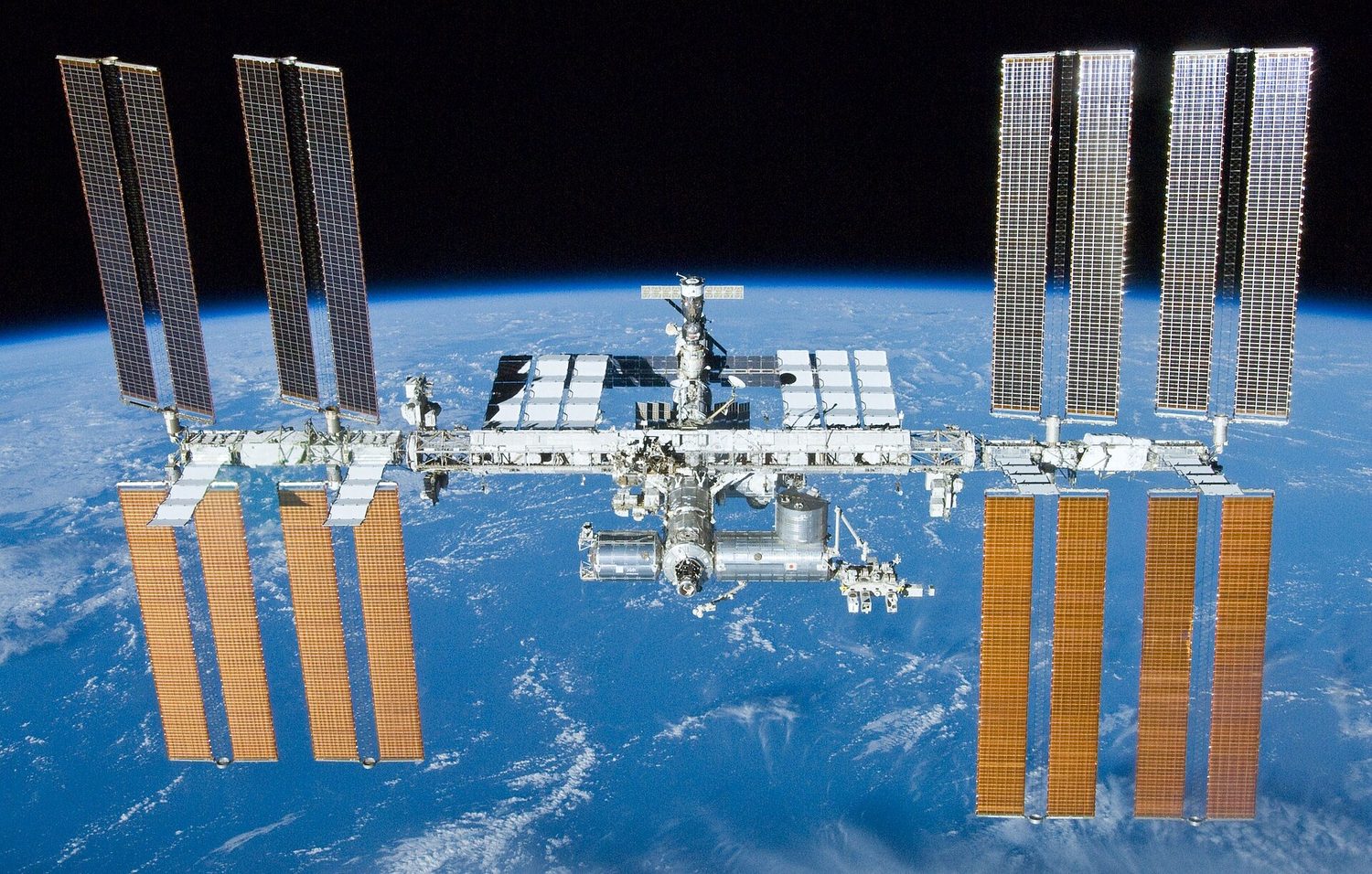
The ISS in orbit: parametric equations describe position as a function of time
Какие параметрические уравнения описывают единичную окружность?
Сложность 1/5 · 100 монет + небольшой бонус за первое выполнение сегодня
$\cos^2 t+\sin^2 t=1$ описывает единичную окружность.
The slope $\tfrac{dy}{dx}$ from derivatives in $t$
- To find the curve's slope, differentiate each coordinate in $t$ and divide:
-
$$\frac{dy}{dx}=\frac{dy/dt}{dx/dt}$$
- Both $\tfrac{dy}{dt}$ and $\tfrac{dx}{dt}$ come from the two equations; their ratio is the slope.
- (This is the chain rule: $\tfrac{dy}{dt}=\tfrac{dy}{dx}\cdot\tfrac{dx}{dt}$, rearranged.)
Для параметрической кривой $\dfrac{dy}{dx}=$
Сложность 1/5 · 100 монет + небольшой бонус за первое выполнение сегодня
Числитель делить на знаменатель: формула для производной ⟨$\frac{dy/dt}{dx/dt}$⟩.
Для параметрической системы ⟨$x=t^2$⟩, ⟨$y=t^3$⟩, ⟨$\dfrac{dy}{dx}=\dfrac{3t}{2}$⟩ найдите наклон в точке ⟨$t=2$⟩.
Сложность 2/5 · 140 монет + небольшой бонус за первое выполнение сегодня
$\frac{3(2)}{2}=3$.
Horizontal and vertical tangents
- Horizontal tangent: $\tfrac{dy}{dt}=0$ (and $\tfrac{dx}{dt}\neq0$) — the slope is $0$.
- Vertical tangent: $\tfrac{dx}{dt}=0$ (and $\tfrac{dy}{dt}\neq0$) — the slope is undefined.
- These come directly from the two component derivatives.
- So the same $\tfrac{dy}{dt}$, $\tfrac{dx}{dt}$ give both the slope and its special cases.
Параметрическая кривая имеет горизонтальную касательную там, где...
Сложность 1/5 · 100 монет + небольшой бонус за первое выполнение сегодня
Горизонтальность ⇔ наклон равен ⟨$0$⟩ ⇔ ⟨$\tfrac{dy}{dt}=0$⟩.
Вертикальная касательная возникает там, где ⟨$\dfrac{dx}{dt}=$⟩ ____ (при условии ⟨$\tfrac{dy}{dt}\neq0$⟩).
Сложность 1/5 · 100 монет + небольшой бонус за первое выполнение сегодня
Нулевое значение ⟨$\tfrac{dx}{dt}$⟩ → неопределенный наклон → вертикальная касательная.
The slope is $\dfrac{dy/dt}{dx/dt}$ — a ratio of the two derivatives, not $\dfrac{d}{dt}\big[\tfrac yx\big]$ or $\dfrac{dy}{dt}\cdot\dfrac{dx}{dt}$. And it's top over bottom: $\tfrac{dy}{dt}$ divided by $\tfrac{dx}{dt}$. Swapping them inverts the slope.
For $x=t^2,\ y=t^3$, find $\dfrac{dy}{dx}$ at $t=2$.
- $\dfrac{dx}{dt}=2t$, $\dfrac{dy}{dt}=3t^2$.
- $\dfrac{dy}{dx}=\dfrac{3t^2}{2t}=\dfrac{3t}{2}$.
- At $t=2$: $\dfrac{dy}{dx}=\dfrac{3(2)}{2}=3$.
Parametric equations $x=f(t)$, $y=g(t)$ trace a curve as the parameter $t$ varies. The slope is $\frac{dy}{dx}=\frac{dy/dt}{dx/dt}$ (top over bottom). A horizontal tangent has $\frac{dy}{dt}=0$; a vertical tangent has $\frac{dx}{dt}=0$.