Поиск частных решений с использованием начальных условий и метода разделения переменных
Введено| English | Значение |
|---|---|
| initial condition/ɪˈnɪʃl kənˈdɪʃn/ | начальные условия |
| particular solution/pəˈtɪkjʊlə səˈluːʃn/ | частное решение |
Pinning down the one true curve
- The general solution is a family with a constant $C$. Reality wants one curve.
- An initial condition 初始条件 — a known point $\big(x_0,y_0\big)$ — selects that single member.
- Solve the equation generally, then use the point to find $C$.
- The result is the particular solution 特解 for that situation.
Единственная кривая, выбранная начальным условием, является ____ решением.
Сложность 1/5 · 100 монет + небольшой бонус за первое выполнение сегодня
Одним из членов общего семейства.
The full procedure
- 1. Separate the variables and integrate both sides (with $+C$) — the general solution.
- 2. Substitute the initial condition $\big(x_0,y_0\big)$ to solve for $C$.
- 3. Put that $C$ back in and simplify.
- 4. If asked, solve explicitly for $y$.
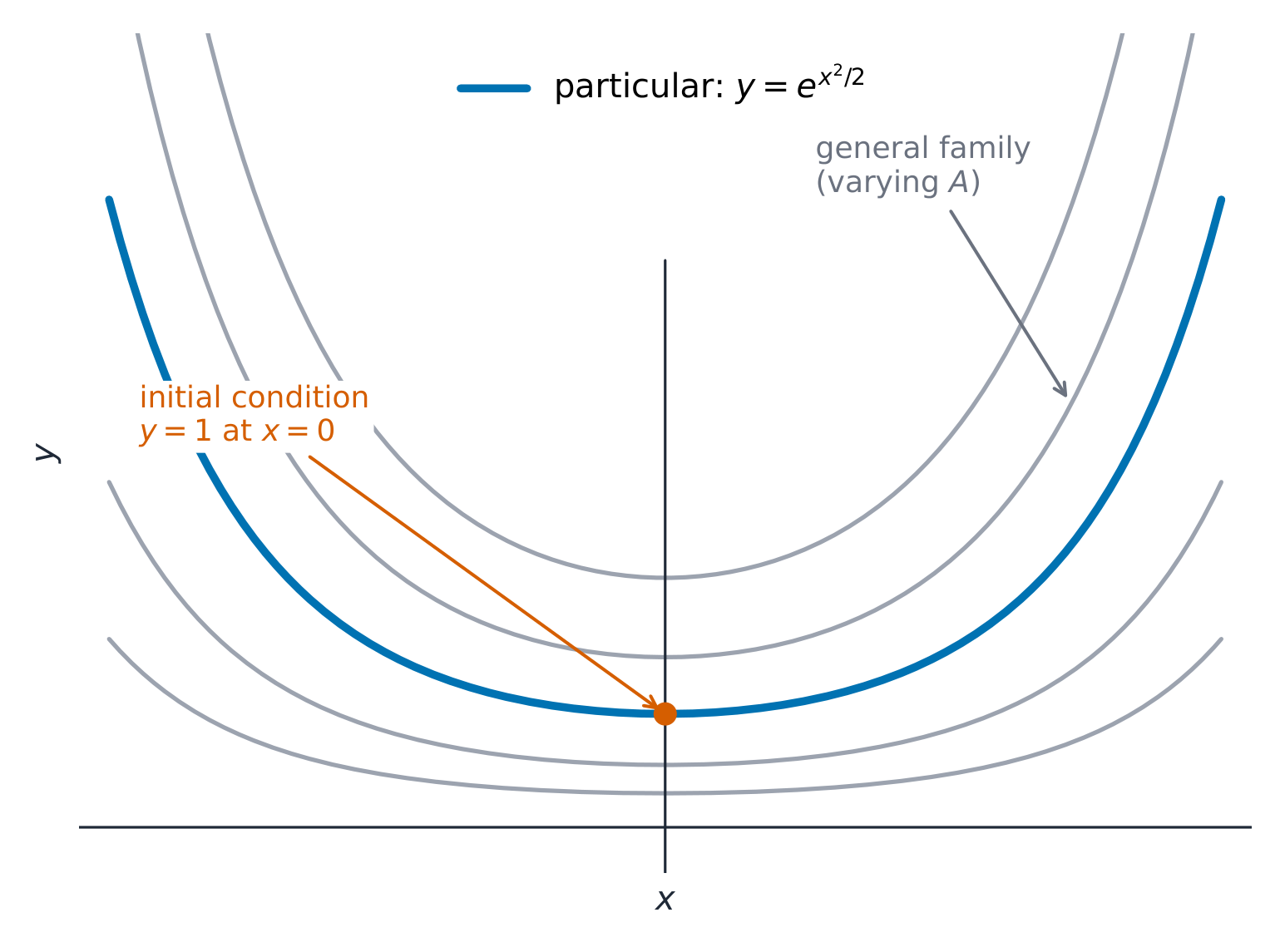
The constant gives a family of curves; an initial condition picks out one
Начальная точка выбирает одну кривую
Общее решение — это целое семейство; начальное условие $y(x_0)=y_0$ выбирает единственную кривую, проходящую через эту точку.
Вы применяете начальное условие, чтобы найти $C$...
Сложность 1/5 · 100 монет + небольшой бонус за первое выполнение сегодня
Сначала получите общее решение, затем используйте точку для определения $C$.
Расставьте шаги для поиска частного решения.
Сложность 3/5 · 200 монет + небольшой бонус за первое выполнение сегодня
Разделите, проинтегрируйте, примените точку, упростите.
A worked particular solution
- Solve $\dfrac{dy}{dx}=xy$ with $y(0)=3$.
- General solution (from last lesson): $y=A\,e^{x^2/2}$.
- Apply the point: $3 = A\,e^{0}=A$, so $A=3$.
- Particular solution: $y=3\,e^{x^2/2}$.
Для $y=x^2+C$ с начальным условием $y(1)=5$ найдите $C$.
Сложность 2/5 · 140 монет + небольшой бонус за первое выполнение сегодня
$5=1+C\Rightarrow C=4$.
Частное решение равно $y=x^2+4$. Найдите $y(3)$.
Сложность 2/5 · 140 монет + небольшой бонус за первое выполнение сегодня
$3^2+4=13$.
Для $\dfrac{dy}{dx}=xy$ с $y(0)=3$ (общее $y=Ae^{x^2/2}$), частное решение равно...
Сложность 1/5 · 100 монет + небольшой бонус за первое выполнение сегодня
$y(0)=A=3$, следовательно, $y=3e^{x^2/2}$.
Watch the domain
- Solving for $y$ may involve $\ln$, roots, or reciprocals — mind where the solution is valid.
- The particular solution usually lives on an interval containing $x_0$, not necessarily all real $x$.
- A sign or an absolute value may need resolving using the given point (e.g. $y_0>0$ picks the $+$ branch).
- State the domain when the algebra restricts it.
Apply the initial condition after integrating, to find $C$ — not before. And use the point to resolve any sign/branch ambiguity: if $\ln|y|=\dots$ and $y_0>0$, drop the absolute value as $y>0$. Substituting the point too early (like in separation of variables' warning) loses the general family.
Solve $\dfrac{dy}{dx}=2x$ with $y(1)=5$.
- General solution: $y=x^2+C$.
- Apply $y(1)=5$: $5 = 1^2 + C \Rightarrow C=4$.
- Particular solution: $y=x^2+4$.
A particular solution is the one member of the general family fixed by an initial condition. Solve generally (integrate, keep $+C$), substitute the point $\big(x_0,y_0\big)$ to find $C$, and simplify. Use the point to settle any sign/branch and note the valid domain.