Приближенное вычисление площадей с помощью сумм Римана
Введено| English | Значение |
|---|---|
| Riemann sum/ˈriːmən sʌm/ | сумма Римана |
| left/left/ | левый конец |
| right/raɪt/ | правый конец |
| midpoint/ˈmɪdpɔɪnt/ | середина отрезка |
| trapezoid/ˈtræpɪzɔɪd/ | трапеция |
| trapezoidal rule/ˈtræpɪzɔɪdl ruːl/ | правило трапеции |
Estimate a curvy area with rectangles
- The area under a curve is rarely a neat rectangle — so approximate it with many thin rectangles.
- Slice the interval into strips, build a rectangle on each, and add up their areas.
- This sum of rectangle areas is a Riemann sum 黎曼和.
- More, thinner rectangles → a better estimate of the true area.
Площадь, которую мы приближенно вычисляем
y = x²
Прямоугольники или трапеции заполняют заштрихованную область под кривой — чем больше и тоньше полосы, тем точнее оценка.
Использование большего количества более тонких прямоугольников обычно улучшает оценку суммы Римана.
Сложность 1/5 · 100 монет + небольшой бонус за первое выполнение сегодня
Более тонкие полосы лучше следуют форме кривой.
Left, right, and midpoint rectangles
- Each rectangle's height comes from the function — but where in the strip do you measure it?
- Left 左端 sum: height from the left edge of each strip.
- Right 右端 sum: height from the right edge.
- Midpoint 中点 sum: height from the middle — usually the most accurate of the three.
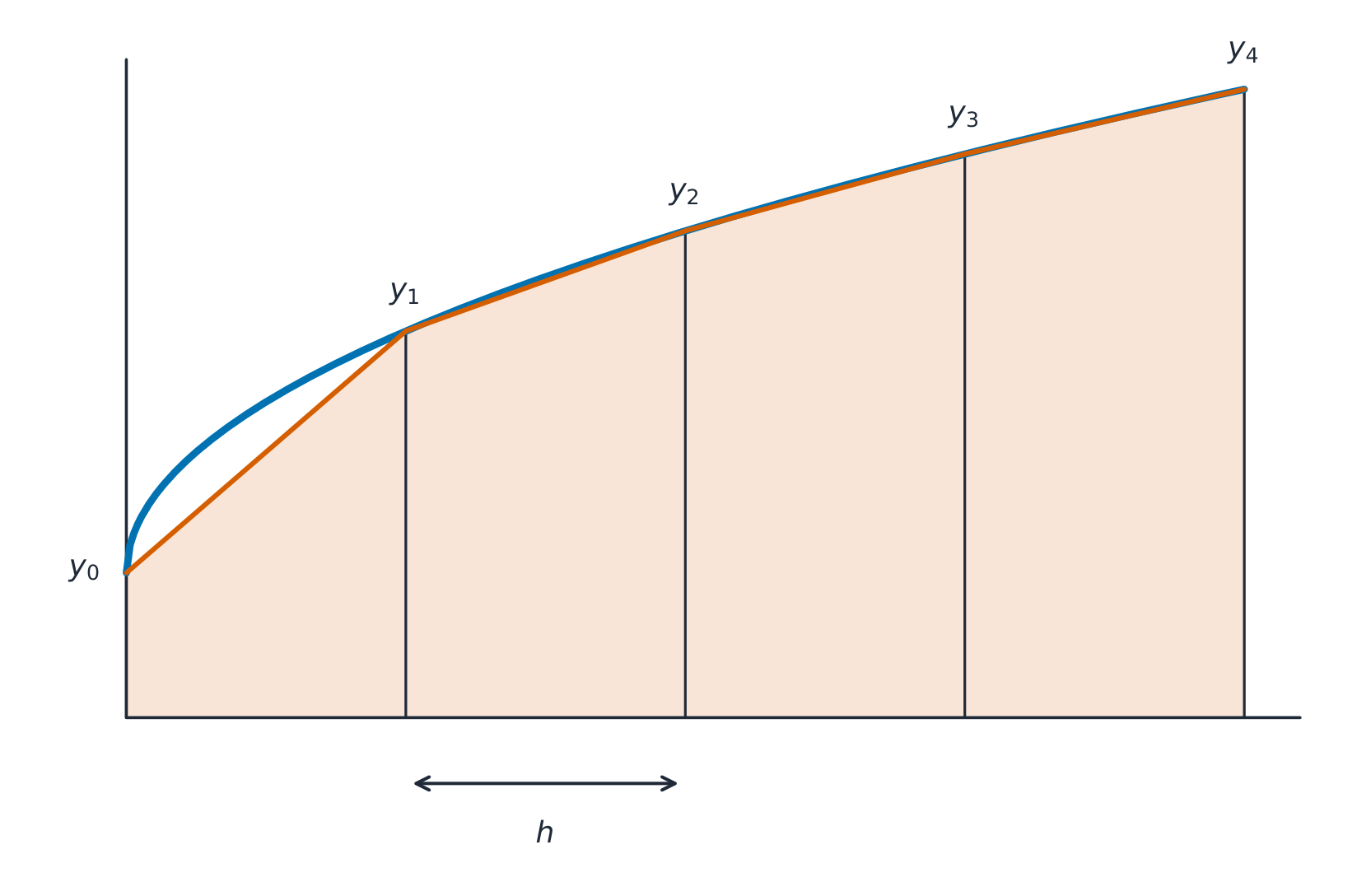
Strips of width h approximate the area under a curve
Для $f(x)=x^2$ на $[0,2]$ с $2$ правыми прямоугольниками (ширина $1$): высоты $f(1)=1$, $f(2)=4$. Найдите правую сумму Римана.
Сложность 2/5 · 140 монет + небольшой бонус за первое выполнение сегодня
$1\cdot1+4\cdot1=5$.
Та же схема, но левая сумма Римана: высоты $f(0)=0$, $f(1)=1$. Найдите её.
Сложность 2/5 · 140 монет + небольшой бонус за первое выполнение сегодня
$0\cdot1+1\cdot1=1$.
Какие из перечисленных являются стандартными способами выбора высоты прямоугольника в сумме Римана?
Сложность 2/5 · 140 монет + небольшой бонус за первое выполнение сегодня
Левая, правая и midpoint (средняя) — стандартные варианты.
Trapezoids fit even better
- Instead of a flat-topped rectangle, connect the two edge heights with a slanted top: a trapezoid 梯形.
- The trapezoidal rule 梯形法则 averages the left and right heights on each strip.
- It hugs a smooth curve more closely than rectangles, so it's usually more accurate.
- Area of each trapezoid $=\tfrac12(\text{left height}+\text{right height})\times\text{width}$.
Правило ____ использует наклонные верхние грани (среднее арифметическое высот боковых граней) для более точного соответствия, чем прямоугольники.
Сложность 1/5 · 100 монет + небольшой бонус за первое выполнение сегодня
Каждая трапеция усредняет левую и правую высоты.
Over- or underestimate?
- On an increasing function: left sums underestimate, right sums overestimate.
- On a decreasing function: it's the reverse — left over, right under.
- The trapezoidal rule's error depends on concavity (over on concave-up, under on concave-down).
- Knowing the direction of the error lets you bound the true area.
Для возрастающей функции левая сумма Римана дает...
Сложность 1/5 · 100 монет + небольшой бонус за первое выполнение сегодня
Левые высоты — меньшие граничные значения на возрастающей кривой → недооценка.
The three rectangle rules can give quite different answers for a small number of strips — they are approximations, not the exact area. And whether a left or right sum over- or under-estimates depends on whether the function is increasing or decreasing, not on the rule alone. Always check the function's behavior.
Estimate the area under $f(x)=x^2$ on $[0,2]$ with $2$ right rectangles (width $1$).
- Right heights: $f(1)=1$ and $f(2)=4$.
- Right sum $=1\cdot1+4\cdot1=5$.
- (The true area is $\tfrac83\approx2.67$; since $x^2$ is increasing, the right sum overestimates — as expected.)
A Riemann sum approximates area with rectangles: left, right, or midpoint heights. The trapezoidal rule uses slanted tops (averaging edge heights) for a closer fit. For an increasing function, left sums underestimate and right sums overestimate; more strips → a better approximation.