Связь функции, её первой производной и второй производной
Введено| English | Значение |
|---|---|
| zero/ˈzɪərəʊ/ | ноль функции |
Three graphs telling one story
- $f$, $f'$, and $f''$ are three views of the same function — and they must all agree.
- A feature of $f$ shows up as a specific feature of $f'$ or $f''$.
- The exam loves handing you one of the three and asking about another.
- Master the translation table and these questions become quick.
What the zeros of $f'$ say
- A zero 零点 of $f'$ (where $f'=0$) is a critical point of $f$ — a possible extremum.
- $f'$ goes $+\to-$ at that zero → $f$ has a local max; $-\to+$ → local min.
- Where $f'>0$, $f$ increases; where $f'<0$, $f$ decreases.
- So the sign of $f'$ gives increase/decrease, and its zeros give extrema.
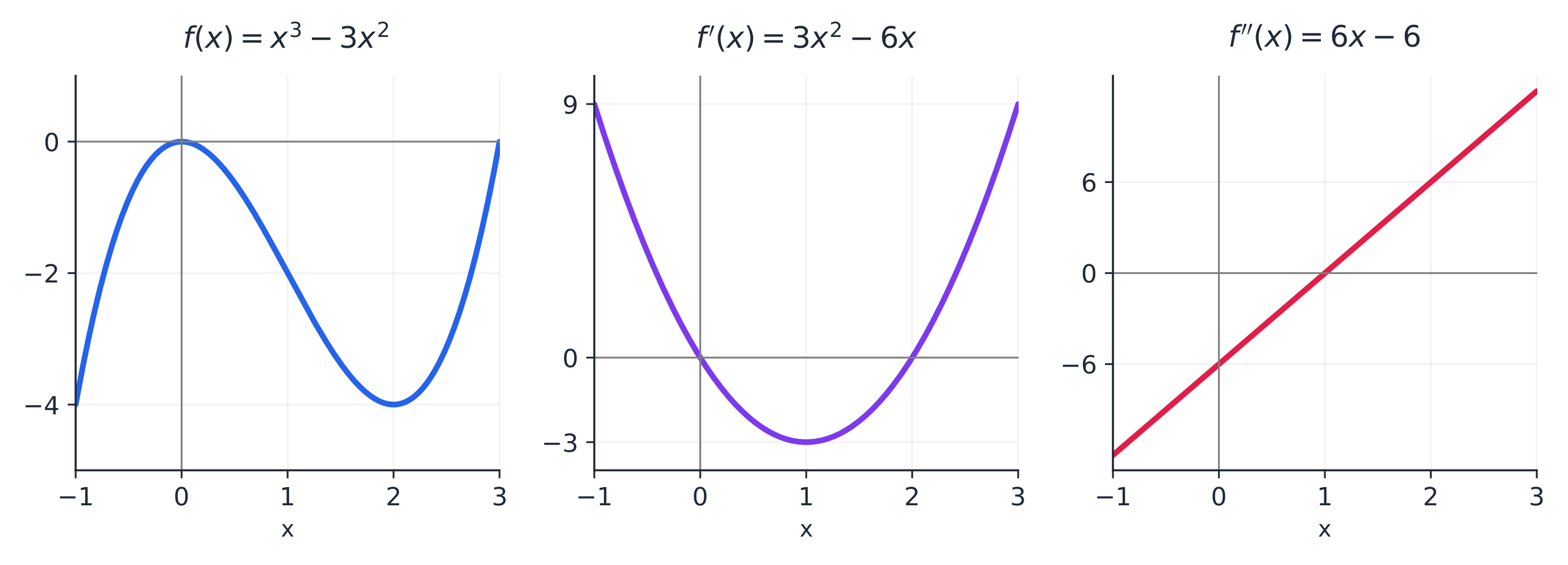
A cubic with its first and second derivatives on the same x-axis
Одна функция, три чтения
y = ax³ + cx
На этой кривой нули функции $f'$ обозначают пик и впадину, а нуль функции $f''$ обозначает точку перегиба.
Нуль, меняющий знак, функции $f'$ обозначает на графике функции $f$...
Сложность 1/5 · 100 монет + небольшой бонус за первое выполнение сегодня
Нули функции $f'$ (меняющие знак) являются экстремумами функции $f$.
На интервале, где график функции $f'$ положителен, функция $f$ возрастает.
Сложность 1/5 · 100 монет + небольшой бонус за первое выполнение сегодня
$f'>0$ ⇔ $f$ возрастает.
What the zeros of $f''$ say
- A sign-changing zero of $f''$ is a point of inflection of $f$.
- Where $f''>0$, $f$ is concave up; where $f''<0$, concave down.
- Note: $f''$ is the derivative of $f'$, so a zero of $f''$ is where $f'$ has a max or min (its steepest slope on $f$).
- The sign of $f''$ gives concavity; its sign-changing zeros give inflections.
Нуль, меняющий знак, функции $f''$ обозначает на графике функции $f$...
Сложность 1/5 · 100 монет + небольшой бонус за первое выполнение сегодня
Нули, меняющие знак, функции $f''$ являются точками перегиба функции $f$.
По графику функции $f''$ можно прочитать какие особенности функции $f$?
Сложность 2/5 · 140 монет + небольшой бонус за первое выполнение сегодня
Выпуклость + перегибы берутся из $f''$; точные значения требуют самой функции $f$.
Reading across representations
- Given a graph of $f'$: its zeros → extrema of $f$; its sign → increase/decrease of $f$; its own increase/decrease → concavity of $f$.
- Given a table of values: estimate $f'$ and $f''$ with difference quotients, then apply the same rules.
- Given a formula: differentiate and use sign charts.
- Same logic, three languages — translate freely.
График функции $f'$ положителен, затем отрицателен, пересекая ноль в точке $x=2$. В точке $x=2$, функция $f$ имеет...
Сложность 1/5 · 100 монет + небольшой бонус за первое выполнение сегодня
$f'$ меняется с $+\to-$ → локальный максимум функции $f$.
На графике $f'$ именно ____ (а не вершины) обозначают экстремумы $f$.
Сложность 1/5 · 100 монет + небольшой бонус за первое выполнение сегодня
Нули функции $f'$ = экстремумы функции $f$; пики функции $f'$ связаны с перегибами функции $f$.
Keep the levels straight. A zero of $f'$ is an extremum of $f$ (not of $f'$). A zero of $f''$ is an inflection of $f$ and an extremum of $f'$. Reading a graph of $f'$ as if it were $f$ — treating its peaks as maxima of $f$ — is a classic mix-up. Its zeros, not its peaks, mark $f$'s extrema.
You are given the graph of $f'$, which is positive on $(-\infty,2)$, zero at $x=2$, and negative after. What happens to $f$ at $x=2$?
- $f'$ changes $+\to-$ at $x=2$ → $f$ has a local maximum there.
- $f$ is increasing before $x=2$ and decreasing after (matching $f'>0$ then $f'<0$).
- The value $f'(2)=0$ means a horizontal tangent on $f$.
$f$, $f'$, $f''$ tell one consistent story. Zeros of $f'$ (sign-changing) are $f$'s extrema; the sign of $f'$ gives increase/decrease. Zeros of $f''$ (sign-changing) are $f$'s inflection points; the sign of $f''$ gives concavity. Translate this across graphs, tables, and formulas.