Определение Промежутков, На которых Функция Увеличивается или Уменьшается
Введено| English | Значение |
|---|---|
| sign of the first derivative/saɪn ɒvðə fɜːst dɪˈrɪvətɪv/ | знак первой производной |
| sign chart/saɪn tʃɑːt/ | таблица знаков |
The sign of $f'$ tells the story
- Where a curve rises or falls is written in the sign of the first derivative 一阶导数的符号.
- $f'(x)>0$ on an interval → $f$ is increasing there (going uphill).
- $f'(x)<0$ → $f$ is decreasing (going downhill).
- So to map out where $f$ climbs and drops, you just track the sign of $f'$.
Подъем вверх, где f′ > 0
y = ax³ + cx
Кривая растет, где ее наклон положителен, и падает, где отрицателен — знак производной $f'$ определяет поведение каждого участка.
Функция возрастает на интервале тогда и только тогда, когда...
Сложность 1/5 · 100 монет + небольшой бонус за первое выполнение сегодня
Положительная первая производная означает возрастание.
Build a sign chart
- Start by finding the critical points (where $f'=0$ or is undefined) — these split the number line.
- Draw a sign chart 符号表: mark the critical points, creating open intervals between them.
- Pick a test point in each interval and check the sign of $f'$ there.
- One sign per interval is enough — $f'$ can't change sign without passing through a critical point.
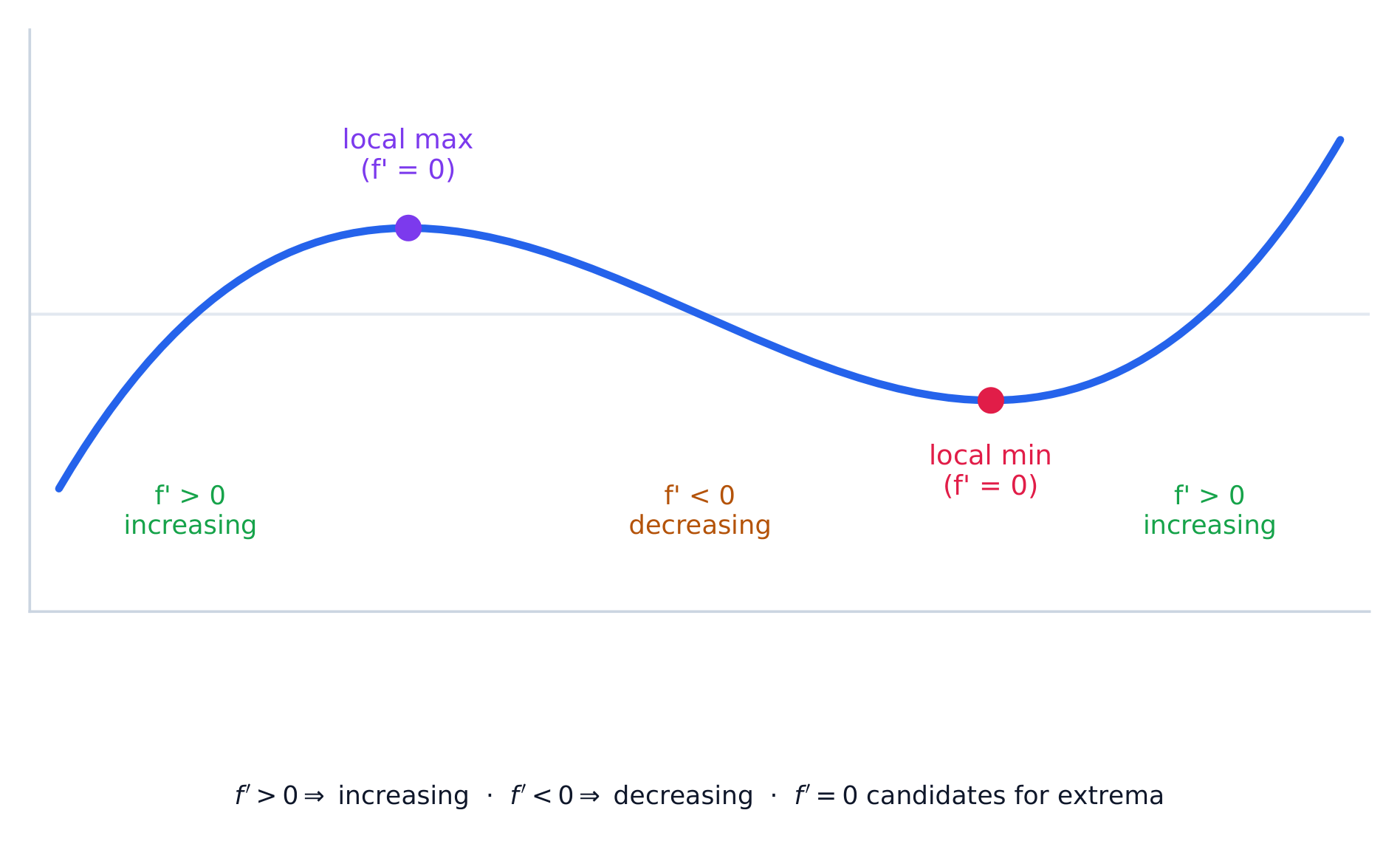
f′ > 0 where f increases and f′ < 0 where f decreases
Для функции $f'(x)=3(x-1)(x+1)$ вычислите значение производной $f'(0)$, чтобы проверить средний интервал.
Сложность 2/5 · 140 монет + небольшой бонус за первое выполнение сегодня
Производная отрицательна ($3(-1)(1)=-3<0$), значит функция $f$ убывает на интервале $(-1,1)$.
Критические точки разбивают числовую прямую на интервалы для ____-таблицы для $f'$.
Сложность 1/5 · 100 монет + небольшой бонус за первое выполнение сегодня
Таблица знаков отслеживает, где производная $f'$ положительна или отрицательна.
Read off the intervals
- Each interval where $f'>0$ is an interval of increase; each where $f'<0$ is an interval of decrease.
- Write them in interval notation: e.g. increasing on $(-\infty,-1)\cup(1,\infty)$.
- Use the function's domain as the outer boundaries.
- (Whether to include a critical point is a convention detail; the AP usually accepts open intervals.)
Для функции $f(x)=x^3-3x$ (критические точки $\pm1$) выберите все промежутки возрастания.
Сложность 2/5 · 140 монет + небольшой бонус за первое выполнение сегодня
$f'>0$ вне $[-1,1]$; функция убывает внутри этого интервала.
Why it works
- Between two consecutive critical points, $f'$ keeps one sign — no sign flip without a zero or a break.
- So one test value settles the whole interval.
- This sign information is the foundation of the First Derivative Test (next lesson).
- Increasing/decreasing behavior is exactly what a rate function encodes.
Функция, которая отрицательна (ниже оси $x$), все еще может возрастать.
Сложность 1/5 · 100 монет + небольшой бонус за первое выполнение сегодня
Возрастание зависит от знака производной $f'>0$, а не от знака значений функции $f$.
Одна контрольная точка достаточно для всего интервала, так как производная $f'$ не может изменить знак без...
Сложность 1/5 · 100 монет + небольшой бонус за первое выполнение сегодня
Изменение знака требует нуля или точки неопределенности производной $f'$.
Track the sign of $f'$, not the sign of $f$. A function can be negative yet increasing (e.g. rising from $-5$ toward $-1$). "Increasing" means the outputs are getting larger ($f'>0$), regardless of whether $f$ itself is above or below the $x$-axis.
Where is $f(x)=x^3-3x$ increasing?
- $f'(x)=3(x-1)(x+1)$; critical points $x=-1,1$.
- Test $x=-2$: $f'>0$. Test $x=0$: $f'=-3<0$. Test $x=2$: $f'>0$.
- Increasing on $(-\infty,-1)$ and $(1,\infty)$; decreasing on $(-1,1)$.
The sign of $f'$ determines monotonic behavior: $f'>0$ → increasing, $f'<0$ → decreasing. Split the number line at the critical points, build a sign chart with one test point per interval, and read off the intervals of increase and decrease. Track the sign of $f'$, not of $f$.