Дифференцирование обратных функций
Введено| English | Значение |
|---|---|
| inverse function/ɪnˈvɜːs ˈfʌŋkʃn/ | обратная функция |
| reciprocals/rɪˈsɪprəklz/ | обратные величины |
Slopes of a function and its mirror
- An inverse function 反函数 $f^{-1}$ undoes $f$: it reflects the graph across the line $y=x$.
- Reflecting swaps the roles of rise and run — so it flips the slope upside down.
- That gives a neat shortcut: you can find the inverse's derivative from the original's.
- Best of all, you often don't need a formula for $f^{-1}$ at all.
The reciprocal-slope rule
- At matching points, the slopes of $f$ and $f^{-1}$ are reciprocals 倒数.
-
$$\big(f^{-1}\big)'(x)=\frac{1}{f'\!\big(f^{-1}(x)\big)}$$
- Read it as: the inverse's slope at $x$ is $1$ divided by $f$'s slope at the matching input.
- The matching input is $f^{-1}(x)$ — the point on $f$ that maps to $x$.
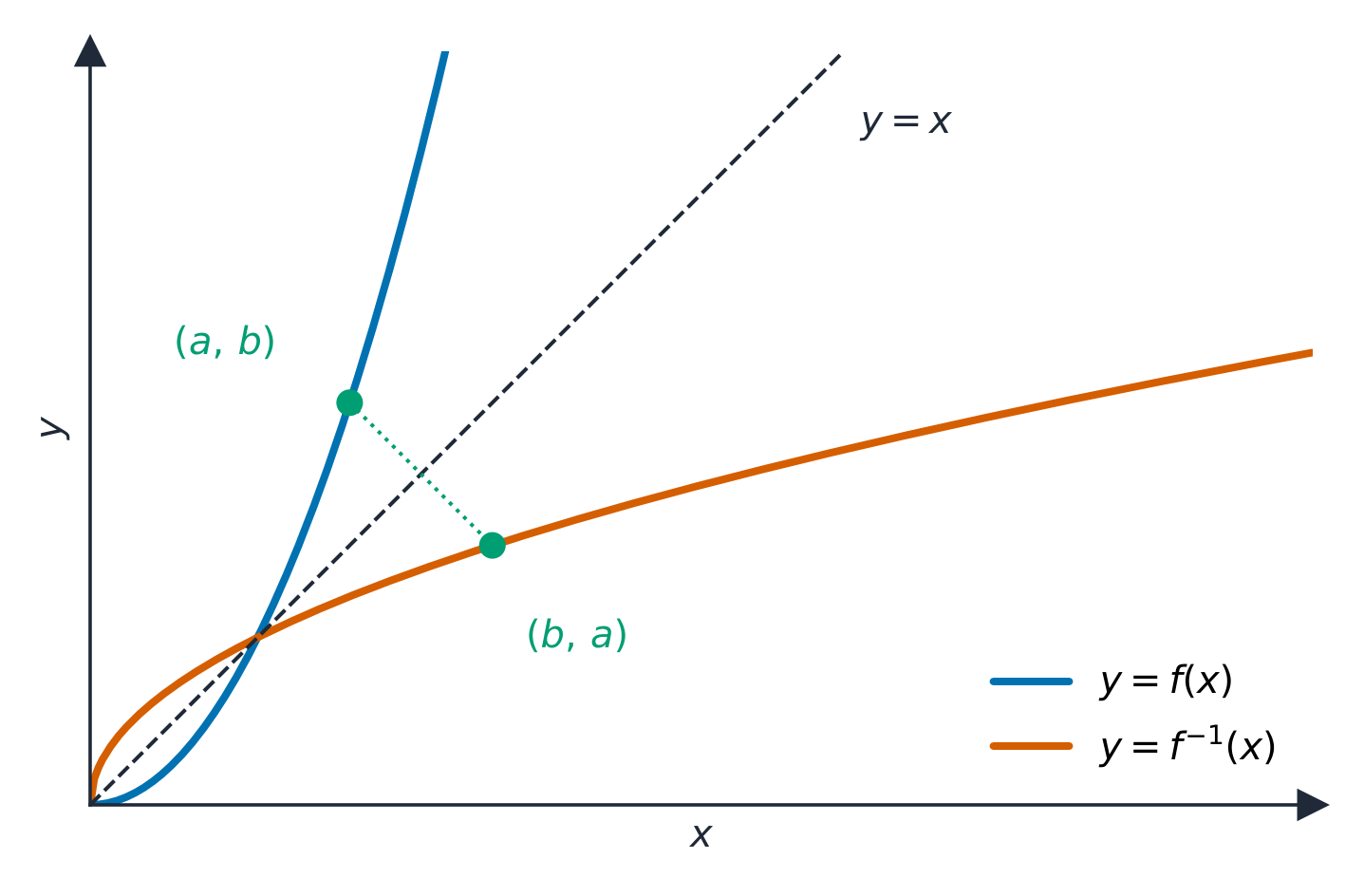
The inverse function is the mirror image of the function in the line y = x
Производная обратной функции равна $\big(f^{-1}\big)'(x)=$
Сложность 1/5 · 100 монет + небольшой бонус за первое выполнение сегодня
Единица, деленная на исходную производную в соответствующем значении аргумента $f^{-1}(x)$.
Evaluate without inverting
- Usually you only need the derivative at one point, and you can skip finding $f^{-1}$.
- Say $f(2)=5$ and $f'(2)=3$. Then the point $(5,2)$ is on $f^{-1}$, so $f^{-1}(5)=2$.
- Apply the rule: $\big(f^{-1}\big)'(5)=\dfrac{1}{f'(2)}=\dfrac{1}{3}$.
- You never needed a formula — just the matching pair and one derivative value.
Если даны $f(2)=5$ и $f'(2)=4$, найдите $\big(f^{-1}\big)'(5)$.
Сложность 2/5 · 140 монет + небольшой бонус за первое выполнение сегодня
$f^{-1}(5)=2$, следовательно, $\big(f^{-1}\big)'(5)=\tfrac{1}{f'(2)}=\tfrac14$.
Для вычисления $\big(f^{-1}\big)'(c)$ в точке вам необходимо...
Сложность 2/5 · 140 монет + небольшой бонус за первое выполнение сегодня
Вам нужны соответствующий аргумент и значение $f'$ там (ненулевое, чтобы существовала обратная величина) — полная формула обратной функции не требуется.
Why reciprocal? See the reflection
- Reflecting across $y=x$ turns a "rise of $3$ over run of $1$" into a "rise of $1$ over run of $3$."
- So a slope of $3$ becomes a slope of $\tfrac13$ — literally flipped.
- This is why $f$ and $f^{-1}$ have reciprocal slopes at corresponding points.
- (It also warns you: if $f'=0$ at a point, the inverse has a vertical tangent there — its slope is undefined.)
Наклон и его обратная величина
y = x³ + 1
Отражение кривой относительно $y=x$ меняет местами подъем и горизонтальное смещение — наклон $3$ становится $\tfrac13$ у обратной функции.
Чтобы найти $\big(f^{-1}\big)'(5)$, нужно вычислить $f'$ при $5$.
Сложность 1/5 · 100 монет + небольшой бонус за первое выполнение сегодня
Вы вычисляете $f'$ при соответствующем значении аргумента $f^{-1}(5)$, а не при $5$.
В соответствующих точках наклоны $f$ и $f^{-1}$ являются ____ друг для друга.
Сложность 1/5 · 100 монет + небольшой бонус за первое выполнение сегодня
Отражение относительно $y=x$ инвертирует наклон.
Если $f'(a)=0$ равно нулю в соответствующем значении аргумента, то обратная функция в соответствующей точке имеет...
Сложность 1/5 · 100 монет + небольшой бонус за первое выполнение сегодня
Деление на $0$ не определено — отраженная касательная вертикальна.
Use the derivative of $f$ at the matching input $f^{-1}(x)$, not at $x$ itself. For $\big(f^{-1}\big)'(5)$ you need $f'$ at the input that maps to $5$, i.e. $f'(f^{-1}(5))$, not $f'(5)$. Plugging $5$ straight into $f'$ is the classic error.
$f(x)=x^3+1$ has $f(1)=2$ and $f'(x)=3x^2$. Find $\big(f^{-1}\big)'(2)$.
- The matching input: $f^{-1}(2)=1$ (since $f(1)=2$).
- $f'(1)=3(1)^2=3$.
- $\big(f^{-1}\big)'(2)=\dfrac{1}{f'(1)}=\dfrac{1}{3}$.
The derivative of an inverse function is the reciprocal of the original's derivative at the matching point: $\big(f^{-1}\big)'(x)=\dfrac{1}{f'(f^{-1}(x))}$. Reflection across $y=x$ swaps rise and run, flipping the slope. You can evaluate it at a point using just a matching pair — no formula for $f^{-1}$ required.