Оценка производных функции в точке
Введено| English | Значение |
|---|---|
| estimate/ˈestɪmət/ | ⟦оценка⟧ |
| difference quotient/ˈdɪfrəns ˈkwəʊʃənt/ | разностное отношение |
Measuring a slope you can't compute exactly
- Sometimes you have a graph or a table, not a formula — but you still want $f'$ at a point.
- You can estimate the derivative from what you have.
- From a graph: measure the steepness of the tangent line by eye.
- From a table: use a difference quotient over the closest available inputs.
Оцените наклон визуально
y = x²
Переместите точку и наблюдайте за касательной — её крутизна представляет собой производную, которую можно оценить по графику.
From a graph: tangent steepness
- Draw (or imagine) the tangent line at the point, then read its slope as rise ÷ run.
- Pick two clear points on the tangent, not on the curve, and compute $\tfrac{\Delta y}{\Delta x}$.
- Steeper tangent → larger $|f'|$; a flat tangent → $f'\approx0$.
- Uphill tangent → positive derivative; downhill → negative.
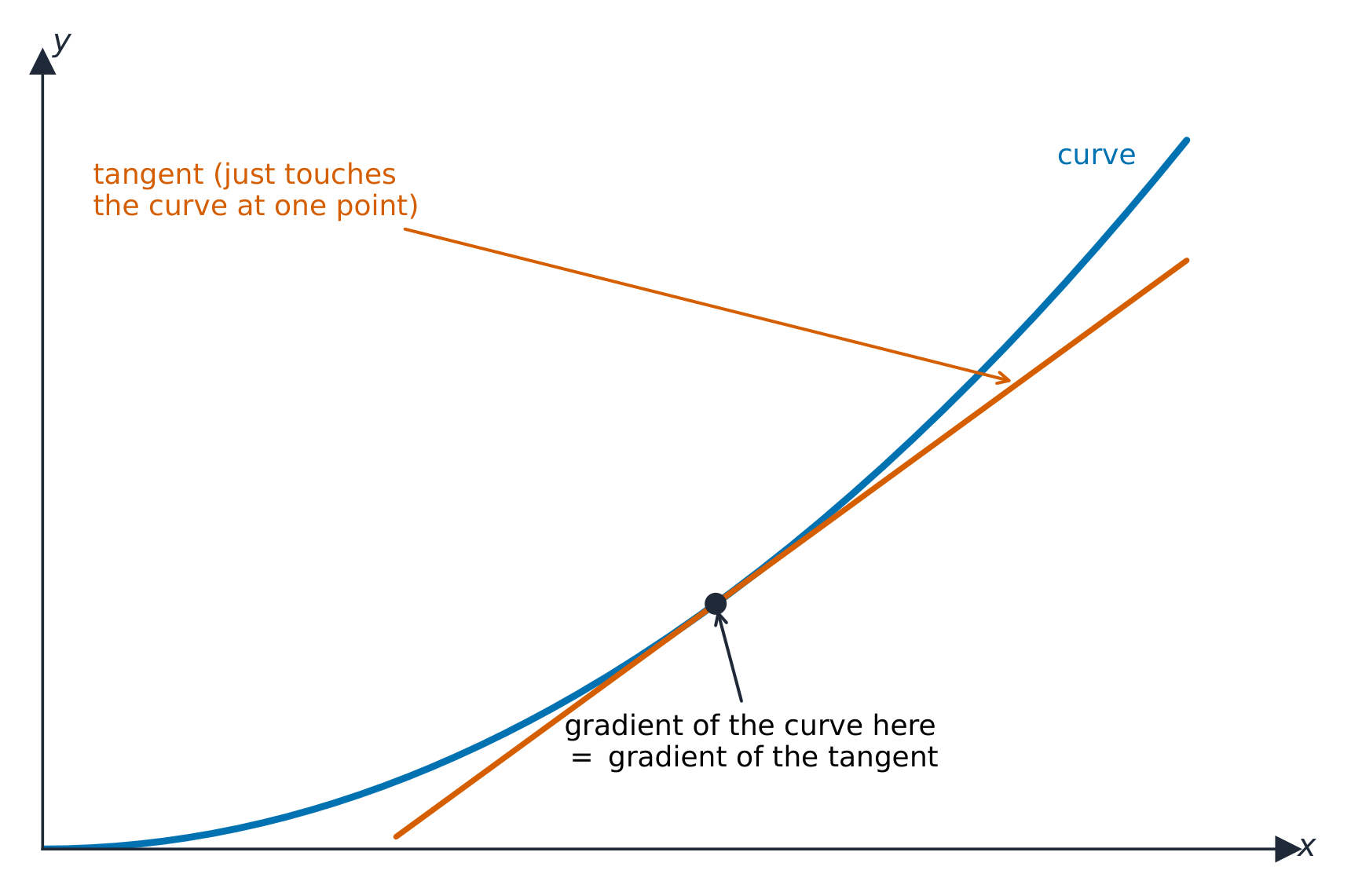
The instantaneous rate of change is the gradient of the tangent at a point
Чтобы оценить $f'(a)$ по графику, следует измерить наклон...
Сложность 1/5 · 100 монет + небольшой бонус за первое выполнение сегодня
Производная — это наклон касательной, считанный по точкам на касательной линии.
From a table: nearest difference quotient
- With table values, approximate $f'(a)$ by the difference quotient over the closest points:
- A symmetric estimate is best: $f'(a)\approx\dfrac{f(a+h)-f(a-h)}{2h}$, using one point on each side.
- Or use a one-sided quotient $\dfrac{f(a+h)-f(a)}{h}$ if only one neighbor is available.
- Smaller $h$ (closer inputs) generally gives a better estimate 估计值.
Таблица содержит значения $f(1.9)=4.2$ и $f(2.1)=5.8$. Используйте симметричное разностное отношение для оценки $f'(2)$.
Сложность 2/5 · 140 монет + небольшой бонус за первое выполнение сегодня
$\dfrac{5.8-4.2}{2(0.1)}=\dfrac{1.6}{0.2}=8$.
Использование значений входных данных, более близких к точке, обычно улучшает оценку производной по таблице.
Сложность 1/5 · 100 монет + небольшой бонус за первое выполнение сегодня
Меньший интервал лучше аппроксимирует наклон касательной.
Производная, прочитанная из таблицы или графика, является ____, а не точным значением.
Сложность 1/5 · 100 монет + небольшой бонус за первое выполнение сегодня
Только алгебраические преобразования формулы дают точную производную.
Из $f(3)=10$ и $f(3.2)=11.4$ оцените $f'(3)$ с помощью одностороннего разностного отношения.
Сложность 2/5 · 140 монет + небольшой бонус за первое выполнение сегодня
$\dfrac{11.4-10}{3.2-3}=\dfrac{1.4}{0.2}=7$.
Reading sign and size
- The sign of the estimate says which way $f$ is heading: $+$ rising, $-$ falling.
- The size says how fast: a derivative of $12$ means $f$ changes about $12$ units per unit of $x$ there.
- Always attach units and interpret in context (e.g. "the temperature is rising about $2^\circ$C per minute").
- An estimate is an approximation — say so, and use the closest data you have.
Если оцененная производная в точке отрицательна, то функция в этой точке...
Сложность 1/5 · 100 монет + небольшой бонус за первое выполнение сегодня
Отрицательная скорость означает, что функция убывает там.
When estimating from a graph, read the slope of the tangent line, not of a nearby secant, and take your two points off the tangent, not off the curve. From a table, don't reuse the point $a$ itself as both inputs — you need two different inputs bracketing (or approaching) $a$.
A table gives $f(1.9)=4.2$, $f(2)=5.0$, $f(2.1)=5.9$. Estimate $f'(2)$.
- Symmetric difference quotient: $f'(2)\approx\dfrac{f(2.1)-f(1.9)}{2(0.1)}=\dfrac{5.9-4.2}{0.2}=\dfrac{1.7}{0.2}=8.5$.
- (A one-sided estimate $\dfrac{5.9-5.0}{0.1}=9$ is close but less balanced.)
- So $f'(2)\approx8.5$ — $f$ is rising at about $8.5$ units per unit of $x$.
To estimate a derivative: from a graph, read the slope of the tangent line (rise ÷ run using points on the tangent); from a table, use a difference quotient over the closest inputs — the symmetric quotient $\frac{f(a+h)-f(a-h)}{2h}$ is most accurate. The sign gives direction, the size gives rate.