Defining Limits and Using Limit Notation
Введено| English | Значение |
|---|---|
| limit/ˈlɪmɪt/ | предел |
| approaches/əˈprəʊtʃɪz/ | стремится к |
| one-sided limit/wʌn ˈsaɪdɪd ˈlɪmɪt/ | односторонний предел |
| left-hand/left hænd/ | левосторонний |
| right-hand/raɪt hænd/ | правосторонний |
| two-sided limit/tuː ˈsaɪdɪd ˈlɪmɪt/ | двусторонний предел |
Where is the graph heading?
- Forget the single point for a moment — ask where the curve is heading as you slide $x$ toward a value.
- Follow $f(x)=\dfrac{x^2-1}{x-1}$ as $x$ gets close to $1$. Plug in $x=1$ and you get $\tfrac{0}{0}$ — undefined.
- Yet the outputs march steadily toward $2$: $f(0.9)=1.9$, $f(0.99)=1.99$, $f(1.01)=2.01$.
- The function has a hole at $x=1$, but it is clearly aiming at $2$. That target value is the limit 极限.
Следите за направлением кривой
y = ax² + bx + c
Drag the coefficients and pick an input $c$ in your mind — the limit is the height the curve approaches near $c$, not the point itself.
Writing it down: limit notation
- We write $\displaystyle\lim_{x \to c} f(x) = L$ and read it "the limit of $f$ of $x$, as $x$ approaches 趋近 $c$, equals $L$."
- $c$ is the input we creep toward; $L$ is the output the function heads for.
- Crucially, $x \to c$ means "gets close to $c$" — never "equals $c$." We stay off the point itself.
- For our example: $\displaystyle\lim_{x \to 1}\dfrac{x^2-1}{x-1} = 2$, even though $f(1)$ does not exist.
The notation $\lim_{x \to c} f(x) = L$ means that as $x$...
Сложность 1/5 · 100 монет + небольшой бонус за первое выполнение сегодня
$x \to c$ means $x$ approaches $c$ without touching it, and $f(x)$ heads toward $L$.
Оценка $\displaystyle\lim_{x \to 3}\dfrac{x^2-9}{x-3}$.
Сложность 2/5 · 140 монет + небольшой бонус за первое выполнение сегодня
Factor: $\frac{(x-3)(x+3)}{x-3}=x+3$ for $x\neq3$, which heads to $3+3=6$.
Coming from the left and the right
- You can approach $c$ from two directions, and each has its own one-sided limit 单侧极限.
- From below ($x$ slightly less than $c$): the left-hand 左侧 limit, $\displaystyle\lim_{x \to c^-} f(x)$.
- From above ($x$ slightly more than $c$): the right-hand 右侧 limit, $\displaystyle\lim_{x \to c^+} f(x)$.
- The small $-$ and $+$ signs sit up high on $c$ to show the direction of travel.
Which expression is the right-hand limit of $f$ at $c$?
Сложность 1/5 · 100 монет + небольшой бонус за первое выполнение сегодня
The $+$ superscript on $c$ means $x$ approaches from above — the right-hand side.
The two sides must agree
- The ordinary two-sided limit 双侧极限 $\displaystyle\lim_{x \to c} f(x)$ exists only when both one-sided limits exist and are equal.
-
$$\lim_{x \to c^-} f(x) = \lim_{x \to c^+} f(x) = L \iff \lim_{x \to c} f(x) = L$$
- If the left side heads for one value and the right side for another, the two-sided limit does not exist (DNE).
A two-sided limit at $c$ exists only when the left-hand and right-hand limits are both present and ____.
Сложность 1/5 · 100 монет + небольшой бонус за первое выполнение сегодня
The two one-sided limits must agree on a single value $L$.
Select все situations in which $\lim_{x\to c} f(x)$ делает нет exist.
Сложность 2/5 · 140 монет + небольшой бонус за первое выполнение сегодня
A limit fails when the sides disagree, the value is unbounded, or it oscillates. A mismatch with $f(c)$ alone does нет kill the limit — it only breaks continuity.
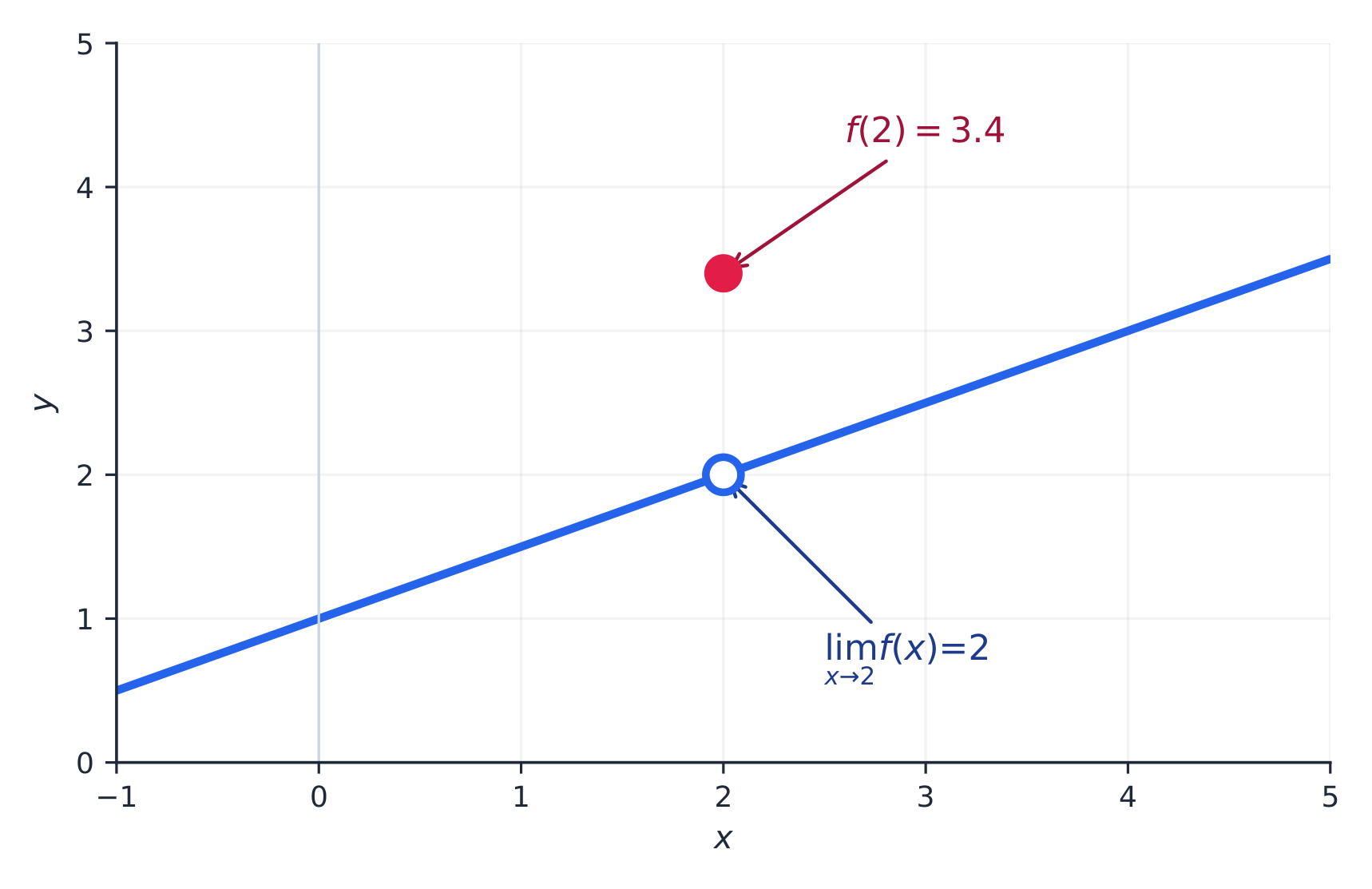
The limit is about the journey, not the destination point. $\lim_{x \to c} f(x)$ can exist even when $f(c)$ is undefined, and it can differ from $f(c)$ when the point is plotted somewhere off the curve. Never assume $\lim_{x\to c} f(x)=f(c)$ — that is a special case (continuity), not a rule.
If $f(c)$ is undefined, then $\lim_{x \to c} f(x)$ cannot exist.
Сложность 1/5 · 100 монет + небольшой бонус за первое выполнение сегодня
The limit is about the approach, not the point. $\lim_{x\to 1}\frac{x^2-1}{x-1}=2$ even though $f(1)$ is undefined.
For a piecewise function, $\displaystyle\lim_{x\to 2^-} f(x) = 3$ and $\displaystyle\lim_{x\to 2^+} f(x) = 5$.
- The left side heads for $3$; the right side heads for $5$.
- They disagree, so $\displaystyle\lim_{x \to 2} f(x)$ does not exist — the graph jumps at $x=2$.
- This is true no matter what value (if any) is plotted at $x=2$.
$\displaystyle\lim_{x\to c} f(x)=L$ says $f(x)$ heads toward $L$ as $x$ nears $c$ from both sides — without ever touching $c$. The two-sided limit exists iff the left-hand and right-hand limits both exist and are equal. The limit describes where the function is going, which need not equal $f(c)$.
Write from a limit that misses the dot
- From both sides, the heights head toward 5.
- The plotted point at the input is at height 1.
What is the limit, and must it equal the function value?
The hole or the dot is not the limit.
Both sides approach 5, but f(c) = 1. What is the limit?
Сложность 1/5 · 100 монет + небольшой бонус за первое выполнение сегодня
The shared height is the limit.