Electron configuration
Введено| English | Значение |
|---|---|
| shell/ʃel/ | электронный слой |
| sub-shell/sʌb ʃel/ | подуровень |
| orbital/ˈɔːbɪtl/ | орбиталь |
| ground state/ɡraʊnd steɪt/ | The lowest-energy state available to an atom, particle or other quantum system. |
| principal quantum number/ˈprɪnsɪpl ˈkwɒntəm ˈnʌmbə/ | главный квантовый номер |
| configuration/kənˌfɪɡjəˈreɪʃn/ | электронная конфигурация |
| transition metal/trænˈsɪʃn ˈmetl/ | переходный металл |
Count electrons before choosing their arrangement
- Electrons occupy shells 壳层, sub-shells 亚层 and orbitals 轨道. The ground state 基态 is the lowest-energy arrangement for that atom or ion.
- This syllabus section assesses ground-state species from hydrogen to krypton. First calculate the number of electrons, then fill the available orbitals; do not use the nucleon number as the electron total.
Relate a shell to its orbitals
- The principal quantum number 主量子数 $n$ labels the main shell. Larger $n$ generally means a greater spatial extent, but $n$ alone does not put every sub-shell of a multi-electron atom into energy order.
- Each orbital holds up to two electrons. A shell contains sub-shells; a p sub-shell contains three orbitals, not one six-electron orbital.
| Sub-shell | Number of orbitals | Maximum electrons |
|---|---|---|
| s | 1 | 2 |
| p | 3 | 6 |
| d | 5 | 10 |
Заполнение оболочек
Drag the proton number. Electrons fill the shells from the inside out (2, then 8, then 8) — the basis of the periodic table.
How many electrons can a p sub-shell hold?
Сложность 1/5 · 100 монет + небольшой бонус за первое выполнение сегодня
A p sub-shell has 3 orbitals, each holding 2 electrons, so 6 in total (s = 2, d = 10).
Match each sub-shell to how many electrons it holds.
Сложность 2/5 · 140 монет + небольшой бонус за первое выполнение сегодня
Each orbital holds 2; s has 1 orbital, p has 3, d has 5 — so 2, 6 and 10 electrons.
Use the filling order with its limits
- This is the usual construction order for the neutral ground-state configurations studied here. Fill lower-energy available states first; chromium and copper have the exceptions shown below.
- Do not use the sequence to claim that 4s is always below occupied 3d levels. For first-row transition-metal cations, remove 4s electrons before 3d electrons.
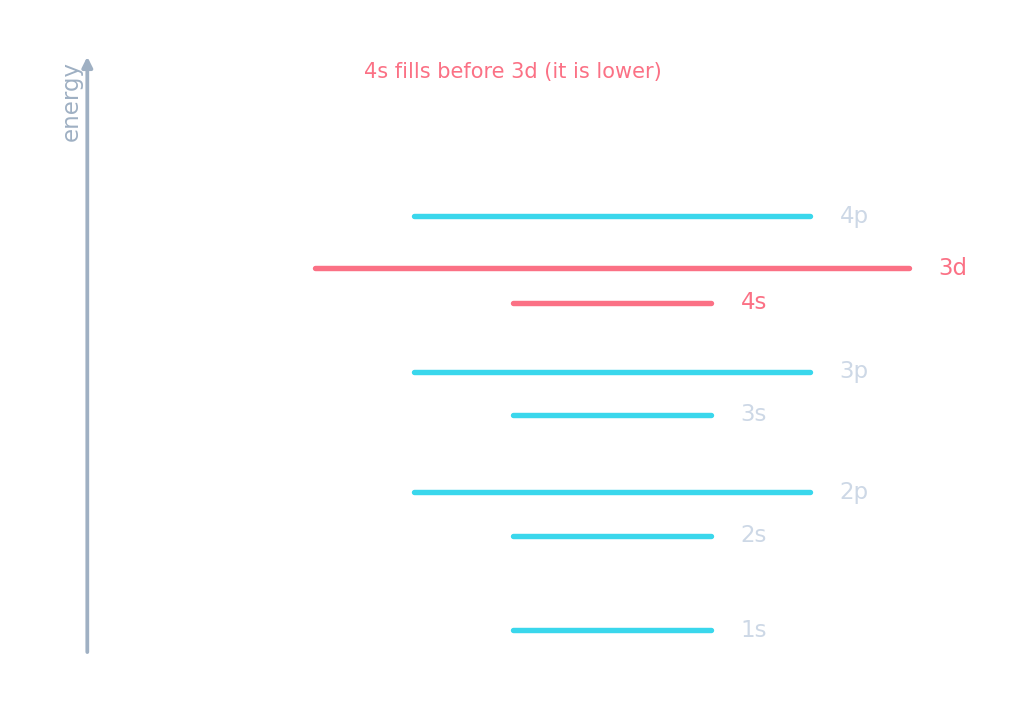
The diagram supports the filling sequence; apply the separate ion-removal rule when forming transition-metal cations.
In the usual neutral-atom filling sequence used here, which is reached first: 4s or 3d?
Сложность 1/5 · 100 монет + небольшой бонус за первое выполнение сегодня
4s is reached before 3d in the usual neutral filling sequence. This does not mean that 4s remains lower in energy in every occupied atom or ion.
Put these sub-shells in the order they fill.
Сложность 3/5 · 200 монет + небольшой бонус за первое выполнение сегодня
Fill by energy, not by number: 4s comes before 3d.
Write configurations 电子排布 and check their sum
- Fe has 26 electrons: $1\mathrm{s}^2\,2\mathrm{s}^2\,2\mathrm{p}^6\,3\mathrm{s}^2\,3\mathrm{p}^6\,3\mathrm{d}^6\,4\mathrm{s}^2$, or $[\mathrm{Ar}]\,3\mathrm{d}^6\,4\mathrm{s}^2$. The [Ar] core represents 18 electrons, not one orbital.
- Group terms by $n$ to count shells: Fe has $2,8,14,2$. Its third shell contains 3s, 3p and 3d electrons, even though 4s was reached before 3d in the filling sequence.
The electron configuration of sodium (11 electrons) is 1s² 2s² 2p⁶ ______.
Сложность 1/5 · 100 монет + небольшой бонус за первое выполнение сегодня
Sodium has one electron in the 3s sub-shell.
The ground-state configuration of iron (Z = 26) is:
Сложность 1/5 · 100 монет + небольшой бонус за первое выполнение сегодня
After argon (18), iron adds 4s² then 3d⁶: [Ar] 3d⁶ 4s².
An Fe atom is [Ar] 3d⁶ 4s². Give the number of electrons in each occupied main shell and explain why the third-shell total is not eight.
The shell totals are 2,8,14,2. The argon core includes 3s² and 3p⁶, then the 3d⁶ electrons also belong to n = 3, giving 2 + 6 + 6 = 14. Filling 4s before 3d does not make 3d part of the fourth shell.
Keep the two neutral-atom exceptions
- Chromium has $[\mathrm{Ar}]\,3\mathrm{d}^5\,4\mathrm{s}^1$ and copper has $[\mathrm{Ar}]\,3\mathrm{d}^{10}\,4\mathrm{s}^1$. These are their ground states, rather than the result of mechanically assigning two 4s electrons in every case.
- A transition metal 过渡金属 ion may have a different occupation from the neutral atom. Start from the correct neutral configuration and remove the stated number of electrons; an ion does not gain electrons because its charge number is positive.
Make the ion, then recount
- Fe²⁺ loses two 4s electrons, giving $[\mathrm{Ar}]\,3\mathrm{d}^6$. Fe³⁺ loses one further 3d electron, giving $[\mathrm{Ar}]\,3\mathrm{d}^5$. The proton number remains 26; the electron totals are 24 and 23.
- For negative ions, add electrons. F⁻ has $9+1=10$ electrons, so it is $1\mathrm{s}^2\,2\mathrm{s}^2\,2\mathrm{p}^6$. Always check both the total and the sub-shell capacities.
For Co²⁺ ($Z=27$), neutral Co is [Ar] 3d⁷ 4s². Remove two 4s electrons: [Ar] 3d⁷, with $18+7=25$ electrons. The charge check is $27-25=+2$.
When iron forms Fe³⁺, which electrons are lost first?
Сложность 1/5 · 100 монет + небольшой бонус за первое выполнение сегодня
Transition metals lose 4s before 3d, so Fe³⁺ is [Ar] 3d⁵.
For Mn (Z = 25) and Mn²⁺, write the ground-state shorthand electron configurations and check the electron totals. Explain which sub-shell loses electrons first.
Mn is [Ar] 3d⁵ 4s², with 18 + 5 + 2 = 25 electrons. Mn²⁺ is [Ar] 3d⁵, with 23 electrons: the two 4s electrons are removed first. Its proton number stays 25 and the charge check is 25 − 23 = +2.
Neutral copper (Z = 29) has ground-state configuration [Ar] 3d¹⁰ 4s¹. Deduce the configurations of Cu⁺ and Cu²⁺ and explain why beginning with [Ar] 3d⁹ 4s² would be inappropriate.
Remove the single 4s electron first: Cu⁺ is [Ar] 3d¹⁰, with 28 electrons. Remove one 3d electron next: Cu²⁺ is [Ar] 3d⁹, with 27 electrons. The stated neutral ground state is copper’s exception to the simple filling pattern; [Ar] 3d⁹ 4s² has the right electron total but is not its ground-state configuration.
You've got it
- Shell → sub-shell → orbital; s, p and d capacities are 2, 6 and 10.
- Use the neutral filling sequence, but retain Cr and Cu ground-state exceptions.
- Remove 4s before 3d when forming the first-row transition-metal cations studied here.
- Check electron total, charge, orbital capacity and the shell number of every term.