Exam workshop: plan, answer and review
Plan a multipart answer
The report question below is worth six practice points for a complete algorithm. Before coding, list its identifiers and types. Separate storing entries from selecting entries, even if your implementation processes them in one loop. A record is appropriate because a code and a measured value have different types.
Worked example: a model answer, point by point
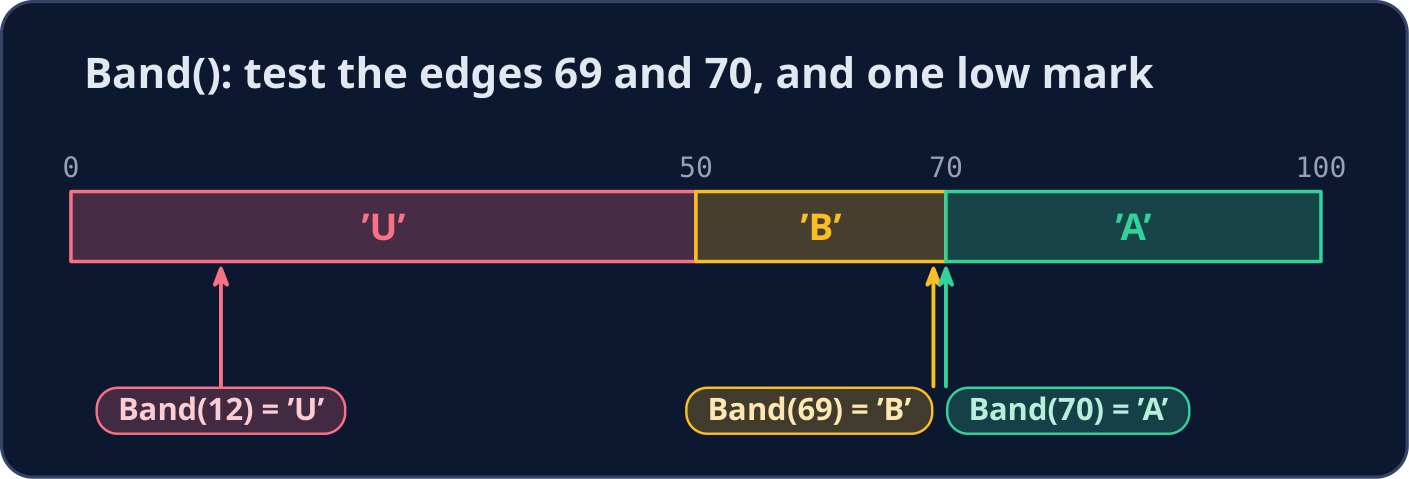
Question (5 marks): Write pseudocode for a function Band(). It takes an integer Mark as a parameter and returns 'A' for a mark of 70 or more, 'B' for 50 to 69, and 'U' otherwise.
FUNCTION Band(Mark : INTEGER) RETURNS CHAR
    IF Mark >= 70 THEN
        RETURN 'A'
    ELSE
        IF Mark >= 50 THEN
            RETURN 'B'
        ELSE
            RETURN 'U'
        ENDIF
    ENDIF
ENDFUNCTION

OUTPUT Band(70), Band(69), Band(12)
The test line outputs ABU. A mark scheme for this kind of question gives one mark for each of these points:
- The function header, with the parameter and its type, and
RETURNS CHAR. - A correct test for 70 or more, with
>=. - A correct test for 50 to 69.
- Returning each of the three characters.
ENDFUNCTION, with the value returned rather than output.
Point 5 is the one most often lost: OUTPUT 'A' inside a function does not give the caller anything.
Where marks are lost
OUTPUTinstead ofRETURNin a function that "returns" a value.- A missing type:
FUNCTION Band(Mark) RETURNS CHARdrops the parameter type. >where the question says "or more", so the boundary value lands in the wrong band.- Missing
ENDIF,NEXTorENDFUNCTION. Each block keeps its closing keyword. - An array declared too small:
ARRAY[1:3]when four entries can arrive.
Marking checklist
Review each feature: record definition; correctly bounded array; reading every requested entry; inclusive threshold; output in input order; correctly initialised count and final output. A teacher may award partial marks for these features even when a runnable solution fails a case. Our local check awards the complete-algorithm points only when all cases pass.
Attempt, then compare
Try the algorithm without hints. Trace a value below the threshold, one exactly on it, and one above it. After checking, use the authored hints and worked answer to compare decisions. Explain why Code is a STRING and why Count is initialised outside the loop. When ready, attempt assessment A and assessment B without support.
Сложность 4/5 · 280 монет + небольшой бонус за первое завершение сегодня
Read NumberOfEntries (1 to 4), then Target, then NumberOfEntries code/value pairs. Define TYPE Entry with Code : STRING and Value : INTEGER, and store an array of records. Output codes whose Value is at least Target, in input order, then the matching count.
Нажмите Запустить, чтобы увидеть результат здесь.
Сложность 3/5 · 200 монет + небольшой бонус за первое завершение сегодня
Write FUNCTION Band(Mark : INTEGER) RETURNS CHAR: A for 70 or more, B for 50 to 69, U otherwise. The main program reads one integer and outputs Band() of it.
Нажмите Запустить, чтобы увидеть результат здесь.
Сложность 4/5 · 280 монет + небольшой бонус за первое завершение сегодня
For Target = 10 and values 9, 10, 15, give Count after each iteration. Count starts at 0 and increases for values at least Target.
Explain your choice of data structure and loop. Identify one boundary case and predict its result. For a subroutine, explain what is returned or changed in the caller.
Сохранено для этой сессии в данном браузере. Проверьте самостоятельно или вместе с учителем; эти объяснения не оцениваются автоматически.
Сравните ваше объяснение с данными критериями
- My types and data structure match the data and the question.
- I justified the loop and checked its first and last iterations.
- Initial values and rejected operations preserve the intended state.
- My test includes input, purpose and expected result.
- I distinguished returning a value from printing and changing caller state.