Static electricity · Eletricidade estática
| English | Português |
|---|---|
| static electricity/ˈstætɪk ɪlekˈtrɪsɪti/ | eletricidade estática |
| charge/tʃɑːdʒ/ | carga |
| electrons/ɪˈlektrɒnz/ | elétrons |
| coulombs/ˈkuːlɒmz/ | coulombs |
| conductor/kənˈdʌktə/ | condutor |
| insulator/ˈɪnsjuːleɪtə/ | isolante |
| electric field/ɪˈlektrɪk fiːld/ | campo elétrico |
| ion/ˈaɪɒn/ | ião |
Sparks and sticky balloons
- Rub a balloon on your hair and it sticks to the wall; lightning is the same effect, in giant form.
- Both come from static electricity 静电 — charge 电荷 that has built up and is not moving.
- It all comes down to tiny electrons 电子.
Faíscas e balões grudantes
- Esfregue um balão no cabelo e ele cola na parede; o raio é o mesmo efeito, em grande escala.
- Ambos vêm de eletricidade estática 静电 — carga 电荷 que se acumulou e não está se movendo.
- Tudo se resume a pequenos elétrons 电子.
Electric charge
- There are two kinds of charge: positive and negative.
- The rule is like magnetic poles: same charges repel, different charges attract.
- Charge is measured in coulombs 库仑 (C).
Carga elétrica
- Existem dois tipos de carga: positiva e negativa.
- A regra é como os polos magnéticos: cargas iguais se repelem, cargas diferentes se atraem.
- Carga é medida em coulombs 库仑 (C).
Rub a balloon and watch it charge · Esfregue um balão e veja ele carregar
Rubbing moves electrons onto the balloon, making it negative — then it attracts a neutral wall or your hair, but repels another negative balloon. · A fricção move elétrons para o balão, tornando-o negativo — então ele atrai uma parede neutra ou seu cabelo, mas repele outro balão negativo.
Two negative charges attract each other. · Duas cargas negativas se atraem.
Like charges repel; only different charges (+ and −) attract. · Cargas iguais se repelem; apenas cargas diferentes (+ e −) se atraem.
Charging by friction
- Rub two different materials together and electrons (tiny negative particles) move from one to the other.
- The material that gains electrons becomes negative; the one that loses them becomes positive.
- Only the negative electrons move — the positive charge stays put.
- Example: a plastic rod rubbed with a cloth becomes negative (it gained electrons); the cloth is left positive.
Carregamento por fricção
- Esfregue dois materiais diferentes e elétrons (partículas negativas minúsculas) se movem de um para o outro.
- O material que ganha elétrons fica negativo; o que os perde fica positivo.
- Apenas os elétrons negativos se movem — a carga positiva permanece fixa.
- Exemplo: uma haste de plástico esfregada com um pano fica negativa (ganhou elétrons); o pano fica positivo.
When you rub a plastic rod with a cloth, the rod gains electrons. The rod becomes: · Quando você esfrega uma haste de plástico com um pano, a haste ganha elétrons. A haste torna-se:
Gaining electrons (which are negative) makes the rod negative. The cloth, having lost electrons, is left positive. · Ganhar elétrons (que são negativos) torna a haste negativa. O pano, tendo perdido elétrons, fica positivo.
During charging by friction, what actually moves between the materials? · Durante o carregamento por fricção, o que realmente se move entre os materiais?
Only the negative electrons move. The positive charge stays fixed in place. · Apenas os elétrons negativos se movem. A carga positiva permanece fixa.
Match each static-electricity idea to what it means. · Combine cada ideia de eletricidade estática com o que significa.
Each item links the term to its correct meaning. · Cada item associa o termo ao seu significado correto.
Conductors 导体 and insulators 绝缘体
- A conductor (copper and other metals) lets charge flow easily, because it has free electrons.
- An insulator (plastic, rubber, glass) does not — its electrons cannot move freely.
- Test it: put the material in a circuit with a lamp and a battery — the lamp lights only for a conductor.
Condutores 导体 e isolantes 绝缘体
- Um condutor (cobre e outros metais) permite que a carga flua facilmente, pois possui elétrons livres.
- Um isolante (plástico, borracha, vidro) não — seus elétrons não podem se mover livremente.
- Teste: coloque o material em um circuito com uma lâmpada e uma bateria — a lâmpada acende apenas para um condutor.
Why is copper a good conductor of electricity? · Por que o cobre é bom condutor de eletricidade?
A conductor has free electrons that can flow through it. Insulators have no free-moving charges. · Um condutor tem elétrons livres que podem fluir através dele. Isolantes não têm cargas móveis.
Electric fields 电场 and ions 离子
- An electric field is a region where a charge feels a force.
- Its direction at a point is the direction of the force on a positive charge.
- Field patterns: lines point away from + and toward −; between parallel plates the lines are straight and evenly spaced.
- An atom that loses electrons becomes a positive ion; one that gains electrons becomes a negative ion.
Campos elétricos 电场 e íons 离子
- Um campo elétrico é uma região onde uma carga sente uma força.
- Sua direção em um ponto é a direção da força sobre uma carga positiva.
- Padrões de campo: linhas apontam para fora de + e para dentro de −; entre placas paralelas as linhas são retas e uniformemente espaçadas.
- Um átomo que perde elétrons torna-se um íon positivo; um que ganha elétrons torna-se um íon negativo.
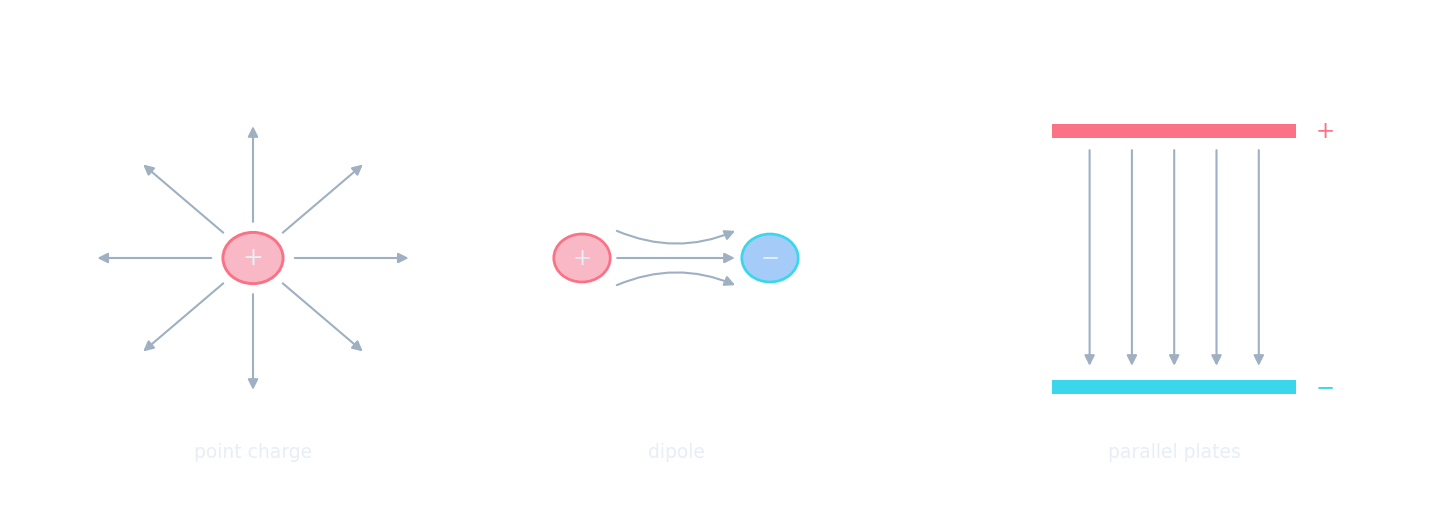
The direction of an electric field at a point is the direction of the force on: · A direção de um campo elétrico em um ponto é a direção da força sobre:
By convention, the electric field direction is the direction of the force on a positive charge. · Por convenção, a direção do campo elétrico é a direção da força sobre uma carga positiva.
A neutral atom loses two electrons. It becomes: · Um átomo neutro perde dois elétrons. Ele torna-se:
Losing negative electrons leaves more positive charge, so the atom becomes a positive ion. · Perder elétrons negativos deixa mais carga positiva, então o átomo torna-se um íon positivo.
You've got it
- two charges: + and −; same repel, different attract
- charging by friction moves electrons only: gain → negative, lose → positive
- conductors have free electrons; insulators do not
- electric field direction = force on a positive charge; lose electrons → positive ion
Entendeu?
- duas cargas: + e −; iguais se repelem, diferentes se atraem
- carregamento por atrito move apenas elétrons: ganha → negativo, perde → positivo
- condutores têm elétrons livres; isolantes não
- direção do campo elétrico = força sobre uma carga positiva; perde elétrons → íon positivo