Sound · Som
| English | Português |
|---|---|
| longitudinal/ˌlɒŋɡɪˈtjuːdɪnl/ | longitudinal |
| compressions/kəmˈpreʃnz/ | comprimimentos |
| rarefactions/ˌreərɪˈfækʃnz/ | rarefações |
| vacuum/ˈvækjuːm/ | vácuo |
| echo/ˈekəʊ/ | echo |
Good vibrations
- Every sound starts with something vibrating — a guitar string, a drum skin, your vocal cords.
- In space films, explosions are silent for a real reason: sound needs a material to travel through.
- Let's see how sound moves.
Boas vibrações
- Todo som começa com algo vibrando — uma corda de violão, uma membrana de tambor, suas pregas vocais.
- Em filmes de espaço, explosões são silenciosas por um motivo real: o som precisa de um meio material para se propagar.
- Vamos ver como o som se move.
Sound is a longitudinal 纵波 wave
- A vibrating object pushes the air into compressions 压缩 (particles squeezed together) and rarefactions 稀疏 (particles spread apart).
- This makes sound a longitudinal wave — the air vibrates along the direction of travel.
- Because it needs particles, sound cannot travel through a vacuum 真空 (empty space).
Sound as a longitudinal wave: particles vibrate back and forth, creating regions of high density (compressions) and low density (rarefactions).
Worked example. A ship sends a sonar pulse to the seabed $150\ \text{m}$ below. Sound speed in water $= 1500\ \text{m/s}$. The sound travels down and back ($300\ \text{m}$ total), so time $= \dfrac{300}{1500} = 0.2\ \text{s}$.
Sound is NOT like light. Light can travel through empty space (a vacuum); sound cannot. In space films, explosions are silent for a real physics reason — there are no particles to carry the vibration.
O som é uma onda longitudinal 纵波
- Um objeto vibrante empurra o ar criando compressões 压缩 (partículas apertadas) e rarefações 稀疏 (partículas espalhadas).
- Isso torna o som uma onda longitudinal — o ar vibra ao longo da direção de propagação.
- Como precisa de partículas, o som não pode viajar pelo vácuo 真空 (espaço vazio).
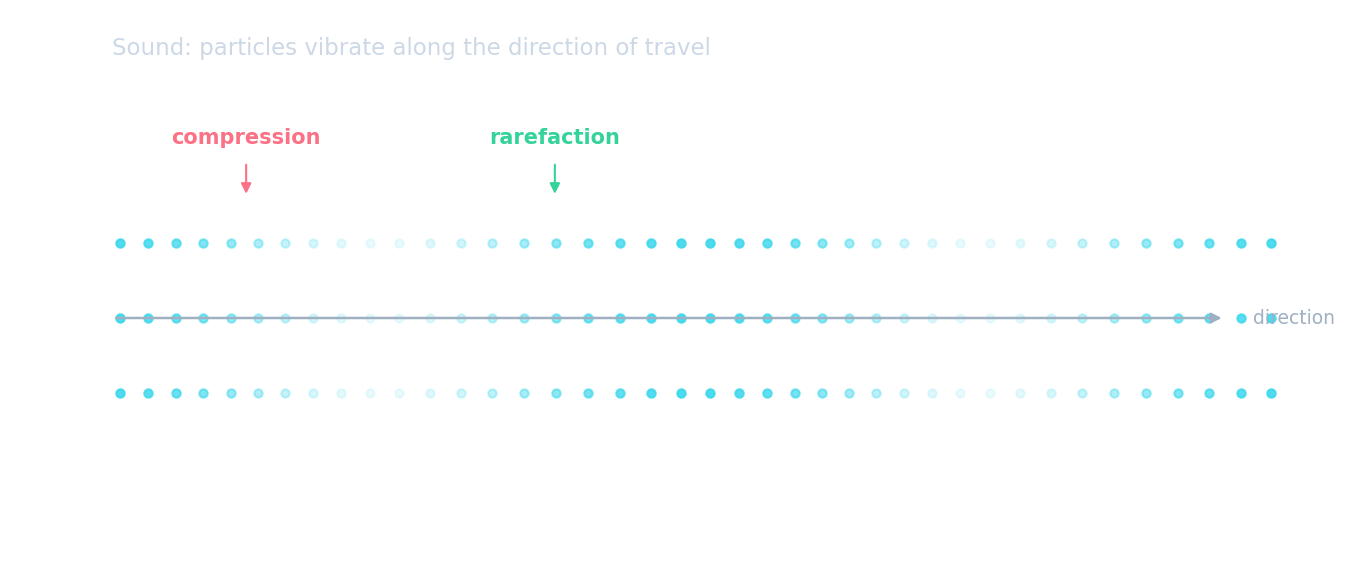
Som como onda longitudinal: partículas vibram de ida e volta, criando regiões de alta densidade (compressões) e baixa densidade (rarefações).
Exemplo resolvido. Um navio envia um pulso de sonar ao fundo do mar $150\ \text{m}$ abaixo. Velocidade do som na água $= 1500\ \text{m/s}$. O som viaja para baixo e volta ($300\ \text{m}$ total), então tempo $= \dfrac{300}{1500} = 0.2\ \text{s}$.
O som NÃO é como a luz. A luz pode viajar pelo espaço vazio (vácuo); o som não pode. Em filmes de espaço, explosões são silenciosas por uma razão física real — não há partículas para transportar a vibração.
Sound · Som
y = a sin(bt + c)
Louder = bigger amplitude; higher pitch = higher frequency · frequência. · Mais alto = maior amplitude; tom mais agudo = maior frequência.
Sound travels as a series of: · O som viaja como uma série de:
A vibrating source squeezes and stretches the air into compressions and rarefactions — a longitudinal wave. · Uma fonte vibrante espreme e estica o ar em compressões e rarefações — uma onda longitudinal.
Sound can travel through a vacuum (empty space). · O som pode viajar através do vácuo (espaço vazio).
Sound needs particles to pass the vibration along, so it cannot travel through a vacuum. · O som precisa de partículas para transmitir a vibração, portanto não pode viajar através do vácuo.
Speed and hearing range
- Humans can hear from about $20\ \text{Hz}$ to $20\,000\ \text{Hz}$.
- Sound travels at about $340\ \text{m/s}$ in air — far slower than light.
- It travels faster in liquids and solids than in gases, because their particles are closer together.
The parts of a wave: wavelength, amplitude, crest and trough
Velocidade e faixa auditiva
- Humanos podem ouvir de aproximadamente $20\ \text{Hz}$ a $20\,000\ \text{Hz}$.
- O som viaja a cerca de $340\ \text{m/s}$ no ar — muito mais lento que a luz.
- Ele viaja mais rápido em líquidos e sólidos do que em gases, porque suas partículas estão mais próximas.

As partes de uma onda: comprimento de onda, amplitude, crista e vale
The approximate range of human hearing is: · A faixa aproximada da audição humana é:
Most people hear from about 20 Hz (very low) up to about 20 000 Hz (very high). · A maioria das pessoas ouve de cerca de 20 Hz (muito grave) até cerca de 20 000 Hz (muito agudo).
Sound travels fastest through: · O som viaja mais rápido através de:
The closer the particles, the faster the vibration is passed on — so sound is fastest in solids, slowest in gases. · Quanto mais próximas as partículas, mais rápido a vibração é transmitida — então o som é mais rápido em sólidos, mais lento em gases.
Echoes 回声
- A reflected sound is an echo.
- You can measure the speed of sound by timing an echo over a known distance.
- The sound travels to the wall and back, so it covers twice the distance.
Ecos 回声
- Um som refletido é um eco.
- Você pode medir a velocidade do som cronometrando um eco sobre uma distância conhecida.
- O som viaja até a parede e volta, cobrindo duas vezes a distância.
A boy shouts at a cliff $660\ \text{m}$ away and hears the echo $4.0\ \text{s}$ later. What is the speed of sound, in m/s? · Um menino grita em um penhasco $660\ \text{m}$ de distância e ouve o eco $4.0\ \text{s}$ depois. Qual é a velocidade do som, em m/s?
The sound travels there and back: $2 \times 660 = 1320\ \text{m}$ in $4.0\ \text{s}$, so $v = \dfrac{1320}{4.0} = 330\ \text{m/s}$. · O som viaja lá e volta: $2 \times 660 = 1320\ \text{m}$ em $4.0\ \text{s}$, então $v = \dfrac{1320}{4.0} = 330\ \text{m/s}$.
You've got it
- sound is made by vibrations and is a longitudinal wave (compressions + rarefactions)
- it needs a medium — no sound in a vacuum
- human hearing: about $20\ \text{Hz}$ to $20\,000\ \text{Hz}$; speed ≈ $340\ \text{m/s}$ in air
- an echo is reflected sound — remember it travels there and back
Entendeu?
- som é produzido por vibrações e é uma onda longitudinal (compressões + rarefações)
- precisa de um meio — não há som no vácuo
- audição humana: de aprox. $20\ \text{Hz}$ a $20\,000\ \text{Hz}$; velocidade ≈ $340\ \text{m/s}$ no ar
- um eco é som refletido — lembre-se que ele vai e volta