Energy, work and power · Energia, trabalho e potência
| English | Português |
|---|---|
| kinetic energy/kɪˈnetɪk ˈenədʒi/ | energia cinética |
| gravitational potential energy/ˌɡrævɪˈteɪʃənl pəˈtenʃl ˈenədʒi/ | energia potencial gravitacional |
| conservation of energy/ˌkɒnsəˈveɪʃn ɒv ˈenədʒi/ | conservação de energia |
| Sankey diagram/ˈsæŋki ˈdaɪəɡræm/ | diagrama de Sankey |
| work done/wɜːk dʌn/ | trabalho realizado |
| joule/dʒuːl/ | joule |
| power/ˈpaʊə/ | potência |
| efficiency/ɪˈfɪʃənsi/ | eficiência |
| watt/wɒt/ | watt |
Energy never disappears
- At the top of a roller-coaster hill the car is slow but high; at the bottom it is fast but low.
- The energy did not vanish — it just moved from one store to another.
- This is the big idea of this lesson: energy is stored, transferred, and always conserved.
Energia nunca desaparece
- No topo de uma colina de montanha-russa o carro é lento mas alto; no fundo é rápido mas baixo.
- A energia não desapareceu — apenas se transferiu de um depósito para outro.
- Esta é a ideia central desta lição: energia é armazenada, transferida e sempre conservada.
Energy stores and transfers
- Energy can be stored as: kinetic, gravitational potential, chemical, elastic (strain), nuclear, electrostatic, and internal (thermal).
- It is transferred between stores by: forces (mechanical work), electric currents, heating, and waves (such as light and sound).
- "Using energy" really means moving it from one store to another.
Wind turbines transfer energy from moving air to electricity
Depósitos e transferências de energia
- A energia pode ser armazenada como: cinética, potencial gravitacional, química, elástica (de deformação), nuclear, eletrostática e interna (térmica).
- Ela é transferida entre depósitos por: forças (trabalho mecânico), correntes elétricas, aquecimento e ondas (como luz e som).
- "Usar energia" realmente significa movê-la de um depósito para outro.
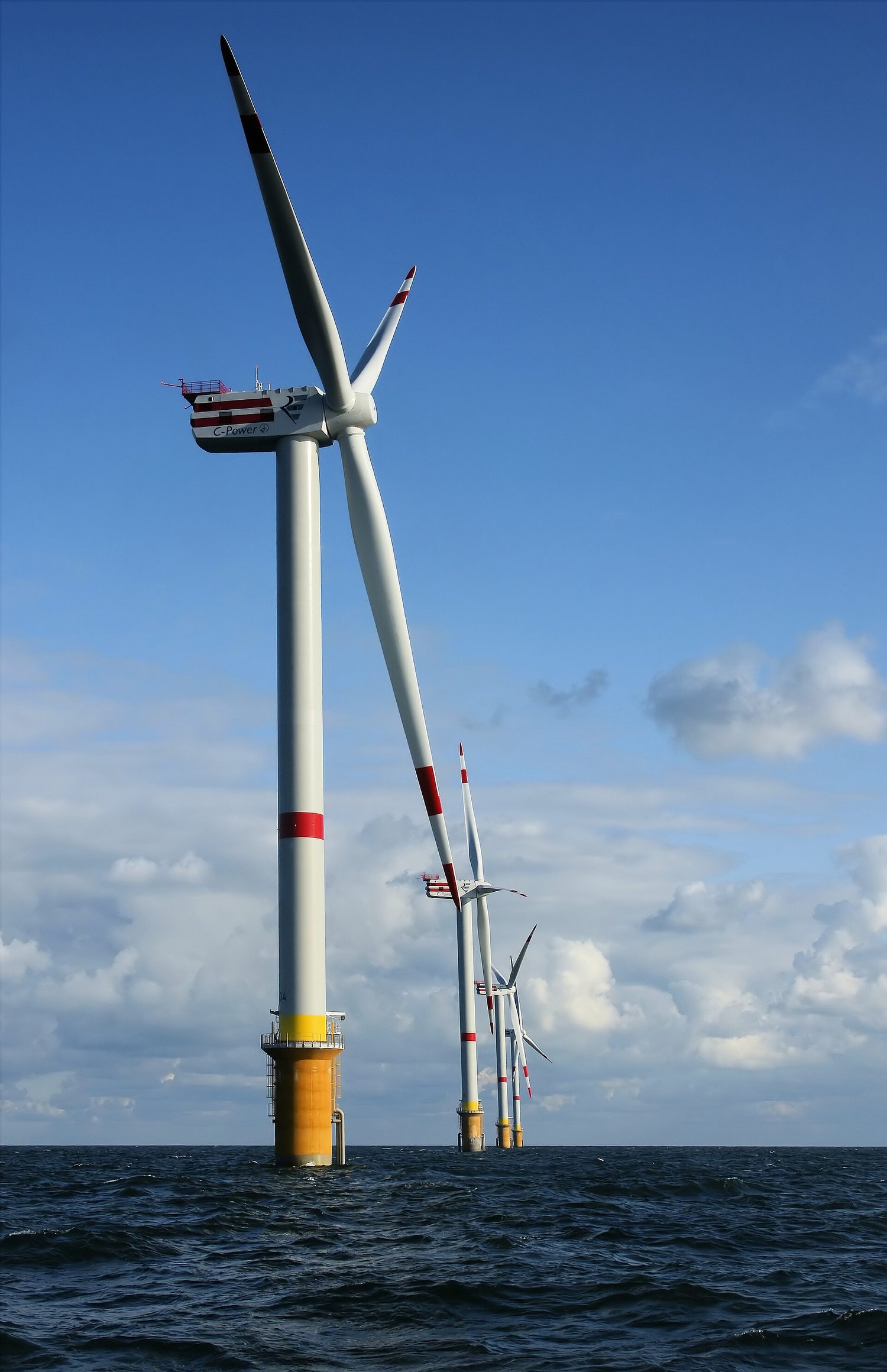
Turbinas eólicas transferem energia do ar em movimento para eletricidade
Energy flow & efficiency · Fluxo de energia & eficiência
Input energy splits into useful output and wasted energy; efficiency is the useful fraction, and the total is always conserved. · A energia de entrada se divide em saída útil e energia desperdiçada; a eficiência é a fração útil, e o total é sempre conservado.
Energy, work & power · Energia, trabalho & potência
PE + KE = constant · PE + CE = constante
As an object falls, potential · ação energy becomes kinetic — total fixed. · À medida que um objeto cai, a energia potencial se transforma em cinética — o total permanece fixo.
Select all · todos of these that are energy stores. · Selecione todos estes que são armazenadores de energia.
Kinetic, chemical and gravitational potential are energy stores. "Loud" and "fast" describe things, but they are not energy stores. · Cinética, química e potencial gravitacional são armazenadores de energia. "Alto" e "rápido" descrevem coisas, mas não são armazenadores de energia.
Kinetic and potential energy
- Kinetic energy 动能 is the energy of a moving object:
- Lifting a mass by a height $\Delta h$ changes its gravitational potential energy 重力势能:
- A falling object turns gravitational PE into kinetic energy.
Energia cinética e potencial
- Energia cinética 动能 é a energia de um objeto em movimento:
- Levantar uma massa por uma altura $\Delta h$ altera sua energia potencial gravitacional 重力势能:
- Um objeto em queda transforma PE gravitacional em energia cinética.

A $2.0\ \text{kg}$ ball moves at $3.0\ \text{m/s}$. What is its kinetic energy, in J? · Uma bola de $2.0\ \text{kg}$ move-se a $3.0\ \text{m/s}$. Qual é sua energia cinética, em J?
$E_k = \tfrac{1}{2}mv^2 = \tfrac{1}{2} \times 2.0 \times 3.0^2 = 9.0\ \text{J}$.
Conservation of energy 能量守恒
- The principle of conservation of energy: energy is never made or destroyed — it only moves between stores.
- Some energy is always wasted — usually spread out as heat to the surroundings.
- A Sankey diagram 桑基图 shows the input energy splitting into useful energy and wasted energy.
On a roller-coaster, stored energy at the top becomes kinetic energy lower down
Conservação de energia 能量守恒
- Princípio da conservação de energia: energia não é criada nem destruída — apenas se move entre depósitos.
- Parte da energia é sempre desperdiçada — geralmente dissipada como calor para o ambiente.
- Um diagrama de Sankey 桑基图 mostra a energia de entrada dividindo-se em energia útil e energia desperdiçada.
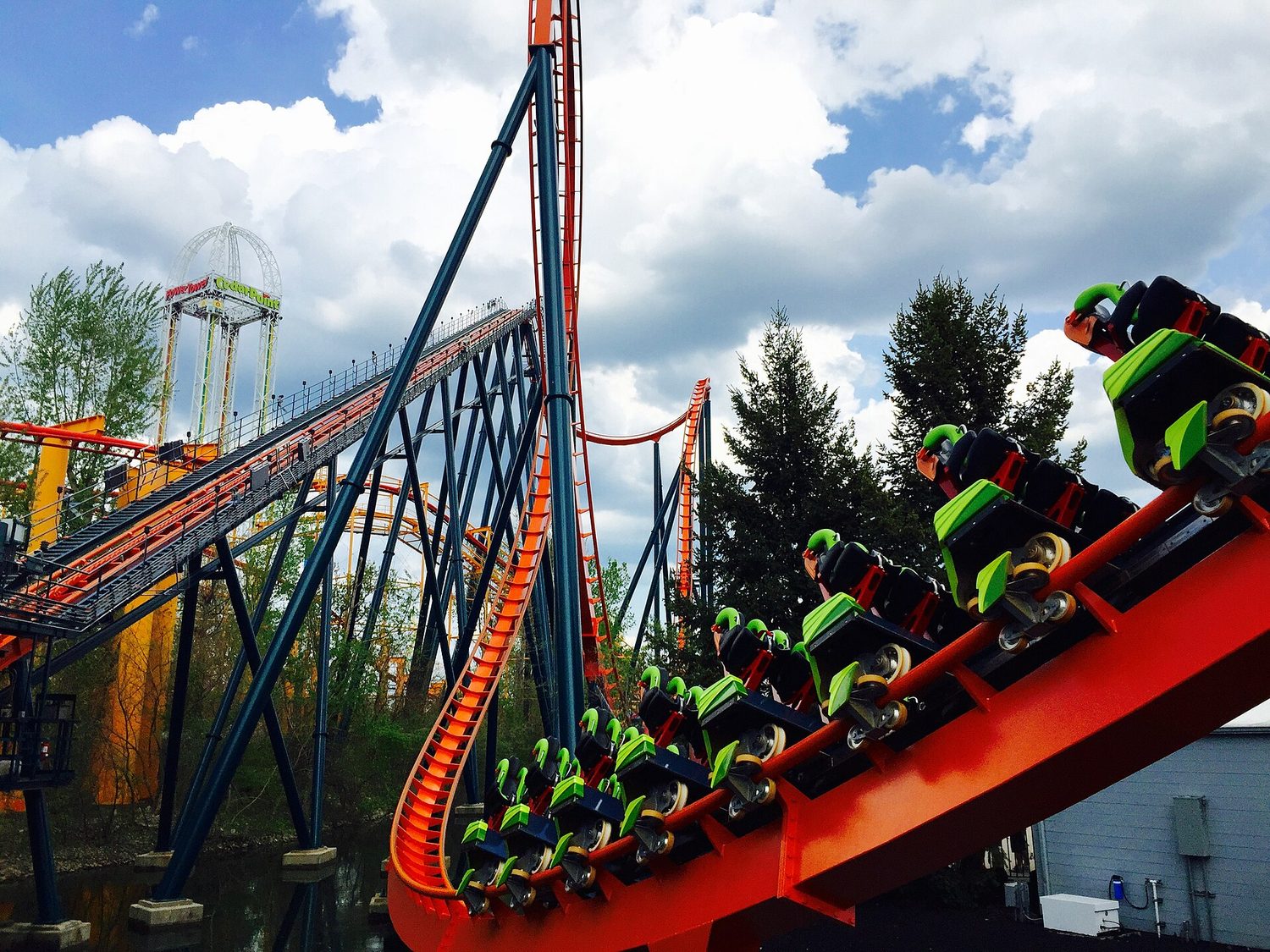
Em uma montanha-russa, energia armazenada no topo torna-se energia cinética mais abaixo
When a machine wastes energy, where does the wasted energy usually go? · Quando uma máquina desperdiça energia, para onde geralmente vai a energia desperdiçada?
Energy is conserved — it is never destroyed. Wasted energy is usually spread out as heat, which is hard to use again. · A energia é conservada — nunca é destruída. A energia desperdiçada geralmente se dispersa como calor, que é difícil de usar novamente.
Work
- Work done 做功 equals the energy transferred. When a force moves an object along its direction:
- The unit of work and energy is the joule 焦耳 (J).
- Lifting a heavier load, or moving it further, does more work.
A swinging pendulum trades gravitational potential energy for kinetic energy and back
Trabalho
- Trabalho realizado 做功 é igual à energia transferida. Quando uma força move um objeto ao longo de sua direção:
- A unidade de trabalho e energia é o joule 焦耳 (J).
- Levantar uma carga mais pesada ou movê-la mais longe realiza mais trabalho.
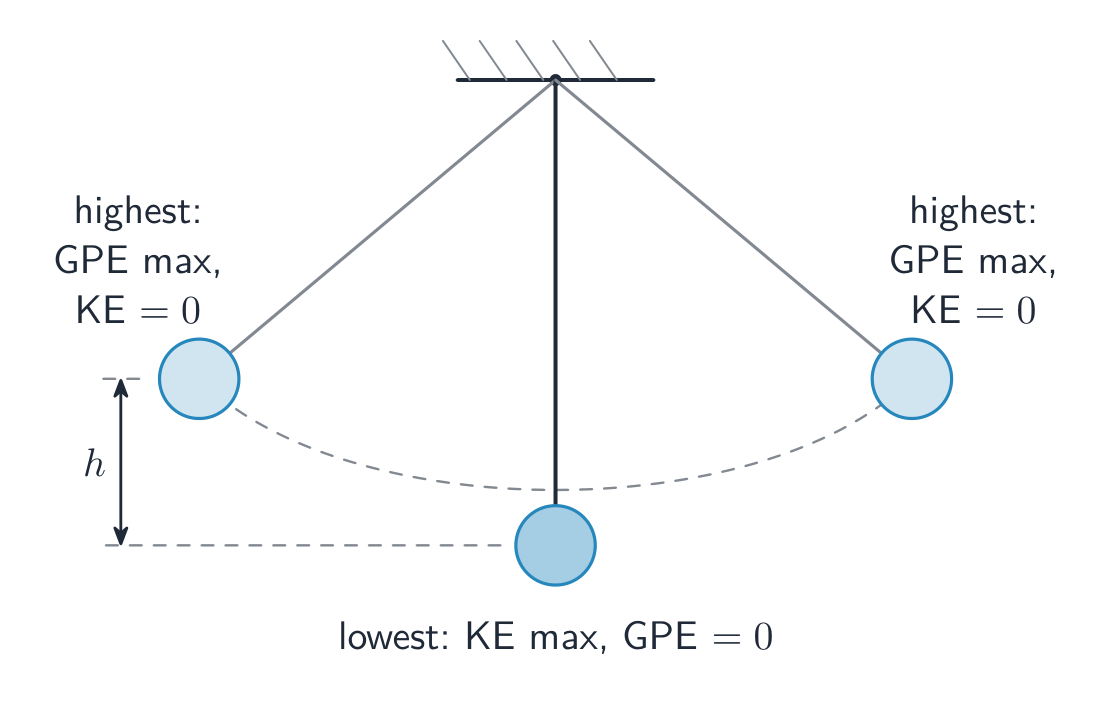
Um pêndulo oscilante troca energia potencial gravitacional por energia cinética e vice-versa
A force of $50\ \text{N}$ pushes a box $4.0\ \text{m}$ along the floor. How much work is done, in J? · Uma força de $50\ \text{N}$ empurra uma caixa por $4.0\ \text{m}$ ao longo do chão. Quanto trabalho é feito, em J?
$W = Fd = 50 \times 4.0 = 200\ \text{J}$.
Power 功率 and efficiency 效率
- Power is the work done (energy transferred) each second:
- The unit is the watt 瓦特 (W); $1\ \text{W} = 1\ \text{J/s}$.
- Efficiency is how much of the input energy becomes useful:
- It is always less than $100\%$ because some energy is always wasted.
A Sankey diagram: the band widths are proportional to the energy, so the input splits into useful output and wasted heat
Potência 功率 e eficiência 效率
- Potência é o trabalho realizado (energia transferida) por segundo:
- A unidade é o watt 瓦特 (W); $1\ \text{W} = 1\ \text{J/s}$.
- Eficiência é quanto da energia de entrada se torna útil:
- É sempre menor que $100\%$ porque parte da energia é sempre desperdiçada.
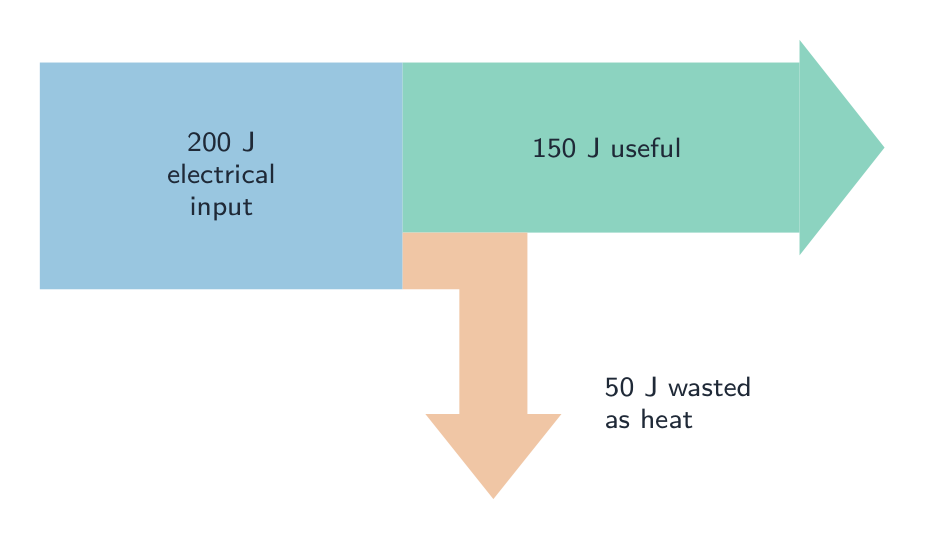
Um diagrama de Sankey: as larguras das faixas são proporcionais à energia, então a entrada divide-se em saída útil e calor desperdiçado
A motor does $200\ \text{J}$ of work in $10\ \text{s}$. What is its power, in W? · Um motor realiza $200\ \text{J}$ de trabalho em $10\ \text{s}$. Qual é sua potência, em W?
$P = \dfrac{W}{t} = \dfrac{200}{10} = 20\ \text{W}$.
A lamp takes in $50\ \text{J}$ of electrical energy and gives out $30\ \text{J}$ of useful light. What is its efficiency, in %? · Uma lâmpada consome $50\ \text{J}$ de energia elétrica e emite $30\ \text{J}$ de luz útil. Qual é sua eficiência, em %?
efficiency · eficiência $= \dfrac{\text{useful}}{\text{total}} \times 100\% = \dfrac{30}{50} \times 100\% = 60\%$. · eficiência $= \dfrac{\text{useful}}{\text{total}} \times 100\% = \dfrac{30}{50} \times 100\% = 60\%$.
You've got it
- $E_k = \tfrac{1}{2}mv^2$ · $\Delta E_p = mg\,\Delta h$
- energy is conserved — wasted energy usually ends up as heat
- work $W = Fd$ (joule); power $P = \dfrac{W}{t}$ (watt)
- efficiency $= \dfrac{\text{useful}}{\text{total}} \times 100\%$, always below $100\%$
Entendeu?
- $E_k = \tfrac{1}{2}mv^2$ · $\Delta E_p = mg\,\Delta h$
- energia é conservada — energia desperdiçada geralmente termina como calor
- trabalho $W = Fd$ (joule); potência $P = \dfrac{W}{t}$ (watt)
- eficiência $= \dfrac{\text{useful}}{\text{total}} \times 100\%$, sempre abaixo de $100\%$