Measurement, scalars and vectors · Medição, escalares e vetores
| English | Português |
|---|---|
| measurement/ˈmeʒəmənt/ | medição |
| scalar/ˈskeɪlə/ | escalar |
| vector/ˈvektə/ | vetor |
| parallax/ˈpærəlæks/ | paralaxe |
| meniscus/ˈmenɪskəs/ | menisco |
| period/ˈpɪərɪəd/ | período |
| resultant/rɪˈzʌltənt/ | resultante |
Why measure carefully?
- Physics starts with measurement 测量 — turning the real world into good numbers.
- A careless reading can ruin a whole experiment.
- So first we learn to measure length and volume, handle tiny amounts, and tell scalars 标量 from vectors 矢量.
Por que medir com cuidado?
- A Física começa com a medição 测量 — transformar o mundo real em bons números.
- Uma leitura descuidada pode estragar todo um experimento.
- Então primeiro aprendemos a medir comprimento e volume, lidar com quantidades minúsculas e distinguir escalares 标量 de vetores 矢量.
Length and volume
- Measure length with a ruler.
- Put your eye straight in front of the mark — looking from the side gives a wrong reading (a parallax 视差 error).
- Measure the volume of a liquid with a measuring cylinder.
- Read the scale at the bottom of the curved surface (the meniscus 弯月面), with your eye level with it.
Read a measuring cylinder at the bottom of the meniscus, with your eye level
Comprimento e volume
- Meça o comprimento com uma régua.
- Coloque o seu olho diretamente à frente da marca — olhar de lado dá uma leitura errada (um erro de parallax 视差).
- Meça o volume de um líquido com um cilindro graduado.
- Leia a escala na base da superfície curva (o menisco 弯月面), com o nível dos olhos alinhado com ele.
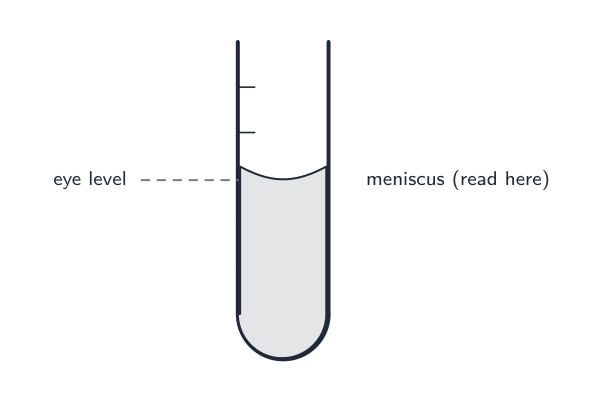
Leia um cilindro graduado na base do menisco, com o nível dos olhos
Scalars & vectors · Escalares & vetores
resultant = a + b · resultante = a + b
Add two vectors tip-to-tail to find the resultant. · Some dois vetores ponta-a-ponta para encontrar o resultante.
You measure water in a measuring cylinder. How should you read the scale? · Você mede água em um cilindro graduado. Como deve ler a escala?
Read at the bottom of the meniscus with your eye level with it — looking from above or below gives a parallax error (a wrong reading). · Leia na parte inferior do menisco com os olhos alinhados a ele — olhar de cima ou de baixo causa erro de paralaxe (uma leitura incorreta).
Measuring tiny amounts
- One thin page, or one quick swing, is too small to measure well.
- The trick: measure many, then divide.
- Stack 100 sheets of paper, measure the height, then $\div 100$ → the thickness of one sheet.
- Time 20 swings of a pendulum, then $\div 20$ → the period 周期 (the time for one swing).
- Measuring many at once makes the error much smaller.
Two vectors at right angles add to a resultant 合矢量, the diagonal of the rectangle
Medindo quantidades pequenas
- Uma folha fina ou um único balanço rápido é demasiado pequeno para ser medido bem.
- O truque: meça muitos, depois divida.
- Empilhe 100 folhas de papel, meça a altura, depois $\div 100$ → a espessura de uma folha.
- Tempore 20 oscilações de um pêndulo, depois $\div 20$ → o período 周期 (o tempo para uma oscilação).
- Medir muitos de uma vez torna o erro muito menor.

Dois vetores em ângulo reto somam-se para formar uma resultante 合矢量, a diagonal do retângulo
A stack of 100 sheets of paper is $12\ \text{mm}$ tall. How thick is one sheet, in mm? · Uma pilha de 100 folhas de papel tem $12\ \text{mm}$ de altura. Qual é a espessura de uma folha, em mm?
Measure many and divide: $12 \div 100 = 0.12\ \text{mm}$. Dividing makes the small measurement much more accurate. · Meça muitas e divida: $12 \div 100 = 0.12\ \text{mm}$. A divisão torna a medida pequena muito mais precisa.
20 swings of a pendulum take $30\ \text{s}$. What is the period (time for one swing), in s? · 20 oscilações de um pêndulo levam $30\ \text{s}$. Qual é o período (tempo para uma oscilação), em s?
The period is the time for one swing: $30 \div 20 = 1.5\ \text{s}$. · O período é o tempo para uma oscilação: $30 \div 20 = 1.5\ \text{s}$.
Scalars and vectors
- A scalar has size only.
- A vector has size and direction.
- Scalars: distance, speed, time, mass, energy, temperature.
- Vectors: force, weight, velocity, acceleration, momentum.
- "$30\ \text{m/s}$" is a speed (scalar). "$30\ \text{m/s}$ due north" is a velocity (vector).
Escalares e vetores
- Um escalar tem apenas magnitude.
- Um vetor tem magnitude e direção.
- Escalares: distância, velocidade escalar, tempo, massa, energia, temperatura.
- Vetores: força, peso, velocidade, aceleração, momento.
- "$30\ \text{m/s}$" é uma velocidade (escalar). "$30\ \text{m/s}$ para norte" é uma velocidade vetorial (vetor).
Select all · todos the quantities that are vectors. · Selecione todas as quantidades que são vetores.
Vectors have size and direction: force, velocity, acceleration. Mass and temperature are scalars (size only). · Vetores têm magnitude e direção: força, velocidade, aceleração. Massa e temperatura são escalares (magnitude apenas).
Speed is a vector. · Velocidade é um vetor.
Speed has size only, so it is a scalar. Velocity (speed in a stated direction) is the vector. · A velocidade escalar tem magnitude apenas, por isso é um escalar. A velocidade vetorial (velocidade em uma direção especificada) é o vetor.
Adding vectors at right angles
- Two vectors at $90°$ add to a resultant — the diagonal of the rectangle they make.
- Find its size with Pythagoras:
- Find its direction with trigonometry (an angle measured from one side).
Somando vetores em ângulo reto
- Dois vetores em $90°$ somam-se para formar uma resultante — a diagonal do retângulo que formam.
- Encontre a sua magnitude com Pitágoras:
- Encontre a sua direção com trigonometria (um ângulo medido a partir de um dos lados).
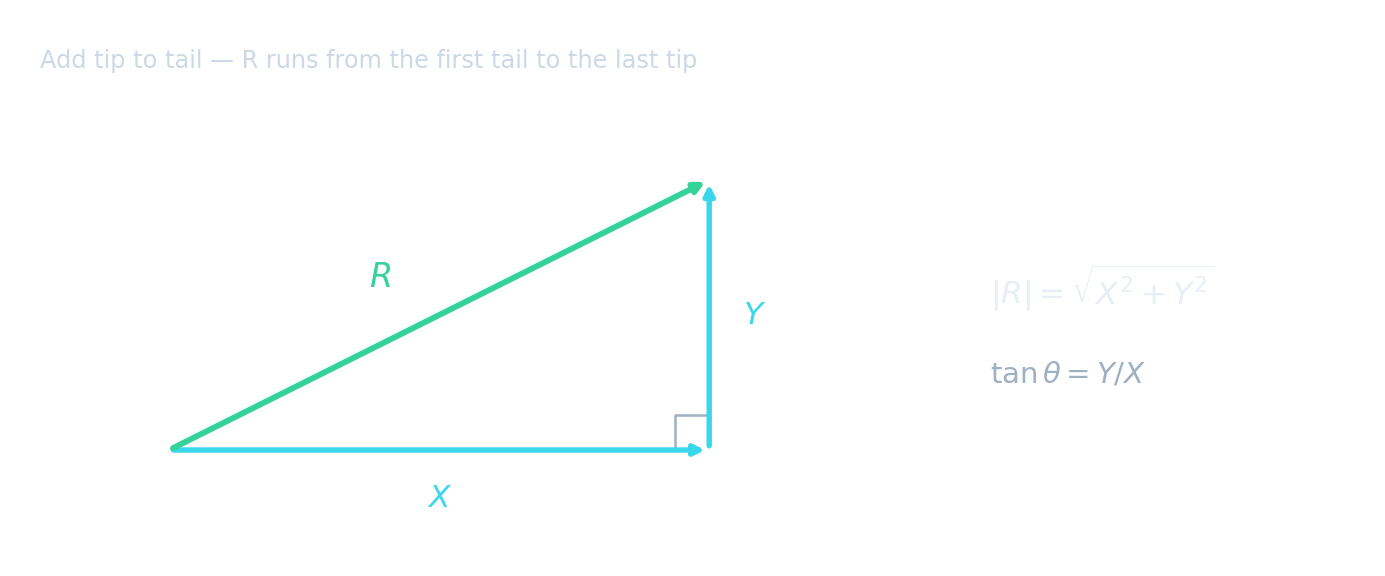
A force of $3.0\ \text{N}$ acts east and $4.0\ \text{N}$ acts north. What is the size of the resultant, in N? · Uma força de $3.0\ \text{N}$ age para leste e $4.0\ \text{N}$ age para norte. Qual é a magnitude do resultante, em N?
They are at right angles, so use Pythagoras: $R = \sqrt{3.0^2 + 4.0^2} = \sqrt{25} = 5.0\ \text{N}$. · Eles estão em ângulo reto, então use Pitágoras: $R = \sqrt{3.0^2 + 4.0^2} = \sqrt{25} = 5.0\ \text{N}$.
You've got it
- read a scale with your eye level with the mark; read a liquid at the meniscus
- for tiny amounts, measure many and divide
- scalar = size only; vector = size and direction
- two vectors at $90°$ → resultant $R = \sqrt{a^2 + b^2}$
Entendeu?
- leia uma escala com o seu nível dos olhos alinhado com a marca; leia um líquido no menisco
- para quantidades pequenas, meça muitos e divida
- escalar = magnitude apenas; vetor = magnitude e direção
- dois vetores em $90°$ → resultante $R = \sqrt{a^2 + b^2}$