Graphs of functions and sketching curves · Gráficos de funções e esboço de curvas
| English | Português |
|---|---|
| function/ˈfʌŋkʃn/ | função |
| parabola/pəˈræbələ/ | parábola |
| reciprocal/rɪˈsɪprəkl/ | recíproco |
| roots/ruːts/ | raízes |
| intersection/ˌɪntəˈsekʃn/ | interseção |
| asymptotes/ˈæsɪmptəʊts/ | assíntotas |
| turning point/ˈtɜːnɪŋ pɔɪnt/ | ponto de inversão |
The shape of a function 函数
- Every function has a signature shape, like a fingerprint. A linear function is a straight line; a quadratic is a parabola 抛物线; a reciprocal 倒数 has two branches that never touch the axes.
- Recognising the shape lets you sketch a graph in seconds — without plotting dozens of points.
A forma de uma função
- Toda função tem um formato característico, como uma impressão digital. Uma função linear é uma linha reta; uma quadrática é uma parábola; uma recíproca tem dois ramos que nunca tocam os eixos.
- Reconhecer a forma permite esboçar um gráfico em segundos — sem plotar dezenas de pontos.
Plotting and reading graphs
- Make a table of values: pick $x$-values, calculate $y$-values, plot the coordinates, join with a smooth curve.
- Roots 根 are where the graph crosses the $x$-axis (the solutions of $y = 0$).
- The intersection 交集 of two graphs solves the two equations simultaneously.
A suspension bridge cable hangs in a parabola, a quadratic curve
Plotando e lendo gráficos
- Faça uma tabela de valores: escolha valores de $x$, calcule valores de $y$, plote as coordenadas, una com uma curva suave.
- As raízes são onde o gráfico cruza o eixo $x$ (as soluções de $y = 0$).
- A intersecção de dois gráficos resolve as duas equações simultaneamente.

O cabo de uma ponte suspensa pende em uma parábola, uma curva quadrática
Sketching curves · Esboçando curvas
y = ax³ + bx² + cx + d
Sketch a curve from its turning points and where it crosses the axes. · Esboce uma curva a partir de seus pontos de virada e onde ela corta os eixos.
The roots of a graph are where it: · As raízes de um gráfico são onde ele:
Roots are the x-values where y = 0 — where the curve meets the x-axis. · Raízes são os valores de x onde y = 0 — onde a curva encontra o eixo x.
Three families of curves
Three families every mathematician should recognise: line, parabola, reciprocal.
| Function | Shape | Key features |
|---|---|---|
| $y = mx + c$ | straight line | gradient $m$, intercept $c$ |
| $y = ax^2 + bx + c$ | parabola | U if $a > 0$, ∩ if $a < 0$ |
| $y = \dfrac{a}{x}$ | reciprocal | two branches, asymptotes 渐近线 at axes |
Parabola direction. $y = x^2 - 4$ opens upward (U-shape) because the coefficient of $x^2$ is positive. $y = -x^2 + 4$ opens downward (∩-shape).
Três famílias de curvas
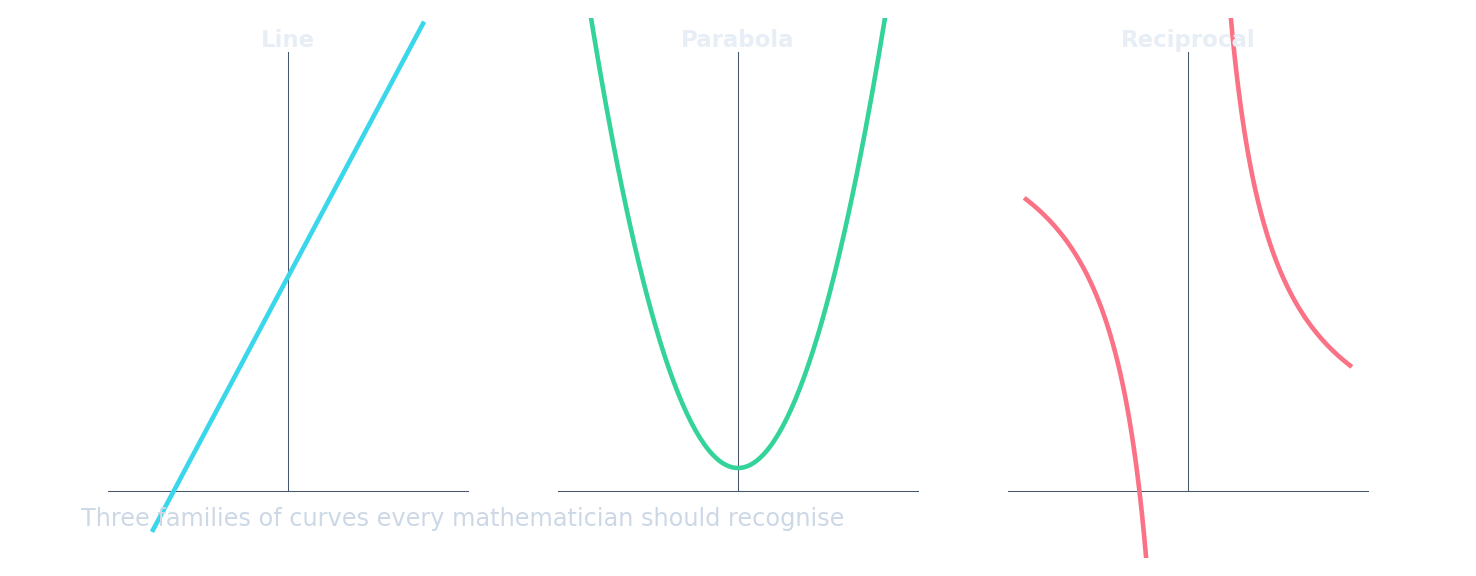
Três famílias que todo matemático deve reconhecer: linha, parábola, recíproca.
| Função | Forma | Características principais |
|---|---|---|
| $y = mx + c$ | linha reta | gradiente $m$, intercepto $c$ |
| $y = ax^2 + bx + c$ | parábola | U se $a > 0$, ∩ se $a < 0$ |
| $y = \dfrac{a}{x}$ | recíproca | dois ramos, assíntotas nos eixos |
Direção da parábola. $y = x^2 - 4$ abre para cima (formato U) porque o coeficiente de $x^2$ é positivo. $y = -x^2 + 4$ abre para baixo (formato ∩).
The graph of y = ax² + bx + c (with a > 0) is a: · O gráfico de y = ax² + bx + c (com a > 0) é um:
A positive a gives a U-shaped parabola; a negative a gives an ∩ shape. · Um a positivo dá uma parábola em forma de U; um a negativo dá uma forma ∩.
The graph of y = −x² + 4 opens upward. · O gráfico de y = −x² + 4 abre para cima.
The coefficient of x² is negative (−1), so the parabola opens downward (∩-shape). · O coeficiente de x² é negativo (−1), então a parábola abre para baixo (forma ∩).
The graph of y = a/x has two branches that never touch the axes. These lines are called ______. · O gráfico de y = a/x tem dois ramos que nunca tocam os eixos. Essas linhas são chamadas de ______.
Asymptotes are lines the curve approaches but never touches. For y = a/x, the axes are asymptotes. · Assíntotas são linhas que a curva se aproxima mas nunca toca. Para y = a/x, os eixos são assíntotas.
Turning points 转折点 (Extended)
- A parabola has one turning point (vertex) — its minimum or maximum.
- Completing the square reveals it directly:
- $y = (x + p)^2 + q$ has its turning point at $(-p,\; q)$.
- Example: $y = (x + 3)^2 - 8$ → turning point $(-3, -8)$.
Signs flip. In $(x + 3)^2 - 8$, the turning point is $(-3, -8)$ — the $x$-coordinate has the opposite sign to what's inside the bracket.
Completing the square, $y=(x+3)^2-8$, shows the turning point $(-3,-8)$ and the line of symmetry $x=-3$
The five basic graph shapes; knowing each shape lets you sketch quickly from the equation
Pontos de virada (Aprofundado)
- Uma parábola tem um único ponto de virada (vértice) — seu mínimo ou máximo.
- Completar quadrados o revela diretamente:
- $y = (x + p)^2 + q$ tem seu ponto de virada em $(-p,\; q)$.
- Exemplo: $y = (x + 3)^2 - 8$ → ponto de virada $(-3, -8)$.
Sinais invertidos. Em $(x + 3)^2 - 8$, o ponto de virada é $(-3, -8)$ — a coordenada $x$ tem o sinal oposto ao que está dentro dos colchetes.
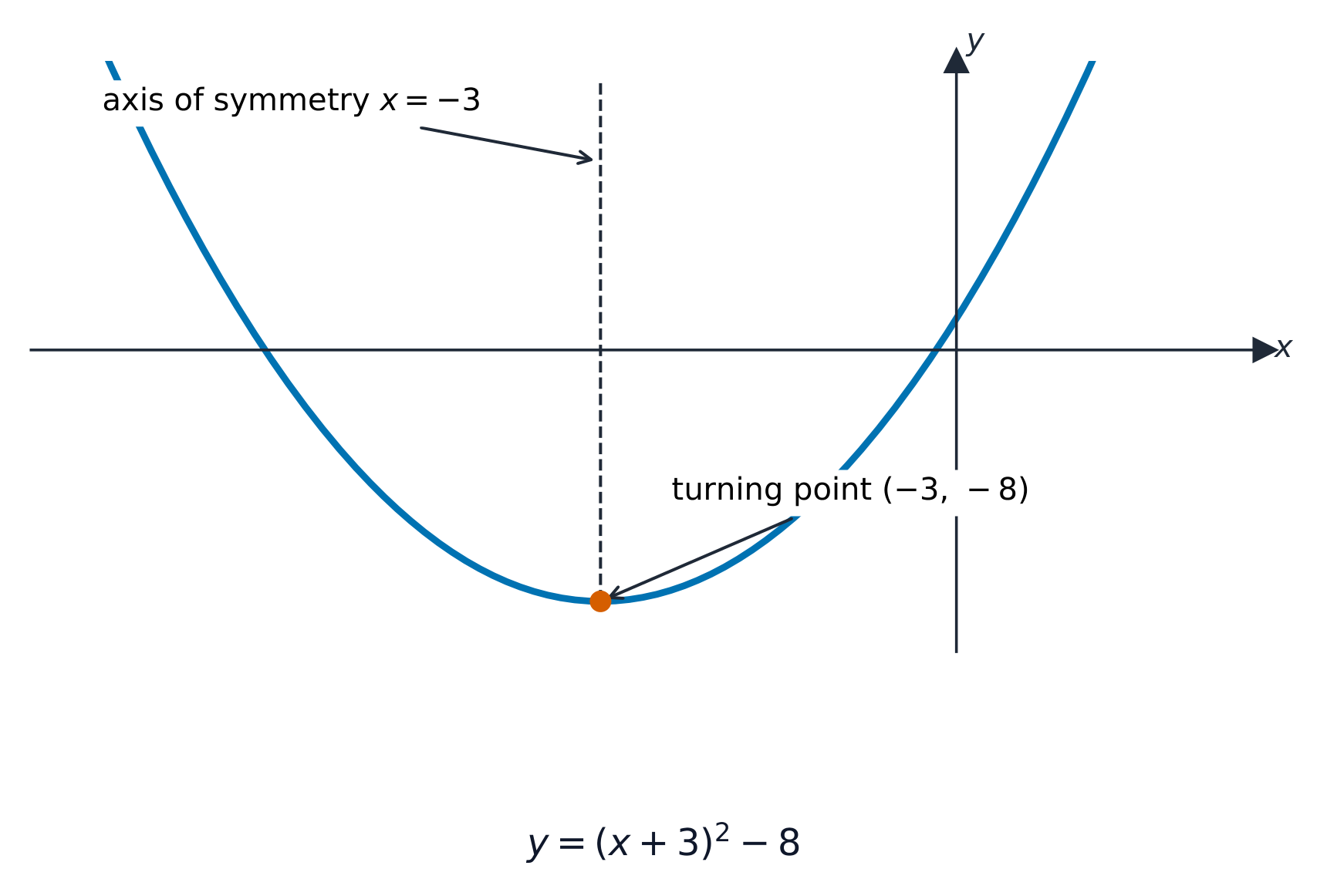
Completando quadrados, $y=(x+3)^2-8$ mostra o ponto de virada $(-3,-8)$ e a linha de simetria $x=-3$
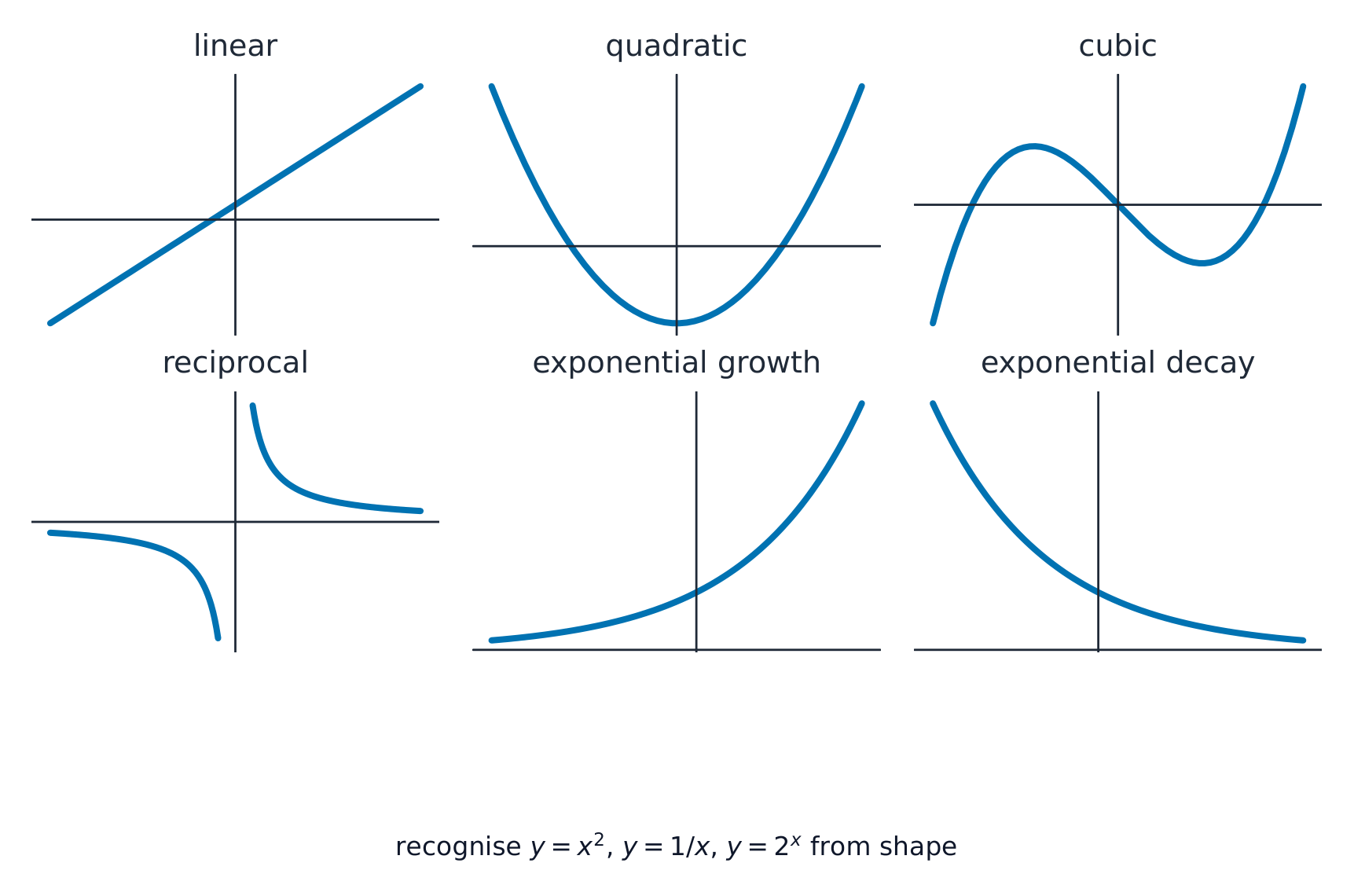
As cinco formas básicas de gráficos; conhecer cada forma permite esboçar rapidamente a partir da equação
The curve y = (x + 3)² − 8 has its turning point at (−3, q). What is q? · A curva y = (x + 3)² − 8 tem seu ponto de virada em (−3, q). Qual é q?
Completed-square form (x+p)² + q has turning point (−p, q), so q = −8. · Forma completada ao quadrado (x+p)² + q tem ponto de virada (−p, q), então q = −8.
Using graphs to solve equations
- Where a line and a curve intersect, both equations are satisfied.
- Solving $x^2 - 4 = 2x + 1$ graphically: plot $y = x^2 - 4$ and $y = 2x + 1$, read off the intersection $x$-values.
Usando gráficos para resolver equações
- Onde uma linha e uma curva se intersectam, ambas as equações são satisfeitas.
- Resolver $x^2 - 4 = 2x + 1$ graficamente: plotar $y = x^2 - 4$ e $y = 2x + 1$, ler os valores de interseção $x$.
The line y = x + 2 intersects the curve y = x² at two points. One has x = 2. What is the other x-value? · A reta y = x + 2 intersecta a curva y = x² em dois pontos. Um deles tem x = 2. Qual é o outro valor de x?
x² = x + 2 → x² − x − 2 = 0 → (x−2)(x+1) = 0 → x = 2 or x = −1. · x² = x + 2 → x² − x − 2 = 0 → (x−2)(x+1) = 0 → x = 2 ou x = −1.
Solve a graph question completely
- For $y=x^2-2$, calculate $y=2,-1,-2,-1,2$ at $x=-2,-1,0,1,2$ and plot a smooth symmetric curve. Draw $y=2$ with a ruler; crossings give solutions $x=-2,2$ to $x^2-2=2$.
- For $y=6/x$, use positive and negative inputs, but never $x=0$. Points $(2,3),(3,2),(-2,-3),(-3,-2)$ lie on separate branches. Core quadratic sketches require roots and symmetry, not turning-point coordinates.
Resolva uma questão de gráfico completamente
- Para $y=x^2-2$, calcule $y=2,-1,-2,-1,2$ em $x=-2,-1,0,1,2$ e trace uma curva suave simétrica. Desenhe $y=2$ com régua; os cruzamentos fornecem as soluções $x=-2,2$ para $x^2-2=2$.
- Para $y=6/x$, use entradas positivas e negativas, mas nunca $x=0$. Os pontos $(2,3),(3,2),(-2,-3),(-3,-2)$ ficam em ramos separados. Esboços quadráticos essenciais exigem raízes e simetria, não coordenadas dos pontos de virada.

What is the positive solution read where y = x² − 2 meets y = 2? · Qual é a solução positiva onde y = x² − 2 encontra y = 2?
The crossing on the right is (2,2), so x = 2. · A interseção à direita é (2,2), logo x = 2.
Extended cubic and exponential graphs
- For $y=x^3-1$, the integer table at $x=-2,-1,0,1,2$ is $-9,-2,-1,0,7$. Draw a smooth increasing S-shape; the root is 1 and the $y$-intercept is $-1$.
- For $y=2^x+1$, the table at $x=-1,0,1,2,3$ is $1.5,2,3,5,9$. The curve approaches horizontal asymptote $y=1$ to the left and rises to the right; it does not touch the asymptote.
Gráficos cúbicos e exponenciais aprofundados
- Para $y=x^3-1$, a tabela inteira em $x=-2,-1,0,1,2$ é $-9,-2,-1,0,7$. Desenhe uma curva suave crescente em forma de S; a raiz é 1 e a intersecção no eixo $y$ é $-1$.
- Para $y=2^x+1$, a tabela em $x=-1,0,1,2,3$ é $1.5,2,3,5,9$. A curva aproxima-se da assíntota horizontal $y=1$ à esquerda e sobe à direita; ela não toca a assíntota.
For y = 2ˣ + 1, find y at x = 3. · Para y = 2ˣ + 1, encontre y quando x = 3.
2³ + 1 = 9.
Shifted reciprocals and fractional powers (Extended)
- $y=2/x+3$ has vertical asymptote $x=0$ and horizontal asymptote $y=3$. Shift both branches of $2/x$ up 3; do not join them across zero.
- For $y=\sqrt{x}$ use $x\ge0$ and points $(0,0),(1,1),(4,2),(9,3)$. For $y=1/\sqrt{x}$ use $x>0$ and points $(1,1),(4,1/2),(9,1/3)$. For $y=1/x^2$, positive and negative inputs give positive outputs, with symmetry about the $y$-axis.
Recíprocas transladadas e potências fracionárias (Aprofundado)
- $y=2/x+3$ tem assíntota vertical $x=0$ e assíntota horizontal $y=3$. Transladar ambos os ramos de $2/x$ para cima 3; não uni-los através do zero.
- Para $y=\sqrt{x}$ use $x\ge0$ e pontos $(0,0),(1,1),(4,2),(9,3)$. Para $y=1/\sqrt{x}$ use $x>0$ e pontos $(1,1),(4,1/2),(9,1/3)$. Para $y=1/x^2$, entradas positivas e negativas produzem saídas positivas, com simetria em relação ao eixo $y$.
For y = 2/x + 3, give the value of y at the horizontal asymptote. · Para y = 2/x + 3, forneça o valor de y na assíntota horizontal.
The 2/x term tends to 0 as |x| grows, so the horizontal asymptote is y = 3. · O termo 2/x tende a 0 quando |x| cresce, logo a assíntota horizontal é y = 3.
You've got it
- roots $=$ where the curve crosses the $x$-axis; intersection solves two equations
- a quadratic is a parabola (U if $a > 0$, ∩ if $a < 0$)
- the turning point of $(x+p)^2 + q$ is $(-p,\; q)$
- reciprocal curves have asymptotes they never touch
Entendeu?
- raízes $=$ onde a curva cruza o eixo $x$; interseção resolve duas equações
- uma parábola é um paraboloide (U se $a > 0$, ∩ se $a < 0$)
- o ponto de virada de $(x+p)^2 + q$ é $(-p,\; q)$
- curvas recíprocas têm assíntotas que nunca tocam