Equations · Equações
| English | Português |
|---|---|
| linear equations/ˈlɪnɪə ɪˈkweɪʒnz/ | equações lineares |
| simultaneous equations/ˌsɪməlˈteɪnɪəs ɪˈkweɪʒnz/ | equações simultâneas |
| eliminate/ɪˈlɪmɪneɪt/ | eliminar |
| quadratic/kwɒˈdrætɪk/ | quadrática |
| subject/ˈsʌbdʒekt/ | assunto |
The ancient art of balancing
- The word "equation" comes from "equal" — both sides must be the same, like a balance scale.
- Babylonians solved linear equations 一次方程 4000 years ago using clay tablets. Today we use the same principle: do the same to both sides.
A antiga arte do equilíbrio
- A palavra "equação" vem de "igual" — ambos os lados devem ser iguais, como uma balança.
- Babilônios resolveram equações lineares há 4000 anos usando tábuas de argila. Hoje usamos o mesmo princípio: faça o mesmo em ambos os lados.
Linear equations
- Solve by doing the same operation to both sides until the unknown is alone.
- $3x + 7 = 22 \Rightarrow 3x = 15 \Rightarrow x = 5$.
Watch the signs. $-2x + 5 = 11 \Rightarrow -2x = 6 \Rightarrow x = -3$. Dividing by a negative flips the sign of the answer.
Solve by doing the same to both sides
Equações lineares
- Resolva fazendo a mesma operação nos dois lados até que o desconhecido fique sozinho.
- $3x + 7 = 22 \Rightarrow 3x = 15 \Rightarrow x = 5$.
Cuidado com os sinais. $-2x + 5 = 11 \Rightarrow -2x = 6 \Rightarrow x = -3$. Dividir por um negativo inverte o sinal da resposta.

Resolva fazendo o mesmo nos dois lados
Solving an equation · Resolvendo uma equação
y = ax² + bx + c
Solving means finding the roots · raízes — where the curve crosses the x-axis.
Solve 3x + 7 = 22.
3x = 22 − 7 = 15, so x = 5.
Simultaneous equations 联立方程
- Two equations, two unknowns. Eliminate 消元 one variable by adding or subtracting.
- $2x + y = 7$ and $3x - y = 8$: adding gives $5x = 15$, so $x = 3$, then $y = 1$.
Check your answer. Substitute back: $2(3) + 1 = 7$ ✓ and $3(3) - 1 = 8$ ✓.
Equações simultâneas
- Duas equações, duas incógnitas. Elimine uma variável somando ou subtraindo.
- $2x + y = 7$ e $3x - y = 8$: somando resulta $5x = 15$, logo $x = 3$, então $y = 1$.
Verifique sua resposta. Substitua de volta: $2(3) + 1 = 7$ ✓ e $3(3) - 1 = 8$ ✓.
Solve 2x + y = 7 and 3x − y = 8. What is x?
Adding the equations: 5x = 15, so x = 3 (then y = 1).
From 2x + y = 7 and 3x − y = 8, what is y?
x = 3 from adding. Substituting: 2(3) + y = 7 → y = 1.
Quadratic 二次 equations (Extended)
- A quadratic $ax^2 + bx + c = 0$ can have two, one, or zero real solutions.
- By factorising: $x^2 + 5x + 6 = 0 \Rightarrow (x+2)(x+3) = 0 \Rightarrow x = -2$ or $x = -3$.
- By the formula: $x = \dfrac{-b \pm \sqrt{b^2 - 4ac}}{2a}$ (given in the exam).
The roots of a quadratic are where the parabola crosses the $x$-axis — the solutions of $y = 0$.
Equações quadráticas (Ampliado)
- Uma quadrática $ax^2 + bx + c = 0$ pode ter duas, uma ou zero soluções reais.
- Por fatoração: $x^2 + 5x + 6 = 0 \Rightarrow (x+2)(x+3) = 0 \Rightarrow x = -2$ ou $x = -3$.
- Pela fórmula: $x = \dfrac{-b \pm \sqrt{b^2 - 4ac}}{2a}$ (fornecida na prova).
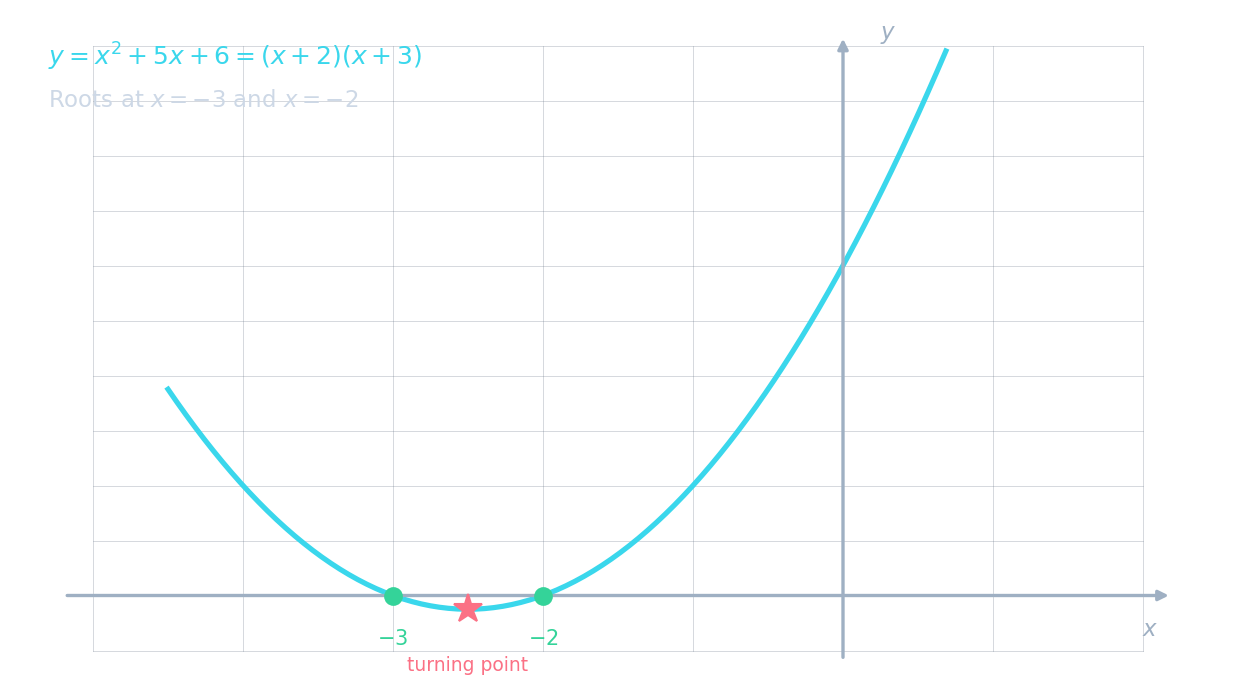
As raízes de uma quadrática são onde a parábola cruza o eixo $x$ — as soluções de $y = 0$.
Solve x² + 5x + 6 = 0 by factorising.
(x + 2)(x + 3) = 0, so x = −2 or x = −3.
The quadratic formula is x = (−b ± √(b² − 4ac)) / (2a).
This formula solves any quadratic ax² + bx + c = 0.
Powers in rearranging formulae (Extended)
- Make a letter the subject 主项 by reversing the operations applied to it.
- Make $r$ the subject of $V = \dfrac{4}{3}\pi r^3$: $\;r^3 = \dfrac{3V}{4\pi}$, so $r = \sqrt[3]{\dfrac{3V}{4\pi}}$.
Potências ao rearranjar fórmulas (Ampliado)
- Torne uma letra o assunto invertendo as operações aplicadas a ela.
- Torne $r$ o assunto de $V = \dfrac{4}{3}\pi r^3$: $\;r^3 = \dfrac{3V}{4\pi}$, logo $r = \sqrt[3]{\dfrac{3V}{4\pi}}$.
Make r the subject of V = (4/3)πr³. r = ∛(____).
Multiply by 3/(4π): r³ = 3V/(4π), then take the cube root.
Build an equation, then choose a method
- A ticket problem gives $2a+c=31$ and $a+2c=26$. Double the second and subtract the first: $3c=21$, so $c=7$, then $a=12$. Check both original totals.
- Core rearrangement: $C=5t+8$ gives $C-8=5t$, then $t=(C-8)/5$. The subject appears once and has no power or root.
Construa uma equação e, em seguida, escolha um método
- Um problema de ingressos fornece $2a+c=31$ e $a+2c=26$. Duplique o segundo e subtraia o primeiro: $3c=21$, logo $c=7$, depois $a=12$. Verifique ambos os totais originais.
- Rearranjo básico: $C=5t+8$ resulta em $C-8=5t$, depois $t=(C-8)/5$. O assunto aparece uma vez e não tem potência nem raiz.
For 2a + c = 31 and a + 2c = 26, find a.
Eliminate a: 3c = 21, c = 7. Then 2a = 24, a = 12.
Completing the square and the formula (Extended)
- $x^2+6x+5=0$ becomes $(x+3)^2-4=0$, so $x+3=\pm2$, giving $x=-1,-5$.
- For $2x^2+x-3=0$, choose $a=2,b=1,c=-3$ in $x=(-b\pm\sqrt{b^2-4ac})/(2a)$. Thus $x=(-1\pm5)/4=1,-1.5$. Substitution checks each root.
Completando o quadrado e a fórmula (Ampliado)
- $x^2+6x+5=0$ torna-se $(x+3)^2-4=0$, logo $x+3=\pm2$, resultando em $x=-1,-5$.
- Para $2x^2+x-3=0$, escolha $a=2,b=1,c=-3$ em $x=(-b\pm\sqrt{b^2-4ac})/(2a)$. Assim $x=(-1\pm5)/4=1,-1.5$. A substituição verifica cada raiz.
Find the positive root of 2x² + x − 3 = 0.
The formula gives (−1+5)/4 = 1; the other root is −1.5.
Fractional equations (Extended)
- For $x/(x+2)=3/5$, exclude $x=-2$. Multiply by $5(x+2)$: $5x=3(x+2)$, so $2x=6$ and $x=3$. Check $3/5=3/5$.
- For $2/(x+1)+1/(x-1)=1$, exclude $x=-1,1$. Multiply through by $(x+1)(x-1)$: $2(x-1)+(x+1)=x^2-1$. This gives $x^2-3x=0$, so $x=0$ or 3; both are allowed.
Equações fracionárias (Ampliado)
- Para $x/(x+2)=3/5$, exclua $x=-2$. Multiplique por $5(x+2)$: $5x=3(x+2)$, logo $2x=6$ e $x=3$. Verifique $3/5=3/5$.
- Para $2/(x+1)+1/(x-1)=1$, exclua $x=-1,1$. Multiplique toda a expressão por $(x+1)(x-1)$: $2(x-1)+(x+1)=x^2-1$. Isso resulta em $x^2-3x=0$, logo $x=0$ ou 3; ambos são permitidos.
Solve x/(x+2) = 3/5.
5x = 3x+6, so x = 3, which is not the excluded value −2.
One line and one curve (Extended)
- Solve $y=x+2$ and $y=x^2$ by substituting: $x^2=x+2$, so $(x-2)(x+1)=0$. Thus $x=2$ or $-1$.
- Find the matching $y$ for each: the pairs are $(2,4)$ and $(-1,1)$. Do not mix one root with the other root's $y$ value.
Uma linha e uma curva (Ampliado)
- Resolva $y=x+2$ e $y=x^2$ por substituição: $x^2=x+2$, logo $(x-2)(x+1)=0$. Portanto $x=2$ ou $-1$.
- Encontre o $y$ correspondente para cada par: os pares são $(2,4)$ e $(-1,1)$. Não misture uma raiz com o valor de $y$ da outra raiz.
Solve y = x+2 and y = x². Give the positive x solution.
x²−x−2 = (x−2)(x+1), so the positive solution is 2.
A subject appearing twice (Extended)
- Rearrange $y=(3x+2)/(x-1)$ for $x$: $y(x-1)=3x+2$, then $yx-3x=y+2$.
- Factor the subject: $x(y-3)=y+2$, giving $x=(y+2)/(y-3)$, $y\ne3$. The original also requires $x\ne1$.
Um assunto que aparece duas vezes (Ampliado)
- Rearranje $y=(3x+2)/(x-1)$ para $x$: $y(x-1)=3x+2$, então $yx-3x=y+2$.
- Fatore o assunto: $x(y-3)=y+2$, resultando em $x=(y+2)/(y-3)$, $y\ne3$. A original também exige $x\ne1$.
You've got it
- linear: same operation to both sides; simultaneous: add/subtract to eliminate
- quadratics: factorise, complete the square, or use the formula
- rearrange: undo the operations in reverse order to make a letter the subject
Entendeu?
- linear: mesma operação para ambos os lados; simultâneo: some/subtraia para eliminar
- quadráticas: fatore, complete o quadrado ou use a fórmula
- rearranje: desfaz as operações em ordem inversa para tornar uma letra o assunto