Simple molecules and covalent bonds
Introduzido| English | Significado |
|---|---|
| covalent bond/ˈkəʊvələnt bɒnd/ | ligação covalente |
| molecules/ˈmɒlɪkjuːlz/ | moléculas |
| simple molecular/ˈsɪmpl məˈlekjʊlə/ | molecular simples |
Sharing, not giving
- Two non-metals can't both grab electrons — so instead they share them.
- Shared pairs of electrons form covalent bonds 共价键, holding atoms together in molecules 分子.
A covalent bond is:
Dificuldade 1/5 · Moedas 100 + pequeno bônus na primeira conclusão hoje
Covalent bonding shares electrons.
In a covalent bond, atoms ______ a pair of electrons.
Dificuldade 1/5 · Moedas 100 + pequeno bônus na primeira conclusão hoje
Sharing lets both atoms fill their outer shells.
Covalent bonds
- A covalent bond is a shared pair of electrons between two atoms.
- Sharing lets both atoms reach a full outer shell.
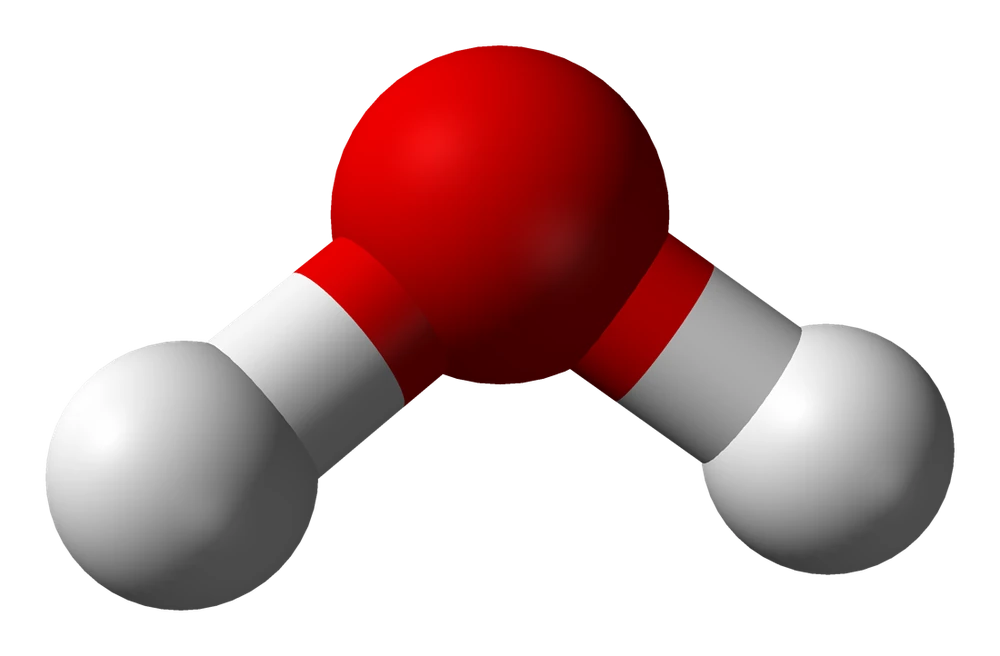
A model of a water molecule: atoms share electrons in covalent bonds
Ligação covalente (compartilhamento)
Step through it: two non-metal atoms overlap and share a pair of electrons — counting for both — so each reaches a full outer shell. That shared pair is the covalent bond; O₂ shares two pairs (a double bond).
Which is a simple molecule?
Dificuldade 1/5 · Moedas 100 + pequeno bônus na primeira conclusão hoje
CO₂ is a small covalent molecule.
Match each idea about simple molecules.
Dificuldade 2/5 · Moedas 140 + pequeno bônus na primeira conclusão hoje
Strong covalent bonds hold atoms inside a molecule, but only weak forces act between molecules.
Simple molecules
- Simple molecular 简单分子 substances are small molecules (e.g. H₂O, CO₂, O₂).
- The bonds inside each molecule are strong, but the forces between molecules are weak.
Why a molecule has its shape
Shared electron pairs repel one another and spread out as far apart as they can. Four bonding pairs and no lone pairs gives a tetrahedral shape, like methane (CH4).
Simple molecular substances have low melting points because:
Dificuldade 1/5 · Moedas 100 + pequeno bônus na primeira conclusão hoje
Only the weak intermolecular forces need breaking.
Simple molecular substances do not conduct electricity because they have:
Dificuldade 1/5 · Moedas 100 + pequeno bônus na primeira conclusão hoje
No charged particles are free to move.
Their properties
- Low melting and boiling points — only the weak forces between molecules need breaking.
- They don't conduct electricity (no free electrons or ions).
It's the weak forces between molecules that melt easily — not the bonds. The covalent bonds inside a molecule are strong; melting only separates the molecules, breaking the weak forces between them. That's why simple molecules melt at low temperatures.
Worked example: ammonia, NH₃
Show how the atoms in ammonia, $\text{NH}_3$, reach full outer shells.
- Nitrogen has 5 outer electrons and needs 3 more; each hydrogen has 1 and needs 1 more. So N shares one pair with each of the 3 H atoms: 3 covalent bonds.
- Nitrogen now has 8 outer electrons: 3 shared pairs and 1 lone pair that is not shared. Each H has 2, a full first shell. Ammonia is a simple molecule, so it is a gas at room temperature.
Carbon has 4 outer electrons. How many shared pairs (covalent bonds) are in a methane molecule, $\text{CH}_4$?
Dificuldade 2/5 · Moedas 140 + pequeno bônus na primeira conclusão hoje
Carbon needs 4 more electrons, so it shares one pair with each of the 4 hydrogen atoms.
Oxygen has 6 outer electrons. In water, $\text{H}_2\text{O}$, how many lone pairs does oxygen have?
Dificuldade 1/5 · Moedas 100 + pequeno bônus na primeira conclusão hoje
O uses 2 electrons in its 2 bonds and keeps 4 unshared electrons: 2 lone pairs.
You've got it
- a covalent bond is a shared pair of electrons (lets atoms fill their outer shells)
- simple molecules have strong internal bonds but weak forces between molecules
- so they have low melting points and don't conduct electricity
Write from the data given
- An oxygen molecule has a double bond between the two oxygen atoms.
- Each shared pair is one covalent bond.
How many shared pairs are in that double bond?
Each covalent bond is one shared pair.
How many electron pairs are shared in an oxygen double bond?
Dificuldade 1/5 · Moedas 100 + pequeno bônus na primeira conclusão hoje
A double bond is two shared pairs.