Fornecimento de alimentos
Introduzido| English | Significado |
|---|---|
| food supply/fuːd səˈplaɪ/ | fornecimento de alimentos |
| fertilisers/ˈfɜːtəlaɪzəz/ | fertilizantes |
| pesticides/ˈpestɪsaɪdz/ | pesticidas |
| herbicides/ˈhɜːbɪsaɪdz/ | herbicidas |
| intensive farming/ɪnˈtensɪv ˈfɑːmɪŋ/ | agricultura intensiva |
Feeding a growing world
- The human population keeps growing, and all those people need food.
- Increasing food supply 食物供应 uses science — but it has costs as well as benefits.
Food supply pressure lab
Follow how demand, farming and waste affect food supply.
Fertilisers increase crop yields by:
Dificuldade 1/5 · Moedas 100 + pequeno bônus na primeira conclusão hoje
Fertilisers supply nutrients like nitrates.
Which increase food supply? (Select all that apply.)
Dificuldade 2/5 · Moedas 140 + pequeno bônus na primeira conclusão hoje
Removing nutrients would reduce yields.
Ways to increase food supply
- Fertilisers 化肥 add nutrients; machinery works land faster; pesticides 农药 kill pests.
- Selective breeding and glasshouses raise yields further.
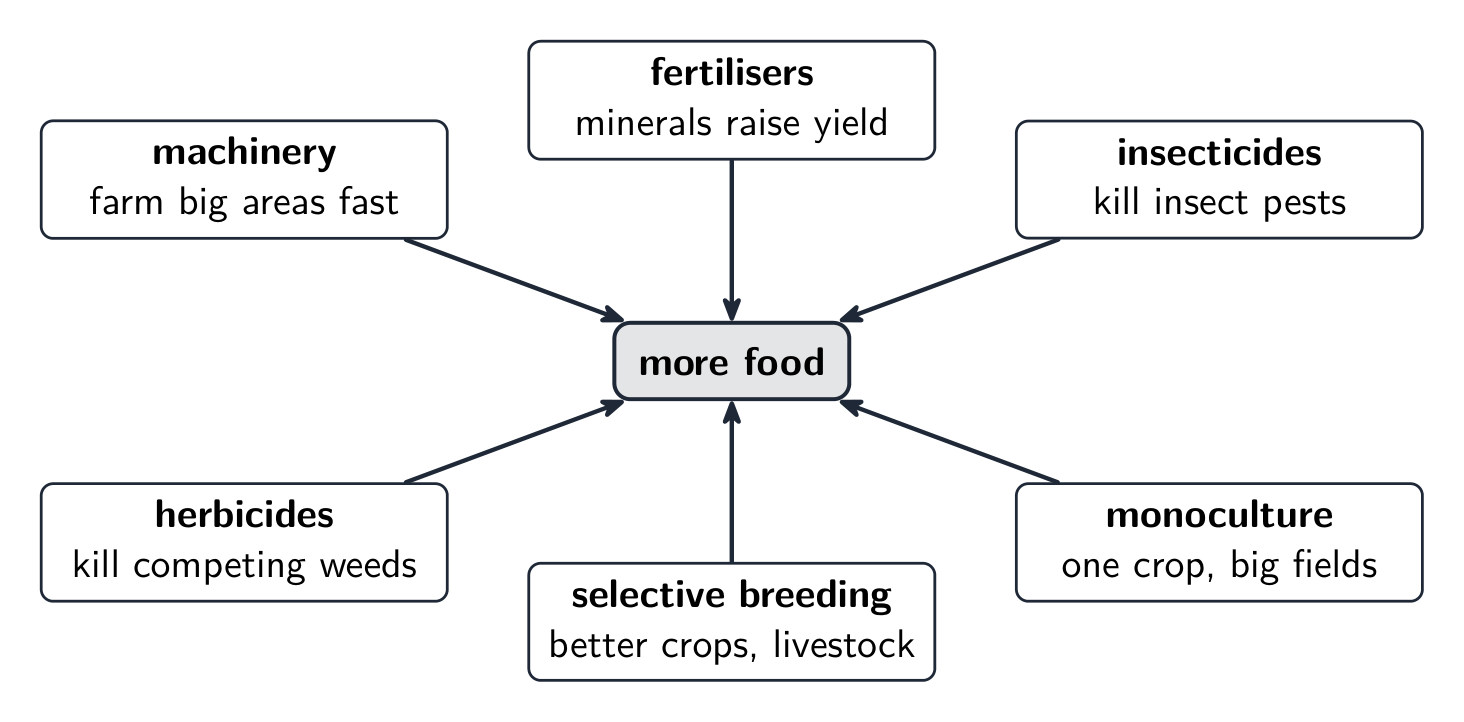
Ways farmers increase food production
A drawback of pesticides is that they can:
Dificuldade 1/5 · Moedas 100 + pequeno bônus na primeira conclusão hoje
Pesticides can damage non-target species.
Chemicals that kill weeds competing with crops are called ______.
Dificuldade 1/5 · Moedas 100 + pequeno bônus na primeira conclusão hoje
Herbicides remove competing weeds.
Pesticides and their problems
- Pesticides protect crops but can harm helpful insects and build up in food chains.
- Herbicides 除草剂 kill weeds that compete with crops.
Overusing fertilisers can pollute rivers.
Dificuldade 1/5 · Moedas 100 + pequeno bônus na primeira conclusão hoje
Fertiliser run-off causes eutrophication.
Intensive farming 集约农业: pros and cons
- Pros: much more food per area, lower prices.
- Cons: pollution from fertilisers, loss of habitats, and animal-welfare concerns.
More food can mean more pollution. Fertilisers boost yields but, washed into rivers, cause eutrophication. Higher food supply must be balanced against environmental harm.
Worked example: one pesticide, two sides
A farmer sprays an insecticide on a wheat field. Give one benefit, and explain how birds of prey far from the field could be harmed.
- Benefit: fewer insect pests eat the crop, so the yield per hectare rises and more food is produced on the same land.
- Harm: some insecticides are not broken down. Small insects take in a little; birds eat many insects; birds of prey eat many birds. The poison builds up along the food chain (bioaccumulation) to a harmful level. It can also kill useful insects, such as bees that pollinate crops.
Growing one crop over a huge area (a monoculture) is risky because:
Dificuldade 1/5 · Moedas 100 + pequeno bônus na primeira conclusão hoje
Identical plants close together give a pest or disease easy spread; biodiversity also falls.
Using ladybirds to eat aphids is an example of biological control instead of a chemical pesticide.
Dificuldade 1/5 · Moedas 100 + pequeno bônus na primeira conclusão hoje
A natural predator reduces the pest without spraying chemicals.
You've got it
- food supply is raised by fertilisers, machinery, pesticides, selective breeding, glasshouses
- pesticides protect crops but can harm helpful species and build up in food chains
- intensive farming gives more food but causes pollution and habitat loss
Write from a pesticide spray
- A farmer sprays a crop to kill insect pests.
- The same farm uses fertiliser to grow more food.
What problem can the pesticide cause, and what is one benefit of the fertiliser?
More food can come with harm to other organisms.
Which is a problem with pesticides?
Dificuldade 1/5 · Moedas 100 + pequeno bônus na primeira conclusão hoje
Helpful insects and food chains can be hit as well.