Mitose
Introduzido| English | Significado |
|---|---|
| gametes/ˈɡæmiːts/ | gâmetas |
| meiosis/meɪˈəʊsɪs/ | meiose |
| variation/ˌveərɪˈeɪʃn/ | variação |
Making gametes 配子
- Gametes must carry only half the chromosomes, so that fertilisation restores the full set.
- The special division that does this is meiosis 减数分裂.
Meiosis produces how many cells from one parent cell?
Dificuldade 1/5 · Moedas 100 + pequeno bônus na primeira conclusão hoje
Meiosis makes four gametes.
Each cell made by meiosis has:
Dificuldade 1/5 · Moedas 100 + pequeno bônus na primeira conclusão hoje
Gametes carry half the chromosomes.
Meiosis produces the sex cells, also called ______.
Dificuldade 1/5 · Moedas 100 + pequeno bônus na primeira conclusão hoje
Gametes have half the chromosome number.
What meiosis is
- Meiosis produces four cells, each with half the chromosome number.
- These cells are the gametes (sperm and eggs).
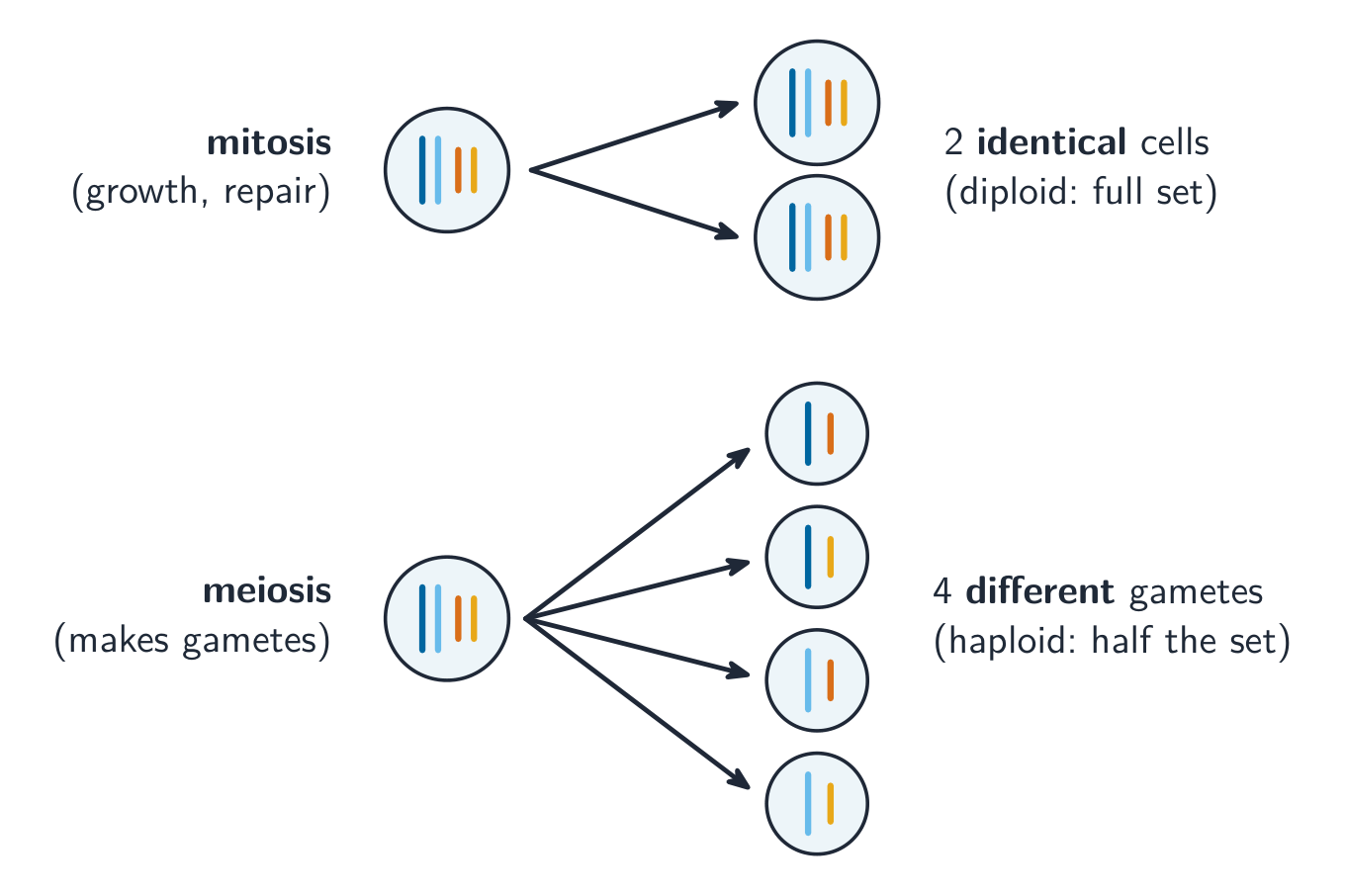
Meiosis makes four genetically different gametes, each with half the chromosomes
Mitose
Meiosis makes gametes — four cells, each with HALF the chromosomes and all different.
Meiosis is important because it:
Dificuldade 1/5 · Moedas 100 + pequeno bônus na primeira conclusão hoje
Meiosis mixes genes, producing variation.
It creates variation 变异
- Meiosis mixes the genes, so each gamete is genetically different.
- This is a major source of variation in sexual reproduction.
Halving the chromosome number stops it doubling each generation.
Dificuldade 1/5 · Moedas 100 + pequeno bônus na primeira conclusão hoje
Fertilisation then restores the full number.
Mitosis vs meiosis
- Mitosis: 2 identical cells, full chromosome number — growth/repair.
- Meiosis: 4 varied cells, half the number — making gametes.
Meiosis halves the chromosome number; mitosis keeps it the same. This halving is essential — without it, the chromosome number would double every generation at fertilisation.
Worked example: count the chromosomes
Human body cells have 46 chromosomes (23 pairs). How many are in a sperm cell, and in a fertilised egg? Why does it matter?
- Meiosis halves the number, so a sperm (or egg) has $46 \div 2 = 23$: one from each pair. These cells are haploid.
- At fertilisation, 23 + 23 = 46, the full diploid number again. If gametes were made by mitosis, the number would double every generation (92, 184, …), so halving is essential.
A dog's body cells have 78 chromosomes. How many chromosomes are in a dog's egg cell?
Dificuldade 2/5 · Moedas 140 + pequeno bônus na primeira conclusão hoje
Meiosis halves the diploid number: $78 \div 2 = 39$.
Which type of cell division repairs a cut in the skin?
Dificuldade 1/5 · Moedas 100 + pequeno bônus na primeira conclusão hoje
Growth and repair need genetically identical diploid cells, made by mitosis.
You've got it
- meiosis makes four cells, each with half the chromosome number — the gametes
- it mixes genes, creating variation
- mitosis = 2 identical (full number); meiosis = 4 varied (half number)
Write from four gametes
- A cell in the ovary divides to make sex cells.
- Four new cells are produced.
Which division is this, and how does the chromosome number compare with the parent cell?
Halving lets fertilisation restore the full set.
How many cells does meiosis make, and what is special about their chromosomes?
Dificuldade 1/5 · Moedas 100 + pequeno bônus na primeira conclusão hoje
Meiosis makes four varied gametes.