Synapses
Introduzido| English | Significado |
|---|---|
| synapse/ˈsɪnæps/ | sinapse |
| neurotransmitter/ˈnjuːrətrænsmɪtə/ | neurotransmissor |
An experiment from a dream, 1921
- On the night before Easter Sunday 1921, the pharmacologist Otto Loewi dreamed of an experiment. He stimulated the nerve to a frog's heart, which slowed it, then moved the liquid around that heart onto a second heart. The second heart slowed too. A chemical — later shown to be acetylcholine — had carried the message.
- Nerve cells pass messages to each other across a synapse 突触 using a chemical neurotransmitter 神经递质.
Loewi's experiment showed that a chemical carries nerve signals to the heart.
Dificuldade 1/5 · Moedas 100 + pequeno bônus na primeira conclusão hoje
The second heart slowed too.
The gap between neurones
- A synapse is a junction between two neurones, with a tiny gap between them.
- An electrical impulse cannot jump the gap; a chemical carries the signal across.
Across the synapse
Neurons don't touch — the impulse crosses the tiny gap using a chemical messenger.
What is a synapse?
Dificuldade 1/5 · Moedas 100 + pequeno bônus na primeira conclusão hoje
A chemical crosses the gap.
What happens at a synapse
-
- An impulse arrives at the end of the first neurone, and vesicles release neurotransmitter into the gap.
-
- The neurotransmitter diffuses across and binds to receptor proteins on the next neurone, which starts a new impulse.
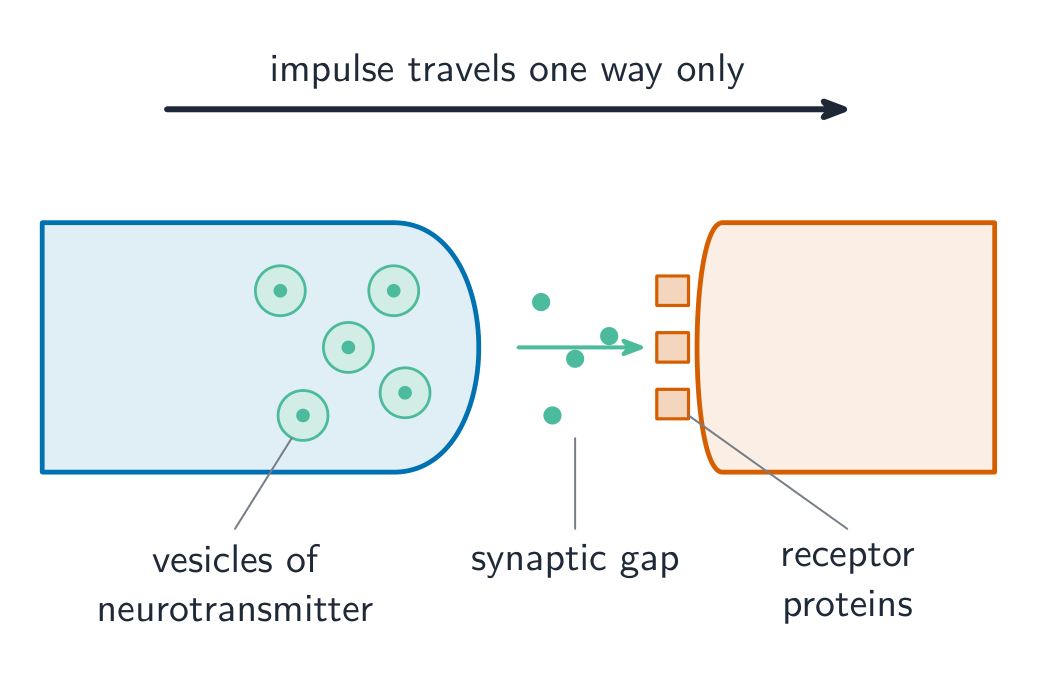
Order the events at a synapse.
Dificuldade 3/5 · Moedas 200 + pequeno bônus na primeira conclusão hoje
Electrical, chemical, electrical.
One-way traffic
- Only the first neurone has vesicles of neurotransmitter, and only the second has receptors, so impulses cross in one direction only.
- The neurotransmitter is then removed from the gap, so the signal stops.
Why do impulses cross synapses in one direction only?
Dificuldade 1/5 · Moedas 100 + pequeno bônus na primeira conclusão hoje
Vesicles on one side, receptors on the other.
Worked example: a reflex arc
You touch a hot plate and pull your hand away.
- Receptor in the skin → sensory neurone → synapse → relay neurone in the spinal cord → synapse → motor neurone → effector (arm muscle contracts).
- Synapses: two in this arc; each carries the signal one way.
- Speed: the brain is not needed to start the reflex, so it is fast.
Order a reflex arc.
Dificuldade 3/5 · Moedas 200 + pequeno bônus na primeira conclusão hoje
Stimulus to response.
Drugs act at synapses
- Many drugs work by changing synapses: some block receptors, some copy the neurotransmitter, and some stop it being removed.
- Heroin, for example, affects synapses in the brain, which is one reason it is so addictive.
Some drugs work by blocking receptors at synapses.
Dificuldade 1/5 · Moedas 100 + pequeno bônus na primeira conclusão hoje
Others copy neurotransmitters.
The electrical impulse does not cross the gap. It stops at the end of the first neurone; a chemical crosses, and a new impulse starts in the next neurone.
The electrical impulse jumps directly across the synaptic gap.
Dificuldade 1/5 · Moedas 100 + pequeno bônus na primeira conclusão hoje
A chemical crosses.
At a synapse, an impulse makes vesicles release neurotransmitter, which diffuses across the gap and binds to receptors on the next neurone, starting a new impulse. Synapses make impulses travel one way and are where many drugs act.
Describe how a signal passes from a sensory neurone to a relay neurone.
The synapse sequence.