Breathing and gas exchange · Respiração ventilatória e troca gasosa
| English | Português |
|---|---|
| ventilation/ˌventɪˈleɪʃn/ | ventilação |
| diaphragm/ˈdaɪəfræm/ | diafragma |
| inhaled/ɪnˈheɪld/ | inspirado |
| exhaled/eksˈheɪld/ | expirado |
Breathing in and out
- To keep the gradient steep at the alveoli, fresh air must be pumped in and stale air out.
- This is ventilation 通气 (breathing), powered by muscles.
Inspirar e expirar
- Para manter o gradiente íngreme nos alvéolos, ar fresco deve ser bombeado para dentro e ar viciado para fora.
- Isso é ventilação 通气 (respiração), acionado por músculos.
When you breathe in, the diaphragm: · Quando você inala, o diafragma:
The diaphragm flattens to increase chest volume. · O diafragma achatou para aumentar o volume torácico.
Air rushes into the lungs when the pressure inside the chest: · O ar entra rapidamente nos pulmões quando a pressão interna do tórax:
Lower internal pressure draws air in. · Menor pressão interna atrai o ar para dentro.
During inhaling, the rib muscles lift the ribs up and out. · Durante a inspiração, os músculos das costelas levantam as costelas para cima e para fora.
This expands the chest, lowering pressure. · Isso expande o tórax, diminuindo a pressão.
The movement of air in and out of the lungs is called ______ (breathing). · O movimento do ar para dentro e para fora dos pulmões é chamado ______ (respiração ventilatória).
Ventilation keeps the gas-exchange gradient steep. · A ventilação mantém o gradiente de troca gasosa íngreme.
Breathing in (inhaling)
- The diaphragm 膈肌 flattens and the rib muscles lift the ribs up and out.
- This increases the chest volume, lowering the pressure, so air rushes in.
The lungs are the gas-exchange organs of the body
Inspirar (inspiração)
- O diafragma 膈肌 aplaina e os músculos intercostais elevam as costelas para cima e para fora.
- Isso aumenta o volume torácico, diminuindo a pressão, então o ar entra rapidamente.
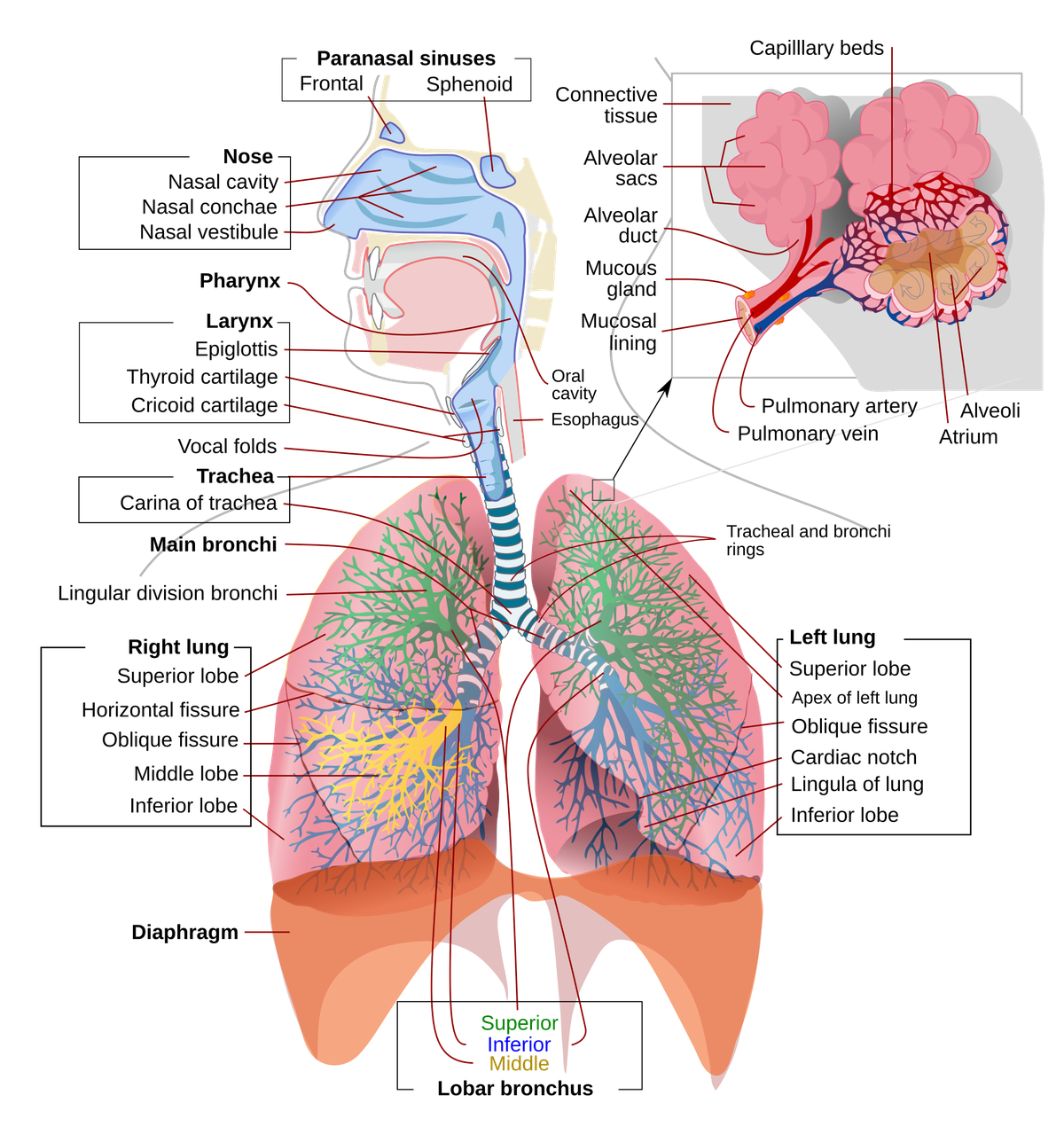
Os pulmões são os órgãos de troca gasosa do corpo
Breathing in and out · Inalar e exalar
Breathing changes the volume of the chest, which changes the pressure and makes air flow in or out. · A respiração ventilatória muda o volume do tórax, o que muda a pressão e faz o ar fluir para dentro ou para fora.
Compared with inhaled air, exhaled air has: · Comparado com o ar inalado, o ar exalado tem:
Oxygen is used and carbon dioxide added. · O oxigênio é consumido e o dióxido de carbono adicionado.
Breathing out (exhaling)
- The diaphragm relaxes (domes up) and the ribs drop.
- Chest volume decreases, pressure rises, and air is pushed out.
Air travels from the trachea through the bronchi and bronchioles to the alveoli
Expirar (expiração)
- O diafragma relaxa (forma cúpula) e as costelas descem.
- O volume torácico diminui, a pressão aumenta e o ar é empurrado para fora.

O ar viaja da traquéia através dos brônquios e bronquíolos até os alvéolos
Breathing mechanism · Mecanismo da respiração ventilatória
Watch a breath — the diaphragm flattens and ribs lift, the chest grows, the pressure drops, and air flows in. Relax and it pushes back out. · Observe uma respiração — o diafragma achatou e as costelas levantaram, o tórax cresceu, a pressão caiu e o ar entrou. Relaxar e ele volta a sair.
Inhaled 吸入的 vs exhaled 呼出的 air
- Inhaled air has more oxygen and less carbon dioxide.
- Exhaled air has less oxygen, more carbon dioxide, and more water vapour.
Worked example. When you breathe in, the diaphragm contracts and flattens, the chest expands, pressure inside falls below the outside, and air flows in — exactly like pulling out a syringe plunger draws air in.
Breathing in makes the thorax bigger; breathing out makes it smaller
Ar inspirado 吸入的 vs exalado 呼出的
- Ar inspirado tem mais oxigênio e menos dióxido de carbono.
- Ar exalado tem menos oxigênio, mais dióxido de carbono e mais vapor d'água.
Exemplo resolvido. Ao inspirar, o diafragma contrai e aplaina, o tórax expande, a pressão interna cai abaixo da externa e o ar flui para dentro — exatamente como puxar o êmbolo de uma seringa atrai ar.

Inspirar torna o tórax maior; expirar torna-o menor
You've got it
- inhaling: diaphragm flattens, ribs rise → chest volume up, pressure down → air in
- exhaling: diaphragm relaxes, ribs drop → chest volume down, pressure up → air out
- exhaled air has less oxygen and more carbon dioxide than inhaled air
Entendeu?
- inspirando: diafragma aplaina, costelas sobem → volume torácico aumenta, pressão diminui → ar entra
- expirando: diafragma relaxa, costelas descem → volume torácico diminui, pressão aumenta → ar sai
- ar exalado tem menos oxigênio e mais dióxido de carbono do que ar inspirado