Sangue
Introduzido| English | Significado |
|---|---|
| red blood cells/red blʌd selz/ | Glóbulos vermelhos |
| plasma/ˈplæzmə/ | Plasma |
| white blood cells/waɪt blʌd selz/ | Glóbulos brancos |
| platelets/ˈpleɪtlɪts/ | Plaquetas |
| haemoglobin/ˌhiːməˈɡləʊbɪn/ | hemoglobina |
| biconcave/baɪˈkɒŋkeɪv/ | Biconcavo |
| clot/klɒt/ | a plug of fibrin threads and trapped cells that stops bleeding |
Little red globules, 1674
- In 1674 the Dutch cloth merchant Antonie van Leeuwenhoek looked at his own blood through a home-made microscope with a single tiny lens. He described it as made of "small red globules" floating in a clear liquid. He was seeing red blood cells.
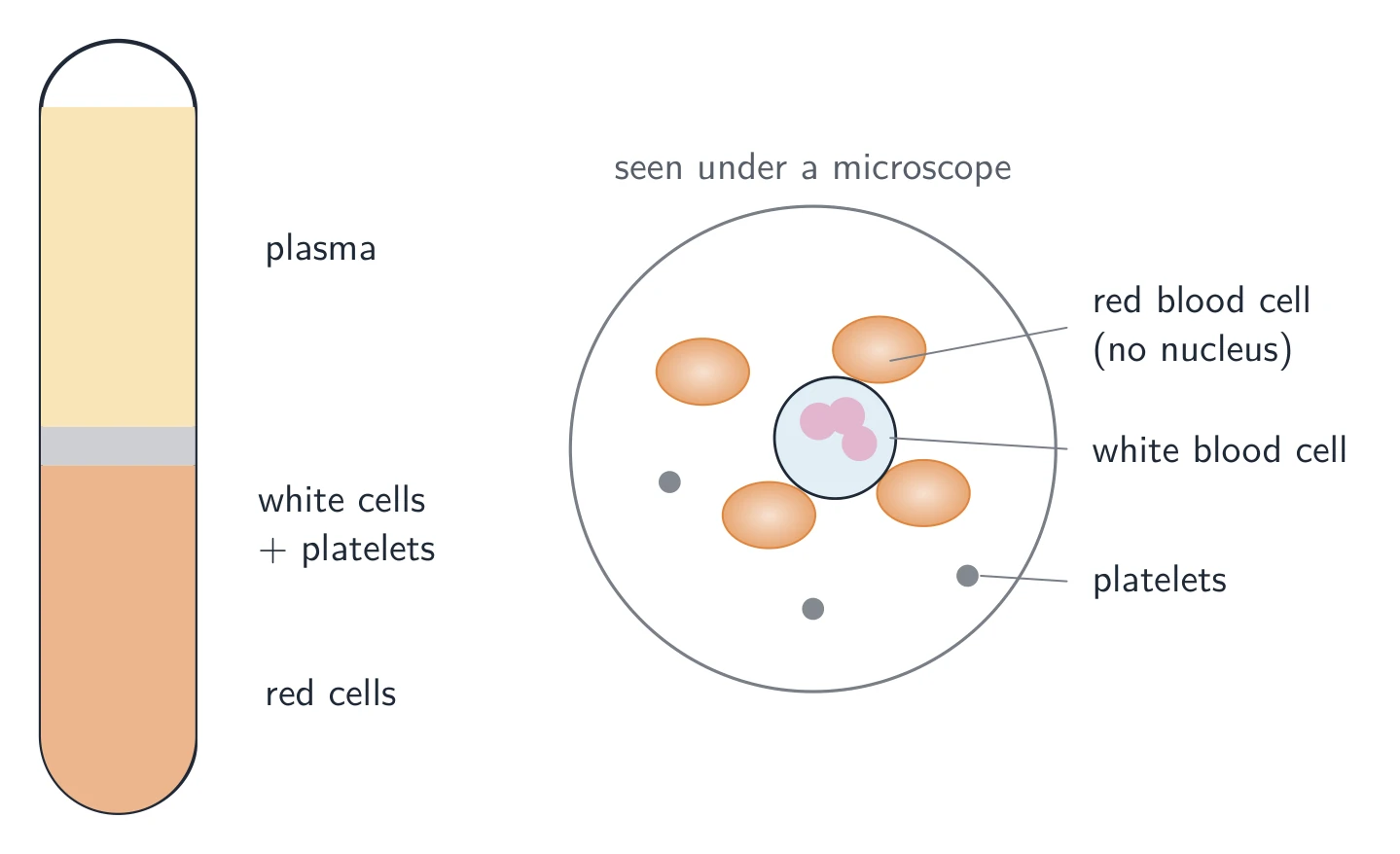
- Blood is plasma 血浆 carrying red blood cells 红细胞, white blood cells 白细胞 and platelets 血小板.
Blood component lab
Classify blood components by the job they do.
What were Leeuwenhoek's "small red globules"?
Dificuldade 1/5 · Moedas 100 + pequeno bônus na primeira conclusão hoje
Seen through his single-lens microscope.
Plasma
- Plasma is mostly water. It carries dissolved glucose, amino acids, carbon dioxide, urea, hormones, salts and heat around the body.
- It makes up just over half of the blood's volume.
Which does plasma carry?
Dificuldade 2/5 · Moedas 140 + pequeno bônus na primeira conclusão hoje
Haemoglobin is inside red cells.
Red blood cells carry oxygen
- Red cells contain haemoglobin 血红蛋白, which joins with oxygen in the lungs and releases it in the tissues.
- They are biconcave 双凹的 discs — a large surface area for diffusion — and have no nucleus, leaving more room for haemoglobin.
Why are red blood cells biconcave?
Dificuldade 1/5 · Moedas 100 + pequeno bônus na primeira conclusão hoje
Faster oxygen uptake and release.
Red blood cells have no nucleus, so there is more room for haemoglobin.
Dificuldade 1/5 · Moedas 100 + pequeno bônus na primeira conclusão hoje
Their main job is carrying oxygen.
White blood cells defend
- Phagocytes engulf and digest pathogens. Lymphocytes make antibodies.
- Phagocytes have a lobed nucleus; lymphocytes have a large round nucleus filling most of the cell.
Match each white cell to its job.
Dificuldade 2/5 · Moedas 140 + pequeno bônus na primeira conclusão hoje
Two kinds of defence.
Worked example: identify cells on a slide
A stained blood smear shows three cell types.
- Many small pale discs with no nucleus: red blood cells.
- A larger cell with a lobed nucleus: a phagocyte.
- A cell with a large round nucleus and little cytoplasm: a lymphocyte. Tiny fragments between them are platelets.
A cell has a large round nucleus filling most of it. What is it?
Dificuldade 1/5 · Moedas 100 + pequeno bônus na primeira conclusão hoje
Little cytoplasm.
Platelets and clotting
- Platelets are cell fragments. At a cut they help soluble fibrinogen change to insoluble fibrin threads, which trap red cells to form a clot 血凝块.
- The clot stops blood loss and keeps pathogens out while the skin heals.
What do fibrin threads do in a clot?
Dificuldade 1/5 · Moedas 100 + pequeno bônus na primeira conclusão hoje
Forming a plug.
Red blood cells do not "carry oxygen in their nucleus". They have no nucleus; the oxygen is carried by haemoglobin in the cytoplasm.
Plasma carries dissolved substances and heat. Red cells (biconcave, no nucleus, haemoglobin) carry oxygen; phagocytes engulf and lymphocytes make antibodies; platelets help form fibrin clots.
Explain how the structure of a red blood cell suits its function, giving three features.
Structure and function.