Chemical digestion
Introduzido| English | Significado |
|---|---|
| amylase/ˈæmɪleɪz/ | amilase |
| chemical digestion/ˈkemɪkl daɪˈdʒestʃn/ | digestão química |
| carbohydrases/ˌkɑːbəʊˈhaɪdreɪzɪz/ | enzymes that break carbohydrates into simple sugars |
| proteases/ˈprəʊteɪsɪz/ | proteases |
| lipases/ˈlɪpeɪsɪz/ | lipases |
| neutralises/ˈnjuːtrəlaɪzɪz/ | neutraliza |
The first enzyme, 1833
- In 1833 two French chemists, Anselme Payen and Jean-François Persoz, made an extract from germinating barley that quickly turned starch into sugar. They called the substance diastase — from the Greek for "separation". It was the first enzyme to be isolated; we now call it amylase 淀粉酶.
- Chemical digestion 化学消化 uses enzymes to break large, insoluble molecules into small, soluble ones that can be absorbed.
What is diastase now called?
Dificuldade 1/5 · Moedas 100 + pequeno bônus na primeira conclusão hoje
It digests starch.
Three groups of enzymes
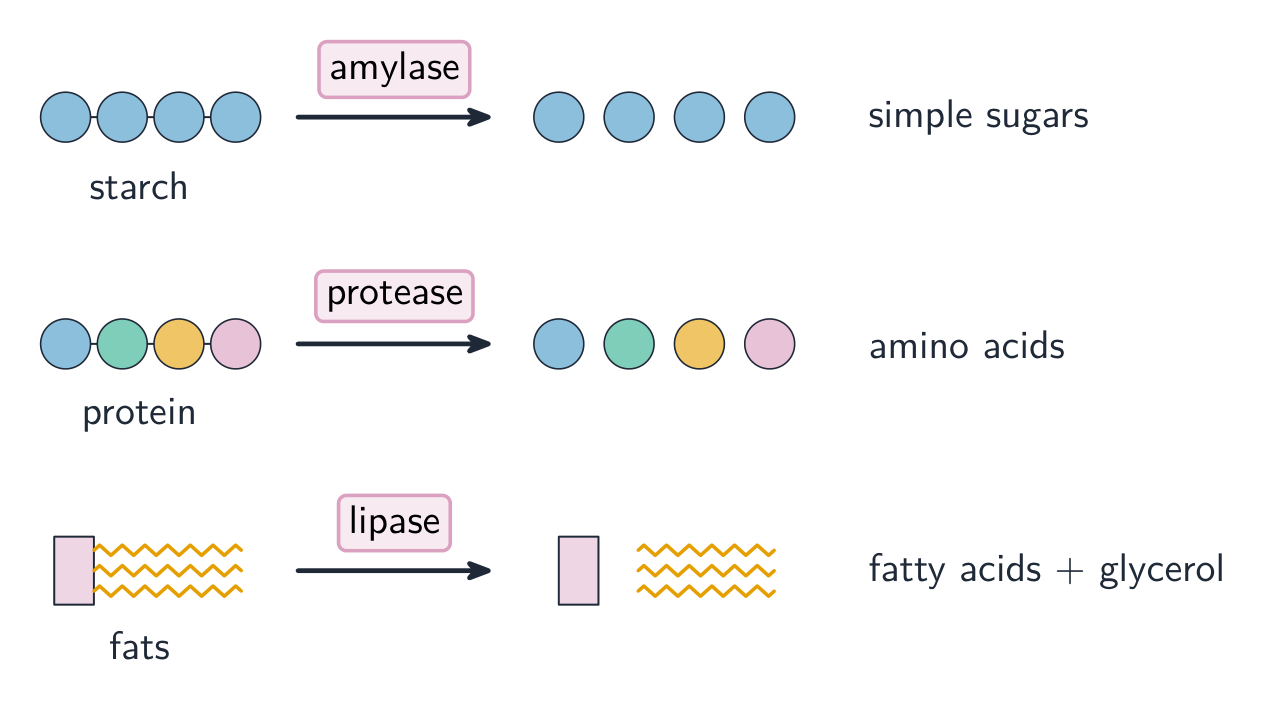
- Carbohydrases 糖酶 break carbohydrates into simple sugars: amylase breaks starch into maltose; maltase breaks maltose into glucose.
- Proteases 蛋白酶 break proteins into amino acids; lipases 脂肪酶 break fats and oils into fatty acids and glycerol.
How fast a digestive enzyme works
Add more substrate and the reaction rate climbs, then levels off as every enzyme is busy — the same way amylase, protease and lipase break down food.
Match each enzyme group to its products.
Dificuldade 2/5 · Moedas 140 + pequeno bônus na primeira conclusão hoje
Small, soluble molecules.
Where each enzyme works
- Amylase: made in the salivary glands and the pancreas; works in the mouth and duodenum.
- Protease (pepsin) works in the stomach; trypsin from the pancreas works in the duodenum. Lipase: made in the pancreas; works in the duodenum.
Where does pepsin work?
Dificuldade 1/5 · Moedas 100 + pequeno bônus na primeira conclusão hoje
At acid pH.
Acid and bile
- The stomach makes hydrochloric acid, which kills bacteria in food and gives the acid pH pepsin needs.
- Bile from the liver neutralises 中和 the stomach acid in the duodenum, giving the alkaline pH that pancreatic enzymes need, and emulsifies fats into small droplets with a larger surface area for lipase.
What does bile do?
Dificuldade 2/5 · Moedas 140 + pequeno bônus na primeira conclusão hoje
It is not an enzyme.
Stomach acid kills bacteria in food.
Dificuldade 1/5 · Moedas 100 + pequeno bônus na primeira conclusão hoje
It also suits pepsin.
Worked example: follow a protein
An egg-white protein is eaten.
- Stomach: pepsin, at pH about 2, starts breaking the protein into shorter chains.
- Duodenum: bile neutralises the acid; trypsin from the pancreas continues the breakdown.
- Ileum: the last enzymes on the villi finish the job; amino acids are absorbed into the blood.
Order the places a protein is digested and absorbed.
Dificuldade 3/5 · Moedas 200 + pequeno bônus na primeira conclusão hoje
Down the canal.
Testing digestion in the lab
- Starch + amylase at 37 °C: iodine solution changes from blue-black to orange-brown as starch disappears; Benedict's test turns from blue to brick-red when heated, showing sugar.
- Boiled amylase gives no change — it is denatured.
What colour is iodine solution when starch has all been digested?
Dificuldade 1/5 · Moedas 100 + pequeno bônus na primeira conclusão hoje
No starch left.
Bile is not an enzyme. It does not break bonds; it neutralises acid and emulsifies fat, which helps lipase work faster.
Carbohydrases (amylase, maltase) make sugars; proteases (pepsin, trypsin) make amino acids; lipases make fatty acids and glycerol. Stomach acid suits pepsin and kills bacteria; bile neutralises acid and emulsifies fats.
Explain why emulsifying fat helps digestion, even though bile is not an enzyme.
Emulsification.