Magnification
Introduzido| English | Significado |
|---|---|
| microscope/ˈmaɪkrəskəʊp/ | microscópio |
| magnification/ˌmæɡnɪfɪˈkeɪʃn/ | aumento |
| micrometres/ˈmaɪkrəʊmiːtəz/ | micrômetros |
| scale bar/skeɪl bɑː/ | barra de escala |
Seeing the invisible
- Cells are far too small to see with the naked eye — we need a microscope 显微镜.
- And to describe what we see, we need to work out the magnification 放大倍数.
Magnification lab
magnification = image size / actual size
Change actual size and see how image size links to magnification.
Magnification is calculated as:
Dificuldade 1/5 · Moedas 100 + pequeno bônus na primeira conclusão hoje
Magnification = image ÷ actual.
An image is 40 mm across and the real object is 0.5 mm. What is the magnification?
Dificuldade 2/5 · Moedas 140 + pequeno bônus na primeira conclusão hoje
40 ÷ 0.5 = ×80.
Magnification is measured in millimetres.
Dificuldade 1/5 · Moedas 100 + pequeno bônus na primeira conclusão hoje
False. Magnification is image size ÷ actual size, a ratio of two lengths, so the units cancel and it has no units.
The magnification formula
- Magnification = image size ÷ actual size.
- Rearranged: actual size = image size ÷ magnification.
Worked example. A cell's image is 30 mm across. The real cell is 0.06 mm. Magnification = 30 ÷ 0.06 = ×500.
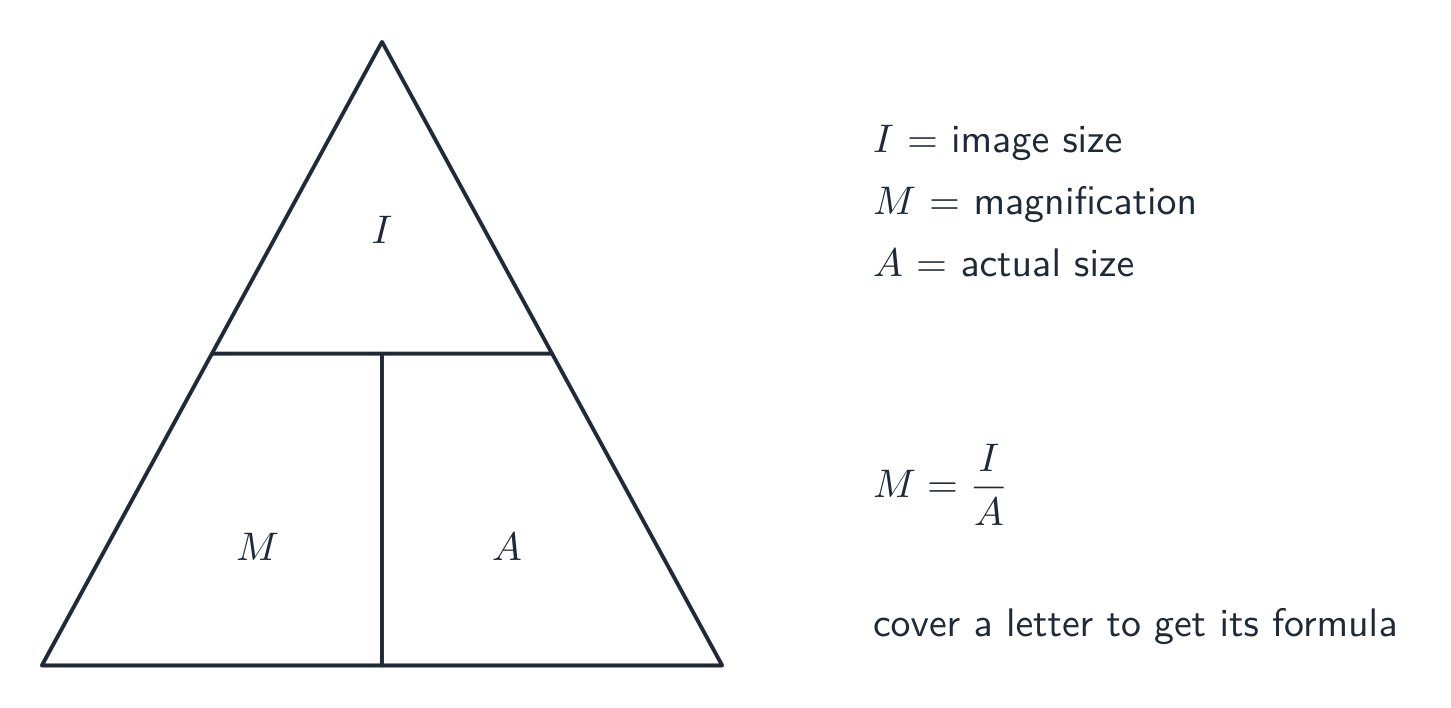
Cover the quantity you want in the triangle to get its formula
An image is 60 mm and the magnification is ×300. What is the actual size (mm)?
Dificuldade 2/5 · Moedas 140 + pequeno bônus na primeira conclusão hoje
Actual = 60 ÷ 300 = 0.2 mm.
How many micrometres (µm) are in 1 millimetre (mm)?
Dificuldade 1/5 · Moedas 100 + pequeno bônus na primeira conclusão hoje
1 mm = 1000 µm.
Units and conversions
- Cells are measured in micrometres 微米 (µm): 1 mm = 1000 µm.
- Always convert both sizes to the same unit before dividing.
Scale bars 比例尺
- A scale bar on an image shows how big a real length is.
- Measure the bar, compare to the value it represents, and you can find the magnification or real sizes.
Keep the units the same. A common mistake is dividing millimetres by micrometres. Convert both to the same unit first, or your magnification will be 1000 times wrong.
Worked example: using a scale bar
On a micrograph, the scale bar is 15 mm long and labelled 5 µm. A cell in the same image is 36 mm long. Find the magnification and the cell's real length.
- Magnification from the bar: change 15 mm to 15 000 µm, then 15 000 ÷ 5 = ×3000.
- Real length: change 36 mm to 36 000 µm, then 36 000 ÷ 3000 = 12 µm. Check: a 12 µm cell is a sensible size for an animal cell.
A scale bar is 20 mm long and labelled 10 µm. What is the magnification?
Dificuldade 2/5 · Moedas 140 + pequeno bônus na primeira conclusão hoje
20 mm = 20 000 µm, and 20 000 ÷ 10 = ×2000.
In the same image (×2000), a nucleus is 12 mm across. What is its real width, in µm?
Dificuldade 2/5 · Moedas 140 + pequeno bônus na primeira conclusão hoje
12 mm = 12 000 µm, and 12 000 ÷ 2000 = 6 µm.
You've got it
- magnification = image size ÷ actual size (no units — it's a ratio)
- rearrange to find actual size = image ÷ magnification
- convert both sizes to the same unit first (1 mm = 1000 µm)
Write from the data: find the actual size
- A drawing of a cell is 20 mm across.
- The magnification is 400.
What is the actual width of the cell in micrometres?
Actual size is image size divided by magnification.
The image is 20 mm at a magnification of 400. What is the actual width?
Dificuldade 1/5 · Moedas 100 + pequeno bônus na primeira conclusão hoje
20 divided by 400 is 0.05 mm, or 50 micrometres.