Digestion, transport and health evidence
Introduzido| English | Significado |
|---|---|
| digestion/daɪˈdʒestʃn/ | digestão |
| absorption/əbˈsɔːpʃn/ | absorção |
What would explain this observation?
- Two foods can have the same mass but provide different nutrients. A health claim must distinguish the nutrient measured from the health outcome inferred.
Build the model
- Large insoluble food molecules are digested into smaller soluble molecules.
- Carbohydrases form sugars, proteases form amino acids, and lipases form fatty acids and glycerol.
- Bile emulsifies lipids and helps neutralize acidic stomach contents.
- digestion 消化: Breakdown of large food molecules.
- absorption 吸收: Movement of soluble products into the body.

Which statement about bile is correct?
Dificuldade 1/5 · Moedas 100 + pequeno bônus na primeira conclusão hoje
Bile is made in the liver and emulsifies lipids: it breaks large fat droplets into smaller ones, increasing the surface area for lipase. Bile is not an enzyme, so it is not a protease, and it digests nothing itself, so it cannot break nutrients into monomers.
Match each technical term to its precise meaning.
Dificuldade 2/5 · Moedas 140 + pequeno bônus na primeira conclusão hoje
Use the definitions to distinguish related quantities and processes.
Choose evidence that can test it
- Absorption moves soluble products into blood or lymph.
- Thin exchange surfaces and a large surface area shorten diffusion paths and increase transfer.
- Enzyme activity and transport are different processes.
In the lab: Use Benedict reagent with controlled heating for reducing sugars, iodine for starch, Biuret reagent for protein, and the ethanol emulsion test for lipids. Keep ethanol away from flames. Use positive and negative controls.
Smaller droplets, more surface, same lipid
Emulsification disperses lipid into smaller droplets. Compare equal total volumes to see why more surface is available for lipase, without treating bile as an enzyme.
Which two habits make the investigation or model in this case more defensible?
Dificuldade 2/5 · Moedas 140 + pequeno bônus na primeira conclusão hoje
Stating the conditions and assumptions lets others repeat the work exactly, and recording the supporting evidence lets them check the conclusion. Hiding disagreeing results removes the evidence that could challenge a wrong conclusion, and one measurement can never establish a wider claim.
Work from known quantities
- Known: 6 of 24 study participants report a condition.
- Proportion = cases / total.
- Percentage = 6/24 × 100 = 25%.
- The percentage describes this sample.
- It does not establish that one food caused the condition; confounders and how the sample was chosen matter.
Your turn: 9 of 36 participants report an outcome. Calculate the percentage.
9 of 36 participants report an outcome. Calculate the percentage.
Dificuldade 2/5 · Moedas 140 + pequeno bônus na primeira conclusão hoje
The result is 25 %. Known: 9 of 36 participants report the outcome. Use percentage = cases / total x 100. Percentage = 9/36 x 100 = 25%. This describes the sample only; it does not show that a food caused the outcome.
Check the conclusion and its limits
- Bile is not an enzyme.
- A positive food test identifies a component under the test conditions; it does not show that a food is healthy or unhealthy in every diet.
Not true: A correlation between diet and illness proves causation. A correlation shows that two measurements vary together; it does not prove one causes the other. A confounding variable, reverse causation or chance could explain the link, so a controlled comparison is needed before claiming causation.
- Large insoluble food molecules are digested into smaller soluble molecules.
- Absorption moves soluble products into blood or lymph.
- Watch for: bile is not an enzyme.
A correlation shows that two measurements vary together; it does not prove one causes the other.
Dificuldade 1/5 · Moedas 100 + pequeno bônus na primeira conclusão hoje
True. A correlation shows that two measurements vary together; it does not prove one causes the other. A confounding variable, reverse causation or chance could explain the link, so a controlled comparison is needed before claiming causation.
Breakdown of large food molecules: write the technical term.
Dificuldade 1/5 · Moedas 100 + pequeno bônus na primeira conclusão hoje
digestion means Breakdown of large food molecules.
Write from 20 percent of a sample
- 4 of 20 study participants report a condition.
- Find the percentage. The percentage does not prove that one food caused the condition.
4 of 20 study participants report a condition. What percentage is that, and what does the percentage not prove?
Percentage is the count divided by the sample size. Correlation is not causation.
In a study sample, 4 of 20 participants report a condition. What percentage of this sample reported it?
Dificuldade 1/5 · Moedas 100 + pequeno bônus na primeira conclusão hoje
4 divided by 20 is 20 percent. The worked example's 6 of 24 is a different sample. Other options — 4 percent (the case count); 25 percent (the worked sample's percentage).
Separate digestion, absorption and transport
- Digestion breaks food down mechanically and chemically. Absorption moves products across the gut epithelium; blood and lymph then transport them.
- Villi and microvilli increase exchange area and the epithelium is thin. Water and ions can be absorbed without first being hydrolysed like large food molecules.
Which step moves a digested sugar across the gut surface?
Dificuldade 1/5 · Moedas 100 + pequeno bônus na primeira conclusão hoje
Distinguish the boundary crossing from breakdown and subsequent transport.
Explain bile without calling it an enzyme
- Bile emulsifies lipid into smaller droplets, increasing the surface available to digestive enzymes and supporting absorption. Lipases catalyse lipid breakdown.
- Pancreatic bicarbonate is important in neutralising acidic contents entering the small intestine. Emulsification, hydrolysis and neutralisation are different processes.
Which action is emulsification?
Dificuldade 1/5 · Moedas 100 + pequeno bônus na primeira conclusão hoje
Physical dispersion increases interface area without being the same as chemical hydrolysis.
Follow the products into different routes
- Carbohydrate digestion supplies smaller sugars and protein digestion supplies peptides and amino acids. Sugars and amino acids enter blood after epithelial transport.
- Lipid digestion supplies fatty acids and monoacylglycerols among its products. Much absorbed dietary lipid is repackaged and initially transported in lymph before reaching blood.
Must all absorbed dietary lipid enter blood directly by the same route as glucose?
Dificuldade 1/5 · Moedas 100 + pequeno bônus na primeira conclusão hoje
The transport form and pathway depend on the material.
Use food tests with controls and a claim boundary
- Benedict reagent with approved heating tests reducing sugars, iodine tests starch, Biuret tests protein and an ethanol emulsion test detects lipids.
- Use suitable positive and negative controls and approved handling; keep ethanol away from flames. A positive test identifies a component under those conditions, not complete dietary quality or a disease cause.
What does a positive component test establish?
Dificuldade 1/5 · Moedas 100 + pequeno bônus na primeira conclusão hoje
A chemical identification result does not establish a broad health outcome.
Connect macronutrients to more than kilojoules
- Carbohydrate supports ATP supply and glycogen stores. Lipids provide stored energy and membrane components. Proteins supply amino acids for enzymes, synthesis and repair and can also contribute to energy metabolism.
- Liver glycogen helps support blood glucose; muscle glycogen mainly supports local muscle use. An adequate total energy intake does not establish every nutrient’s adequacy.
Which statement distinguishes protein’s roles?
Dificuldade 1/5 · Moedas 100 + pequeno bônus na primeira conclusão hoje
Biological function is broader than the food-energy calculation.
Use energy factors with their assumptions
- For this teaching model use 17 kJ/g carbohydrate, 17 kJ/g protein and 37 kJ/g fat. They approximate metabolizable food energy, not ATP molecules produced per gram.
- Digestibility, fibre and label conventions can affect real estimates. Fat’s greater energy density does not make it the fastest pathway for supplying ATP during an explosive action.
Does higher food energy per gram imply faster maximum ATP supply?
Dificuldade 1/5 · Moedas 100 + pequeno bônus na primeira conclusão hoje
Distinguish stored capacity from the rate at which energy can support work.
Calculate a portion’s total energy
- An invented portion contains 60 g carbohydrate, 20 g protein and 10 g fat. Contributions are 1020, 340 and 370 kJ; total = 1730 kJ.
- Show each factor and unit. This estimate does not establish how much is absorbed by an individual or whether the whole diet meets their needs.
In an invented portion, 10 g fat has an assigned energy factor 37 kJ/g. What is its estimated energy contribution?
Dificuldade 1/5 · Moedas 100 + pequeno bônus na primeira conclusão hoje
Fat energy = mass × assigned factor = 10 g × 37 kJ/g = 370 kJ. The gram units cancel. Applying 17 kJ/g would give 170 kJ, but 17 is the supplied carbohydrate/protein factor in this model, not the fat factor.
Choose energy fraction or mass fraction deliberately
- For that invented portion, fat supplies 370/1730 × 100 ≈ 21.4% of estimated energy. Fat is 10/90 × 100 ≈ 11.1% of the specified nutrient mass.
- The percentages differ because the denominators and energy factors differ. Neither percentage by itself classifies a whole diet or prescribes an intake.
An invented portion contains 60 g carbohydrate, 20 g protein and 10 g fat, with energy factors 17, 17 and 37 kJ/g respectively. Why do fat’s energy and nutrient-mass percentages differ?
Dificuldade 1/5 · Moedas 100 + pequeno bônus na primeira conclusão hoje
Estimated total energy = 60 × 17 + 20 × 17 + 10 × 37 = 1730 kJ; fat supplies 370/1730 × 100 ≈ 21.4% of that energy. The specified nutrient mass is 60 + 20 + 10 = 90 g; fat supplies 10/90 × 100 ≈ 11.1% of that mass. Energy share divides energy by total energy, while mass share divides mass by total mass. Fat’s higher assigned energy per gram makes these shares different.
Recalculate using a second invented portion
- With 40 g carbohydrate, 15 g protein and 8 g fat, estimated energy is 680 + 255 + 296 = 1231 kJ.
- Fat supplies 296/1231 × 100 ≈ 24.0% of estimated energy, while its share of those nutrients’ mass is 8/63 × 100 ≈ 12.7%. Preserve unrounded intermediate values.
An invented portion has 40 g carbohydrate, 15 g protein and 8 g fat, supplying 680, 255 and 296 kJ respectively. Which denominator gives fat’s energy percentage?
Dificuldade 1/5 · Moedas 100 + pequeno bônus na primeira conclusão hoje
Total estimated energy = 680 + 255 + 296 = 1231 kJ. Fat’s energy percentage = 296/1231 × 100 ≈ 24.0%. The total specified nutrient mass, 40 + 15 + 8 = 63 g, belongs instead in the mass percentage: 8/63 × 100 ≈ 12.7%. Dividing 296 kJ by 63 g produces an energy-per-mass quantity, not a dimensionless percentage.
Find total kJ for 40 g carbohydrate, 15 g protein and 8 g fat using 17, 17 and 37 kJ/g.
Dificuldade 2/5 · Moedas 140 + pequeno bônus na primeira conclusão hoje
Carbohydrate supplies 40 × 17 = 680 kJ; protein supplies 15 × 17 = 255 kJ; fat supplies 8 × 37 = 296 kJ. Total = 680 + 255 + 296 = 1231 kJ.
Match fuelling evidence to the activity
- Duration, intensity, timing, prior stores and gastrointestinal tolerance affect which strategy is relevant. A carbohydrate-rich choice can support carbohydrate availability without guaranteeing a performance improvement.
- Compare the stated event and measured outcomes. A strategy for prolonged work is not automatically appropriate for every short task, person or medical situation.
What strengthens a strategy comparison?
Dificuldade 1/5 · Moedas 100 + pequeno bônus na primeira conclusão hoje
A mechanism must be connected to the demands and conditions of the activity.
Separate energy availability from whole-day balance
- The teaching estimate of energy availability is (intake − exercise energy expenditure)/fat-free mass. It describes energy remaining for other functions under the defined accounting model.
- Whole-day net energy balance also includes other expenditure. Fat-free mass and total body mass are not interchangeable denominators. The calculation is not a diagnostic threshold or a target diet.
Energy availability is energy intake minus exercise energy expenditure, divided by a body-mass measure. Which denominator defines this estimate?
Dificuldade 1/5 · Moedas 100 + pequeno bônus na primeira conclusão hoje
Keep the definition and units explicit.
Calculate availability without diagnosing a person
- Invented intake 9000 kJ minus exercise expenditure 2400 kJ leaves 6600 kJ. Dividing by 55 kg fat-free mass gives 120 kJ per kilogram fat-free mass per day.
- Food and exercise records can be inaccurate and the recording period may not represent a longer history. One arithmetic value cannot establish RED-S or individual nutritional needs.
Does the result alone diagnose RED-S?
Dificuldade 1/5 · Moedas 100 + pequeno bônus na primeira conclusão hoje
An accounting estimate is not the same as an assessment of a health syndrome.
Daily energy intake is 9000 kJ, exercise energy expenditure is 2400 kJ/day, and fat-free mass is 55 kg. Calculate energy availability in kJ per kg fat-free mass per day using (intake − exercise expenditure)/fat-free mass.
Dificuldade 2/5 · Moedas 140 + pequeno bônus na primeira conclusão hoje
Energy remaining after exercise = 9000 − 2400 = 6600 kJ/day. Divide by 55 kg fat-free mass: 6600/55 = 120 kJ per kg fat-free mass per day. This accounting result is not a diagnosis.
Explain problematic low energy availability
- Low energy availability can leave insufficient energy for normal physiological functions after exercise demands. Problematic exposure can contribute to relative energy deficiency in sport, affecting health and performance in males and females.
- Body mass alone is not a diagnosis and inadequate availability need not be intentional. The IOC’s assessment framework uses multiple findings and appropriate clinical expertise.
Can the syndrome concern male as well as female athletes?
Dificuldade 1/5 · Moedas 100 + pequeno bônus na primeira conclusão hoje
Avoid excluding people by a stereotype or diagnosing them from body size.
Treat ATP as a continuously renewed supply
- Muscle contraction uses ATP, and ATP must be resynthesised continuously. The phosphagen, glycolytic and oxidative systems contribute at the same time with changing proportions.
- A system can be dominant without being exclusive. The body does not wait for one store to reach zero before another system switches on.
What does dominant mean here?
Dificuldade 1/5 · Moedas 100 + pequeno bônus na primeira conclusão hoje
Dominance describes a share rather than exclusive activity.
Compare the phosphagen system’s rate and capacity
- Stored ATP and phosphocreatine support very rapid ATP availability with limited capacity. Phosphocreatine transfers phosphate to ADP to support ATP resynthesis.
- This helps meet sudden high demand, including an acceleration within a longer event. It is not an unlimited supply and is not the same as oxidative ATP production.
Which combination describes this system?
Dificuldade 1/5 · Moedas 100 + pequeno bônus na primeira conclusão hoje
Oxygen independence of one reaction does not imply an unlimited store.
Explain glycolytic contribution without an on-off clock
- Glycolysis supplies ATP from carbohydrate and can contribute rapidly when demand is high. Lactate formation can support continued glycolytic processing.
- Oxidative metabolism can remain active when lactate rises. A timed activity does not have one fixed glycolytic percentage independent of intensity, training and pacing.
Does increasing lactate prove oxidative ATP production stopped?
Dificuldade 1/5 · Moedas 100 + pequeno bônus na primeira conclusão hoje
A metabolite pattern does not imply exclusive use of one pathway.
Compare oxidative capacity and maximum rate
- Oxidative metabolism uses oxygen and can draw on carbohydrate and lipid fuels for sustained ATP resynthesis. Its maximum supply rate is lower than the fastest short-term pathways.
- At rest and sustained submaximal work it often supplies the largest share. Stored energy, delivery, enzyme capacity and task demands constrain the actual contribution.
Can a high-capacity system still have a limited maximum rate?
Dificuldade 1/5 · Moedas 100 + pequeno bônus na primeira conclusão hoje
Distinguish how much can ultimately be supplied from how quickly it can be supplied.
Read the invented energy continuum
- The figure illustrates three activity conditions with contributions from all three ATP systems. The percentages are invented teaching examples, not measured values for named sports or universal time cut-offs.
- A higher percentage does not establish more absolute ATP unless total ATP supply is also known. A sprint surge within a longer event can increase anaerobic contribution.
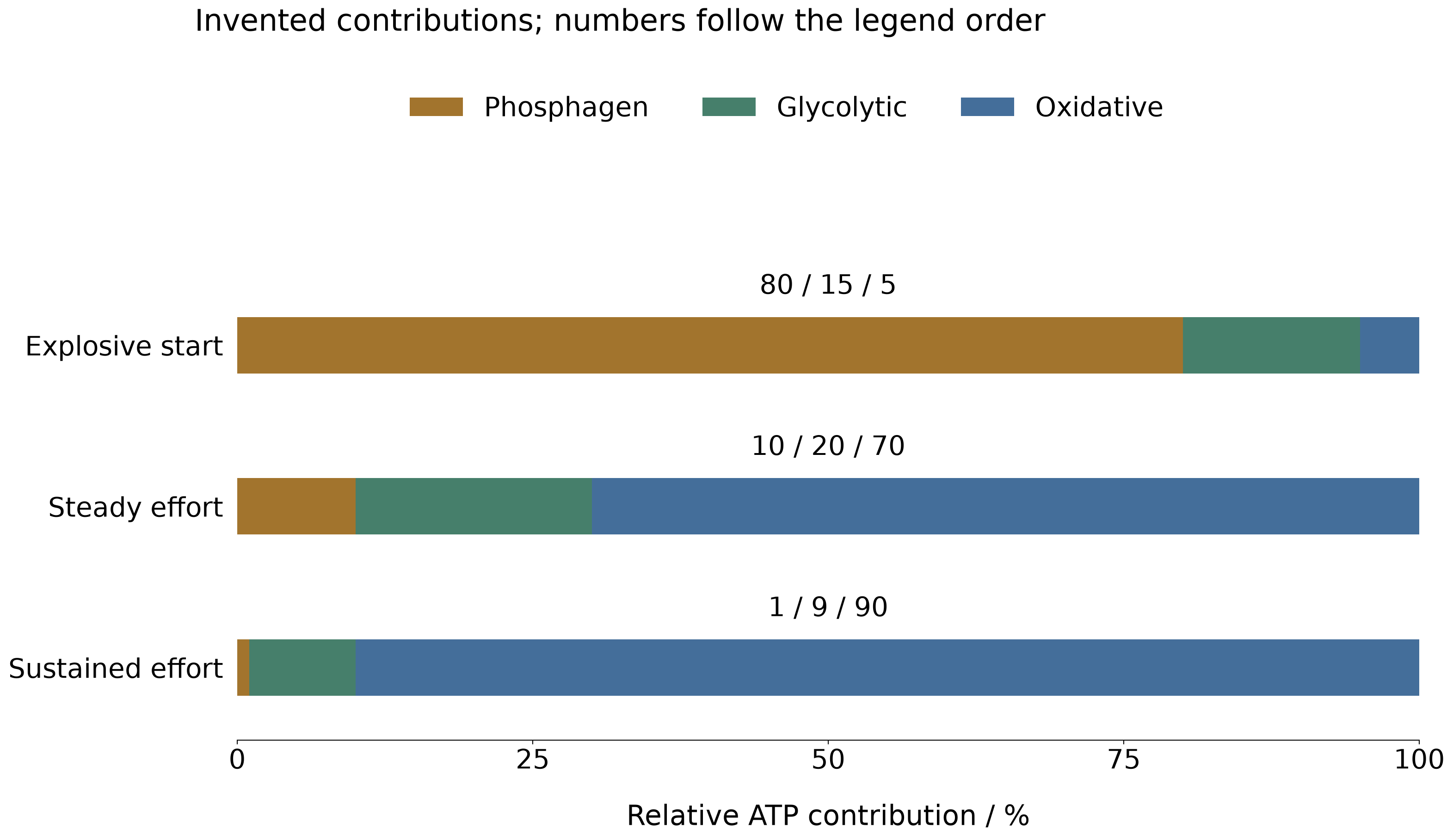
Can two equal percentages represent different absolute ATP amounts?
Dificuldade 1/5 · Moedas 100 + pequeno bônus na primeira conclusão hoje
Every proportion needs its total before conversion into an absolute quantity.
Interpret maximum oxygen uptake in context
- Maximum oxygen uptake describes the highest measured uptake under an appropriate protocol and is influenced by oxygen delivery and use, body composition, training and other individual factors.
- Age and sex-related group patterns do not determine every individual. A heart-rate value or one ordinary submaximal breath sample is not itself a measured maximum uptake.
Does one heart-rate reading directly measure maximum oxygen uptake?
Dificuldade 1/5 · Moedas 100 + pequeno bônus na primeira conclusão hoje
Use evidence from the relevant measurement method.
Convert absolute into relative oxygen uptake
- An invented absolute uptake of 3.6 L/min is 3600 mL/min. At 60 kg, the relative value is 60 mL/kg/min; at 80 kg it is 45.
- The denominator changes the relative number without establishing a change in absolute oxygen delivery. These comparisons do not imply a weight-loss target or a personal strategy.
What is 3600 mL/min divided by 80 kg?
Dificuldade 1/5 · Moedas 100 + pequeno bônus na primeira conclusão hoje
Relative uptake = absolute uptake/body mass = 3600 mL/min ÷ 80 kg = 45 mL/kg/min. The 60 mL/kg/min alternative uses 60 kg, a different denominator.
Separate movement economy from maximum uptake
- Running economy compares oxygen or energy cost at matched submaximal speed under suitable conditions. Lower cost at the same speed can be useful without proving a higher maximum uptake.
- An invented comparison from 2.4 to 2.1 L/min gives (2.4−2.1)/2.4 × 100 = 12.5% lower oxygen cost. Match speed, method and participant conditions.
Does improved submaximal economy automatically prove a higher maximum uptake?
Dificuldade 1/5 · Moedas 100 + pequeno bônus na primeira conclusão hoje
A lower cost at one workload is not identical to a higher maximum capacity.
Find percentage reduction from 2.4 to 2.1 L/min relative to 2.4.
Dificuldade 2/5 · Moedas 140 + pequeno bônus na primeira conclusão hoje
0.3/2.4×100=12.5%.
Check another percentage with the right baseline
- An invented matched-speed comparison falls from 2.0 to 1.8 L/min. Reduction relative to 2.0 is 0.2/2.0 × 100 = 10%.
- Dividing by 1.8 would answer a different percentage comparison. A measured reduction still needs uncertainty, repeatability and a design that addresses alternative explanations.
Oxygen cost at a matched speed falls from 2.0 to 1.8 L/min. Which baseline gives the percentage reduction relative to the initial cost?
Dificuldade 1/5 · Moedas 100 + pequeno bônus na primeira conclusão hoje
Fall = 2.0 − 1.8 = 0.2 L/min. Divide by the initial 2.0 L/min: 0.2/2.0 × 100 = 10%. Dividing by the final 1.8 answers a different comparison.
Evaluate diet evidence beyond a sample fraction
- Six of 24 participants reporting an outcome is 25%. Four of 20 is 20%, as in the original written case. These fractions describe their samples.
- Prior diet, workload, health, selection and reverse causation can affect an association. A suitable comparison and ethical design are needed before a causal claim; never invent a real trial result.
Does the 25% fraction alone establish a dietary cause?
Dificuldade 1/5 · Moedas 100 + pequeno bônus na primeira conclusão hoje
Accurate arithmetic does not automatically establish causation.
Design an ethical nutrition comparison
- Define exposure, timing, outcome and participants, then consider allocation, prior diet, workload, environment, missing data and measurement uncertainty.
- Use invented or appropriately approved data. Do not impose restriction, untested supplementation or sensitive disclosures on classmates to produce a larger effect.
What should an evaluation connect?
Dificuldade 1/5 · Moedas 100 + pequeno bônus na primeira conclusão hoje
The quality of the method matters more than agreement with a preferred conclusion.