Biomechanics: movement and impulse
Introduzido| English | Significado |
|---|---|
| base of support/beɪs ɒv səˈpɔːt/ | base de apoio |
| impulse/ˈɪmpʌls/ | impulso |
| plane/pleɪn/ | A flat two-dimensional surface extending indefinitely in every direction within it. |
| axis/ˈæksɪs/ | axis |
| motor unit | One motor neuron and all the muscle fibres it controls. |
What would explain this observation?
- Landing with bent knees increases the time over which momentum changes. The movement can reduce average impact force for the same momentum change.
Build the model
- Joint movement results from muscle forces acting through lever systems.
- The centre of mass and base of support 支撑面 affect stability.
- Impulse 冲量 connects force-time evidence to momentum change.
- impulse: Force integrated over time, equal to momentum change.
- base of support: The area supporting a body.

For a fixed momentum change, doubling stopping time does what to average force?
Dificuldade 1/5 · Moedas 100 + pequeno bônus na primeira conclusão hoje
Average force = momentum change / time. Doubling the stopping time divides the same momentum change by twice the time, so the average force halves - the principle behind soft landings and follow-through.
Match each technical term to its precise meaning.
Dificuldade 2/5 · Moedas 140 + pequeno bônus na primeira conclusão hoje
Use the definitions to distinguish related quantities and processes.
Choose evidence that can test it
- A biomechanical analysis must define the segment, direction and phase of movement.
- Net force and a single muscle force are not interchangeable.
- A longer lever arm can change torque without changing applied force.
In the lab: Use teacher-approved video of a safe movement with consent. Calibrate distance and time, identify frames consistently, and avoid making medical claims from a two-dimensional recording. Camera perspective can bias apparent joint angles.
Which two habits make the investigation or model in this case more defensible?
Dificuldade 2/5 · Moedas 140 + pequeno bônus na primeira conclusão hoje
Stating the conditions and assumptions lets others repeat the work exactly, and recording the supporting evidence lets them check the conclusion. Hiding disagreeing results removes the evidence that could challenge a wrong conclusion, and one measurement can never establish a wider claim.
Work from known quantities
- Known: momentum changes by 150 kg metres per second.
- Average force magnitude = momentum change/stopping time.
- For 0.30 s, force = 150/0.30 = 500 N.
- For 0.60 s, force = 150/0.60 = 250 N.
- This idealized average excludes the detail of a changing force curve.
Your turn: Momentum change is 120 kg metres per second over 0.40 s. Find average force magnitude.
Same momentum change, longer stopping time
A 50 kg athlete stopping from 3 m/s changes momentum by 150 kg m/s. Over 0.30 s the average force is 500 N; over 0.60 s it halves to 250 N, which is why bending the knees on landing helps.
Momentum change is 120 kg metres per second over 0.40 s. Find average force magnitude.
Dificuldade 2/5 · Moedas 140 + pequeno bônus na primeira conclusão hoje
The result is 300 N. Known: momentum change 120 kg metres per second over 0.40 s. Use average force = momentum change / time. Force = 120/0.40 = 300 N. This is an average; the peak force during the interval can be higher.
Check the conclusion and its limits
- The largest force is not the same as average force.
- A school movement study should not deliberately create high-impact landings to test a prediction.
Not true: A video from one angle proves the cause of a sports injury. One camera angle shows one projection of a complex movement; forces, surfaces, fatigue and individual anatomy are invisible in it. Injury causation needs multiple views, force data and medical evidence, not a single clip.
- Joint movement results from muscle forces acting through lever systems.
- A biomechanical analysis must define the segment, direction and phase of movement.
- Watch for: the largest force is not the same as average force.
A video from one angle proves the cause of a sports injury.
Dificuldade 1/5 · Moedas 100 + pequeno bônus na primeira conclusão hoje
One camera angle shows one projection of a complex movement; forces, surfaces, fatigue and individual anatomy are invisible in it. Injury causation needs multiple views, force data and medical evidence, not a single clip.
Force integrated over time, equal to momentum change: write the technical term.
Dificuldade 1/5 · Moedas 100 + pequeno bônus na primeira conclusão hoje
impulse means Force integrated over time, equal to momentum change.
Write from an average force of 360 N
- Momentum changes by 180 kg metres per second.
- Compare the average force over 0.50 s and over 1.00 s. One camera angle does not prove the cause of an injury.
Momentum changes by 180 kg metres per second. What is the average force magnitude over 0.50 s and over 1.00 s, and what does one camera angle not prove?
Average force magnitude is the momentum change divided by the stopping time. A longer time spreads the same change.
What is the average force magnitude over 0.50 s?
Dificuldade 1/5 · Moedas 100 + pequeno bônus na primeira conclusão hoje
180 divided by 0.50 is 360 N. The one-second interval gives 180 N. Other options — 180 N (the force over 1.00 s); 180 kg metres per second (the momentum change).
B.1: Begin with anatomical reference
- Anatomical position is upright, looking forwards, with arms at the sides and palms forwards. Left and right belong to the person being described, not the viewer.
- A front-view image reverses the sides for the viewer. Reference terms remain anatomical when posture changes; do not rename the palm as the back of the hand because it faces down.
Whose left side is anatomical left?
Dificuldade 1/5 · Moedas 100 + pequeno bônus na primeira conclusão hoje
Fix the reference before interpreting the image.
B.1: Locate axial and appendicular structures
- The axial skeleton includes skull, vertebral column, ribs and sternum. The appendicular skeleton includes shoulder and pelvic girdles and the limbs.
- Central support and protection are major axial roles; linked moving segments are major appendicular roles. Support, protection, mineral storage and blood-cell formation are not exclusive to only one division.
Which belongs to the appendicular skeleton?
Dificuldade 1/5 · Moedas 100 + pequeno bônus na primeira conclusão hoje
Classify the structure by its division, not by proximity to a limb.
B.1: Trace a limb through named bones
- Scapula and clavicle form the shoulder girdle; humerus is in the upper arm; radius and ulna are in the forearm; carpals, metacarpals and phalanges form the hand.
- The pelvic girdle links to femur in the thigh, patella at the knee, tibia and fibula in the lower leg, then tarsals, metatarsals and phalanges in the foot. In anatomical position radius is lateral to ulna, and tibia medial to fibula.
Which forearm bone is on the thumb side in anatomical position?
Dificuldade 1/5 · Moedas 100 + pequeno bônus na primeira conclusão hoje
Use a labelled skeleton and the defined reference.
B.1: Complete a positional comparison
- Superior/inferior mean towards head/feet; anterior/posterior towards front/back. Medial/lateral mean nearer/farther from the midline, while intermediate means between named structures.
- Proximal/distal compare distance from the limb’s attachment to the trunk. Elbow is distal to shoulder but proximal to wrist. These terms concern relative position, not the direction of a force or whether a muscle is active.
How is elbow position described relative to wrist?
Dificuldade 1/5 · Moedas 100 + pequeno bônus na primeira conclusão hoje
Supply the reference structure as part of the answer.
B.1: Pair planes 平面 with perpendicular axes
- A plane is a surface; an axis 轴 is a line of rotation perpendicular to the main movement plane. Sagittal divides left/right; frontal divides front/back; transverse divides upper/lower.
- A forward roll is mainly sagittal about a mediolateral axis; a cartwheel frontal about an anteroposterior axis; an upright spin transverse about a longitudinal axis. Real sequences can combine rotations in several planes.
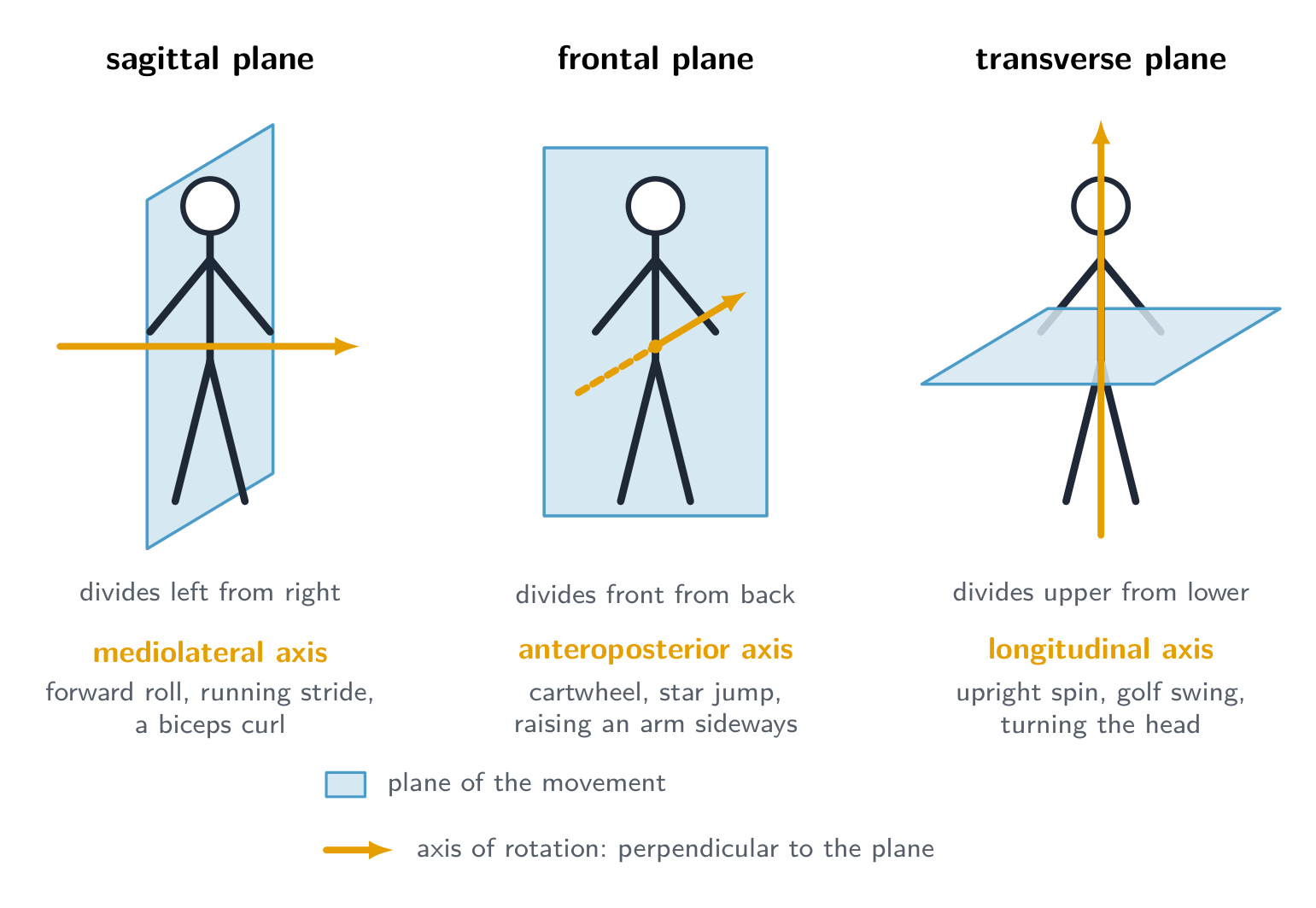
Which axis pairs with a mainly sagittal rotation?
Dificuldade 1/5 · Moedas 100 + pequeno bônus na primeira conclusão hoje
The rotation axis is perpendicular to its plane.
B.1: Name the joint and phase first
- Flexion usually decreases the angle between articulating segments; extension increases it. Elbow bending is flexion and straightening extension.
- An active elbow flexor can control lowering while the joint extends. Joint movement names do not by themselves identify whether one muscle shortens, lengthens or relaxes.
Can elbow extension occur while elbow flexors remain active?
Dificuldade 1/5 · Moedas 100 + pequeno bônus na primeira conclusão hoje
Separate joint kinematics from muscle action.
B.1: Separate sideways and horizontal arm movements
- Shoulder abduction takes the arm away from the midline; adduction returns it. Horizontal flexion moves a raised upper arm across the chest, and horizontal extension reverses it.
- A jumping-jack arm raise and a chest fly are not the same plane of movement. Name the joint, segment and phase rather than calling every raised arm flexion.
What describes bringing a raised upper arm across the chest?
Dificuldade 1/5 · Moedas 100 + pequeno bônus na primeira conclusão hoje
Use the direction and plane of the specified movement.
B.1: Distinguish rotation and circumduction
- Rotation turns a segment about its long axis. Circumduction combines movements so the distal end traces a cone.
- At the forearm, supination brings the palm forwards in anatomical position; pronation turns it backwards as the radius crosses the ulna. Palm-up/palm-down is only a convenient description for some bent-elbow postures.
Does circumduction mean only spinning a bone about its long axis?
Dificuldade 1/5 · Moedas 100 + pequeno bônus na primeira conclusão hoje
Distinguish movement of the endpoint from rotation about the segment axis.
B.1: Describe ankle and foot movements
- Dorsiflexion brings the top of the foot towards the shin; plantarflexion points the foot away. Inversion turns the sole medially, and eversion turns it laterally.
- Inversion and eversion involve joints of the foot and are not simply synonyms for pointing the toes. State which part moves relative to which reference.
Which movement turns the sole towards the midline?
Dificuldade 1/5 · Moedas 100 + pequeno bônus na primeira conclusão hoje
Keep sole orientation distinct from the foot-to-shin angle.
B.1: Describe the girdle and thumb
- Protraction brings the shoulder girdle forwards around the chest; retraction moves it backwards. Elevation raises a structure, and depression lowers it.
- Thumb opposition brings it towards the fingertips; reposition returns it. A throw uses several joints in sequence, so one movement term cannot adequately describe the whole throw.
What describes returning the shoulder girdle backwards?
Dificuldade 1/5 · Moedas 100 + pequeno bônus na primeira conclusão hoje
Use the term belonging to the specified structure.
B.1: Match connective tissue to force transmission
- Bone provides relatively rigid support and levers. Tendon transmits muscle tension to bone; ligament usually connects bones and limits excessive joint movement.
- Articular cartilage provides a smooth load-bearing surface. Fascia surrounds and connects structures and helps organise force transmission. Tendon and ligament are not interchangeable, and not all connective tissue is rigid.
Which tissue principally links muscle tension to bone?
Dificuldade 1/5 · Moedas 100 + pequeno bônus na primeira conclusão hoje
Describe the attachment and mechanical role together.
B.1: Distinguish three articulation groups
- Fibrous joints link bones with dense connective tissue, as in skull sutures. Cartilaginous joints use cartilage, as at the pubic symphysis and between vertebral bodies.
- Synovial joints have a fluid-containing cavity, articular cartilage and capsule. Their shape and supports affect movement; a joint is not necessarily freely movable or fluid-filled.
Does every joint have a synovial cavity?
Dificuldade 1/5 · Moedas 100 + pequeno bônus na primeira conclusão hoje
Classify by structure rather than treating one joint type as universal.
B.1: Link synovial shape and motion
- The main elbow articulation acts mainly as a hinge for flexion/extension; proximal radioulnar joint is a pivot for rotation; shoulder and hip are ball-and-socket joints permitting multi-axis movement.
- Radiocarpal wrist is condyloid; thumb base is saddle; some intercarpal joints are plane joints permitting gliding. The knee is a modified hinge with some rotation. Categories simplify living movement rather than defining an absolute single possible action.
Which example supports pivot rotation?
Dificuldade 1/5 · Moedas 100 + pequeno bônus na primeira conclusão hoje
Choose a matching structure and permitted movement.
B.1: Evaluate mobility and stability together
- A shoulder’s large range supports throwing and reaching but requires soft-tissue control. A deeper hip socket and surrounding supports help load bearing and stability.
- Muscles provide dynamic stabilisation alongside passive capsule and ligament constraints. More range is not automatically better; judge the structure against the particular task and demand.
Do intact passive supports make muscle control unnecessary?
Dificuldade 1/5 · Moedas 100 + pequeno bônus na primeira conclusão hoje
Connect passive structure and active muscular control.
B.1: Keep electrical activation separate from force
- A motor unit 运动单位 is one motor neuron and the muscle fibres it supplies. Its action potential normally activates the fibres of that unit. All-or-none concerns the electrical response after sufficient stimulus.
- A whole muscle produces graded force, and an activated fibre’s force depends on length, fatigue and other conditions. One action potential does not mean every fibre in the whole muscle produces its maximum possible force.
Does all-or-none restrict the whole muscle to zero or maximal force?
Dificuldade 1/5 · Moedas 100 + pequeno bônus na primeira conclusão hoje
Do not transfer an electrical signalling rule into an incorrect mechanical claim.
B.1: Recruit additional units rather than switching classes
- Increasing demand generally adds higher-threshold motor units to those already active and can increase firing rate. Smaller lower-threshold neurons are generally recruited before larger higher-threshold units.
- Type I is relatively slow, oxidative and fatigue resistant; IIa combines fast contraction with substantial oxidative/glycolytic capacity; IIx has rapid force potential but fatigues more readily in repeated work. All require ATP, and fast fibres are not incapable of oxygen use.
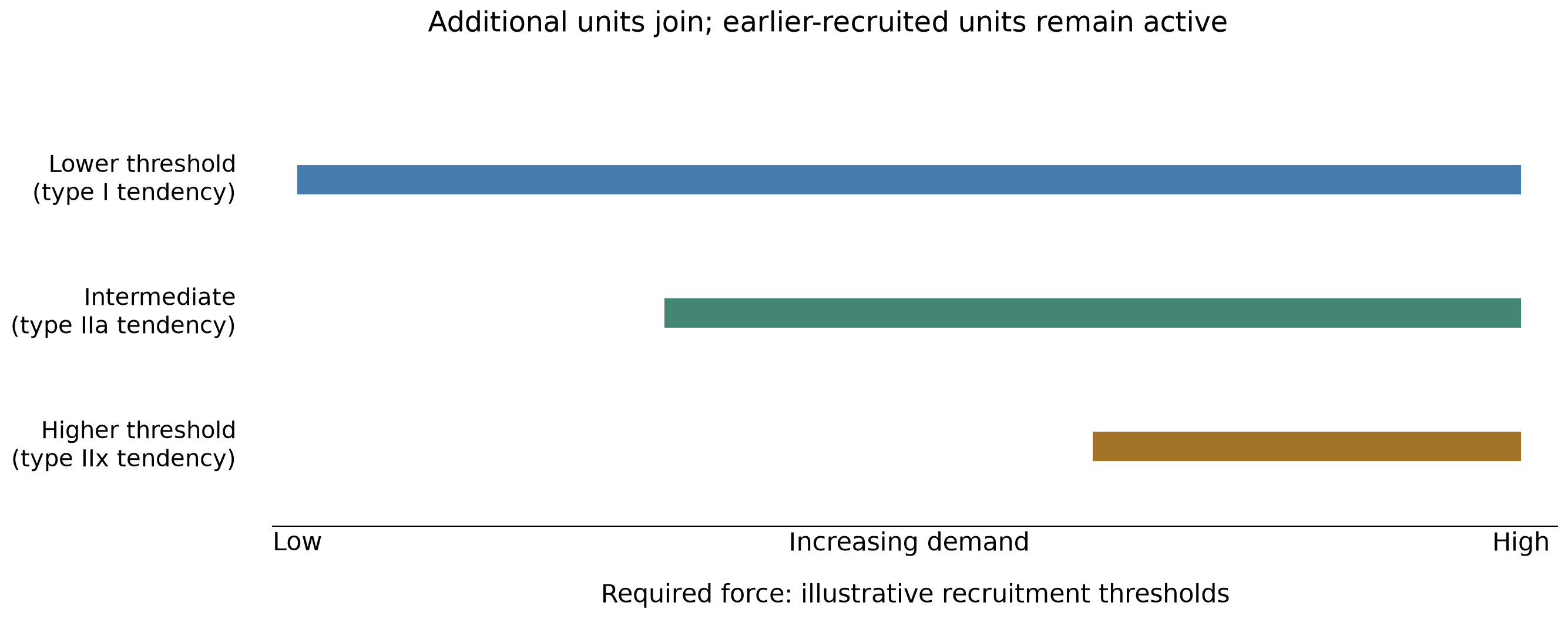
What normally happens to earlier active units as higher-threshold units join?
Dificuldade 1/5 · Moedas 100 + pequeno bônus na primeira conclusão hoje
Additional recruitment is not an exclusive fibre-type handover.
B.1: Distinguish muscle size and recruitment
- Hypertrophy increases muscle-fibre size and can raise force capacity; atrophy reduces size. The neural drive needed for a given external task can therefore change.
- Training also alters recruitment, firing and coordination. A larger fibre is not automatically an extra motor neuron, and axon diameter alone cannot predict sporting performance.
Does hypertrophy necessarily mean more motor neurons?
Dificuldade 1/5 · Moedas 100 + pequeno bônus na primeira conclusão hoje
State which structural variable actually changes.
B.1: Classify active shortening, holding and lengthening
- Concentric action shortens the active muscle; eccentric action lengthens it under load; isometric action maintains approximately constant overall length.
- For elbow flexors, raising a dumbbell is concentric, holding at a fixed elbow angle is approximately isometric, and controlled lowering is eccentric. An eccentric muscle is producing tension, not simply relaxing or pushing bones apart.
What is elbow-flexor action during controlled lowering?
Dificuldade 1/5 · Moedas 100 + pequeno bônus na primeira conclusão hoje
Use the muscle’s length change and activation, not only load direction.
B.1: Interpret isotonic and isokinetic carefully
- The syllabus uses isotonic concentric/eccentric for dynamic actions. Strict isotonic means constant tension, but ordinary free weights do not keep muscle tension exactly constant throughout movement.
- Isokinetic means a specified constant angular velocity, usually with equipment varying resistance. Constant speed does not imply constant force. Isometric activity still uses ATP even when external work on the stationary load is zero.
Does constant angular velocity require constant muscle force?
Dificuldade 1/5 · Moedas 100 + pequeno bônus na primeira conclusão hoje
Keep velocity, force and energy use distinct.
B.1: Assign muscle roles to an action
- The agonist produces the specified action, while an antagonist can oppose it. Synergists assist, and stabilisers hold other segments appropriately. Roles change with the action and phase.
- Reciprocal inhibition can reduce antagonist activation, but co-contraction can aid stability. Do not assume every antagonist is completely inactive whenever an agonist acts.
Can an antagonist remain active during a movement?
Dificuldade 1/5 · Moedas 100 + pequeno bônus na primeira conclusão hoje
Distinguish a coordinating tendency from an absolute all-or-none rule.
B.1: Classify a lever from relative positions
- A first-class lever places fulcrum between effort and load; second-class places load between fulcrum and effort; third-class places effort between fulcrum and load.
- A seesaw, wheelbarrow and elbow-flexion model illustrate the respective arrangements. In a simplified heel raise, forefoot contact is the pivot, body weight the load and Achilles tension the effort. State the model boundary.
Which class has effort between pivot and load?
Dificuldade 1/5 · Moedas 100 + pequeno bônus na primeira conclusão hoje
Classify the order of the three components.
B.1: Use perpendicular moment arms
- Moment = force × perpendicular distance from pivot to the force’s line of action. A distance measured along the bone is not automatically the moment arm.
- In an invented horizontal elbow model, a 100 N load at 0.40 m gives 40 N m. An upward effort with perpendicular arm 0.04 m must be 40/0.04 = 1000 N for rotational equilibrium, neglecting segment weight.
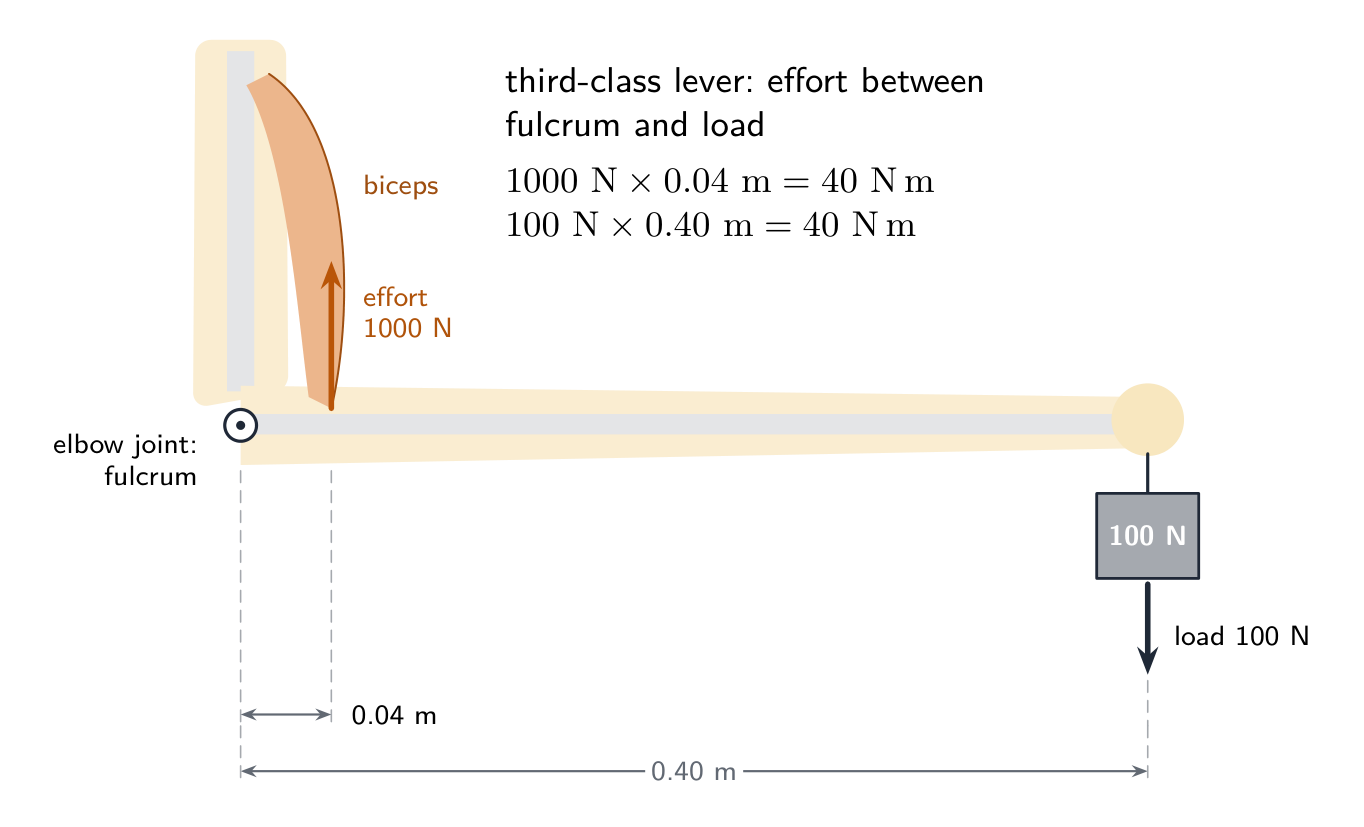
Which distance belongs in the moment calculation?
Dificuldade 1/5 · Moedas 100 + pequeno bônus na primeira conclusão hoje
Draw the force line before choosing its arm.
Find effort in N balancing 100 N at arm 0.40 m with effort arm 0.04 m, ignoring segment weight.
Dificuldade 2/5 · Moedas 140 + pequeno bônus na primeira conclusão hoje
100×0.40/0.04=1000 N.
B.1: Explain mechanical advantage as a trade-off
- Ideal lever mechanical advantage = effort arm/load arm. Here 0.04/0.40 = 0.10, so balancing the external load needs a larger effort force.
- If the effort arm were 0.05 m at the same load moment, effort would be 40/0.05 = 800 N. This model comparison is not a claim that a coaching cue can move anatomical attachments. Force advantage exchanges force for distance or speed, not free energy.
Does mechanical disadvantage violate energy conservation?
Dificuldade 1/5 · Moedas 100 + pequeno bônus na primeira conclusão hoje
Consider work and displacement as well as force.
Find ideal mechanical advantage for effort arm 0.04 m and load arm 0.40 m.
Dificuldade 2/5 · Moedas 140 + pequeno bônus na primeira conclusão hoje
0.04/0.40=0.10.
B.1: Include segment weight in equilibrium
- Adding a 20 N forearm/hand weight at a 0.15 m perpendicular arm adds 3 N m to the original 40. Required effort is 43/0.04 = 1075 N.
- Force balance also needs a joint reaction; it is not automatically equal to the weight in the hand. Dynamic analysis additionally requires acceleration and other forces, rather than applying a static equation unchanged.
What is the total resisting moment in this model?
Dificuldade 1/5 · Moedas 100 + pequeno bônus na primeira conclusão hoje
Include every supplied force and its own moment arm.
B.1: Solve a second lever with its own data
- An invented 120 N load at 0.30 m has moment 36 N m. At effort arm 0.045 m, the balancing effort is 800 N and mechanical advantage 0.15.
- A further 15 N segment weight at 0.12 m adds 1.8 N m. Total moment 37.8 N m gives effort 840 N. Do not reuse the first example’s values when the question supplies new arms or weights.
What effort balances the complete second model?
Dificuldade 1/5 · Moedas 100 + pequeno bônus na primeira conclusão hoje
Recalculate the total moment before dividing by the effort arm.
Find effort for load moment 120×0.30 plus segment moment 15×0.12, with effort arm 0.045 m.
Dificuldade 2/5 · Moedas 140 + pequeno bônus na primeira conclusão hoje
(36+1.8)/0.045=840 N.
B.1: Evaluate an external implement
- For the same angular velocity, a point farther from the rotation axis has greater endpoint speed. A longer implement may also increase rotational inertia and the moment of a resisting load.
- A longer racket is therefore not automatically easier to accelerate or best for every user. State what stays fixed in the comparison and how strength, control, task and equipment fit constrain the benefit.
Does longer necessarily mean easier to accelerate?
Dificuldade 1/5 · Moedas 100 + pequeno bônus na primeira conclusão hoje
A mechanical benefit can come with a competing demand.
B.1: Separate net average force from ground reaction
- The original written case changes momentum by 180 kg m/s over 0.50 s or 1.00 s. Average net force magnitudes are 360 N and 180 N.
- For the same momentum change, longer time lowers the average net force. It does not determine the peak. Ground reaction also requires accounting for weight and any other forces with directions; it is not automatically equal to the net force. B.2 develops this further.
Does halving average net force prove peak ground reaction halves?
Dificuldade 1/5 · Moedas 100 + pequeno bônus na primeira conclusão hoje
An impulse fixes an integral, not a unique force-time shape.
B.1: Design movement evidence around the question
- Define the segment, joint, phase and anatomical landmarks. Fix the camera approximately perpendicular to the main movement plane, calibrate distance and record frame rate.
- Hidden landmarks, perspective and out-of-plane motion add uncertainty. Use consented teacher-approved ordinary movements or supplied data; do not provoke high impacts. A two-dimensional video is not an injury diagnosis or a rehabilitation prescription.
What limitation follows from one two-dimensional projection?
Dificuldade 1/5 · Moedas 100 + pequeno bônus na primeira conclusão hoje
Connect the recording geometry to the inference it can support.
B.2: Choose the body, direction and interval
- A racket–ball analysis must distinguish ball motion during contact from arm motion after separation. Choose the body whose momentum changes, a positive direction and a defined interval.
- Later follow-through cannot add racket contact impulse to an already separated ball. It can reflect useful coordination and deceleration of body segments; that is a different claim. All new numerical scenarios and plotted models below are invented.
Can the racket keep supplying contact force after separation?
Dificuldade 1/5 · Moedas 100 + pequeno bônus na primeira conclusão hoje
Match the force mechanism to the actual contact interval.
B.2: Distinguish distance, displacement and averages
- Distance measures path length; displacement measures change in position with direction. Speed is distance/time, while average velocity uses displacement/time.
- A complete 400 m lap in 80 s gives average speed 5 m/s but zero average velocity because displacement is zero. Neither average tells us the highest instantaneous speed.
What is average velocity over the complete lap?
Dificuldade 1/5 · Moedas 100 + pequeno bônus na primeira conclusão hoje
Use the displacement rather than total path length.
B.2: Keep signed velocity changes
- Acceleration = (final velocity − initial velocity)/time. Changing +2 to +6 m/s in 2 s gives +2 m/s²; changing +6 to +2 gives −2 m/s².
- Changing −1 to −7 m/s in 3 s gives −2 m/s² while speed increases. Negative acceleration does not always mean slowing. Turning at constant speed changes velocity direction and also requires acceleration.
Can an object speed up with negative acceleration?
Dificuldade 1/5 · Moedas 100 + pequeno bônus na primeira conclusão hoje
Compare acceleration direction with velocity, not merely with zero.
B.2: Count frame intervals correctly
- Between frames 10 and 25 there are 15 intervals. At 50 frames/s this is 15/50 = 0.30 s; a +0.60 m displacement gives average velocity +2.0 m/s.
- A second record at 40 frames/s, frames 12 to 20 and +0.50 m displacement, gives eight intervals, 0.20 s and +2.5 m/s. Perspective, scale-plane mismatch and landmark uncertainty can bias the result.
How many intervals separate frames 12 and 20?
Dificuldade 1/5 · Moedas 100 + pequeno bônus na primeira conclusão hoje
Count elapsed gaps rather than displayed images.
Find average velocity in m/s for +0.50 m from frames 12 to 20 at 40 frames/s.
Dificuldade 2/5 · Moedas 140 + pequeno bônus na primeira conclusão hoje
Eight intervals give 8/40=0.20 s; 0.50/0.20=2.5.
B.2: Interpret zero resultant properly
- Newton’s first law concerns constant velocity when resultant external force is zero. Zero resultant does not mean no forces act: opposing forces can balance.
- A runner at constant horizontal velocity may need driving contact force to balance resistance, yet the horizontal resultant remains zero. Continuing motion alone does not prove a forward resultant.
Can a moving body have zero resultant external force?
Dificuldade 1/5 · Moedas 100 + pequeno bônus na primeira conclusão hoje
Distinguish a driving force from the sum of all external forces.
B.2: Include resistance after finding the resultant
- For constant mass, net force = mass×acceleration. A 60 kg model accelerating horizontally at 2 m/s² has resultant 120 N. With 20 N opposing resistance, forward driving force is 140 N.
- In the practice model, 50 kg at 1.5 m/s² gives 75 N net; adding 15 N resistance gives 90 N driving. Whole-body motion does not isolate one internal muscle force.
What is the practice model’s forward driving force?
Dificuldade 1/5 · Moedas 100 + pequeno bônus na primeira conclusão hoje
The net already includes both driving and resisting effects.
B.2: Put third-law forces on different bodies
- A foot pushes the ground backwards; the ground pushes the foot forwards with an equal opposite interaction force. The two forces act on different bodies.
- They do not cancel on a force diagram of the athlete. Balanced weight and support on a stationary athlete both act on that athlete, so they are not one third-law pair with each other.
Why do foot–ground interaction forces not cancel on the athlete’s diagram?
Dificuldade 1/5 · Moedas 100 + pequeno bônus na primeira conclusão hoje
Identify the recipient of each force before summing it.
B.2: Separate weight and support
- Mass is not force. Weight = mass×g; 80 kg at g=9.81 m/s² gives 784.8 N downwards. Support can exceed or fall below weight when vertical motion changes.
- For an 80 kg model gaining 240 kg m/s upward momentum in 0.20 s, average net upward force is 1200 N. With only support and weight vertically, average ground reaction is 1984.8 N upwards.
Is the 1200 N net equal to the total upward ground reaction here?
Dificuldade 1/5 · Moedas 100 + pequeno bônus na primeira conclusão hoje
Draw the vertical forces and retain their directions.
B.2: Read signed area rather than peak height
- Impulse is net force integrated over time and equals momentum change. On a net force-time graph, signed area is impulse; maximum height is peak force.
- The two triangular figure curves have areas 0.5×0.30×1000 = 150 N s and 0.5×0.60×500 = 150 N s. Average forces are 500 and 250 N, half the respective peaks. Equal impulse does not determine one unique curve.
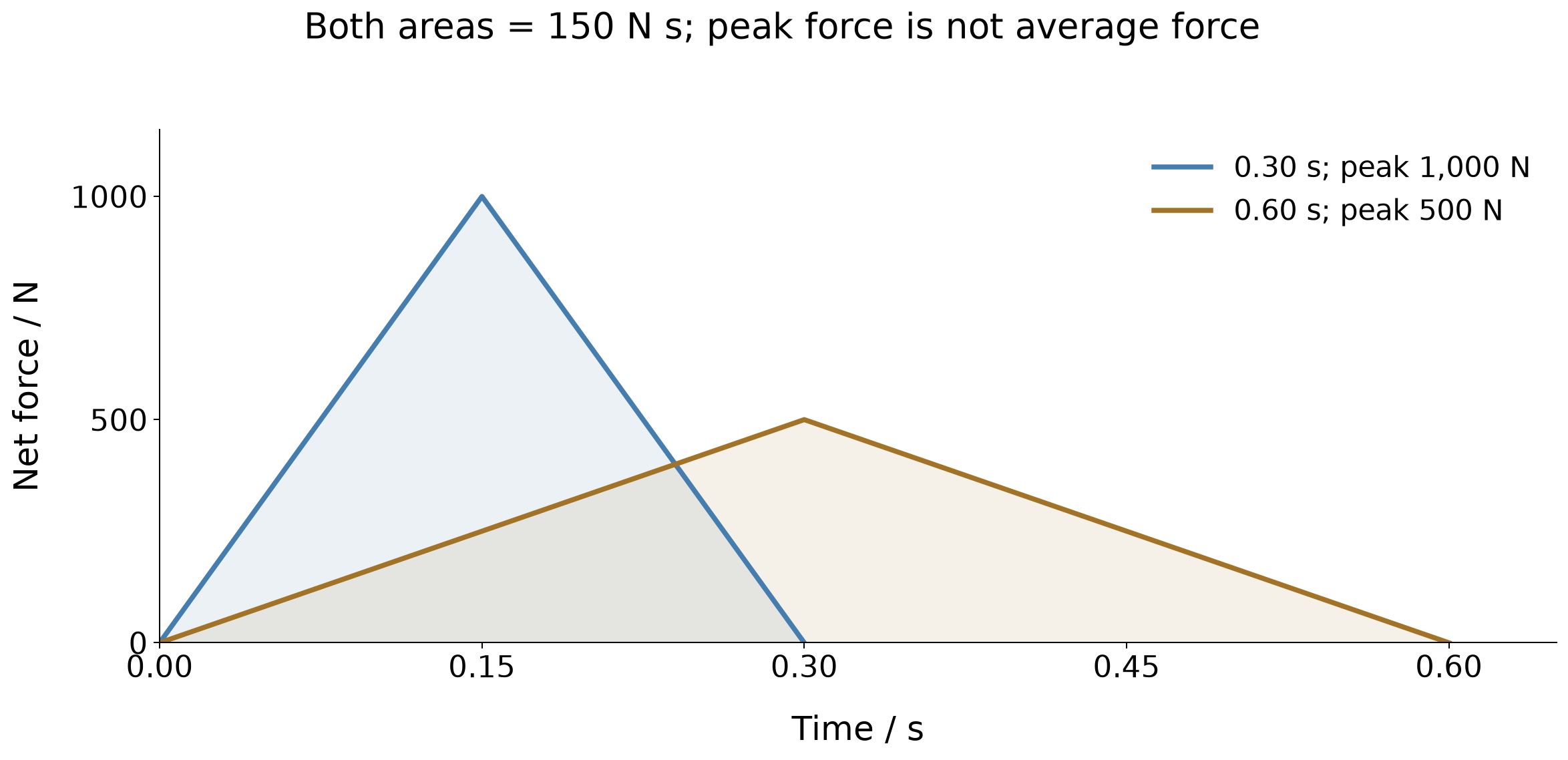
What graph feature gives impulse?
Dificuldade 1/5 · Moedas 100 + pequeno bônus na primeira conclusão hoje
An area and a maximum are distinct quantities.
B.2: Recalculate a second triangular pulse
- A triangular pulse lasting 0.40 s with peak 600 N has impulse 0.5×0.40×600 = 120 N s. Average force is 120/0.40 = 300 N.
- At the same impulse over 0.80 s, average is 150 N. If the second curve is also triangular, peak is 300 N; without that shape assumption the peak is not fixed.
What additional assumption permits the second peak calculation?
Dificuldade 1/5 · Moedas 100 + pequeno bônus na primeira conclusão hoje
Use curve shape explicitly before relating peak and average.
B.2: Treat reversal as a signed change
- For a 0.058 kg ball changing from +30 to +20 m/s, momentum change is −0.58 kg m/s. If it rebounds to −20 instead, change is −2.90 kg m/s.
- The reversal is not merely a 10 m/s speed difference. At 0.005 s the corresponding average resultants are −116 N and −580 N; the sign indicates direction relative to the chosen positive axis.
Which velocity change describes +30 to −20 m/s?
Dificuldade 1/5 · Moedas 100 + pequeno bônus na primeira conclusão hoje
Subtract signed initial velocity from signed final velocity.
B.2: Calculate a new ball contact
- An invented 0.050 kg ball changes from +24 to −16 m/s over 0.008 s. Momentum change = 0.050×(−16−24) = −2.0 kg m/s.
- Average resultant is −2.0/0.008 = −250 N. Report direction or sign, not just a positive force magnitude when the question requests the resultant. Contact force and resultant also differ if other forces are relevant.
An invented 0.050 kg ball changes from +24 to −16 m/s over 0.008 s. With the initial motion chosen positive, what is the signed average resultant force?
Dificuldade 1/5 · Moedas 100 + pequeno bônus na primeira conclusão hoje
Velocity change = final − initial = −16 − (+24) = −40 m/s. Momentum change = 0.050 × (−40) = −2.0 kg m/s. Average resultant force = momentum change/contact time = −2.0/0.008 = −250 N. The minus sign means opposite the initial positive direction. Subtracting speed magnitudes would miss the reversal and produce the wrong +50 N. This calculates the resultant; a particular contact force would also require accounting for any other relevant forces.
Find signed average resultant for 0.050 kg changing +24 to −16 m/s over 0.008 s.
Dificuldade 2/5 · Moedas 140 + pequeno bônus na primeira conclusão hoje
0.050×(−16−24)/0.008=−250 N.
B.2: Recalculate vertical ground reaction
- A 60 kg model gains upward momentum 120 kg m/s over 0.25 s. Average net upward force = 480 N; weight = 60×9.81 = 588.6 N.
- For the supplied weight-plus-support model, average upward reaction is 480+588.6 = 1068.6 N. Other vertical forces, if present, require additional terms. The model does not isolate knee or muscle force.
What is the model’s average upward reaction?
Dificuldade 1/5 · Moedas 100 + pequeno bônus na primeira conclusão hoje
Add the opposing weight when solving the stated vertical force balance.
Find upward reaction for net upward average 480 N plus weight of a 60 kg body at g=9.81.
Dificuldade 2/5 · Moedas 140 + pequeno bônus na primeira conclusão hoje
480+60×9.81=1068.6.
B.2: Evaluate the direction of a stability margin
- The centre of mass is the mass-weighted mean position. On a level support, its vertical projection gives the line of gravity; the base of support encloses supporting contacts.
- A lower centre of mass and wider base in the disturbance direction can improve a simple toppling margin. Sideways widening does not provide the same improvement against every fore–aft disturbance. Friction, mass and the task also matter.
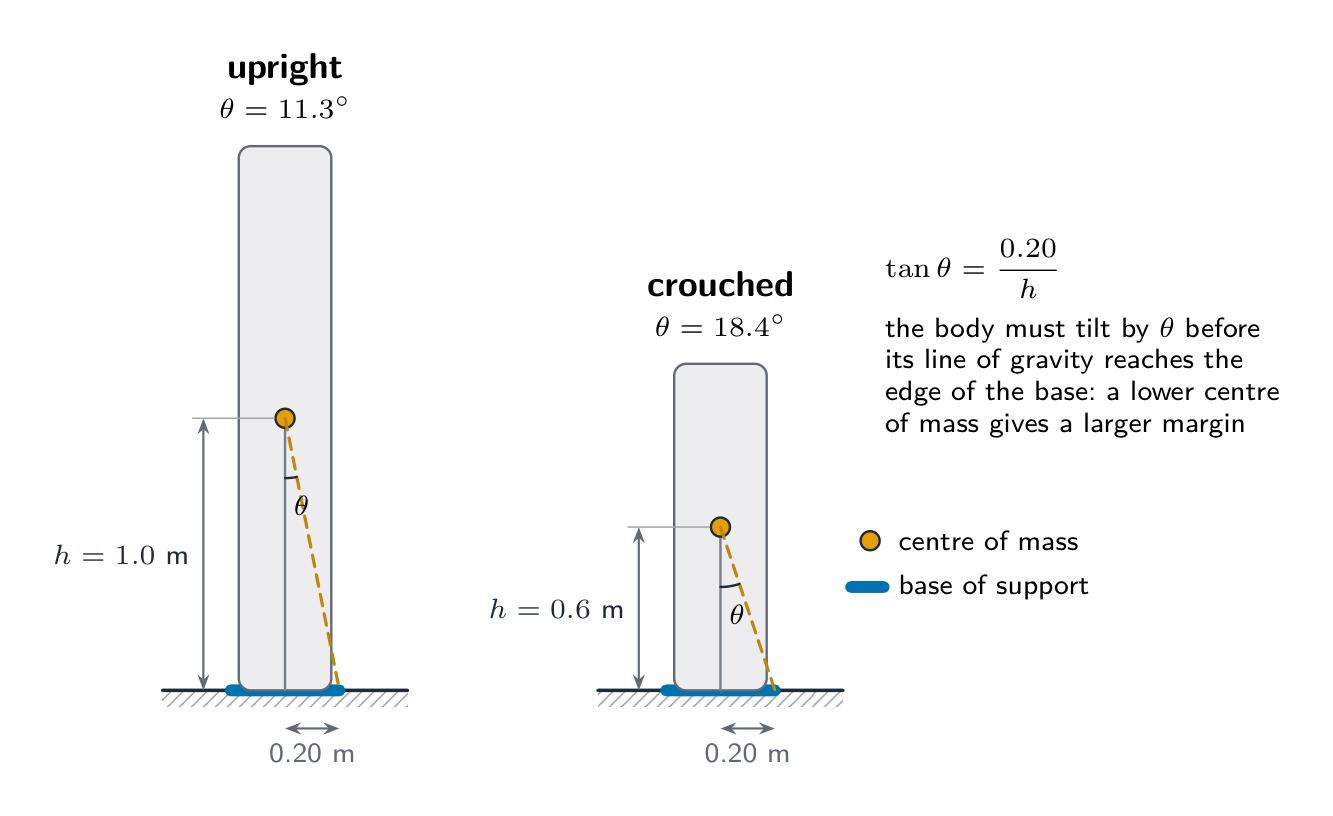
Does a wider sideways stance maximise stability against every disturbance?
Dificuldade 1/5 · Moedas 100 + pequeno bônus na primeira conclusão hoje
Link geometry to the particular disturbance and model.
B.2: Distinguish static toppling and running
- In a simple static model, a gravity line beyond a support edge can create a toppling moment unless support or another action changes conditions.
- A moving runner may place the centre-of-mass projection outside the current contact area while maintaining controlled motion through the next step. Greater mass increases inertia but does not guarantee balance or eliminate the need for control.
Can a static rule fully describe every running phase?
Dificuldade 1/5 · Moedas 100 + pequeno bônus na primeira conclusão hoje
State whether the model is static or dynamic.
B.2: Explain coordination rather than adding isolated forces
- Leg, trunk, shoulder, elbow and wrist actions can contribute sequentially to an implement’s motion. Timing and segment interactions affect energy transfer and endpoint speed.
- Summing joint forces is not a licence to add muscle-force numbers pointing in different directions at different sites. A larger isolated muscle force alone does not prove a faster or more accurate throw.
What must a coordination analysis consider?
Dificuldade 1/5 · Moedas 100 + pequeno bônus na primeira conclusão hoje
A linked movement needs more than an unqualified scalar sum.
B.2: Identify the line of action for torque
- Torque is force×perpendicular arm about a specified axis. A force whose line passes through the centre of mass can change translation without a torque about that centre.
- An off-centre line of action can change both linear and angular motion. Eccentric force in this mechanical sense concerns an offset line, distinct from eccentric muscle action meaning active lengthening.
Does every force away from the centre have a turning effect about it?
Dificuldade 1/5 · Moedas 100 + pequeno bônus na primeira conclusão hoje
Use the force line, not just the location of contact.
B.2: Conserve angular momentum under the right condition
- When net external torque about the chosen axis is negligible, angular momentum is conserved. In the simple model L = I×angular velocity.
- Invented I=0.80 kg m² and angular velocity 4 rad/s give L=3.2 kg m²/s. Reducing I to 0.40 gives 8 rad/s at the same L. Shape change increases rotation rate without creating extra angular momentum.
What is conserved in this comparison?
Dificuldade 1/5 · Moedas 100 + pequeno bônus na primeira conclusão hoje
Keep the conserved product distinct from its changing factors.
B.2: Keep gravity during flight
- Negligible external torque does not require zero external force. Gravity acts through the centre of mass and has no moment about that centre in the simplified flight model.
- Practice values I=0.60 and angular velocity 5 give L=3.0; at I=0.30 the new angular velocity is 10 rad/s. Air or contact torques can change the angular momentum, especially during take-off or landing.
Can gravity act while angular momentum about the centre is conserved?
Dificuldade 1/5 · Moedas 100 + pequeno bônus na primeira conclusão hoje
Specify the axis and the net external torque condition.
Conserve angular momentum from I=0.60 and 5 rad/s to I=0.30. Find new angular velocity.
Dificuldade 2/5 · Moedas 140 + pequeno bônus na primeira conclusão hoje
0.60×5/0.30=10.
B.2: Interpret the projectile apex
- After release, separate horizontal and vertical motion. With no drag, horizontal velocity stays constant while vertical acceleration remains gravitational and downwards.
- In the figure model, horizontal speed is 4 m/s and initial upward component 6 m/s with g=10. At the apex after 0.60 s, vertical velocity is zero but horizontal velocity and downward acceleration remain.
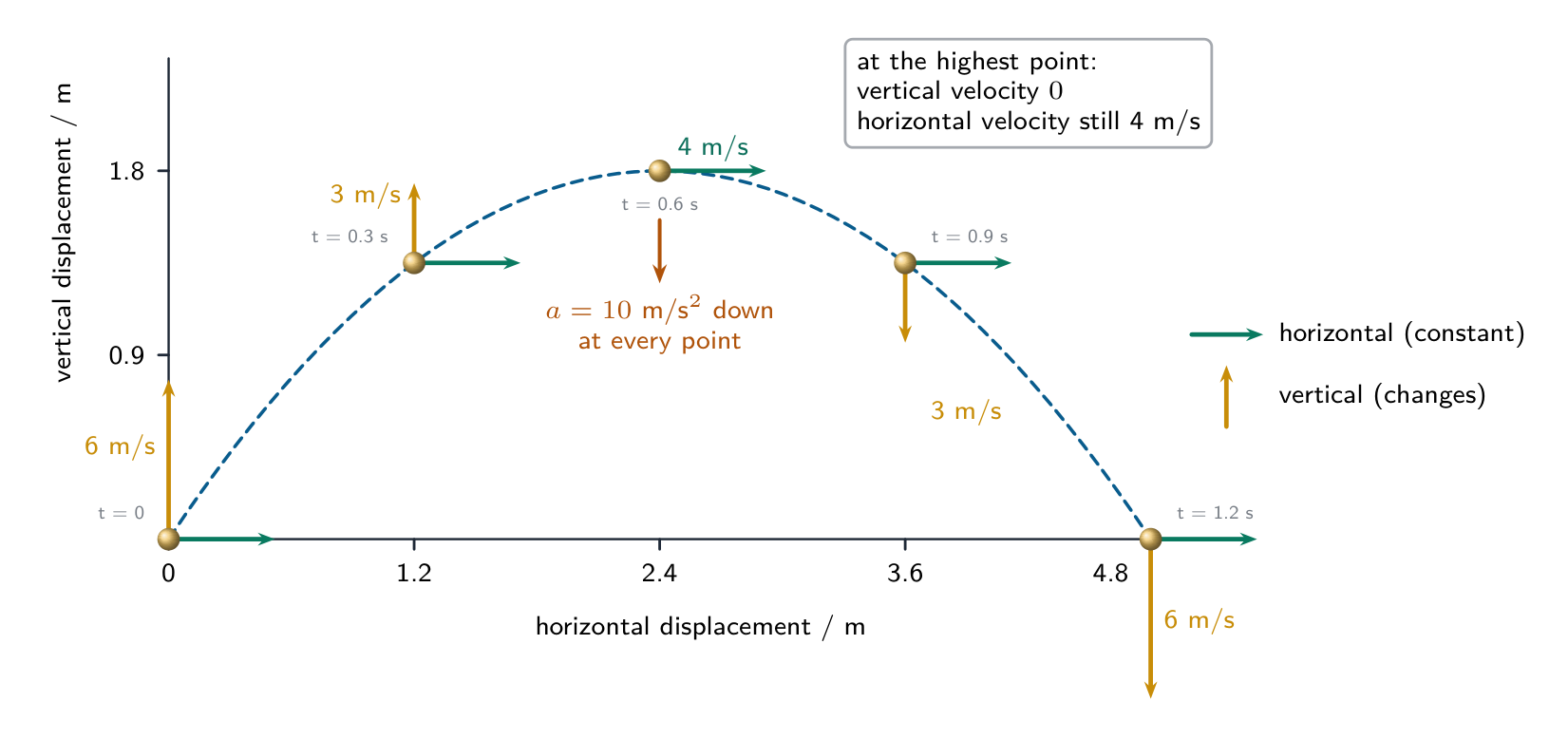
What becomes zero at the apex of this model?
Dificuldade 1/5 · Moedas 100 + pequeno bônus na primeira conclusão hoje
A zero component of velocity is not zero acceleration.
B.2: Use release conditions rather than a universal angle
- For the equal-height figure model, flight lasts 1.20 s and horizontal range is 4×1.20 = 4.8 m. A separate supplied 5 m/s horizontal speed over 0.80 s gives range 4.0 m.
- Release height relative to the target, direction and speed affect the path. Air resistance can slow horizontal motion and make the path asymmetric. A 45-degree release is not universally best for every task. No trigonometric resolution is required for these supplied-component examples.
What is range for 5 m/s horizontal speed over 0.80 s without drag?
Dificuldade 1/5 · Moedas 100 + pequeno bônus na primeira conclusão hoje
Multiply compatible speed and duration rather than adding unlike quantities.
Find no-drag range for 5 m/s horizontal velocity over 0.80 s.
Dificuldade 2/5 · Moedas 140 + pequeno bônus na primeira conclusão hoje
5×0.80=4.0 m.
B.2: Compare the weight-to-resistance context
- A light object with large area relative to weight can be strongly affected by air resistance compared with a dense compact object under otherwise comparable conditions.
- A shuttlecock and a shot do not follow one identical gravity-only path. State the shape, release and force assumptions; spin and flow can change the path without continued hand contact. HL develops the distinct fluid mechanisms.
Can one no-drag trajectory be applied unchanged to every implement?
Dificuldade 1/5 · Moedas 100 + pequeno bônus na primeira conclusão hoje
Transfer the model only when its conditions are justified.
B.2: Define phases and the critical instant
- A discrete throw has preparation, force production, critical instant and follow-through. Preparation positions the system; force production develops motion; release may be the chosen critical instant.
- Follow-through controls subsequent movement. Continuous skills use recovery towards the next cycle. Define a boundary such as the last frame of hand–ball contact consistently; the critical instant is not the whole force-production phase.
Which definition makes release identification reproducible?
Dificuldade 1/5 · Moedas 100 + pequeno bônus na primeira conclusão hoje
Operational definitions make timing comparisons interpretable.
B.2: Use movement analysis for a bounded improvement
- Analysis can identify a limited range, mistimed sequence or accessibility obstacle. Compare matched tasks and camera geometry, measuring a defined outcome rather than every feature at once.
- If an invented closer target reduces required reach, this supports evaluating that adjustment; it does not diagnose an impairment. Use supplied or consented low-risk records, preserve privacy and distinguish classroom analysis from qualified rehabilitation assessment.
What does reduced reach demand directly support?
Dificuldade 1/5 · Moedas 100 + pequeno bônus na primeira conclusão hoje
Keep the inference within the actual measurement and intervention.