Injury evidence: compare exposure as well as counts
Introduzido| English | Significado |
|---|---|
| incidence rate/ˈɪnsɪdəns reɪt/ | taxa de incidência |
| overuse injury/ˌəʊvəˈjuːs ˈɪndʒəri/ | lesão por uso excessivo |
What would explain this observation?
- A team records more injuries after adding training sessions. A larger count does not necessarily mean a larger risk per hour of exposure.
Build the model
- Injury surveillance requires an explicit injury definition, consistent recording and an exposure denominator.
- Acute injuries follow a particular event; overuse injuries can develop through repeated loading.
- Mechanism, tissue capacity, previous injury, equipment and environment can contribute, so one observed association rarely establishes a single cause.
- incidence rate 发生率: New events divided by a specified exposure measure.
- overuse injury 过度使用损伤: Injury associated with repeated loading over time.

Why use athlete-hours when comparing injury counts?
Dificuldade 1/5 · Moedas 100 + pequeno bônus na primeira conclusão hoje
Counts are comparable only against equal exposure: a group that trains twice as many hours is expected to have more injuries without being more dangerous. Athlete-hours normalise the exposure.
Match each technical term to its precise meaning.
Dificuldade 2/5 · Moedas 140 + pequeno bônus na primeira conclusão hoje
Use the definitions to distinguish related quantities and processes.
Choose evidence that can test it
- An incidence rate divides new injury events by exposure time, often expressed per 1,000 athlete-hours.
- Use the same case definition and exposure method in comparisons.
- Severity, recurrence and missing records also matter; two groups with equal incidence can have different time lost or different injury types.
In the lab: Use anonymized fictional surveillance tables. Identify what counts as an injury and how training or match exposure was recorded. Calculate comparable rates, check sample sizes and reporting changes, and propose prevention hypotheses for qualified staff to evaluate. Students do not induce injuries, diagnose peers or decide return-to-play clearance.
Which two habits make the investigation or model in this case more defensible?
Dificuldade 2/5 · Moedas 140 + pequeno bônus na primeira conclusão hoje
Stating the conditions and assumptions lets others repeat the work exactly, and recording the supporting evidence lets them check the conclusion. Hiding disagreeing results removes the evidence that could challenge a wrong conclusion, and one measurement can never establish a wider claim.
Work from known quantities
- Known: group A has 6 injuries in 3,000 athlete-hours, rate 2 per 1,000 hours.
- Group B has 8 injuries in 8,000 athlete-hours, rate 1 per 1,000 hours.
- Group B has the larger count but the smaller recorded exposure-normalized rate.
- Different reporting systems or injury severity could still make the comparison misleading.
Your turn: A fictional group records 9 injuries in 4,500 athlete-hours. Calculate injuries per 1,000 hours.
A fictional group records 9 injuries in 4,500 athlete-hours. Calculate injuries per 1,000 hours.
Dificuldade 2/5 · Moedas 140 + pequeno bônus na primeira conclusão hoje
The result is 2 per 1,000 hours. Known: 9 injuries in 4,500 athlete-hours. Use rate = injuries / hours x 1,000. Rate = 9/4,500 x 1,000 = 2 injuries per 1,000 athlete-hours. Small counts make such rates uncertain.
Check the conclusion and its limits
- A rate estimate from a small number of events is uncertain.
- A low recorded rate can reflect under-reporting, and exposure-normalized association is not proof of a prevention intervention’s causal effect.
Not true: The group with more recorded injuries necessarily has a greater injury rate per hour. Rate = count / exposure. More injuries with much more exposure can be a LOWER rate per hour - as the worked case shows, 8 injuries in 8,000 hours (1 per 1,000) has a lower recorded injury rate than 6 in 3,000 (2 per 1,000). Severity and reporting still matter.
- Injury surveillance requires an explicit injury definition, consistent recording and an exposure denominator.
- An incidence rate divides new injury events by exposure time, often expressed per 1,000 athlete-hours.
- Watch for: A rate estimate from a small number of events is uncertain.
The group with more recorded injuries necessarily has a greater injury rate per hour.
Dificuldade 1/5 · Moedas 100 + pequeno bônus na primeira conclusão hoje
Rate = count / exposure. More injuries with much more exposure can be a LOWER rate per hour - as the worked case shows, 8 injuries in 8,000 hours (1 per 1,000) has a lower recorded injury rate than 6 in 3,000 (2 per 1,000). Severity and reporting still matter.
New events divided by a specified exposure measure: write the technical term.
Dificuldade 1/5 · Moedas 100 + pequeno bônus na primeira conclusão hoje
incidence rate means New events divided by a specified exposure measure.
Write from 3 injuries per 1,000 hours
- A fictional group records 3 injuries in 1,000 athlete-hours.
- Find the injury rate. A smaller count can still be a higher rate.
A fictional group records 3 injuries in 1,000 athlete-hours. What is the rate per 1,000 hours, and why can a smaller injury count still be a higher rate?
Rate is count divided by exposure. The count alone does not rank the groups.
A fictional group records 3 injuries in 1000 athlete-hours. What is its injury rate per 1000 athlete-hours?
Dificuldade 1/5 · Moedas 100 + pequeno bônus na primeira conclusão hoje
3 injuries in 1,000 hours is 3 per 1,000 hours. The count is not a rate per single hour.
B.3: Separate risk factors from mechanisms
- A risk factor concerns the chance of an outcome in specified circumstances. A mechanism describes how damaging loading occurs. Neither an association nor one visible event establishes every cause.
- Previous ankle injury, reduced control, an abrupt rise in running volume and uneven ground may interact. The surface is visible, but that does not prove it alone caused the outcome. The scenarios and numerical records below are invented.
Does one associated factor establish an inevitable injury?
Dificuldade 1/5 · Moedas 100 + pequeno bônus na primeira conclusão hoje
Distinguish a probabilistic association from a mechanism and individual outcome.
B.3: Link the individual and environment
- Internal factors include development, age, sex-related physiology, pregnancy, congenital characteristics, previous injury and training effects. Their relevance depends on the person, task and circumstances.
- External factors include equipment, surface, weather, rules, other participants and how activity is organised. A demographic category does not determine every individual’s capacity; an external exposure interacts with current tissue capacity and recovery.
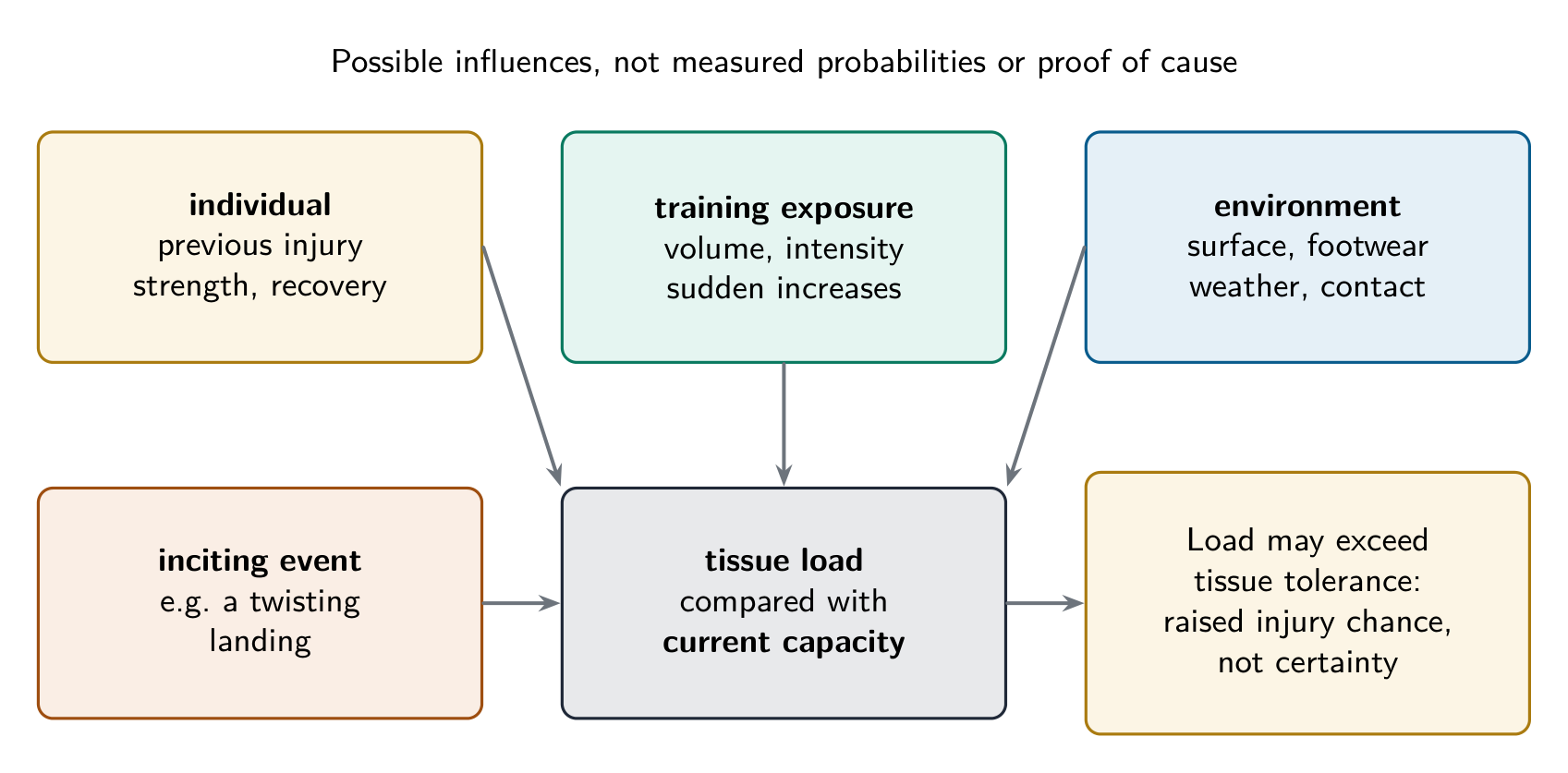
What makes a risk-factor explanation more defensible?
Dificuldade 1/5 · Moedas 100 + pequeno bônus na primeira conclusão hoje
Connect the factor to the actual task without treating a group label as destiny.
B.3: Classify loading history and tissue separately
- Acute trauma follows a sudden excessive or unexpected load. Cumulative trauma involves repeated loading whose combined demands exceed recovery or adaptation.
- Symptoms can appear suddenly after a cumulative history. A sudden report of pain is not proof that all prior tissue loading was acute; repeated loading and acute events can affect several tissue types.
Does sudden symptom onset rule out cumulative loading?
Dificuldade 1/5 · Moedas 100 + pequeno bônus na primeira conclusão hoje
Distinguish when symptoms appear from how loading developed.
B.3: Name the injured structure precisely
- A sprain affects ligament; a strain affects muscle or tendon. Fractures and bone stress injuries concern bone. Skin can sustain cuts, abrasions and repeated friction damage.
- Cartilage and fascia also support or transmit loads. Tissue type and loading mechanism are separate classifications. A whole-body net force does not directly measure stress in one ligament: geometry and internal force distribution matter.
Which tissue does sprain identify?
Dificuldade 1/5 · Moedas 100 + pequeno bônus na primeira conclusão hoje
Use the tissue definition before inferring loading history.
B.3: Define the injury before counting it
- Surveillance needs an explicit case definition, location, timing, exposure and relevant consequences. Any physical complaint and missed participation are different recording thresholds.
- Keep the definition consistent before comparing groups or seasons. A recurrent injury, continuing unresolved problem and new event require consistent classification; altered definitions can change counts without a true change in occurrence.
Can a changed case definition alter the recorded count?
Dificuldade 1/5 · Moedas 100 + pequeno bônus na primeira conclusão hoje
The event definition determines what enters the numerator.
B.3: Build athlete-hours from participation
- An athlete-hour is one participant exposed for one hour. Twelve athletes each attending eight 1.5-hour sessions contribute 12×8×1.5 = 144 athlete-hours if attendance is complete.
- Ten participants each attending six 1.5-hour sessions contribute 90 athlete-hours. Use actual participation if people miss sessions or leave early; session hours alone omit the number exposed.
Ten participants each complete six 1.5-hour sessions. What is their total exposure?
Dificuldade 1/5 · Moedas 100 + pequeno bônus na primeira conclusão hoje
Each participant completes 6 × 1.5 = 9 hours. Total exposure = 10 × 9 = 90 athlete-hours. Counting only the nine session hours omits the number of participants.
Find athlete-hours for ten participants each completing six 1.5-hour sessions.
Dificuldade 2/5 · Moedas 140 + pequeno bônus na primeira conclusão hoje
10×6×1.5=90.
B.3: Compare rates as well as counts
- The original records are A: 6 events/3000 athlete-hours and B: 8/8000. Multiplying count/exposure by 1000 gives 2 and 1 events per 1000 athlete-hours.
- B has more events but the lower recorded event rate. This alone does not prove it is safer in every sense: severity, reporting, participants and exposure composition may differ. A group rate is not a guarantee about the next individual.
Group A records 6 injuries in 3000 athlete-hours; group B records 8 in 8000 athlete-hours. Which has the lower recorded injury rate?
Dificuldade 1/5 · Moedas 100 + pequeno bônus na primeira conclusão hoje
A: 6/3000 × 1000 = 2 events per 1000 athlete-hours. B: 8/8000 × 1000 = 1. B has the lower rate despite its larger count. Severity and reporting still need comparison.
B.3: Recalculate a new exposure rate
- Nine events over 4500 athlete-hours give 9/4500×1000 = 2 per 1000. Eight over 4000 give the same rate.
- Three over 1000 give 3 per 1000, while four over 2000 give 2. These are events per exposure, not percentages of participants. One person can contribute many hours and potentially more than one event.
What is the rate for four events over 2000 athlete-hours?
Dificuldade 1/5 · Moedas 100 + pequeno bônus na primeira conclusão hoje
Rate = events/exposure × 1000 = 4/2000 × 1000 = 2 events per 1000 athlete-hours. This is an event rate, not a percentage of participants.
Find events per 1000 athlete-hours for four events over 2000 athlete-hours.
Dificuldade 2/5 · Moedas 140 + pequeno bônus na primeira conclusão hoje
4/2000×1000=2.
B.3: Measure burden and severity separately
- Time-loss burden combines recorded days lost with exposure. A’s 120 days/3000 hours gives 40 days per 1000 athlete-hours; B’s 400/8000 gives 50.
- B therefore has lower event frequency but higher recorded time-loss burden. Define whether lost time concerns training, competition or both and how overlapping absences are counted. Equal rates can hide different severity and recurrence patterns.
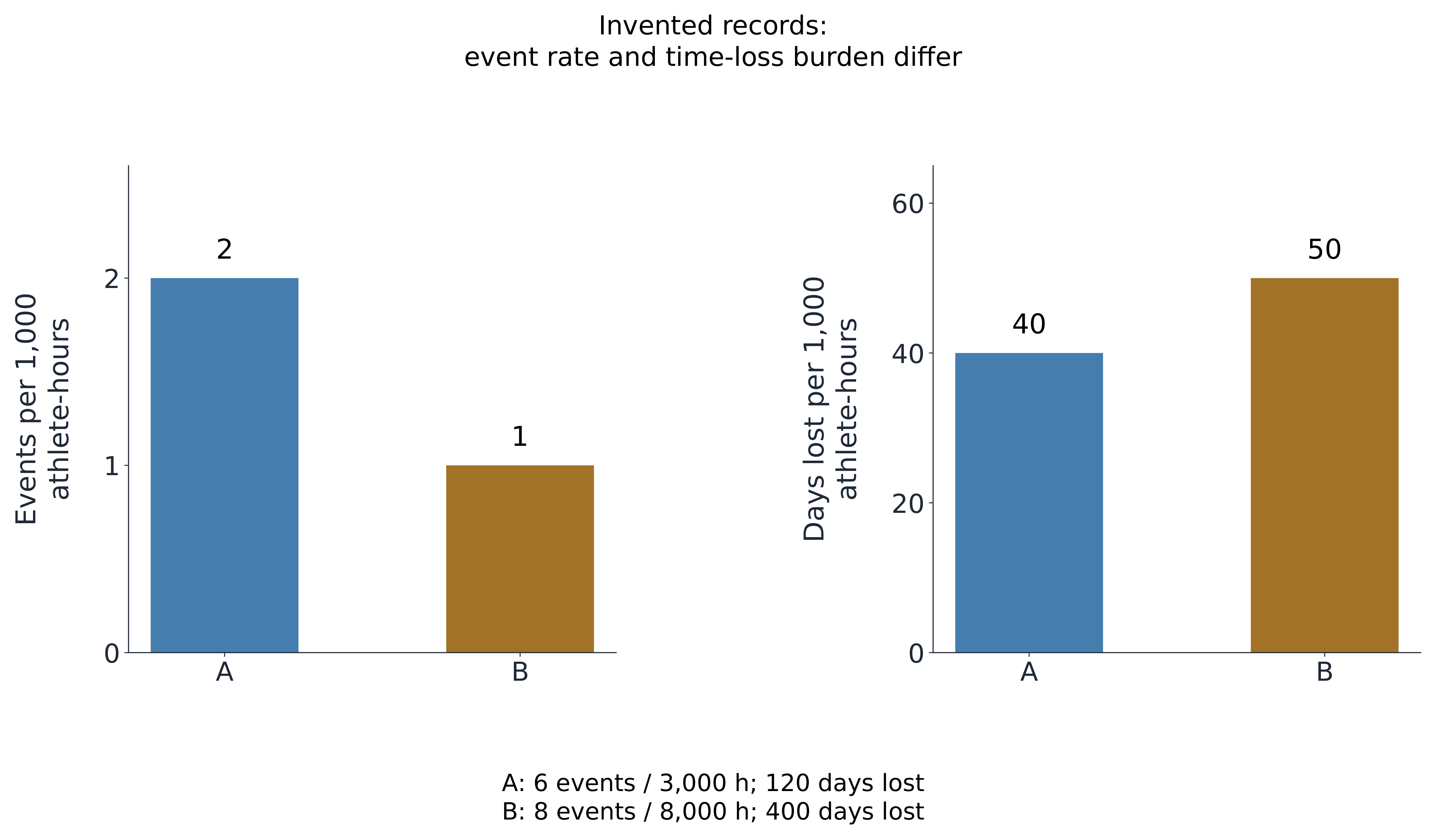
Can a lower event rate coexist with greater time-loss burden?
Dificuldade 1/5 · Moedas 100 + pequeno bônus na primeira conclusão hoje
Counts, exposure rates and consequences answer different questions.
Find days lost per 1000 athlete-hours for 400 days over 8000 athlete-hours.
Dificuldade 2/5 · Moedas 140 + pequeno bônus na primeira conclusão hoje
400/8000×1000=50.
B.3: Evaluate small samples and missing records
- A rate based on a few events is uncertain. Under-reporting, missing exposure, different tasks or participant selection can change a comparison.
- Improved reporting can raise a recorded rate while improving care. Report missing information and investigate plausible causes rather than hiding events that oppose a preferred intervention claim.
Can better reporting increase the recorded rate without more actual injury?
Dificuldade 1/5 · Moedas 100 + pequeno bônus na primeira conclusão hoje
Separate occurrence from ascertainment.
B.3: Connect prevention to a specific demand
- Appropriate progression, strength, balance and control work can develop capacity. Warm-up prepares movement and physiological responses; prehabilitation targets relevant vulnerabilities before injury.
- Flexibility can improve useful range for a task, but more range without control is not universally better. Developmentally appropriate rules, technique and equipment reduce different demand mismatches; no single routine prevents every injury.
What strengthens a prevention explanation?
Dificuldade 1/5 · Moedas 100 + pequeno bônus na primeira conclusão hoje
Link intervention, mechanism and relevant outcome.
B.3: Evaluate protective equipment realistically
- Equipment fit, maintenance, age suitability and appropriate certification matter. Padding can alter how force is distributed over time or area, but cannot remove every injury mechanism.
- The CDC helmet guidance explains that protection does not mean a concussion-proof helmet. Rules, coaching and recognition of injury remain relevant alongside equipment.
Does a helmet guarantee that concussion cannot occur?
Dificuldade 1/5 · Moedas 100 + pequeno bônus na primeira conclusão hoje
Evaluate a specific protective function without promising zero risk.
B.3: Consider equipment and surface together
- Footwear traction depends on the surface and conditions. More grip can support acceleration but also change loading during turns, so maximal friction is not a universal safety objective.
- Visibility, space, weather, fatigue, communication and accessibility affect the setting in which a technique is used. Name the mechanism and measure the relevant outcome before recommending one setting for everyone.
Is the largest friction coefficient automatically safest?
Dificuldade 1/5 · Moedas 100 + pequeno bônus na primeira conclusão hoje
A performance advantage can interact with other demands.
B.3: Design a fair prevention comparison
- Before/after records need comparable exposure, participants, activity, recording and season. Appropriate comparison groups, allocation, adherence records and missing-data reporting strengthen inference.
- Fewer recorded events alone do not prove an intervention caused less injury. A large relative change from a few events may still be highly uncertain; report the actual count and denominator as well as a percentage.
What can confound a warm-up before/after claim?
Dificuldade 1/5 · Moedas 100 + pequeno bônus na primeira conclusão hoje
Test alternative explanations rather than treating chronology as proof of cause.
B.3: Separate inflammation and recovery outcomes
- Inflammation contributes to defence, removal of damaged material and repair. Pain and swelling can accompany it, but symptom relief is different from restored tissue capacity or readiness.
- Treatment selection depends on injury, timing and individual circumstances. A label such as sprain does not alone choose a medicine, dose or complete rehabilitation plan. Evaluate the goal and evidence for the actual intervention.
Does reduced pain prove full load capacity has returned?
Dificuldade 1/5 · Moedas 100 + pequeno bônus na primeira conclusão hoje
Ask which outcome improved and which remain unmeasured.
B.3: Explain treatment principles without a universal recipe
- Compression, elevation, ice and NSAIDs are syllabus examples used to manage symptoms or inflammation. Their suitability varies; devices and medicines can have adverse effects, and relief does not itself prove faster repair.
- Some severe tears or fractures may require surgical repair; others do not. Appropriate rehabilitation develops range, strength, control and task tolerance progressively. Clinical assessment determines the plan; a classroom dataset cannot supply individual treatment or clearance (AAOS overview).
Does naming a therapeutic device establish its benefit?
Dificuldade 1/5 · Moedas 100 + pequeno bônus na primeira conclusão hoje
Distinguish an intervention label from demonstrated effectiveness.
B.3: Recognise concussion without relying on unconsciousness
- A blow or jolt to the body can transmit forces to the head. Concussion can disturb function without loss of consciousness; symptoms can involve thinking, balance, headache or behaviour.
- A routine scan can be normal despite concussion, while concerning findings can require investigation for other injury. Recognition, medical diagnosis and clearance are distinct steps, not a classmate’s judgement from one answer.
Does remaining conscious rule out concussion?
Dificuldade 1/5 · Moedas 100 + pequeno bônus na primeira conclusão hoje
Do not use one absent feature to exclude a functional injury.
B.3: Act on suspicion and danger signs
- For suspected concussion, remove the athlete from sport and arrange medical assessment; no same-day sporting return. Examples such as worsening headache, repeated vomiting, seizures, increasing drowsiness or weakness need urgent emergency assessment.
- These recognition principles do not ask pupils to grade severity or clear someone. Use the CDC response guidance and danger-sign guidance to distinguish appropriate escalation from diagnosis.
Who should determine diagnosis and sporting clearance?
Dificuldade 1/5 · Moedas 100 + pequeno bônus na primeira conclusão hoje
Initial recognition prompts removal and assessment rather than amateur clearance.
B.3: Explain relative rest and learning support
- Relative rest initially reduces excessive demands; complete isolation until every symptom disappears is not the general model. The Amsterdam consensus describes an initial period commonly around 24–48 hours with appropriate symptom-limited daily activity.
- Learning can resume with adjustments such as breaks, modified tasks and extra time under relevant advice. A supported school return is not contact-sport readiness (Amsterdam consensus; CDC recovery guidance).
Does relative rest require all movement and thought to stop until symptom-free?
Dificuldade 1/5 · Moedas 100 + pequeno bônus na primeira conclusão hoje
Distinguish reducing excessive demands from eliminating every activity.
B.3: Read return pathways as reviewed progression
- Learning and physical progression can overlap. The CDC sports framework moves from regular activities through light, moderate and heavy non-contact activity to appropriate practice/contact and competition with healthcare approval and supervision.
- Stages typically require at least 24 hours, but that is not a six-day promise. Symptoms or clinical findings can require review, pausing or stepping back; later contact-risk stages need appropriate medical authorisation. Full regular non-sport activities without injury-related support precede completion of sporting return (CDC framework).
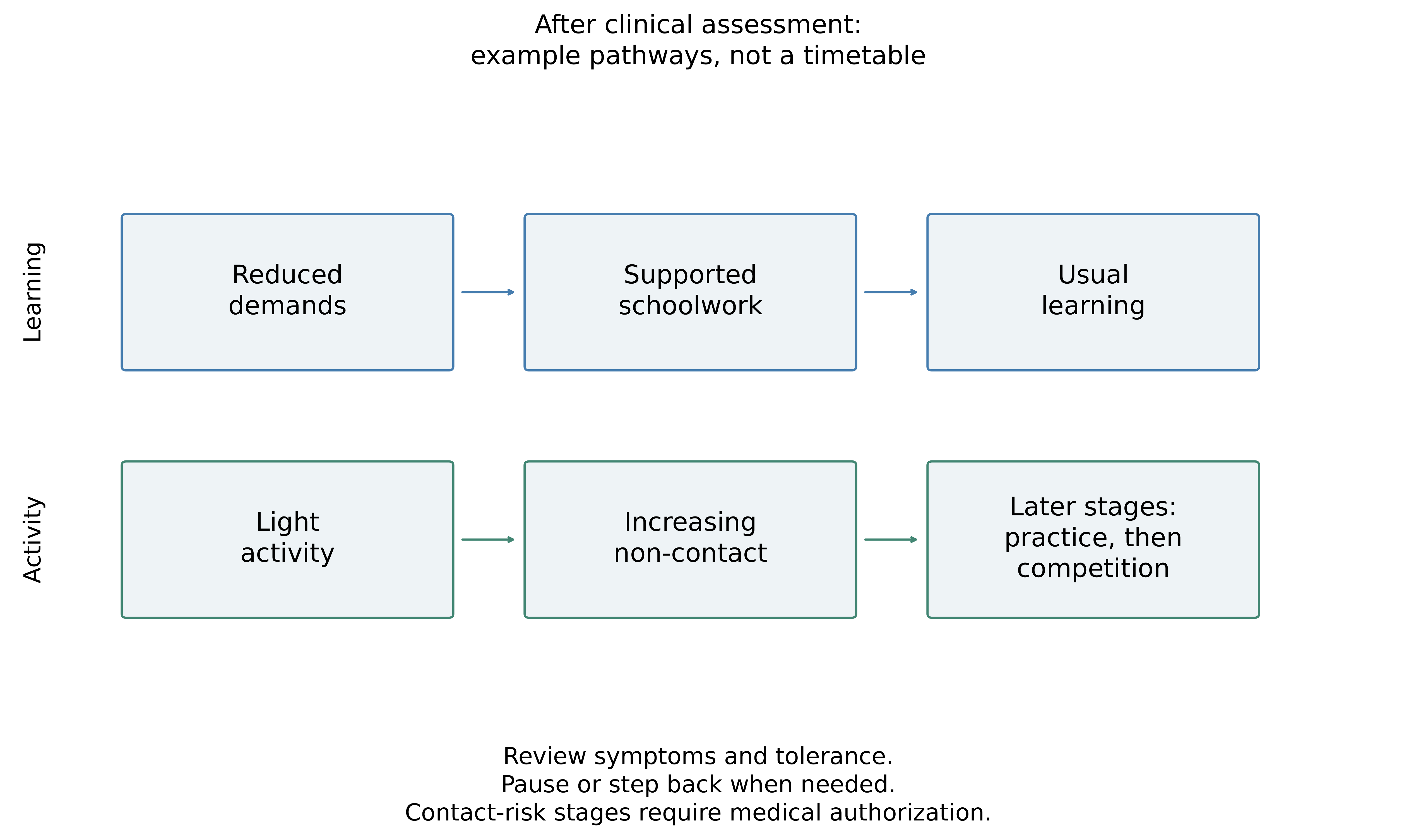
Does a minimum stage duration promise a fixed return date?
Dificuldade 1/5 · Moedas 100 + pequeno bônus na primeira conclusão hoje
A minimum interval is a constraint, not an individual recovery prediction.
B.3: Interpret a non-linear symptom record
- Invented ratings 3,2,3,1,0 include a rise from 2 to 3 before later decreases. Use a consistent scale and note what tasks and conditions accompanied each observation.
- The final zero describes one measurement under its conditions. It does not establish tolerance of all school demands, exercise or contact. A desired final appearance or upcoming competition cannot replace assessment.
What does the temporary 2-to-3 change show?
Dificuldade 1/5 · Moedas 100 + pequeno bônus na primeira conclusão hoje
A setback and the overall course are separate interpretations.
B.3: Match the conclusion to the evidence
- A prevention evaluation should define the event, exposure, severity and comparison. A recovery evaluation should identify symptoms, function and tolerance separately.
- Use anonymised invented or appropriately approved records. Students can compare evidence without inducing injury, diagnosing peers, demanding sensitive disclosures or deciding return-to-play clearance. State the result and its limits rather than expanding one measure into a universal conclusion.
Which conclusion fits an isolated lower recorded event rate?
Dificuldade 1/5 · Moedas 100 + pequeno bônus na primeira conclusão hoje
Do not attribute outcomes that were not actually measured.
AHL B.3: Link technique to task and capacity
- A biomechanical maladaptation is a movement or loading pattern poorly suited to the person’s task and current capacity. It is not any deviation from a preferred drawing.
- Body proportions, previous injury, equipment, load and recovery can affect which adjustment helps. A different stride may redistribute loading rather than reduce every tissue demand. A smoother video alone does not establish safer tissues.
Does a changed running technique necessarily reduce every tissue load?
Dificuldade 1/5 · Moedas 100 + pequeno bônus na primeira conclusão hoje
Specify the tissue and task rather than judging appearance alone.
AHL B.3: Control the camera before inferring improvement
- A before/after joint-angle comparison is confounded if camera position or movement phase changes. Measured projection is not a direct tissue-stress measurement.
- Standardise geometry, landmarks, scale, frame rate, task and phase; repeat measurements and assess observer agreement. Additional views or appropriate force evidence can improve interpretation. Test with supplied or ordinary low-risk movements rather than provoking painful repetitions.
What is an alternative explanation for a changed two-dimensional angle?
Dificuldade 1/5 · Moedas 100 + pequeno bônus na primeira conclusão hoje
Separate measurement geometry from physiological inference.
AHL B.3: Calculate rate differences with the right units
- Before coaching, 18 events/6000 athlete-hours gives 3 per 1000; afterwards 12/6000 gives 2. The absolute difference is 1 event per 1000 athlete-hours.
- Relative reduction = (3−2)/3×100 = 33.333…%. This is not 33.3 percentage points of participants. Season, load, reporting and participant differences require a suitable comparison before assigning causation.
An injury rate falls from 3 to 2 events per 1000 athlete-hours. Which denominator gives the relative percentage reduction from its initial rate?
Dificuldade 1/5 · Moedas 100 + pequeno bônus na primeira conclusão hoje
Rate difference = 3 − 2 = 1 event per 1000 athlete-hours. Relative reduction = 1/3 × 100 ≈ 33.3%, using the initial rate 3. It is not a change in percentage points of participants.
Find relative percentage fall from 3 to 2 events per 1000 athlete-hours, relative to 3.
Dificuldade 2/5 · Moedas 140 + pequeno bônus na primeira conclusão hoje
(3−2)/3×100=33.333…%.
AHL B.3: Multiply load components before comparing totals
- An invented proxy is repetitions×per-repetition index. At 400×100 it is 40000 arbitrary units; at 300×80 it is 24000.
- Repetitions fall (400−300)/400×100 = 25%; the index falls (100−80)/100×100 = 20%. Remaining fractions multiply: (300/400)×(80/100) = 0.75×0.80 = 0.60, so total falls (1−0.60)×100 = 40%. Adding the percentage falls would incorrectly give 45%. The model needs a defined index; it is not a measured tissue energy or clinical risk.
A proxy equals repetitions × per-repetition index. Repetitions fall from 400 to 300 and the index from 100 to 80. How do the remaining fractions combine?
Dificuldade 1/5 · Moedas 100 + pequeno bônus na primeira conclusão hoje
Repetitions retain 300/400 = 0.75 of the initial value; the index retains 80/100 = 0.80. Total retains 0.75 × 0.80 = 0.60, so the reduction is 1 − 0.60 = 0.40 = 40%. Adding the two reductions would give an incorrect 45%.
Find percentage reduction in proxy from 400×100 to 300×80.
Dificuldade 2/5 · Moedas 140 + pequeno bônus na primeira conclusão hoje
Initial proxy = 400 × 100 = 40000 AU; final proxy = 300 × 80 = 24000 AU. Fall = 16000 AU. Percentage reduction = 16000/40000 × 100 = 40%. This proxy is not an injury probability.
AHL B.3: Do not turn a proxy into injury probability
- A 40% reduction in a defined load index does not establish a 40% reduction in injury probability. Proxy validity, nonlinear tissue response, recovery, technique variation and other exposure matter.
- Evaluate the mechanism and collect relevant outcomes with suitable comparison and professional oversight. Improvements in one movement measure, a rate and symptoms may support different conclusions; preserve those distinctions in an exam evaluation.
What is needed before interpreting a proxy as an injury-probability model?
Dificuldade 1/5 · Moedas 100 + pequeno bônus na primeira conclusão hoje
A numerical model’s output has only the meaning its validated definition supports.