Motivation, stress and evidence in sport
Introduzido| English | Significado |
|---|---|
| coping/ˈkəʊpɪŋ/ | enfrentamento |
| motivation/ˌməʊtɪˈveɪʃn/ | motivação |
| stress/stres/ | A harmful or demanding environmental influence that can disrupt an organism's normal functioning or reduce its success. |
| anxiety | anxiety |
| personality/ˌpɜːsəˈnælɪti/ | personality |
| big Five/bɪɡ faɪv/ | A personality model of openness, conscientiousness, extraversion, agreeableness and neuroticism. |
| conscientiousness/ˌkɒnsɪˈenʃəsnəs/ | A personality dimension concerning organisation, dependability and self-discipline. |
| neuroticism/njuːˈrɒtɪsɪzəm/ | A tendency to experience negative emotions and emotional instability. |
| mental toughness | mental toughness |
| maturation | The body's progress towards its adult state. |
| Learned helplessness/lɜːnd ˈhelpləsnəs/ | Reduced attempts to change a situation after experience with events perceived as uncontrollable. |
| burnout | Physical and emotional exhaustion with reduced accomplishment and lost interest in sport. |
| attribution/ətrɪˈbjuːʃn/ | The reason a person gives for an outcome. |
| intrinsic motivation/ɪnˈtrɪnsɪk ˌməʊtɪˈveɪʃn/ | Taking part for the enjoyment or interest of the activity itself. |
| extrinsic motivation/ekˈstrɪnsɪk ˌməʊtɪˈveɪʃn/ | Taking part for outside rewards or pressures. |
| ego orientation | Judging success by beating others. |
| task orientation | Judging success by personal improvement and mastery. |
| motivational climate | The learning atmosphere that coaches and peers create, emphasising mastery or rivalry. |
| autonomy/ɔːˈtɒnəmi/ | The feeling of choosing one's own actions. |
| competence | The feeling of being able to do something effectively. |
| relatedness | The feeling of being connected to others. |
| amotivation | A lack of any intention or reason to take part. |
| cognitive evaluation theory | The idea that rewards raise or lower intrinsic motivation by how they affect autonomy and competence. |
| stressor/ˈstresə/ | A relevant demand or event. |
| cortisol/ˈkɔːtɪsɒl/ | A steroid stress hormone that raises blood glucose and supports fuel use. |
| drive theory | The idea that performance of a well-learned skill rises as arousal rises. |
| cognitive anxiety | The worry and negative thoughts part of anxiety. |
| trait anxiety | trait anxiety |
| state anxiety | Temporary anxiety felt in a particular situation. |
| somatic anxiety | somatic anxiety |
| reframing | Interpreting a situation in a more useful way. |
| problem-focused coping/ˈprɒbləm ˈfəʊkəst ˈkəʊpɪŋ/ | Dealing with stress by acting on its cause. |
| emotion-focused coping/ɪˈməʊʃn ˈfəʊkəst ˈkəʊpɪŋ/ | Dealing with stress by managing one's feelings about it. |
| self-talk | What athletes say to themselves, aloud or silently. |
| imagery/ˈɪmɪdʒri/ | imagery |
| concentration/ˌkɒnsənˈtreɪʃn/ | Holding attention on relevant cues. |
| performance profile | An athlete's own rating of the qualities their sport requires. |
| outcome goal | A target based on the result of a competition, such as winning. |
| performance goal | A target based on the athlete's own standard, such as a personal best. |
| process goal | A target based on technique or actions during performance. |
| instructional self-talk | Self-talk that directs technique or focus. |
| motivational self-talk | Self-talk that builds effort, confidence or mood. |
| matching hypothesis | The idea that a stress technique works best when it fits the type of anxiety. |
| pre-performance routine | pre-performance routine |
| choking | choking |
| goal setting/ɡəʊl ˈsetɪŋ/ | Choosing specific targets to direct effort and measure progress. |
What would explain this observation?
- Two athletes can react differently to the same competition. Their appraisal, experience and coping 应对 strategies affect the response.
Build the model
- Motivation 动机 concerns initiation, direction and persistence of behaviour.
- Stress depends partly on the relationship between perceived demands and perceived resources.
- Arousal and anxiety are related but distinct constructs.
- motivation: Processes influencing initiation and persistence.
- coping: Strategies used to manage demands.

Which classroom approach is ethically appropriate?
Dificuldade 1/5 · Moedas 100 + pequeno bônus na primeira conclusão hoje
Research with people needs voluntary, informed, low-risk participation, so an approved anonymous questionnaire is acceptable. Deliberately inducing distress fails ethics, and one questionnaire score is not a clinical diagnosis.
Match each technical term to its precise meaning.
Dificuldade 2/5 · Moedas 140 + pequeno bônus na primeira conclusão hoje
Use the definitions to distinguish related quantities and processes.
Choose evidence that can test it
- A self-report scale measures reported experience under its design.
- It does not diagnose a disorder or establish a universal relationship between arousal and performance.
- Analyse within-person and between-person variation separately.
In the lab: Use anonymous voluntary questionnaires approved by the school, avoid sensitive personal disclosure, and allow withdrawal. Compare the same task and time point, define the scale and explain its limitations.
Which two habits make the investigation or model in this case more defensible?
Dificuldade 2/5 · Moedas 140 + pequeno bônus na primeira conclusão hoje
Stating the conditions and assumptions lets others repeat the work exactly, and recording the supporting evidence lets them check the conclusion. Hiding disagreeing results removes the evidence that could challenge a wrong conclusion, and one measurement can never establish a wider claim.
Work from known quantities
- Known: reported scores are 2, 4, 4, 5 and 5.
- Mean = sum/count = 20/5 = 4.
- Range = maximum-minimum = 5-2 = 3.
- The mean summarizes this sample and scale, without proving why the participants differ.
Your turn: Scores are 3, 5, 5 and 7. Find the mean.
Scores are 3, 5, 5 and 7. Find the mean.
Dificuldade 2/5 · Moedas 140 + pequeno bônus na primeira conclusão hoje
The result is 5 . Known: scores 3, 5, 5 and 7. Use mean = sum / count. Sum = 3 + 5 + 5 + 7 = 20. Mean = 20/4 = 5. The mean summarises this sample; it does not explain why individuals differ.
Check the conclusion and its limits
- Correlation does not prove that stress caused a performance result.
- Students should not induce distress to investigate coping.
Not true: A self-report stress score is a medical diagnosis. A self-report score is a subjective indication on one scale on one day. A medical diagnosis requires qualified clinical assessment; a questionnaire cannot provide it.
- Motivation concerns initiation, direction and persistence of behaviour.
- A self-report scale measures reported experience under its design.
- Watch for: correlation does not prove that stress caused a performance result.
A self-report stress score is a medical diagnosis.
Dificuldade 1/5 · Moedas 100 + pequeno bônus na primeira conclusão hoje
A self-report score is a subjective indication on one scale on one day. A medical diagnosis requires qualified clinical assessment; a questionnaire cannot provide it.
Processes influencing initiation and persistence: write the technical term.
Dificuldade 1/5 · Moedas 100 + pequeno bônus na primeira conclusão hoje
motivation means Processes influencing initiation and persistence.
Write from a mean of 6
- Reported scores are 3, 3, 4, 8 and 12.
- Find the mean and the range. A self-report score is not a medical diagnosis.
Reported scores are 3, 3, 4, 8 and 12. What are the mean and the range, and why is the mean not a medical diagnosis?
The mean is the sum divided by the count. The range is the maximum minus the minimum.
Reported scores are 3, 3, 4, 8 and 12. What is their mean?
Dificuldade 1/5 · Moedas 100 + pequeno bônus na primeira conclusão hoje
Sum = 3 + 3 + 4 + 8 + 12 = 30. Mean = 30/5 = 6 scale units. The range is 12 − 3 = 9; the maximum is 12. These are different statistics.
C.1: Distinguish trait, state and behaviour
- Personality 人格 concerns relatively enduring patterns of thinking, feeling and behaving. A current mood is a state; one observed action occurs in a specific role and situation.
- An athlete may report different nerves before two events without a lasting personality change. Biological inheritance, learning and environment interact; one questionnaire cannot partition their contributions. All numerical examples here are invented.
Does one anxious pre-match report establish a fixed personality?
Dificuldade 1/5 · Moedas 100 + pequeno bônus na primeira conclusão hoje
Specify the construct and timescale before interpreting a score.
C.1: Use trait models as tendencies
- Trait approaches describe relatively stable differences, not identical behaviour at every event. They do not require every influence to be inherited or every situation irrelevant.
- Historical extraversion/introversion descriptions are not rules assigning individuals to team or individual sports. A preference or trait score is not a deterministic prediction of success.
Does extraversion alone determine the right sport for a person?
Dificuldade 1/5 · Moedas 100 + pequeno bônus na primeira conclusão hoje
Avoid turning a group tendency into an individual assignment.
C.1: Describe the Big Five 大五人格 precisely
- The Big Five are openness, conscientiousness 尽责性, extraversion, agreeableness and neuroticism 神经质. Openness concerns receptiveness to experiences; conscientiousness organisation and self-regulation; extraversion sociability and energetic engagement.
- Agreeableness concerns cooperative interpersonal tendencies; neuroticism concerns a tendency towards negative emotion, contrasted with emotional stability. High or low scores are not moral rankings or clinical diagnoses.
Which trait most directly concerns organisation and self-regulation?
Dificuldade 1/5 · Moedas 100 + pequeno bônus na primeira conclusão hoje
Use the defined trait rather than a general positive or negative label.
C.1: Apply a person–situation explanation
- An interaction model considers the person, environment and their relationship. A normally calm player can respond differently under provocation, fatigue or a high-stakes role.
- Behaviour = f(person, environment) is an organising idea rather than an exact numerical prediction. Ask how the conditions change interpretation, opportunities or responses.
What does an interaction account require?
Dificuldade 1/5 · Moedas 100 + pequeno bônus na primeira conclusão hoje
Connect the specific context to the observed behaviour.
C.1: Treat historical layers as an organising extension
- Hollander’s psychological core concerns deeper values and self-image; typical responses concern usual reactions; role-related behaviour concerns a particular social role.
- A captain may encourage teammates more visibly than when not captain without changing every core value. The layer model is a historical extension alongside the syllabus emphasis on trait patterns and the Big Five.
Does changed captain behaviour necessarily prove changed core values?
Dificuldade 1/5 · Moedas 100 + pequeno bônus na primeira conclusão hoje
Interpret the appropriate level of the organising model.
C.1: Separate mood profiles from personality prediction
- The iceberg sketch uses invented standardized mood values around a reference mean of 50: vigour is above the reference while several negative-mood subscales are below it.
- It is not raw athlete data, a winner-selection threshold or a diagnosis from a subscale named depression. Mood can reflect sleep, illness, workload and events. A profile alone does not determine performance.
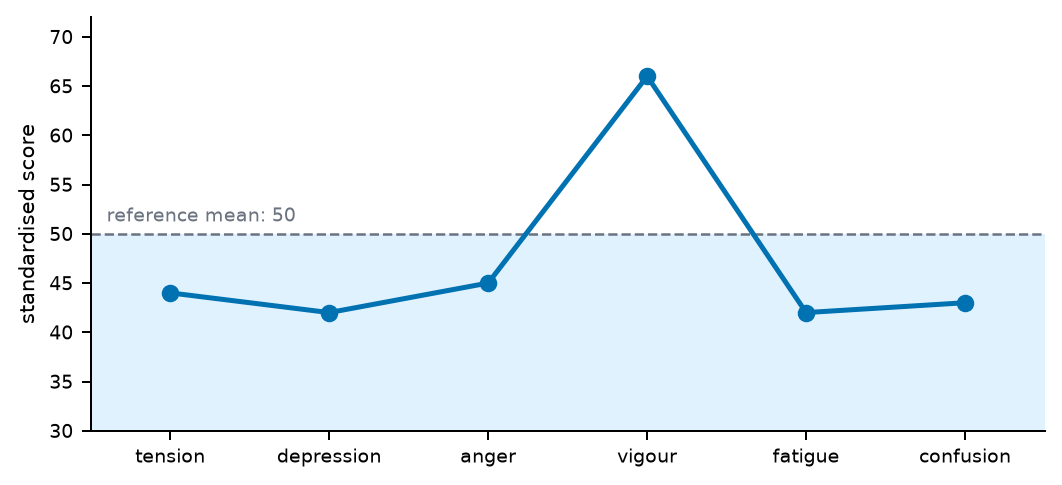
Does the profile identify an inevitable future winner?
Dificuldade 1/5 · Moedas 100 + pequeno bônus na primeira conclusão hoje
A descriptive sketch is not validated individual prediction.
C.1: Evaluate prediction rather than choosing a label
- A useful predictive claim needs a suitable sample, independently measured outcomes, repeated evidence and testing beyond the sample in which the rule was formed.
- A trait may help understand a person’s experience without justifying exclusion. Do not attach an unsupported exact percentage of performance explained to an illustrative mood curve.
What strengthens a prediction claim?
Dificuldade 1/5 · Moedas 100 + pequeno bônus na primeira conclusão hoje
Test prediction against outcomes rather than assuming a named model has already proved it.
C.1: Distinguish reliability and validity
- Reliability concerns consistency under appropriate repeated measurement. Validity concerns whether evidence supports the intended interpretation and use.
- A measure can consistently record socially desirable responses or a different construct. Standardisation aids comparison but does not by itself establish that a scale predicts sporting success or diagnoses illness.
Can a consistent instrument still support an invalid interpretation?
Dificuldade 1/5 · Moedas 100 + pequeno bônus na primeira conclusão hoje
Ask what the instrument measures and which conclusion is justified.
C.1: Compare measurement methods
- Questionnaires permit standardised reports but language, culture, understanding and social desirability can affect responses. Interviews add detail but may introduce interviewer effects.
- Observation records behaviour in context, with observer judgement and opportunity affecting what is seen. Combining suitable evidence can clarify a question without giving perfect access to an inner trait.
What is a limitation of observation?
Dificuldade 1/5 · Moedas 100 + pequeno bônus na primeira conclusão hoje
Describe how the method’s limitations affect the particular inference.
C.1: Explain mental toughness 心理韧性 beyond a slogan
- Mental toughness concerns managing challenging and pressurised situations through appraisal, commitment, confidence, perceived control and resilience. Appraisal concerns how demands and resources are interpreted.
- Resilience involves adapting after setbacks, not never feeling distress. Actual support, health and task demands matter; a toughness label does not guarantee identical performance.
Does resilience mean never experiencing difficulty or distress?
Dificuldade 1/5 · Moedas 100 + pequeno bônus na primeira conclusão hoje
Distinguish effective response from absence of challenge.
C.1: Use the 4Cs as one framework
- Control concerns perceived influence over life and emotions; commitment sustained engagement; challenge interpreting demands as opportunities; confidence belief in relevant capacity.
- A footballer may re-focus after a disputed call, keep working towards a goal, engage with a demanding opponent and trust a practised skill. These examples illustrate a framework, not a diagnostic score or instruction to ignore injury.
Which C describes sustained engagement with goals and tasks?
Dificuldade 1/5 · Moedas 100 + pequeno bônus na primeira conclusão hoje
A useful construct should not be confused with harmful proof-of-toughness demands.
C.1: Interpret high standards in context
- As an extension example, perfectionistic strivings concern high personal standards; concerns involve mistakes, criticism and evaluation. They are related but distinct dimensions.
- High standards alone do not guarantee better performance. Interpret the actual demands, feedback and well-being evidence without diagnosing someone from a label or claiming inevitable dropout.
Do high standards by themselves prove improved outcomes?
Dificuldade 1/5 · Moedas 100 + pequeno bônus na primeira conclusão hoje
Separate a stated standard from its measured consequences.
C.1: Combine characteristics and opportunities
- Talent development involves individual characteristics, health, practice, coaching, facilities and opportunity. A current physical advantage is not the whole of long-term potential.
- A single marker or one current score cannot identify a future champion. Inherited and environmental influences interact rather than supplying mutually exclusive explanations.
Can one physical marker identify an inevitable champion?
Dificuldade 1/5 · Moedas 100 + pequeno bônus na primeira conclusão hoje
Do not infer a complete developmental pathway from one measurement.
C.1: Define the selection year before interpreting age
- Relative age concerns chronological differences within a selection-year cohort. A January cut-off makes January-born participants older than December-born peers in the same cohort.
- Biological maturation 成熟 varies within chronological age. The eligible birth distribution and actual cut-off are needed before interpreting selected birth-quarter counts; older does not mean every individual is more mature or capable.
Are chronological age and maturation interchangeable?
Dificuldade 1/5 · Moedas 100 + pequeno bônus na primeira conclusão hoje
Separate the selection-year position from biological development.
C.1: Calculate a selected distribution
- Invented academy counts 48,36,22,14 total 120. First-quarter share is 48/120×100 = 40%; last-quarter share is 14/120×100 = 11.666…%; ratio is 48/14 = 3.42857… .
- The line at 30 each assumes a uniform eligible reference, not a measured universal birth pattern. Selected counts do not themselves prove which maturity or coaching mechanism caused them.
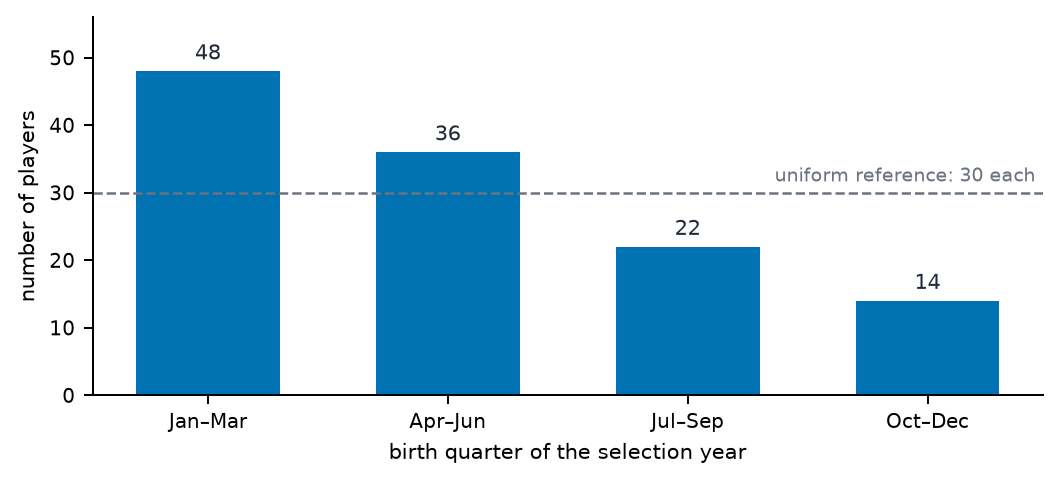
What assumption underlies a reference of 30 per quarter?
Dificuldade 1/5 · Moedas 100 + pequeno bônus na primeira conclusão hoje
State the reference assumption before assessing an apparent imbalance.
Find count ratio for first-quarter 48 and last-quarter 14 records.
Dificuldade 2/5 · Moedas 140 + pequeno bônus na primeira conclusão hoje
48/14=3.42857…; this does not establish cause.
C.1: Recalculate a second squad
- In an invented January-cut-off squad of 40, first-quarter count 17 gives 42.5%; last-quarter count 4 gives 10%. The count ratio is 17/4 = 4.25.
- A mechanism claim needs the eligible pool, selection process, uncertainty and other relevant evidence. Do not replace 4.25 by an imprecise rounded value before later calculations.
In a squad of 40 selected athletes, 17 were born in the first quarter. What is the first-quarter share?
Dificuldade 1/5 · Moedas 100 + pequeno bônus na primeira conclusão hoje
Share = first-quarter count/total × 100 = 17/40 × 100 = 42.5%. The count 17 alone is not a percentage.
Find percentage represented by 17 of 40 selected records.
Dificuldade 2/5 · Moedas 140 + pequeno bônus na primeira conclusão hoje
17/40×100=42.5%.
C.1: Evaluate responses to a selection pattern
- Possible approaches include maturity-informed grouping, open or delayed selection, adjusted comparisons and review of cut-offs. Each needs evaluation against access, measurement and practical constraints.
- Changing a cut-off may redistribute an advantage; maturity grouping needs appropriate reliable measurements. It does not follow that every late maturer must overtake peers or have superior decision-making.
Does changing a cut-off automatically remove every selection disadvantage?
Dificuldade 1/5 · Moedas 100 + pequeno bônus na primeira conclusão hoje
Connect the proposal to the actual mechanism and limitations.
C.1: Read a participation model as a pathway
- The developmental model shows approximate sampling, specialisation and investment stages, with recreational participation possible throughout. It is an extension framework, not a compulsory age timetable.
- Focused practice may develop relevant skills while narrowing other opportunities and concentrating demands. Evaluate access, enjoyment, load, recovery and individual development rather than claiming one route guarantees success.
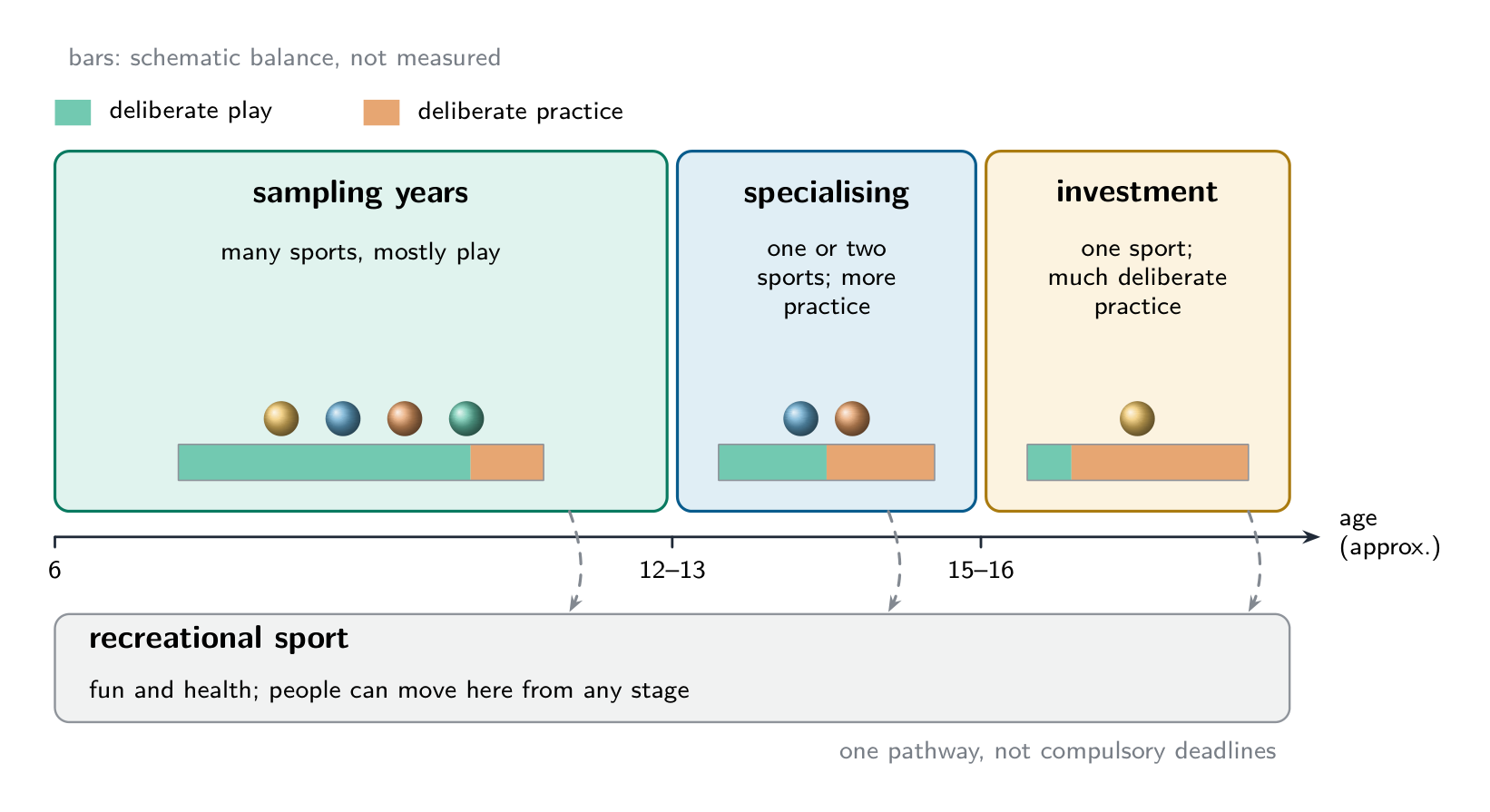
Do the model’s age bands prescribe deadlines for every child?
Dificuldade 1/5 · Moedas 100 + pequeno bônus na primeira conclusão hoje
A model trajectory is not a universal requirement.
C.1: Separate across-person and within-person questions
- Between-person comparisons compare different people. Within-person comparisons follow one person over time or conditions. Their relationships can differ.
- Group scores 2,4,4,5,5 have mean 4.0. One person’s repeated scores 2,3,5,4,3 have mean 3.4 and range 3. The group average does not describe every occasion for that person or isolate a cause.
Does a group relationship automatically hold within every individual?
Dificuldade 1/5 · Moedas 100 + pequeno bônus na primeira conclusão hoje
Match the inference to the level and conditions of measurement.
Find mean of one person’s repeated scores 2,3,5,4,3.
Dificuldade 2/5 · Moedas 140 + pequeno bônus na primeira conclusão hoje
Sum = 2 + 3 + 5 + 4 + 3 = 17. Mean = sum/count = 17/5 = 3.4 scale units. This describes one person’s five recorded occasions.
C.1: Keep the supplied scale and sample
- A separate invented scale with scores 3,3,4,8,12 has sum 30, mean 6 and range 9, matching the original written case. The earlier 1-to-5 example is a different specified scale.
- A mean summarises the records; it does not identify why people differ, establish a clinical diagnosis or justify a public rank. Match task, time point and instrument before comparing scores.
What is the mean of 3,3,4,8,12?
Dificuldade 1/5 · Moedas 100 + pequeno bônus na primeira conclusão hoje
Sum = 3 + 3 + 4 + 8 + 12 = 30; count = 5. Mean = 30/5 = 6 scale units. The alternative 9 is the range, 12 − 3.
Find range of 3,3,4,8,12.
Dificuldade 2/5 · Moedas 140 + pequeno bônus na primeira conclusão hoje
12−3=9; mean is the different value 6.
C.1: Protect participants and explain anonymity
- Use school-approved low-risk voluntary questions with informed participation and appropriate confidentiality. Avoid sensitive disclosure and public labelling or selection from scores.
- Explain withdrawal arrangements before collection. Fully anonymous records cannot later identify a specific pupil unless an agreed method permits it. Students should not induce distress to study psychological responses.
Why explain anonymous-data withdrawal limits in advance?
Dificuldade 1/5 · Moedas 100 + pequeno bônus na primeira conclusão hoje
Consent should accurately describe what the procedure can and cannot do.
AHL C.1: Trace observational learning
- Attention notices the model; retention stores a representation; reproduction requires relevant capability; motivation affects performance of the observed action.
- A respected captain’s constructive response to a mistake may be noticed and copied after its acceptance by teammates. Regard for the model and observed consequences matter, but learning does not require immediate visible imitation by every observer.
Can someone retain an observed action without performing it immediately?
Dificuldade 1/5 · Moedas 100 + pequeno bônus na primeira conclusão hoje
Distinguish the stages instead of treating observation as automatic copying.
AHL C.1: Limit an experiment’s inference
- Bandura, Ross and Ross’s 1961 experiment found more reproduction of modelled aggression after exposure to aggressive models in its experimental setting.
- This supports a bounded observational-learning inference, not a claim that every viewer of professional sport becomes aggressive or that inherited influences do not exist. Describe the setting, outcome and generalisation limit.
Does that experiment prove identical aggression in every real sporting viewer?
Dificuldade 1/5 · Moedas 100 + pequeno bônus na primeira conclusão hoje
Keep the inference tied to what was actually studied.
AHL C.1: Study personality development over time
- Experience, coaching and reflection can contribute to longer-term change, even while traits show relative stability. Role behaviour, mood and persistent trait change differ in timescale and meaning.
- Use repeated appropriate measures across contexts; consider measurement error, response bias and wider life changes. There is no single profile that determines every sporting outcome.
Does a one-session behaviour change establish lasting personality change?
Dificuldade 1/5 · Moedas 100 + pequeno bônus na primeira conclusão hoje
Define persistence and use evidence appropriate to it.
AHL C.1: Explain a self-fulfilling process
- An expectation can change feedback, opportunity, persistence and practice; those behaviours can influence an outcome and reinforce the expectation. The initial belief need not accurately measure ability.
- A coach giving one player more constructive chances may help that player develop. Confidence does not directly manufacture a result: identify the behavioural and environmental links and consider alternative explanations.
What makes the explanation a process rather than magic confidence?
Dificuldade 1/5 · Moedas 100 + pequeno bônus na primeira conclusão hoje
Trace the mechanism and its practical limits.
AHL C.1: Interpret perceived lack of control
- Learned helplessness 习得性无助 concerns a perception that actions do not influence outcomes, which can discourage attempts to change them. Real barriers outside the individual’s control also matter.
- A statement such as nothing I do affects selection suggests a question about perceived action–outcome control, not a diagnosis from one sentence. Constructive feedback identifies feasible actions and fair opportunities without blaming the person.
Does one quiet response diagnose learned helplessness?
Dificuldade 1/5 · Moedas 100 + pequeno bônus na primeira conclusão hoje
Avoid substituting a visible stereotype for the proposed mechanism.
AHL C.1: Evaluate toughness and health associations
- A prospective study of young elite athletes associated higher toughness scores with fewer reported burnout 倦怠 and depressive symptoms under high stress; the pattern differed at low stress. A separate study linked scores with objectively recorded sleep characteristics.
- These findings do not prove toughness training prevents or treats illness. Stress, sleep, support and health can affect each other; follow-up establishes temporal information but is not random allocation (athlete study; sleep study).
Does an association establish a treatment effect?
Dificuldade 1/5 · Moedas 100 + pequeno bônus na primeira conclusão hoje
Separate reported traits, symptoms, diagnosis and intervention evidence.
AHL C.1: Distinguish locus, stability and control
- Attributions 归因 explain outcomes. Locus places the perceived cause internally or externally; stability asks whether it is expected to persist. Controllability asks separately whether it can be changed.
- Internal does not automatically mean controllable, and external does not mean permanent. Classify the actual stated explanation and timescale rather than memorising an immutable label for every mention of ability or effort.
Does internal locus guarantee controllability?
Dificuldade 1/5 · Moedas 100 + pequeno bônus na primeira conclusão hoje
Keep the three dimensions separate.
AHL C.1: Classify the stated explanation
- I have no ability and never will is internal/stable in that account; I missed my routine this time is internal/unstable. This course remains difficult is external/stable; a one-off gust affected it is external/unstable.
- Stable describes expected persistence in the account, not proof that ability can never develop. These are illustrative interpretations, not verified causes of the actual result.
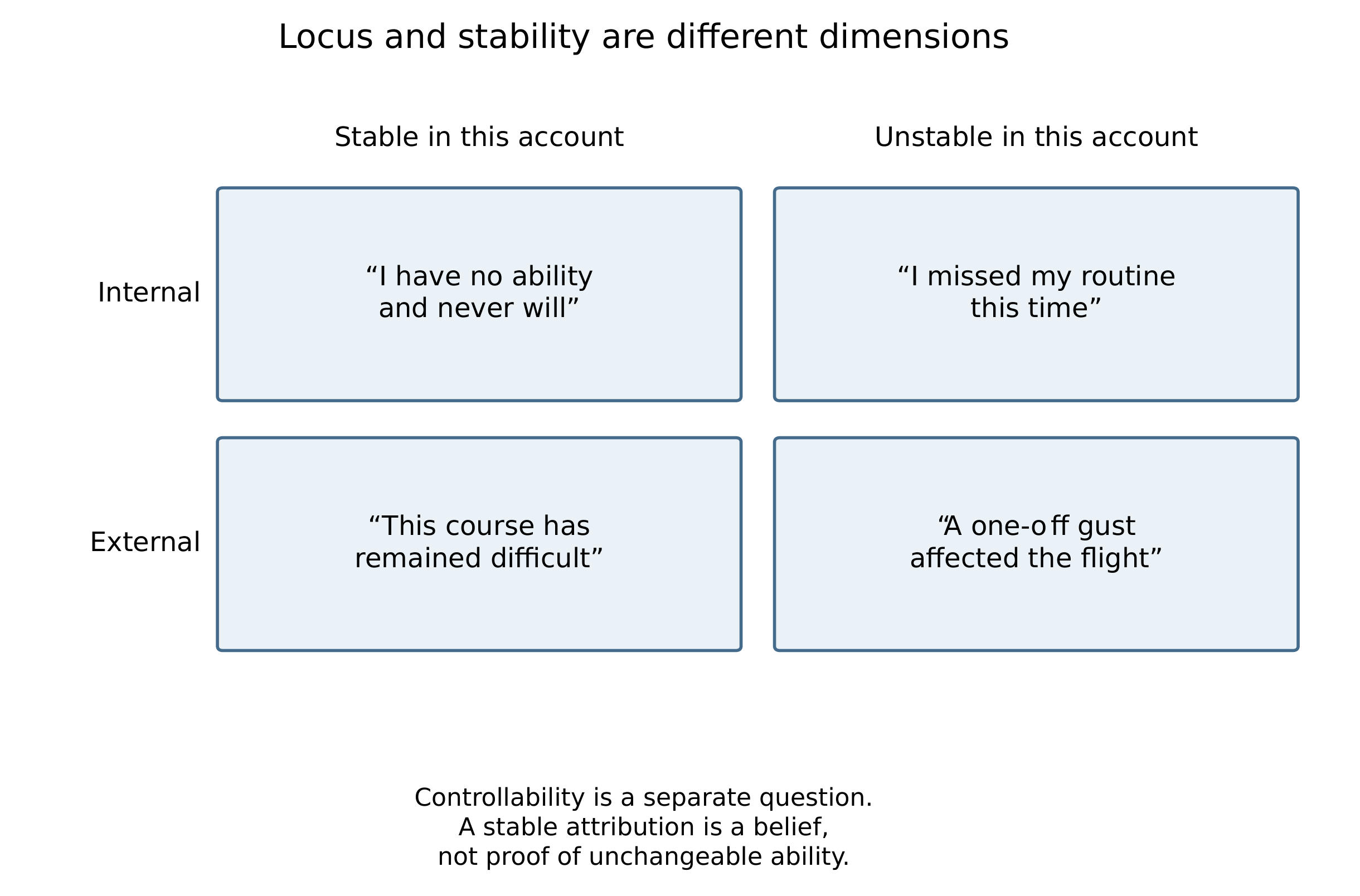
What does stable mean in this classification?
Dificuldade 1/5 · Moedas 100 + pequeno bônus na primeira conclusão hoje
Distinguish the belief being classified from facts established by evidence.
AHL C.1: Connect attribution and future confidence
- A perceived lasting cause can affect expectations for next time; a specific changeable action may support an improvement plan when evidence and resources permit it.
- A helpful explanation should remain accurate. Do not invent a positive story, deny genuine barriers or assume that all internal/unstable explanations produce the same confidence response. Evaluate the person, task and outcome.
What should a constructive response identify?
Dificuldade 1/5 · Moedas 100 + pequeno bônus na primeira conclusão hoje
Support confidence through a defensible interpretation and opportunity.
C.3: Define direction and intensity
- Motivation concerns which activities someone chooses and the effort and persistence they invest. Attendance is an observable behaviour; the reason for it is a different question.
- Two pupils in the same session may enjoy learning, value a health benefit, seek approval or avoid criticism. Several reasons can coexist. Numerical examples here are invented unless a named historical study is identified.
Does identical attendance establish identical motivation?
Dificuldade 1/5 · Moedas 100 + pequeno bônus na primeira conclusão hoje
Distinguish the observed action from the proposed reason.
C.3: Distinguish enjoyment and instrumental purpose
- Intrinsic motivation 内在动机 concerns enjoyment or interest in doing the activity itself. Extrinsic motivation 外在动机 concerns a separable purpose, such as recognition or a valued benefit.
- Extrinsic does not always mean unwilling or pressured. A pupil can willingly practise an uninteresting component because they personally value its contribution to a goal.
Is every extrinsic reason necessarily experienced as external pressure?
Dificuldade 1/5 · Moedas 100 + pequeno bônus na primeira conclusão hoje
Separate enjoyment from the degree of willingness.
C.3: Trace a need-achievement explanation
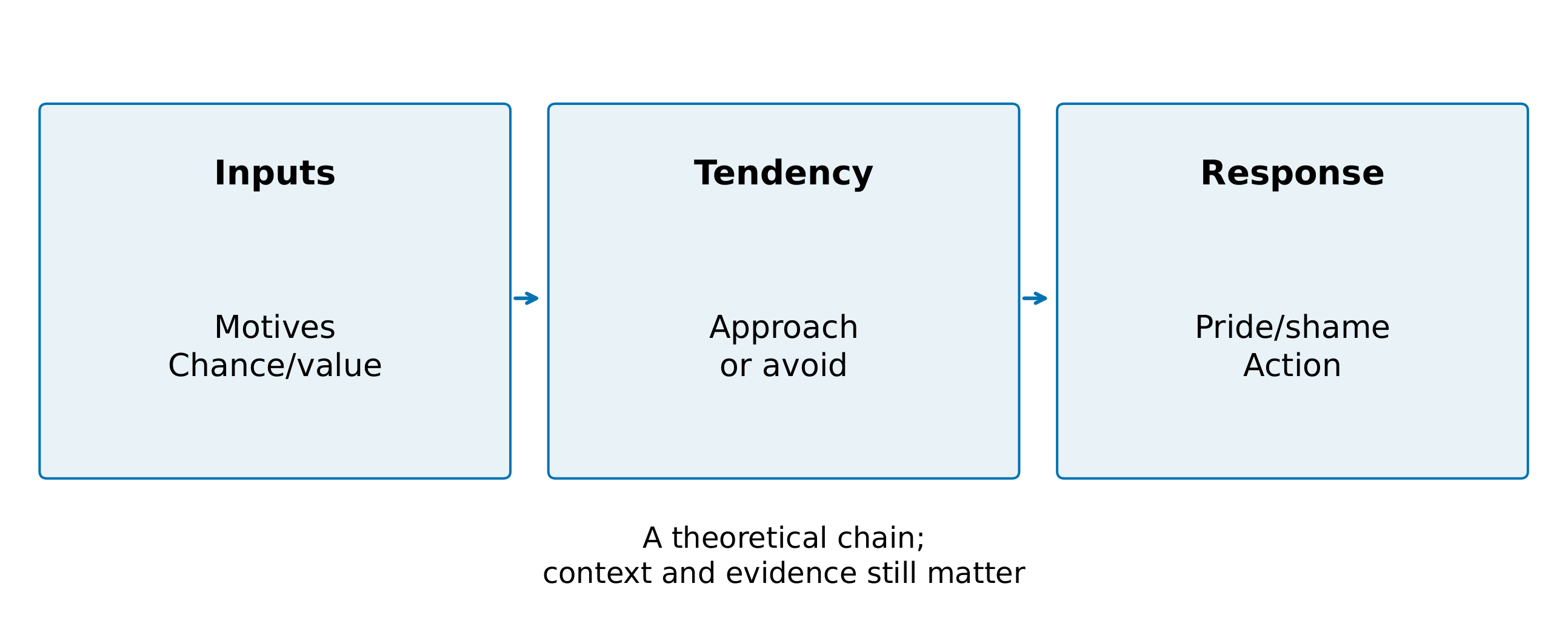
- In need-achievement theory, approach and avoidance motives interact with perceived chance and value of success. A resultant tendency relates to anticipated pride or shame and then task choice, effort or avoidance.
- Describe the links in a particular situation rather than diagnosing a fixed personality from one decision. Opportunity, prior experience and actual demands also matter.
What belongs in a person–situation explanation?
Dificuldade 1/5 · Moedas 100 + pequeno bônus na primeira conclusão hoje
Connect the model’s factors to the actual decision.
C.3: Change the meaning of evaluation
- A learner may avoid a public time trial because failure feels humiliating. A coach can offer a suitable development target and specific private feedback.
- Changing the situation can change the perceived demand and available ways to succeed. It does not guarantee motivation, instantly change a trait or establish why a particular pupil was absent.
Which is a situational coaching change?
Dificuldade 1/5 · Moedas 100 + pequeno bônus na primeira conclusão hoje
Target the conditions and their meaning, not a personal stereotype.
C.3: Interpret moderate challenge as a model
- A moderate perceived probability of success can balance achievement value with a realistic opportunity. The familiar 50% example belongs to a simplified theoretical account.
- It is not an instruction that half of every learner’s attempts should fail. Task risk, confidence, progression and access affect what challenge is appropriate.
Does the theory prescribe exactly 50% failure for every drill?
Dificuldade 1/5 · Moedas 100 + pequeno bônus na primeira conclusão hoje
Keep assumptions distinct from practical prescriptions.
C.3: Define task and ego orientation 自我取向
- Task orientation 任务取向 judges success by learning, effort and personal improvement. Ego orientation uses comparison with others or norm-referenced superiority.
- The orientations can coexist. A person can want to improve and also win; a single competitive goal does not establish low task orientation or predict moral behaviour.
Can someone value both improvement and winning?
Dificuldade 1/5 · Moedas 100 + pequeno bônus na primeira conclusão hoje
Describe the success criteria without assuming an either/or identity.
C.3: Separate the individual from the climate
- Goal orientation concerns the participant’s criterion of success. Motivational climate 动机氛围 concerns what coaching tasks, instructions, feedback and recognition make important.
- A coach can encourage improvement and cooperation while still preparing a team to compete. A participant’s orientation and the environment’s climate require different evidence.
Is task orientation identical to a mastery climate?
Dificuldade 1/5 · Moedas 100 + pequeno bônus na primeira conclusão hoje
Keep levels of explanation distinct.
C.3: Support autonomy 自主 with meaningful structure
- Autonomy concerns willing endorsement. Offer relevant choices, explain reasons and acknowledge the learner’s perspective within clear boundaries.
- Autonomy does not mean doing anything without rules or abandoning supervision. A nominal choice can still feel coercive if humiliation or unfair consequences remove a meaningful option.
Can clear safety rules coexist with autonomy support?
Dificuldade 1/5 · Moedas 100 + pequeno bônus na primeira conclusão hoje
Examine how structure and choice are experienced.
C.3: Support competence 胜任 without public superiority
- Competence concerns feeling capable of effective action. Achievable challenges, appropriate progression and usable specific feedback can support it.
- A pupil can improve without becoming the best in the group. Praise should remain accurate; a badge or winning score alone does not prove all participants feel competent.
Does competence require always outperforming teammates?
Dificuldade 1/5 · Moedas 100 + pequeno bônus na primeira conclusão hoje
Distinguish mastery evidence from public comparison.
C.3: Support relatedness 归属 through actual inclusion
- Relatedness concerns valued connection and belonging. Respect, reliable support and meaningful participation can contribute.
- Being assigned to a team does not establish acceptance. Conditional approval or exclusion can frustrate connection even when the team wins.
Is a team-membership list sufficient evidence that relatedness is satisfied?
Dificuldade 1/5 · Moedas 100 + pequeno bônus na primeira conclusão hoje
Evaluate interaction and participation, not labels alone.
C.3: Distinguish controlled, autonomous and absent reasons
- Controlled motivation involves experienced pressure such as approval or guilt. Autonomous motivation involves willingness and personal endorsement. Amotivation 无动机 involves little intention or perceived useful connection between action and outcome.
- A pupil may value an instrumental fitness purpose without enjoying each drill. A one-session reason is not necessarily a stable orientation across all contexts.
Which example is autonomous but may remain instrumental?
Dificuldade 1/5 · Moedas 100 + pequeno bônus na primeira conclusão hoje
Classify the stated reason rather than whether a coach is present.
C.3: Recognise forms of intrinsic interest
- An athlete may enjoy discovering a new technique, accomplishing a challenge or experiencing the sensations of a well-timed movement. These concern the activity itself.
- Enjoyment can support engagement, but health, timetable, cost and access also affect participation. One label does not guarantee persistence or diagnose well-being.
Does enjoyment guarantee attendance under all practical conditions?
Dificuldade 1/5 · Moedas 100 + pequeno bônus na primeira conclusão hoje
Connect motivation to behaviour without ignoring circumstances.
C.3: Describe a mastery climate concretely
- A mastery climate recognises effort, cooperation and improvement and treats mistakes as information for learning. An ego climate makes norm comparison and winning at all costs central.
- Explain the actual instructions and feedback rather than judging a climate from a team’s results. Competition can coexist with development-focused teaching.
What is direct evidence of a development-focused climate?
Dificuldade 1/5 · Moedas 100 + pequeno bônus na primeira conclusão hoje
Use features of the environment rather than the outcome alone.
C.3: Design TARGET tasks and authority
- Set meaningful tasks with suitable challenge and variation. Share appropriate decisions and explain why relevant constraints remain.
- For example, let a learner choose between suitable passing targets while maintaining agreed safety and practice goals. Task and authority choices should fit capability and context.
What combines task design with appropriate authority?
Dificuldade 1/5 · Moedas 100 + pequeno bônus na primeira conclusão hoje
A concrete choice should support the intended learning.
C.3: Design TARGET recognition and grouping
- Recognise accurate evidence of effort, improvement and cooperation without humiliating public comparisons. Use grouping that supports the actual task and participation.
- Mixed groups may help some cooperative tasks, but no grouping label guarantees inclusion or safety. Examine roles, access and whether everyone gets useful opportunities.
Does mixed grouping automatically prove a mastery climate?
Dificuldade 1/5 · Moedas 100 + pequeno bônus na primeira conclusão hoje
Evaluate what grouping enables rather than the label itself.
C.3: Design TARGET evaluation and time
- Evaluate progress against suitable personal or task criteria and allow useful time to learn. Feedback should help the learner interpret and improve an action.
- Different tasks and starting points may need different practice opportunities. A fixed identical schedule can look equal while giving different learners unequal access to useful success.
What is an appropriate evaluation criterion for personal development?
Dificuldade 1/5 · Moedas 100 + pequeno bônus na primeira conclusão hoje
Match the reference point to the teaching aim.
C.3: Calculate an attendance contrast
- An invented club rises from 18 of 30 attendees to 24 of 30: 60% to 80%. The rise is 20 percentage points.
- Relative increase uses the starting rate: (80−60)/60×100 = 33.333…%, equivalently (24−18)/18×100. Counts do not themselves identify motives or causes.
Attendance rises from 18 of 30 members to 24 of the same 30 members, or 60% to 80%. Which is the percentage-point rise?
Dificuldade 1/5 · Moedas 100 + pequeno bônus na primeira conclusão hoje
Initial attendance = 18/30 × 100 = 60%; final attendance = 24/30 × 100 = 80%. Difference = 80 − 60 = 20 percentage points. Relative increase = 20/60 × 100 ≈ 33.3%, a different quantity.
Find relative percentage increase from 18 to 24 attenders. Give the percentage to three significant figures.
Dificuldade 2/5 · Moedas 140 + pequeno bônus na primeira conclusão hoje
The increase is 24−18=6 attenders. Relative increase = 6/18×100=33.333333…%, or 33.3% to three significant figures. Divide by the starting attendance, not the final 24.
C.3: Test a climate claim with suitable evidence
- A change in tasks and feedback may coincide with improved attendance. Season, timetable, transport, membership and extra coaching may also change.
- Record the intervention, use appropriate comparable baselines/groups and follow outcomes over time. Examine experience as well as participation; a before/after difference alone does not prove the mechanism.
Does rising attendance after a change prove the change caused it?
Dificuldade 1/5 · Moedas 100 + pequeno bônus na primeira conclusão hoje
Distinguish a compatible observation from a causal estimate.
C.3: Keep the drawing study bounded
- Lepper, Greene and Nisbett’s 1973 study compared initially interested preschool children under expected, unexpected and no-award conditions. Later free-play interest was lower after expected reward than in comparison conditions.
- This supports a setting-specific inference, not a universal numerical reduction or a direct estimate for paying young athletes. Participant, activity, contingency and later outcome matter (original paper).
Does that finding prove every sporting certificate harms every child?
Dificuldade 1/5 · Moedas 100 + pequeno bônus na primeira conclusão hoje
State what was studied and limit the conclusion to its evidence.
C.3: Calculate retention and dropout
- An invented class begins with 60 participants and retains 39. Retention = 39/60×100 = 65%; cumulative dropout = 21/60×100 = 35%.
- Use the original cohort for cumulative dropout, defining who counts as retained. Missing records, eligibility changes and attendance definitions can affect interpretation.
A class starts with 60 participants and retains 39. Which denominator gives cumulative dropout as a percentage of the original cohort?
Dificuldade 1/5 · Moedas 100 + pequeno bônus na primeira conclusão hoje
Number leaving = 60 − 39 = 21. Cumulative dropout = 21/60 × 100 = 35%, using the original 60 rather than the 39 remaining.
Find cumulative dropout percentage when 39 of an original 60 remain.
Dificuldade 2/5 · Moedas 140 + pequeno bônus na primeira conclusão hoje
Number lost = original cohort − remaining = 60 − 39 = 21. Cumulative dropout percentage = 21/60 × 100 = 35%.
C.3: Distinguish cumulative and interval loss
- A separate invented cohort begins with 80; 56 remain in December and 44 in March. Cumulative dropout is 30% and 45%; March retention is 55%.
- From December to March, 12 of the 56 December participants leave: 12/56×100 = 21.428571…%. That interval denominator differs from the original 80.
A cohort starts with 80 participants; 56 remain in December and 44 in March. Which denominator gives the percentage lost from December to March among December participants?
Dificuldade 1/5 · Moedas 100 + pequeno bônus na primeira conclusão hoje
Interval loss = 56 − 44 = 12. Divide by the 56 present at the interval’s start: 12/56 × 100 ≈ 21.4%. Original-cohort dropout instead uses 80.
Find percentage lost from the 56 December attenders when 44 remain in March. Give the percentage to three significant figures.
Dificuldade 2/5 · Moedas 140 + pequeno bônus na primeira conclusão hoje
(56−44)/56×100=21.428571…%, or 21.4% to three significant figures. The denominator is the 56 December attenders, distinct from original-cohort dropout.
C.3: Do not infer a behaviour-change stage from the month
- As an extension, stages of change describe intention and the duration of a defined regular behaviour. Prior activity and actual individual histories are needed.
- A club’s six-month anniversary does not establish that every remaining person has exercised regularly for six months. Counts also do not reveal why someone left or which support will help.
Can the calendar month alone establish each participant’s stage?
Dificuldade 1/5 · Moedas 100 + pequeno bônus na primeira conclusão hoje
Use the model’s actual criteria rather than a calendar shortcut.
C.3: Investigate barriers without blaming a person
- Ask about suitable access, preferences, health and demands before choosing support. Enjoyable tasks, constructive feedback and reliable connection can be evaluated.
- Use school-approved low-risk voluntary questions with informed participation, confidentiality and explained withdrawal limits. Do not publicly rank motives or infer laziness, illness or a fixed personality from non-attendance.
What is a defensible response to an unexplained absence?
Dificuldade 1/5 · Moedas 100 + pequeno bônus na primeira conclusão hoje
Motivation research should not replace evidence with a judgement.
AHL C.3: Explain threatened ego evaluation
- High ego orientation with low task orientation can leave few improvement-based ways to feel successful. Believing others see one’s ability as low may make comparison threatening.
- Anxiety, excuses, reduced effort or withdrawal can be defensive responses in this account. Do not infer cheating or inevitable dropout from one score or defeat.
Which condition is relevant to the ego-vulnerability account?
Dificuldade 1/5 · Moedas 100 + pequeno bônus na primeira conclusão hoje
Explain the conditional process rather than assigning a stereotype.
AHL C.3: Change the context of competence
- Specific private development feedback and achievable targets can broaden ways to recognise progress. A coach can reduce unnecessary humiliation and support participation.
- Actual injury, exclusion, transport or other barriers still matter. A supportive response does not guarantee identical confidence, eliminate anxiety or instantly change a disposition.
Should a coach deny an access barrier to insist motivation is internal?
Dificuldade 1/5 · Moedas 100 + pequeno bônus na primeira conclusão hoje
Combine a theoretical mechanism with evidence about circumstances.
AHL C.3: Identify the six mini-theories
- SDT includes cognitive evaluation, organismic integration, causality orientations, basic psychological needs, goal contents and relationships motivation theories. They address different questions.
- Apply each to a relevant example rather than treating six names as interchangeable explanations. A single session may be examined at several levels without proving each proposed mechanism.
Does naming SDT establish which particular mechanism caused attendance?
Dificuldade 1/5 · Moedas 100 + pequeno bônus na primeira conclusão hoje
Choose the explanatory question before interpreting the observation.
AHL C.3: Explain cognitive evaluation theory 认知评价理论
- CET concerns intrinsic interest and how events support or undermine perceived autonomy and competence. A reward may communicate useful information, pressure or both.
- Its meaning, contingency and initial interest matter. Accurate feedback can support competence while preserving choice; threats and conditional worth can undermine autonomy. Surprise awards are not a universal rule.
What matters beyond the mere existence of a badge?
Dificuldade 1/5 · Moedas 100 + pequeno bônus na primeira conclusão hoje
Analyse information and control rather than calling all rewards good or bad.
AHL C.3: Explain organismic integration theory
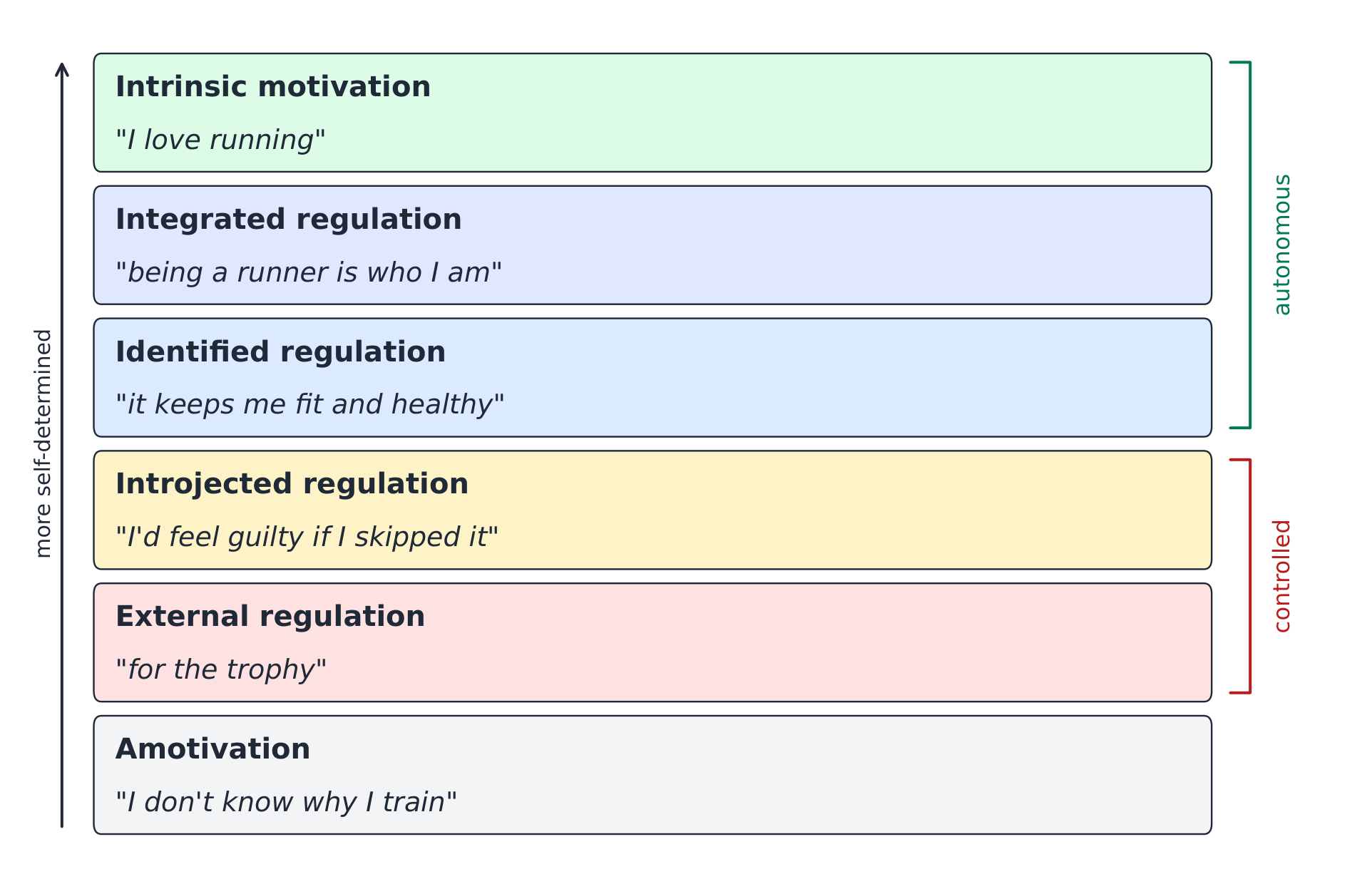
- OIT concerns forms of extrinsic regulation and internalisation of an instrumental purpose. External regulation centres on rewards/sanctions; introjection involves internal pressure such as guilt.
- Identification involves valuing the purpose; integration aligns it with wider values and identity. The latter can be autonomous while still serving a separable outcome.
Does personally valuing a purpose make it identical to enjoying the act itself?
Dificuldade 1/5 · Moedas 100 + pequeno bônus na primeira conclusão hoje
Keep the purpose of the action separate from its degree of internalisation.
AHL C.3: Classify the stated regulation
- Avoiding loss of a privilege suggests external regulation; avoiding shame suggests introjected regulation. Valuing a fitness benefit suggests identified regulation; fitting the purpose with wider identity suggests integrated regulation.
- People can have mixed reasons and need not progress through a fixed sequence. Classify what is stated, and ask for clarification within a real study rather than treating one sentence as a full personality assessment.
Which reason most clearly suggests introjected regulation?
Dificuldade 1/5 · Moedas 100 + pequeno bônus na primeira conclusão hoje
Introjection concerns internal pressure rather than intrinsic pleasure.
AHL C.3: Keep integration distinct from enjoyment
- Integrated regulation fits an instrumental activity with wider identity and values. Intrinsic motivation concerns enjoyment or interest in the activity itself.
- A runner may willingly do an uninteresting drill because it fits a valued training purpose. That does not require claiming that every drill is inherently enjoyable.
Can an integrated training purpose coexist with a boring drill?
Dificuldade 1/5 · Moedas 100 + pequeno bônus na primeira conclusão hoje
Do not collapse autonomous regulation into intrinsic enjoyment.
AHL C.3: Calculate the supplied profile summaries
- An invented 1-to-7 profile gives intrinsic 6.2, integrated 5.8, identified 5.5, introjected 3.1 and external 2.0. The first three average 17.5/3 = 5.833333…; the latter two average 5.1/2 = 2.55.
- These are simple classroom arithmetic summaries, not a validated composite scoring system, diagnosis or guarantee of persistence. Amotivation 1.2 is reported separately.
Does the higher listed autonomous mean guarantee future attendance?
Dificuldade 1/5 · Moedas 100 + pequeno bônus na primeira conclusão hoje
Separate a numerical description from a validated prediction.
Find simple mean of supplied autonomous subscale values 6.2, 5.8 and 5.5.
Dificuldade 2/5 · Moedas 140 + pequeno bônus na primeira conclusão hoje
(6.2+5.8+5.5)/3=5.833333…; not a validated composite.
AHL C.3: Compare a second supplied profile
- A second profile lists intrinsic 2.5, identified 3.0, introjected 5.4 and external 6.1. The two supplied autonomous values average 2.75; controlled values average 5.75.
- Integrated regulation is not supplied here. Do not invent it or assume that summaries based on different subscale sets are identical validated constructs. The listed reasons suggest greater experienced control, without proving dropout.
Can a missing integrated subscale be assumed to be zero?
Dificuldade 1/5 · Moedas 100 + pequeno bônus na primeira conclusão hoje
Respect what the dataset actually supplies.
Find mean of supplied controlled values 5.4 and 6.1.
Dificuldade 2/5 · Moedas 140 + pequeno bônus na primeira conclusão hoje
Sum of the two supplied controlled values = 5.4 + 6.1 = 11.5. Mean = 11.5/2 = 5.75 scale units; this classroom summary is not a validated diagnostic score.
AHL C.3: Examine causality orientations
- COT examines tendencies across contexts: autonomy orientation attends to interest and value; control orientation attends to demands, gains and approval; impersonal orientation involves perceived ineffectiveness or lack of control.
- One reluctant session is not necessarily an enduring cross-context tendency. Repeated appropriate evidence is needed, with context, interpretation and measurement limits acknowledged.
Does one attendance reason establish a stable orientation in all situations?
Dificuldade 1/5 · Moedas 100 + pequeno bônus na primeira conclusão hoje
Match the level of evidence to the level of inference.
AHL C.3: Examine need support and thwarting
- BPNT examines how autonomy, competence and relatedness support or frustration relate to functioning. A technically successful drill may still involve humiliation, coercion or exclusion.
- Low support and active thwarting are distinguishable. One period alone or one absent choice does not establish a lasting need-frustration pattern; the actual experience matters.
Does a team win prove every basic need was met?
Dificuldade 1/5 · Moedas 100 + pequeno bônus na primeira conclusão hoje
Assess the needs directly rather than inferring them from results.
AHL C.3: Distinguish goal contents from regulation
- GCT asks what a goal is about: growth, connection and contribution differ from image, status or financial recognition. Regulation asks why and how willingly it is pursued.
- A community goal may be chosen willingly or under pressure. Neither a goal label nor a correlation establishes a health diagnosis or a person’s moral worth.
Can the same community goal be pursued under pressure or willingly?
Dificuldade 1/5 · Moedas 100 + pequeno bônus na primeira conclusão hoje
Describe both the what and the why.
AHL C.3: Evaluate relationship quality
- RMT examines supportive close connections and their contribution to functioning. Good relationships can support belonging together with autonomy and competence.
- Counting team members does not measure the quality of connection. Reliable listening, respect and meaningful participation differ from conditional acceptance or coercive approval.
What is stronger evidence of supportive relationships than membership alone?
Dificuldade 1/5 · Moedas 100 + pequeno bônus na primeira conclusão hoje
Study the quality and conditions of interaction.
AHL C.3: Select the question that matches the theory
- A reward’s informational/control meaning fits CET; internalising an instrumental purpose fits OIT; cross-context regulation tendencies fit COT. Need support fits BPNT, goal content GCT and supportive connection RMT.
- Theories organise questions and predictions. A careful investigation specifies participants, measurement, change, comparison and follow-up rather than claiming all mini-theories from one improved score (SDT framework).
Which theory directly asks what kind of goal is pursued?
Dificuldade 1/5 · Moedas 100 + pequeno bônus na primeira conclusão hoje
Choose a precise theoretical question and evidence.
AHL C.3: Respect practical limits on a motivational intervention
- A feasible coaching change should be specific enough to observe: constructive private feedback, meaningful choices or a defined inclusive role. Record how it is implemented and experienced.
- A positive intention is not proof of effectiveness. Look for changed opportunity and experience, comparable outcome measures and unintended pressures while preserving voluntary participation and appropriate support.
Does announcing a supportive climate prove an effective intervention?
Dificuldade 1/5 · Moedas 100 + pequeno bônus na primeira conclusão hoje
Judge the actual experience and measured change.
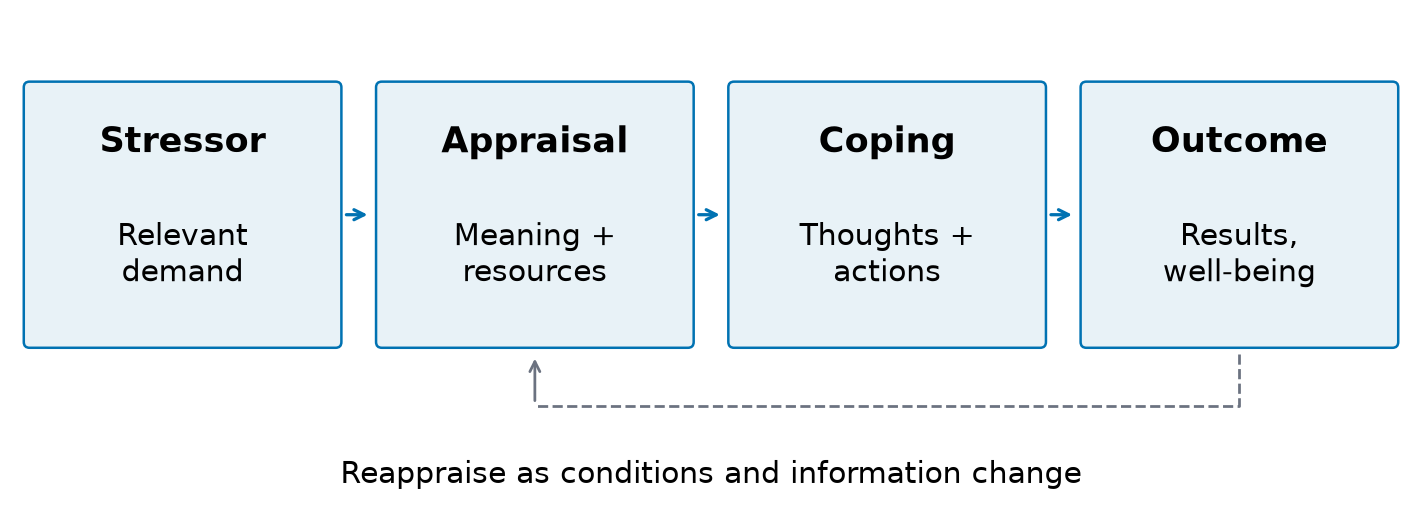
C.4: Explain a stressor 压力源 and its appraisal
- A stressor is a relevant demand or event. Appraisal concerns its meaning and perceived resources; positively experienced challenge and negatively experienced strain can differ between people and change with information.
- Primary and secondary appraisal are related processes, not a guaranteed single-file binary decision. Challenge and threat may coexist. Actual injury, access and timetable constraints matter alongside interpretation.
Can changing an interpretation remove every real demand?
Dificuldade 1/5 · Moedas 100 + pequeno bônus na primeira conclusão hoje
Explain meaning and resources in the actual situation.
C.4: Interpret bodily responses cautiously
- Sympathetic activation and adrenaline can rapidly change pulse, ventilation and fuel availability. HPA signalling links hypothalamus, pituitary ACTH and cortisol 皮质醇 secretion by the adrenal cortex.
- Cortisol has normal regulatory functions. The historical alarm–resistance–exhaustion model does not supply inevitable dates or a literal empty resource tank. One hormone or pulse value does not diagnose stress or coping capacity.
Which tissue secretes cortisol in the HPA pathway?
Dificuldade 1/5 · Moedas 100 + pequeno bônus na primeira conclusão hoje
Distinguish the signalling pathway from the final secretion site.
C.4: Keep activation distinct from worry
- Arousal concerns physical and psychological activation; anxiety involves apprehension or worry and bodily experience. Activation is not automatically harmful or identical to a clinical disorder.
- A rapid pulse can accompany exercise, heat or excitement as well as stress. Define the construct and conditions before interpreting a measurement. All numerical cases here are invented teaching examples.
Does an elevated pulse alone identify psychological anxiety?
Dificuldade 1/5 · Moedas 100 + pequeno bônus na primeira conclusão hoje
A physiological proxy is not a direct construct or diagnosis.
C.4: Apply drive theory 驱力理论 conditionally
- Drive theory proposes that arousal strengthens the dominant response. If that likely response suits the task, strengthening it may help; if it is an error, it may hinder.
- An expert can still have an inappropriate dominant response. Neither a crowd nor expertise guarantees a particular performance change, and the theory alone does not explain every sudden loss.
What determines whether a stronger dominant response helps in this model?
Dificuldade 1/5 · Moedas 100 + pequeno bônus na primeira conclusão hoje
State the model’s mechanism and its practical limits.
C.4: Treat an inverted U as a model
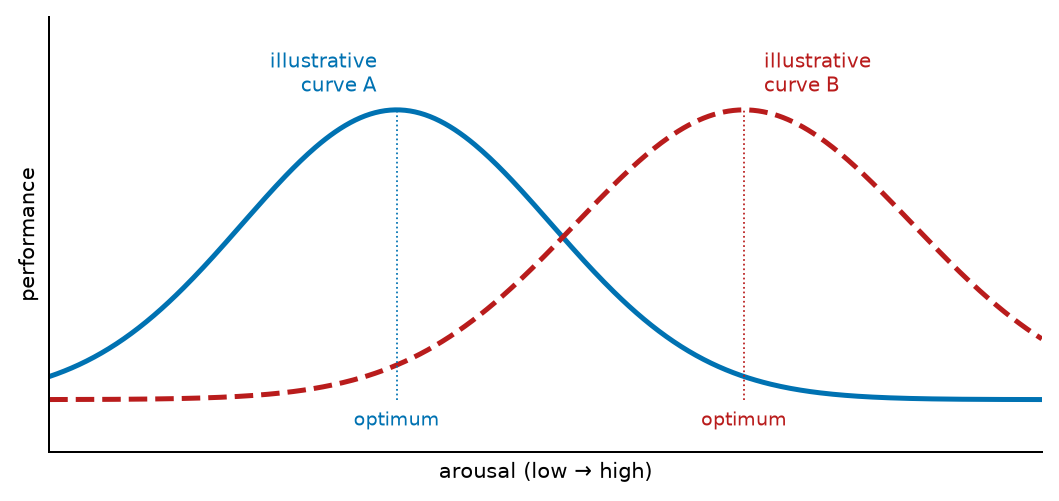
- An inverted-U hypothesis proposes rising performance towards an optimum and declining performance beyond it. Actual relationships may be noisy, asymmetric or context dependent.
- Precision, coordination, force and attention demands differ, but powerful skills are not necessarily simple. A sport, personality or expertise label does not supply an individual optimal arousal score.
Can a fixed optimum be assigned solely because a player is extroverted?
Dificuldade 1/5 · Moedas 100 + pequeno bônus na primeira conclusão hoje
A schematic curve is a prediction to examine, not a prescription.
C.4: Describe selected reports without inventing a threshold
- Five selected successful-event reports are 19,21,22,24,25: sum 111, mean 22.2, range width 6. Current 31 is above that selected 19–25 range.
- Other outcomes, contexts and measurement error are missing. IZOF emphasises individual patterns and ranges, but selecting five successful cases does not validate an optimal zone, diagnose a problem or establish that calming down must help.
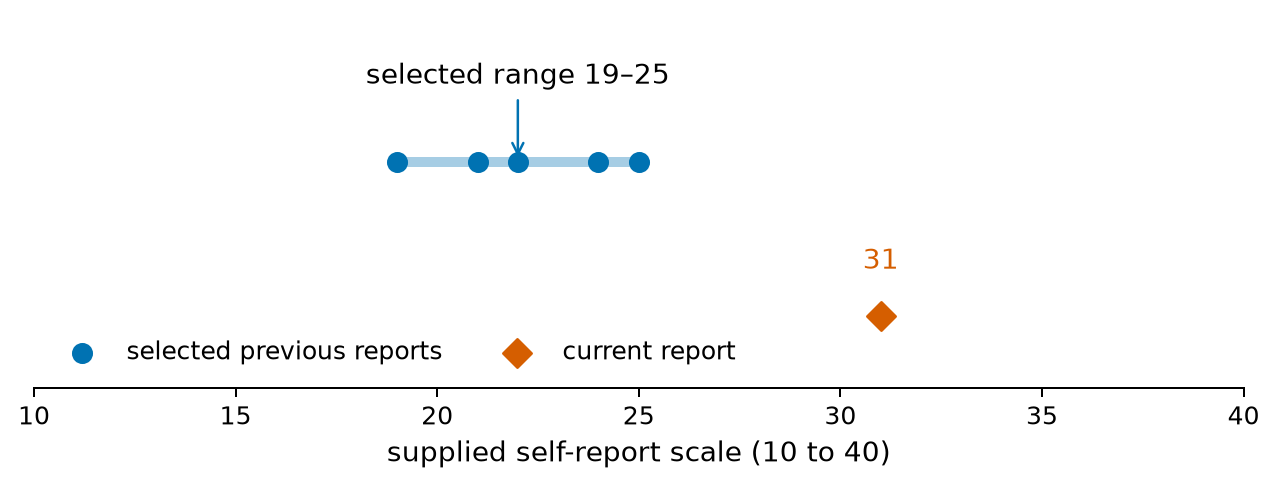
Five selected successful-event ratings are 19, 21, 22, 24 and 25. What can these reports establish directly?
Dificuldade 1/5 · Moedas 100 + pequeno bônus na primeira conclusão hoje
Sum = 19 + 21 + 22 + 24 + 25 = 111; mean = 111/5 = 22.2 scale units. Range width = 25 − 19 = 6. Selecting successful cases does not validate an optimal zone or treatment threshold.
Find mean of selected ratings 19,21,22,24,25.
Dificuldade 2/5 · Moedas 140 + pequeno bônus na primeira conclusão hoje
Sum = 19 + 21 + 22 + 24 + 25 = 111. Mean = 111/5 = 22.2 scale units. These selected reports do not validate an optimum.
Find width of the selected 19–25 range.
Dificuldade 2/5 · Moedas 140 + pequeno bônus na primeira conclusão hoje
25−19=6.
C.4: Explain a sudden model transition
- A catastrophe account distinguishes cognitive anxiety 认知焦虑 from physiological activation and allows an abrupt performance drop under particular interacting conditions. Hysteresis means the return path can differ from the outward path.
- A sketch supplies neither universal trigger numbers nor recovery minutes. Fatigue, technique, distraction or injury can also contribute to an observed sudden loss; the graph does not establish a treatment effect.
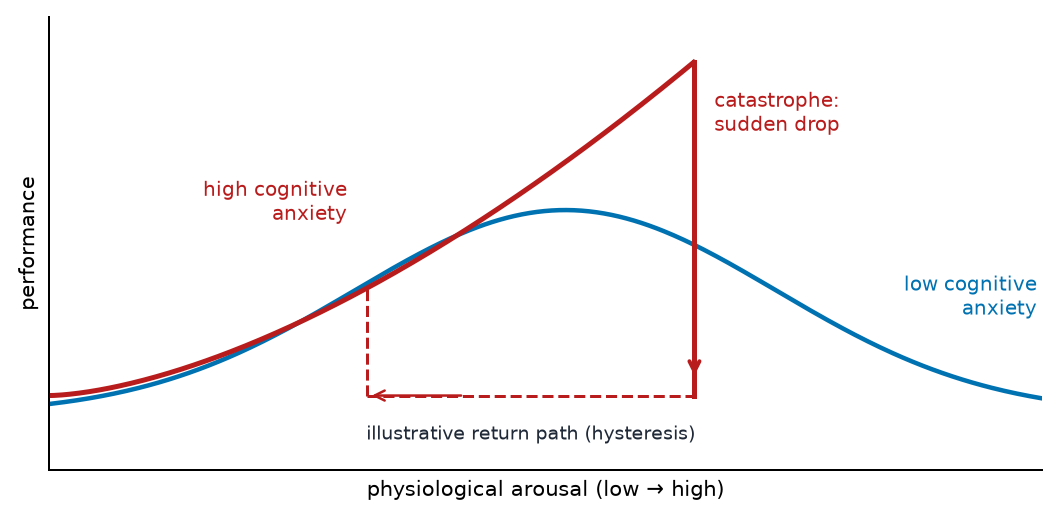
What does hysteresis describe?
Dificuldade 1/5 · Moedas 100 + pequeno bônus na primeira conclusão hoje
Interpret the mathematical/model feature without inventing clinical prescriptions.
C.4: Separate timescale from content
- Trait anxiety 特质焦虑 concerns a relatively enduring tendency; state anxiety 状态焦虑 concerns a report at a particular moment. Cognitive anxiety concerns worry and thoughts; somatic anxiety 躯体焦虑 concerns bodily experience.
- These are separate dimensions, not four mutually exclusive boxes. A state report can include cognitive and somatic features; trait does not determine every event or a fixed timeline.
Can a state report include both worry and bodily sensations?
Dificuldade 1/5 · Moedas 100 + pequeno bônus na primeira conclusão hoje
Classify what each distinction actually asks.
C.4: Distinguish intensity and interpretation
- Intensity concerns how much is reported. Direction concerns whether the performer interprets the experience as helpful or harmful for the task.
- Two equal intensities can have different meanings, and one performer can interpret different events differently. Reframing 认知重构 may examine meaning, but does not remove genuine hazards or guarantee an outcome.
Do identical intensity scores establish identical interpretations?
Dificuldade 1/5 · Moedas 100 + pequeno bônus na primeira conclusão hoje
Measure the dimension needed for the inference.
C.4: Compare measurements and their limits
- Questionnaires access reported experience but depend on comprehension, context and response bias. Pulse, blood pressure and galvanic skin response are instrument readings with non-specific causes.
- Standardise task, timing, posture and environment. More objective measurement of a signal does not make its psychological interpretation automatically valid or diagnostic.
Why control prior exercise when comparing pulse responses?
Dificuldade 1/5 · Moedas 100 + pequeno bônus na primeira conclusão hoje
A useful control improves inference without eliminating every alternative.
C.4: Check which questionnaire version is supplied
- Original CSAI-2 has 27 items in three 9-item subscales, each raw range 9–36. Revised CSAI-2R has a different 17-item structure and scoring instructions.
- Do not inherit original raw totals, clinical cutoffs or interpretations blindly between versions. Standardisation supports consistency but does not establish validity for every language, age or use.
Should original raw scoring be transferred blindly to the revised form?
Dificuldade 1/5 · Moedas 100 + pequeno bônus na primeira conclusão hoje
Measurement version is part of the question’s conditions.
C.4: Calculate separate invented ratings
- Invented nine-item classroom sets sum to 26,15,23; the respective means are 2.888…,1.666…,2.555… . The full sets and working appear in the handout.
- They illustrate arithmetic, not the actual questionnaire items or a validated substitute. A separate original-format profile cognitive 30, somatic 16, confidence 14 describes different dimensions; adding them into one undifferentiated anxiety total is unjustified.
What is a defensible arithmetic comparison?
Dificuldade 1/5 · Moedas 100 + pequeno bônus na primeira conclusão hoje
A calculation does not validate a construct or clinical cutoff.
Find mean for the invented nine-item set with sum 26.
Dificuldade 2/5 · Moedas 140 + pequeno bônus na primeira conclusão hoje
26/9=2.888888…; arithmetic alone does not validate the scale.
C.4: Classify coping by its function
- Problem-focused coping 问题导向应对 addresses a demand, such as obtaining timetable information. Emotion-focused coping 情绪导向应对 regulates the response, such as seeking understanding. Avoidance distances the person from the stressor.
- One conversation may have several functions. A brief music break that supports return differs from repeatedly postponing a necessary action; leaving an unsafe situation may be protective.
Is seeking timetable information most directly a problem-focused action?
Dificuldade 1/5 · Moedas 100 + pequeno bônus na primeira conclusão hoje
Describe the purpose rather than categorising from the action’s appearance alone.
C.4: Use a concise self-talk 自我对话 mechanism
- Useful self-talk may recall a helpful experience, cue a practised routine with an agreed acronym or describe an action in a simple phrase such as scan, choose, pass.
- Self-talk can also be unintentional or discouraging. Extra words can overload a learner; practise a relevant manageable cue and evaluate its use with the performer rather than assuming positivity guarantees success.
Which is an actionable movement cue?
Dificuldade 1/5 · Moedas 100 + pequeno bônus na primeira conclusão hoje
Connect the phrase to a feasible task action.
C.4: Interpret a pulse change without claiming a cure
- In an invented seated example, pulse falls 72→66 beats/min. Absolute fall is 6 beats/min; relative fall is 6/72×100 = 8.333…%.
- Ordinary rest, posture, timing or measurement may contribute. A lower pulse does not establish reduced anxiety, better sporting performance or an effect caused by a particular relaxation routine. Compare suitable conditions and reported experience.
A seated pulse falls from 72 to 66 beats/min. Which reference gives the relative percentage fall from the initial pulse?
Dificuldade 1/5 · Moedas 100 + pequeno bônus na primeira conclusão hoje
Absolute fall = 72 − 66 = 6 beats/min. Relative fall = 6/72 × 100 ≈ 8.33%, using the initial 72. This does not isolate the cause of the change.
Find relative percentage fall from 72 to 66 beats/min.
Dificuldade 2/5 · Moedas 140 + pequeno bônus na primeira conclusão hoje
6/72×100=8.333333…%; causal interpretation requires more evidence.
C.4: Recognise patterns without diagnosing classmates
- Burnout descriptions include physical/emotional exhaustion, reduced accomplishment and devaluation of sport. Demands, recovery, pressure and support can interact.
- A classroom questionnaire, one absence or a temporary setback does not diagnose a disorder. Listen respectfully, examine actual resources and involve appropriate trusted adults or professionals when needed.
Can one low class score diagnose burnout or an anxiety disorder?
Dificuldade 1/5 · Moedas 100 + pequeno bônus na primeira conclusão hoje
Recognition and support differ from diagnosis.
C.4: Distinguish safe withdrawal from failed coping
- USA Gymnastics documented Biles’s health-and-safety withdrawal at Tokyo 2021 and her later beam bronze. These dated events do not let a classroom observer infer one psychological cause.
- Necessary rest, reporting injury, seeking help or leaving danger can be appropriate protective actions. Do not classify every withdrawal as avoidance or insufficient toughness.
Does stopping an unsafe movement prove poor coping?
Dificuldade 1/5 · Moedas 100 + pequeno bônus na primeira conclusão hoje
Interpret behaviour in its real context, including safety.
C.4: Design a voluntary low-risk comparison
- Use school-approved low-risk tasks and non-sensitive measures, with informed participation, confidentiality and explained withdrawal limits. Do not induce distress or publish personal labels.
- Define the strategy, comparison, timing and relevant outcomes. A recognition concern should lead to appropriate support; even a positive screen is not automatically a diagnosis (IOC tool development).
What follows from a concerning self-report screen?
Dificuldade 1/5 · Moedas 100 + pequeno bônus na primeira conclusão hoje
Keep the purpose and limits of measurement clear.
AHL C.4: Separate controllable features and timescales
- Tomorrow’s wind cannot be directly changed, while forecasts, permitted suitable equipment and a safe plan may be available. An exam date can be fixed while some scheduling decisions remain negotiable.
- Controllability depends on the feature, timeframe, resources and authority. A coach’s suggestion is not feasible merely because it sounds simple; it does not make the athlete responsible for every demand.
Can one stressor contain both changeable and unchangeable features?
Dificuldade 1/5 · Moedas 100 + pequeno bônus na primeira conclusão hoje
Make the appraisal specific enough to guide a feasible response.
AHL C.4: Combine coping functions when appropriate
- Problem-focused actions can address feasible demands; emotion-focused actions can help regulate responses to remaining conditions. They need not be competing choices.
- A workable timetable and supportive conversation can address different parts of a school–sport conflict. Reframing alone does not remove incompatible commitments or a real injury.
Can practical planning and emotional support serve the same situation?
Dificuldade 1/5 · Moedas 100 + pequeno bônus na primeira conclusão hoje
Match the combination to actual demands and available resources.
AHL C.4: Match support to its purpose
- Informational support clarifies options or a plan; practical support provides resources such as transport; emotional support offers care and understanding. One interaction may serve several functions.
- Credibility, accessibility and the person’s actual needs affect usefulness. The course highlights support seeking as particularly effective, with individual and situational limits. It is a resource rather than evidence of weak toughness; no one provider is best for every situation.
Which example is practical support?
Dificuldade 1/5 · Moedas 100 + pequeno bônus na primeira conclusão hoje
Identify which resource the action supplies.
AHL C.4: Explain different strategy mechanisms
- Logical analysis examines options and consequences; thought control redirects attention to a useful cue; effort expenditure implements a feasible planned action.
- These mechanisms differ from simply telling someone to try harder. Specify the task, actual choices and resources, then evaluate whether the action helps the intended outcome.
What does logical analysis directly examine?
Dificuldade 1/5 · Moedas 100 + pequeno bônus na primeira conclusão hoje
A strategy needs a plausible mechanism in the stated situation.
AHL C.4: Distinguish regulation, distraction and disengagement
- Relaxation may regulate activation; imagery 表象 may rehearse an appropriate scenario. A brief distraction can help manage emotion and return attention to a task.
- Persistent disengagement, unproductive venting or self-blame may leave demands unresolved; these differ from necessary rest, safe withdrawal and appropriate help seeking. Do not infer function from a pause alone.
Does every short break imply maladaptive disengagement?
Dificuldade 1/5 · Moedas 100 + pequeno bônus na primeira conclusão hoje
Distinguish a temporary regulating action from unresolved avoidance.
AHL C.4: Test effectiveness in context
- Define the strategy, implementation, participants, comparison and follow-up. Record experience and relevant performance or access outcomes, considering expectancy and measurement effects.
- A lower anxiety score need not be the only useful outcome. A workable plan, safe participation or improved access may matter; a group association does not guarantee an identical individual result.
Does one lower score prove the strategy is universally effective?
Dificuldade 1/5 · Moedas 100 + pequeno bônus na primeira conclusão hoje
Evaluate the actual purpose instead of treating the strategy name as evidence.
C.5: Separate a skill and a technique
- Confidence or concentration 专注 is a psychological skill; a goal, attentional cue or reset routine is a technique used to develop or apply it.
- Education explains a method and its limits, acquisition teaches it, and practice applies and reviews it in relevant conditions. Repetition does not guarantee an effect.
Which is a technique rather than the intended quality?
Dificuldade 1/5 · Moedas 100 + pequeno bônus na primeira conclusão hoje
Separate what is wanted from how it might be developed.
C.5: Discuss a performance profile 表现剖面图
- Invented hockey ideal/current ratings are decision making 9/6, aggression control 7/6 and confidence 9/5. The gaps are 3,1,4.
- The largest reported gap identifies a discussion point, not an automatic priority. Consider importance, rating meaning, wishes and resources; one class profile does not diagnose a condition.
Does gap 4 automatically establish the correct treatment priority?
Dificuldade 1/5 · Moedas 100 + pequeno bônus na primeira conclusão hoje
An arithmetic gap is not a diagnosis or a complete decision rule.
Find the confidence gap from ideal 9 and current 5.
Dificuldade 2/5 · Moedas 140 + pequeno bônus na primeira conclusão hoje
9−5=4; not a diagnosis or automatic priority.
C.5: Distinguish a report and an outcome
- A smaller profile gap at follow-up means the reported ratings changed under those conditions. Comparable observed actions, performance and experience help examine what improved.
- Question wording, social expectations and changed scale interpretation may affect reports. A lower score alone does not establish a stronger skill or a causal effect of training.
What does a smaller reported gap directly establish?
Dificuldade 1/5 · Moedas 100 + pequeno bônus na primeira conclusão hoje
Name the actual measurement before interpreting it.
C.5: Use repeated baselines
- One before–after test can reflect ordinary variation, prior trends or regression towards typical performance. Repeated baseline measures help reveal trend and variability.
- Staggering an intervention across cases can strengthen inference if changes align with its introduction. Other training, expectancy, changed scoring and maturation can remain alternative explanations.
Does a staggered pattern eliminate every alternative cause?
Dificuldade 1/5 · Moedas 100 + pequeno bônus na primeira conclusão hoje
Describe the improvement in evidence without claiming proof.
C.5: Classify goals by their reference
- An outcome goal 结果目标 concerns a result against others, such as winning a final. A performance goal 表现目标 concerns a self-referenced measurable standard, such as beating a previous time.
- A process goal 过程目标 concerns how to perform: a technique or strategy such as attending to a release cue. Classify the target rather than whether the athlete ultimately succeeds.
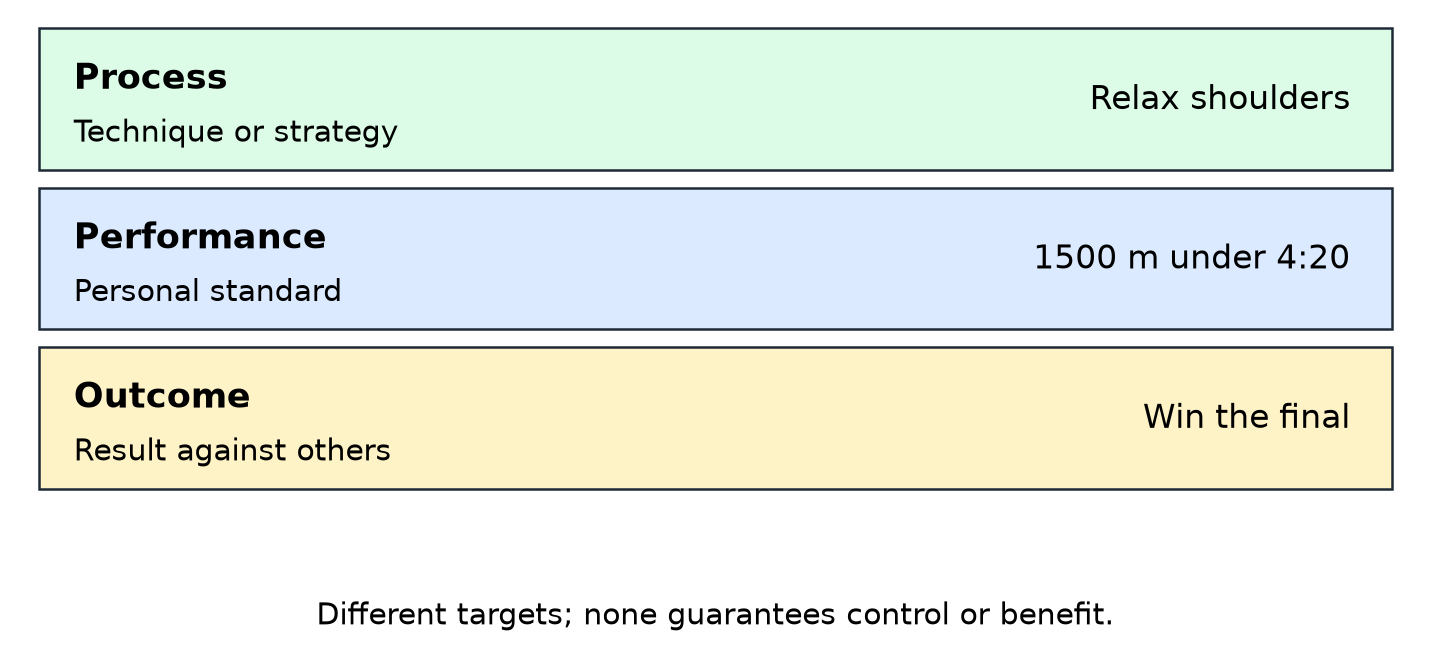
Which is a performance goal?
Dificuldade 1/5 · Moedas 100 + pequeno bônus na primeira conclusão hoje
Personal standard and placing use different references.
C.5: Keep controllability conditional
- Opponents influence placing; weather and health influence personal time; fatigue and opportunity influence execution of a process cue. No goal type guarantees full control.
- A process goal may be more directly actionable than a placing, but the action must suit the person and task. Combining all three types is not automatically the best plan.
Is a process goal fully controllable in every situation?
Dificuldade 1/5 · Moedas 100 + pequeno bônus na primeira conclusão hoje
More actionable does not mean completely controllable.
C.5: Explain attention and effort
- Goals may direct attention, increase effort and persistence, and encourage strategies. A clear feasible cue can organise action.
- Too many cues can overload attention, while an imposed or unrealistic target may discourage engagement. The intended mechanism does not guarantee the desired outcome.
Why can several simultaneous movement goals hinder a learner?
Dificuldade 1/5 · Moedas 100 + pequeno bônus na primeira conclusão hoje
Connect the goal to the actual attentional demand.
C.5: Consider achievement motivation
- A challenging comparison may prompt approach and persistence in one person but fear of failure or avoidance in another. Perceived competence, resources and prior experience matter.
- A need-for-achievement label does not determine each response. Discuss how the target is experienced rather than assigning a fixed goal from personality or past results alone.
Can the same public goal produce different motivational responses?
Dificuldade 1/5 · Moedas 100 + pequeno bônus na primeira conclusão hoje
Relate the goal to the individual without making a trait destiny.
C.5: Use SMART as a planning checklist
- Specific, measurable, achievable, realistic and time-bound goals clarify a plan. A number and deadline alone do not establish feasibility or benefit.
- Agree practice opportunities, recovery, feedback and review with the athlete. Evidence about the starting point and variability matters; an arbitrary target is not made realistic by calling it SMART.
What else is needed beyond a number and deadline?
Dificuldade 1/5 · Moedas 100 + pequeno bônus na primeira conclusão hoje
A checklist supports planning rather than proving an effect.
C.5: Calculate a swimming planning line
- An invented goal reduces 100 m time from 68.0 to 66.0 s in eight weeks, checking every two weeks. Four intervals divide 2.0 s into 0.5 s each.
- The targets would be 67.5,67.0,66.5,66.0 s. This is arithmetic, not a prediction of even adaptation; review conditions and revise if the plan becomes unsuitable.
How many two-week intervals are in eight weeks?
Dificuldade 1/5 · Moedas 100 + pequeno bônus na primeira conclusão hoje
Count the stated intervals before dividing the proposed change.
C.5: Calculate a running planning line
- An invented runner proposes 58.0→56.0 s over ten weeks with two-week checks: five intervals and 0.4 s per interval. Targets are 57.6,57.2,56.8,56.4,56.0 s.
- Relative time reduction is 2/58×100=3.448…%. This is not an equal percentage increase in speed, and the invented line does not guarantee feasibility.
An invented time target falls from 58.0 to 56.0 s. Which reference gives the relative percentage reduction from the initial time?
Dificuldade 1/5 · Moedas 100 + pequeno bônus na primeira conclusão hoje
Time reduction = 58.0 − 56.0 = 2.0 s. Relative reduction = 2.0/58.0 × 100 ≈ 3.45%, using the starting time. This is a percentage reduction in time, not the percentage increase in speed.
Find the proposed even seconds reduction per two-week interval for 58 to 56 s in ten weeks.
Dificuldade 2/5 · Moedas 140 + pequeno bônus na primeira conclusão hoje
Total proposed time reduction = 58 − 56 = 2 s. Ten weeks contain 10/2 = 5 two-week intervals. Even reduction per interval = 2/5 = 0.4 s. This planning line does not predict even adaptation.
Find the relative percentage time reduction from 58 to 56 s.
Dificuldade 2/5 · Moedas 140 + pequeno bônus na primeira conclusão hoje
2/58×100=3.448275862…%; this is time, not speed.
C.5: Separate points and relative change
- A proposed free-throw success change 60%→70% is 10 percentage points and 10/60×100=16.666…% relative increase.
- Compare suitable numbers of attempts, similar difficulty and consistent scoring. A target percentage without conditions does not establish learning or an attainable plan.
Free-throw success rises from 60% to 70%. Are the 10 percentage-point rise and a 10% relative increase identical?
Dificuldade 1/5 · Moedas 100 + pequeno bônus na primeira conclusão hoje
Percentage-point rise = 70 − 60 = 10. Relative increase = (70 − 60)/60 × 100 ≈ 16.7%. The initial 60% is the reference for relative change.
Find the percentage-point increase from 60% to 70%.
Dificuldade 2/5 · Moedas 140 + pequeno bônus na primeira conclusão hoje
70−60=10 points; relative increase is 16.666…%.
C.5: Choose useful self-talk
- Instructional self-talk 指导性自我对话 cues an action, such as scan for the next pass; motivational self-talk 激励性自我对话 encourages effort, such as keep contributing.
- A weightlifter may need a technical cue and a darts player encouragement. The sport label alone does not select the best phrase; agree a manageable cue and evaluate it.
Can an athlete in a power sport need an instructional cue?
Dificuldade 1/5 · Moedas 100 + pequeno bônus na primeira conclusão hoje
Match the purpose and person rather than a fixed sport stereotype.
C.5: Reframe accurately
- After a missed penalty, one possible reframe is one miss does not determine the next phase; I can attend to my next action.
- Notice an unhelpful thought and redirect to an agreed cue without inventing a save, promising success or using painful triggers. A thought recurring does not mean that the athlete failed.
Which reframe avoids an invented factual explanation?
Dificuldade 1/5 · Moedas 100 + pequeno bônus na primeira conclusão hoje
Helpful interpretation should still be accurate.
C.5: Regulate without a fixed prescription
- The matching hypothesis 匹配假说 relates a technique to a mainly bodily or cognitive difficulty, but these experiences interact. A classroom category is not a clinical prescription.
- Familiar comfortable voluntary methods may be explored appropriately. Avoid forced breathing, painful contractions or the claim that a fixed number of weeks guarantees an effect.
Does one anxiety label establish a specific treatment dose?
Dificuldade 1/5 · Moedas 100 + pequeno bônus na primeira conclusão hoje
Distinguish a teaching hypothesis from individual clinical care.
C.5: Examine activation and attention
- Feeling flat can involve recovery, sleep, motivation and task demands. Familiar music, ordinary warm-up or a cue may suit some athletes; more activation is not automatically better.
- Broad/narrow describes attention width; internal/external describes direction. Scanning the court is broad external; considering a plan broad internal; one bodily cue narrow internal; the target narrow external.
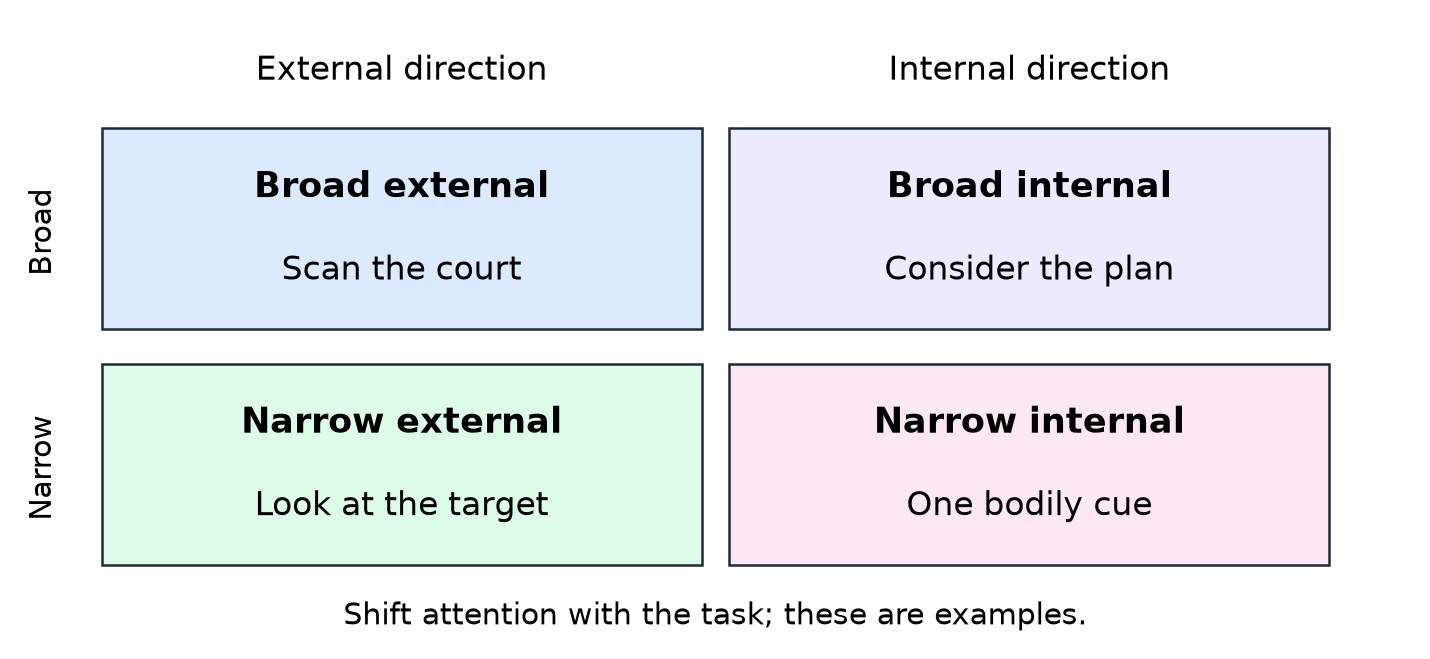
Which example is narrow external attention?
Dificuldade 1/5 · Moedas 100 + pequeno bônus na primeira conclusão hoje
Keep width and direction as separate dimensions.
C.5: Adapt a pre-performance routine 赛前常规
- A practised sequence can give attention a useful next action and familiar starting point. An invented free-throw routine might check feet, use a comfortable reset and look at the target.
- Adapt to interruptions, rules and safety. One miss does not diagnose choking 发挥失常; distraction and excessive monitoring are proposed explanations alongside other possible causes. A routine does not guarantee prevention or success.
Must an exact ritual be completed despite an interruption or safety issue?
Dificuldade 1/5 · Moedas 100 + pequeno bônus na primeira conclusão hoje
Consistency can help without becoming an inflexible guarantee.
C.5: Evaluate a feasible programme
- Agree the intended outcome and voluntary participation; collect repeated comparable baseline and follow-up measurements, describe the method and record adherence and other training.
- A dated champion result does not isolate a psychological cause. Evaluate experience, relevant behaviour, access and performance without diagnosing classmates or assuming universal transfer.
Why record whether the technique was actually used?
Dificuldade 1/5 · Moedas 100 + pequeno bônus na primeira conclusão hoje
Define the method, measurement and actual implementation.
AHL C.5: Explain the goal-setting 目标设定 paradox
- The syllabus paradox describes sometimes feeling less satisfied after achieving a higher goal than after an easier one; post-success deflation is a proposed explanation. Greater achievement need not bring greater satisfaction.
- Immediately raising the target again may compound dissatisfaction, but escalation alone does not define that comparison. Neither response is inevitable in every elite athlete.
- A medal or personal best does not reveal the athlete’s experience. Recognise achievement and examine the meaning and feasibility of the next target.
Which comparison captures the syllabus goal-setting paradox?
Dificuldade 1/5 · Moedas 100 + pequeno bônus na primeira conclusão hoje
Post-success deflation is a proposed explanation for the comparison. Escalating targets alone do not define it, and the response is not inevitable.
AHL C.5: Adjust or replace a goal
- Goal adjustment can revise, replace or disengage from an unsuitable target when health, resources or priorities change. An agreed learning or participation goal may become more relevant.
- This is not automatically weak commitment. Explain the reason, retain useful feedback and review a workable next step rather than merely escalating targets after every success.
Can replacing an unsuitable time target be a reasoned adjustment?
Dificuldade 1/5 · Moedas 100 + pequeno bônus na primeira conclusão hoje
Judge the evidence and purpose rather than persistence alone.
AHL C.5: Compare specific, best-effort and open goals
- A specific goal uses an agreed threshold; do your best encourages effort without that fixed performance threshold; an open goal invites exploration, such as see how many accurate passes you can make comfortably.
- A novice may not yet know a sensible numerical target. Open goals still need appropriate safety conditions, task clarity and feedback. No form guarantees better engagement or performance in every context.
Does an open goal remove task or safety limits?
Dificuldade 1/5 · Moedas 100 + pequeno bônus na primeira conclusão hoje
Distinguish openness of achievement from absence of constraints.
AHL C.5: Define imagery and perspective
- Imagery represents experience without the corresponding actual perception. Relevant visual, auditory, kinaesthetic and other information may combine with emotion; every sense need not be included.
- Internal and external refer to first-person and third-person views. Kinaesthetic information concerns movement sensation and can accompany either view. Neither perspective is universally best for a sport.
Does a first-person view specify the imagery’s purpose?
Dificuldade 1/5 · Moedas 100 + pequeno bônus na primeira conclusão hoje
Separate sensory information, viewpoint and intended function.
AHL C.5: Apply Paivio’s four functions
- Cognitive specific imagery rehearses a skill such as free-throw release; cognitive general imagery rehearses strategy such as a press-break play.
- Motivational specific imagery concerns a goal; motivational general imagery concerns confidence or activation. One sequence can serve several functions; classify the intended purpose rather than whether it is pleasant.
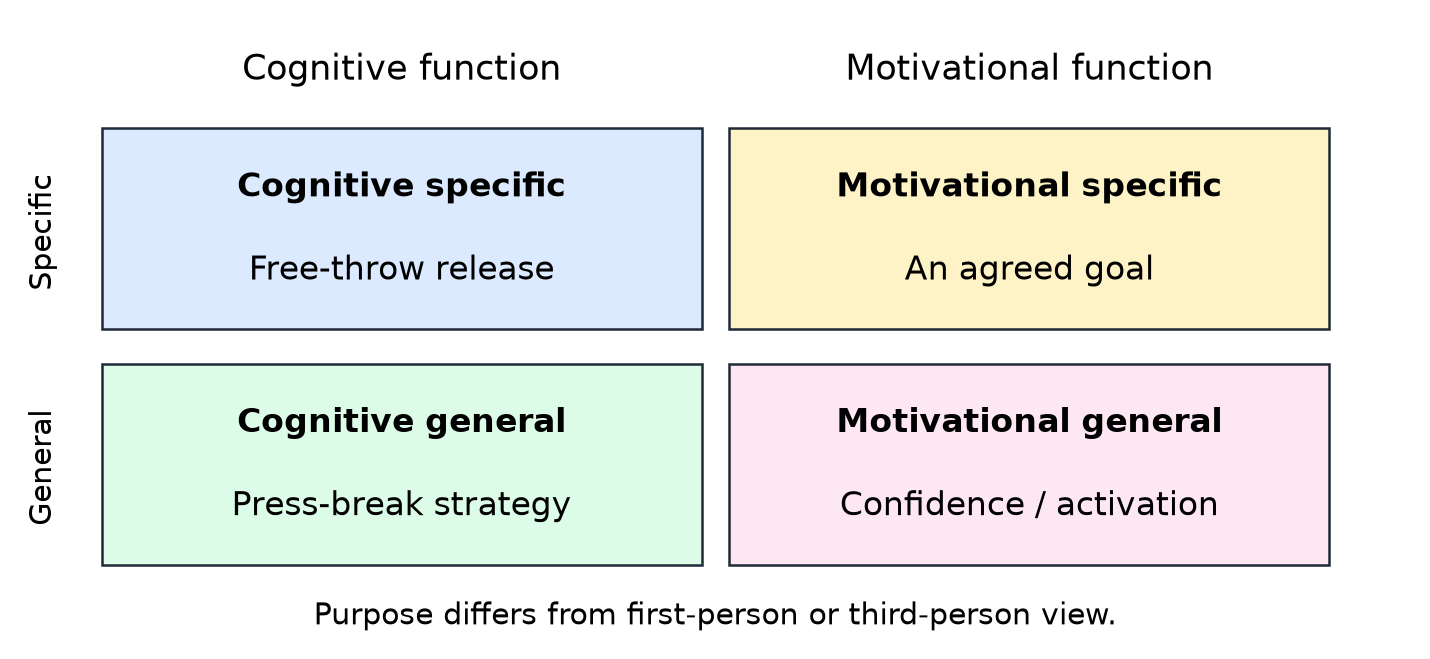
Which example is cognitive general imagery?
Dificuldade 1/5 · Moedas 100 + pequeno bônus na primeira conclusão hoje
Skill/strategy and goal/general motivational function use different categories.
AHL C.5: Apply all seven PETTLEP features
- Physical, environment, task, timing, learning, emotion and perspective form the seven-feature planning framework. For a swimmer: relevant posture, pool cues, own technique, suitable rhythm, updated content, appropriate experience and a useful view.
- Functional similarity is a planning proposal, not proof of benefit. Timing and perspective should suit the purpose; no framework supplies a universal daily-minute dose or permission to induce distress.
Which set completes physical, environment, task and timing?
Dificuldade 1/5 · Moedas 100 + pequeno bônus na primeira conclusão hoje
Keep the seven features distinct from outcome evidence.
AHL C.5: Distinguish mechanisms from evidence
- Motor-activation accounts propose links with imagined action; symbolic accounts propose rehearsal of movement information and sequences. Small muscle signals do not by themselves prove stronger skills or better performance.
- Equalise relevant physical practice when testing an additional imagery contribution. Extra physical practice in one group confounds the comparison; record content, adherence, outcomes and follow-up.
Why is imagery plus extra physical practice an unfair isolated test?
Dificuldade 1/5 · Moedas 100 + pequeno bônus na primeira conclusão hoje
A mechanism and a successful outcome need an appropriate causal test.