Atomic models and line spectra
Introduzido| English | Significado |
|---|---|
| energy level/ˈenədʒi ˈlevl/ | nível de energia |
| emission spectrum/ɪˈmɪʃn ˈspektrəm/ | espectro de emissão |
What would explain this observation?
- An excited gas produces separate coloured lines rather than every wavelength. The pattern is evidence for discrete atomic energy differences.
Build the model
- Atoms have a small positive nucleus and electrons.
- Emission and absorption spectra arise from transitions between discrete energy levels 能级.
- A photon energy equals the level difference and obeys E = hf.
- emission spectrum 发射光谱: Wavelength pattern of radiation emitted by a source.
- energy level: An allowed energy state in a model.

What produces a higher-frequency emitted photon?
Dificuldade 1/5 · Moedas 100 + pequeno bônus na primeira conclusão hoje
Emitted photon energy equals the difference between the levels, and E = hf ties frequency to that difference. A larger downward jump emits a higher-frequency photon; upward transitions require absorption, and h is a universal constant.
Match each technical term to its precise meaning.
Dificuldade 2/5 · Moedas 140 + pequeno bônus na primeira conclusão hoje
Use the definitions to distinguish related quantities and processes.
Choose evidence that can test it
- An emitted photon corresponds to a transition to a lower energy level.
- Absorption requires a compatible energy difference.
- Rutherford scattering supported a small dense nucleus, but that experiment alone did not establish the complete quantum model.
In the lab: Read a labelled energy-level diagram before calculating. Keep joules and electronvolts distinct and use the given constants. Compare attributed spectra at a common wavelength scale and avoid looking at unsafe light sources.
Which two habits make the investigation or model in this case more defensible?
Dificuldade 2/5 · Moedas 140 + pequeno bônus na primeira conclusão hoje
Stating the conditions and assumptions lets others repeat the work exactly, and recording the supporting evidence lets them check the conclusion. Hiding disagreeing results removes the evidence that could challenge a wrong conclusion, and one measurement can never establish a wider claim.
Work from known quantities
- Known: energy levels are −6.0 and −2.0 eV.
- A downward transition releases 4.0 eV = 6.4×10⁻¹⁹ J using 1 eV = 1.6×10⁻¹⁹ J.
- With h = 6.63×10⁻³⁴ J s, frequency is 9.65×10¹⁴ Hz.
Your turn: Levels are −7.0 and −2.0 eV. Find the energy emitted in the downward transition.
A photon carries the energy gap
Negative bound levels give positive photon energies; equal gaps share a spectral line.
Levels are −7.0 and −2.0 eV. Find the energy emitted in the downward transition.
Dificuldade 2/5 · Moedas 140 + pequeno bônus na primeira conclusão hoje
The result is 5 eV. Known: levels -7.0 and -2.0 eV; downward transition. Photon energy = level difference = (-2.0) - (-7.0) = 5.0 eV. The energies are negative relative to the ionization zero, but the emitted photon carries the positive difference.
Check the conclusion and its limits
- Negative bound-state energies are relative to a chosen zero; they do not mean a negative photon energy is emitted.
- A larger downward energy difference gives higher frequency.
Not true: A negative bound-state energy means an emitted photon has negative energy. Level energies are measured relative to a chosen zero (a free electron at rest), so bound states are negative. For emission, subtract the lower final energy from the higher initial energy: Eγ = Eupper − Elower. For example, −2 − (−6) = +4 eV for the photon; the atom changes by −4 eV. The subtraction order, not merely two negative level values, determines the sign.
- Atoms have a small positive nucleus and electrons.
- An emitted photon corresponds to a transition to a lower energy level.
- Watch for: negative bound-state energies are relative to a chosen zero; they do not mean a negative photon energy is emitted.
A negative bound-state energy means an emitted photon has negative energy.
Dificuldade 1/5 · Moedas 100 + pequeno bônus na primeira conclusão hoje
Level energies are measured relative to a chosen zero (a free electron at rest), so bound states are negative. For emission, subtract the lower final energy from the higher initial energy: Eγ = Eupper − Elower. For example, −2 − (−6) = +4 eV for the photon; the atom changes by −4 eV. The subtraction order, not merely two negative level values, determines the sign.
Wavelength pattern of radiation emitted by a source: write the technical term.
Dificuldade 1/5 · Moedas 100 + pequeno bônus na primeira conclusão hoje
emission spectrum means Wavelength pattern of radiation emitted by a source.
Write from the data: find the photon energy
- Levels are minus 12.0 and minus 4.0 electronvolts.
- Find the photon energy of the downward transition. A negative level does not make the photon energy negative.
Energy levels are minus 12.0 and minus 4.0 electronvolts. What photon energy is emitted in the downward transition, and why is that energy not negative?
The initial atomic level is −4.0 eV and the final level is −12.0 eV. Eγ = Einitial − Efinal = (−4.0) − (−12.0) = +8.0 eV. The atom loses 8.0 eV and the photon carries positive energy. Negative bound-state energies use a chosen continuum zero; they do not make photon energy negative.
In an invented energy-level model, an atom moves from −4.0 eV to −12.0 eV. What photon energy is emitted?
Dificuldade 1/5 · Moedas 100 + pequeno bônus na primeira conclusão hoje
Photon energy = initial atomic energy − final atomic energy = (−4.0) − (−12.0) = +8.0 eV. The atom loses 8.0 eV while the photon carries positive energy. Negative bound-state level values do not imply a negative photon energy; the subtraction order matters.
Test an atomic model with scattering
- Visible light cannot resolve ordinary atomic structure because an atom is much smaller than its wavelength. In a scattering experiment, use a narrow beam of fast, positively charged alpha particles as probes. A thin metal foil reduces repeated large deflections and energy loss. An evacuated chamber reduces scattering in air. A zinc sulfide screen produces flashes when particles arrive; counting them at different angles tests the model rather than directly photographing nuclei.
- The diagram is a school model of the arrangement, not an exact reconstruction of every historical experiment. Geiger and Marsden investigated several metals and foil thicknesses. Their 1909 paper reports about one reflected particle per 8000 incident particles for a specified platinum-reflector arrangement. That fraction is not a universal gold-foil constant: material, geometry and particle energy matter. The decisive observation was that some heavy, fast probes returned through large angles.
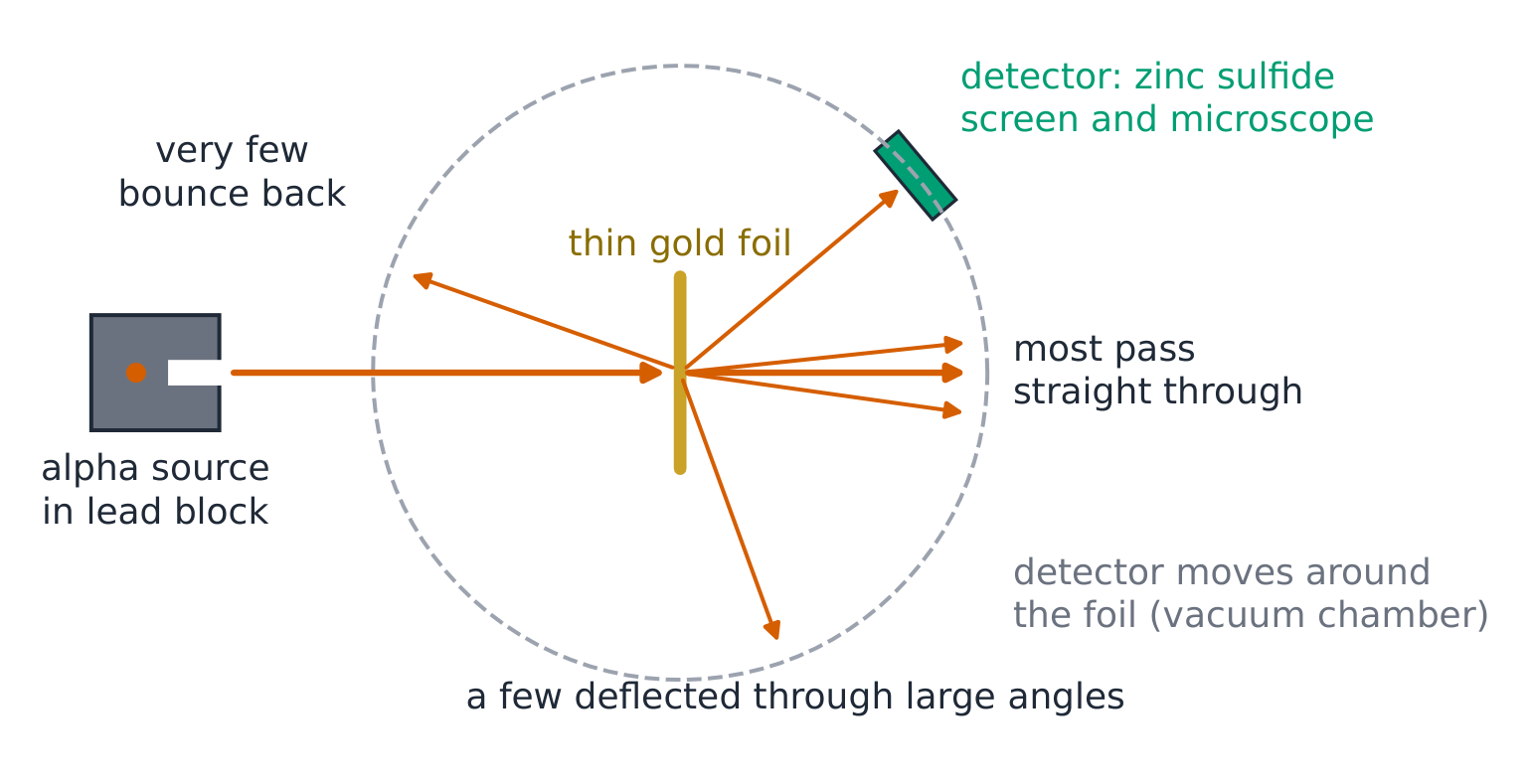
What does the original 1909 one-in-8000 reflection result establish?
Dificuldade 1/5 · Moedas 100 + pequeno bônus na primeira conclusão hoje
The original paper describes a particular reflector and counting arrangement. Material, energy and geometry affect rates; the significant evidence is the existence and angular pattern of large deflections.
Connect each observation to a limited conclusion
- Most alpha particles pass through thin foil with little deflection. This supports an atom whose mass and positive charge are concentrated rather than spread uniformly across its full volume. Rare large-angle deflections require a much stronger electric field in a small region. A light electron cannot readily reverse a fast alpha particle; the scattering centre must also be sufficiently massive. Together these results support a small, massive nuclear centre within a much larger atom.
- In the positive-nucleus model, the closer an alpha particle approaches, the stronger the repulsion and generally the larger its deflection for the same incoming energy. Do not treat “most pass through” alone as proof of every nuclear property. Scattering did not reveal neutrons or quantised electron levels, and the full historical inference about charge sign involved other evidence too. The spread-out positive charge of the plum-pudding model cannot give the observed frequency of very large deflections under the experimental conditions.
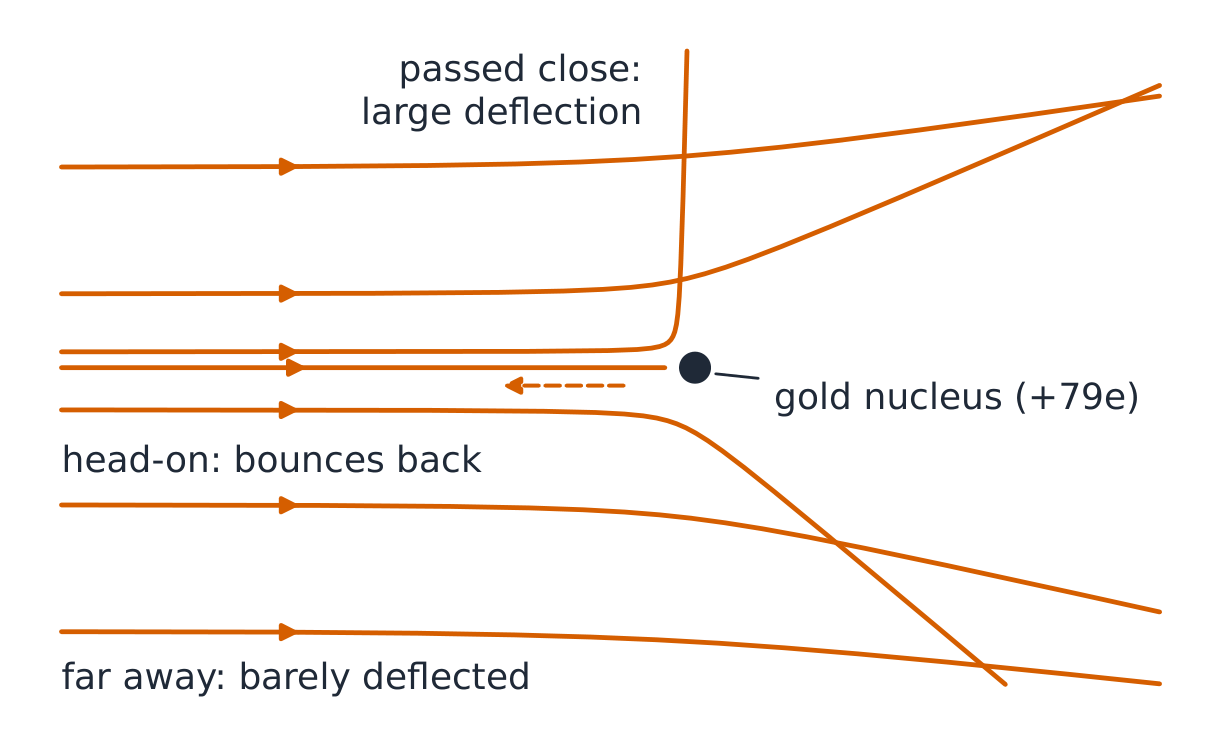
Which conclusion requires evidence beyond alpha scattering alone?
Dificuldade 1/5 · Moedas 100 + pequeno bônus na primeira conclusão hoje
Scattering constrains the nuclear centre; spectral evidence addresses electron energy separations. A successful nuclear model is not by itself a complete quantum model.
Read nuclides and ions without changing the element
- In nuclide notation, $Z$ is proton number and $A$ is total protons plus neutrons. Neutrons number $A-Z$; a neutral atom has $Z$ electrons. For uranium-235 with $Z=92$, the counts are 92 protons, 143 neutrons and 92 electrons. An alpha particle is a helium-4 nucleus: two protons and two neutrons, with charge $+2e$, rather than a neutral helium atom.
- Isotopes have the same $Z$ and different neutron numbers. Ordinary ionisation changes electrons, not $Z$ or $A$. An invented counting example, iron-56 with $Z=26$ and ion charge $3+$, has 26 protons, 30 neutrons and 23 electrons. Do not subtract the ion charge from the neutron count. Chemical symbols and required data should be taken from the question or reference table; recognise what each number means rather than guessing an element from its mass alone.
Iron-56 has Z = 26. For an ion of charge 3+, find its electron count.
Dificuldade 2/5 · Moedas 140 + pequeno bônus na primeira conclusão hoje
Protons remain 26, neutrons are 56 − 26 = 30, and losing three electrons leaves 23. Ionisation does not change neutron number or the element.
Compare spectra for the same atomic transition
- A hot dense source gives a broadly continuous spectrum. An excited low-pressure gas gives bright emission lines, while suitable gas in front of a brighter continuum can remove light at absorption wavelengths. For a particular pair of atomic levels, the emitted and absorbed photon energies correspond to the same separation, so their wavelengths match within the model. The figure shows schematic visible hydrogen lines, assuming enough atoms occupy the lower level needed for those absorptions.
- Do not conclude that every emission line must be equally visible in every absorption spectrum. Absorption requires atoms in the appropriate lower state, while emission requires populated upper states; temperature, ionisation and density affect the line strengths. Spectral lines have finite widths, and other mechanisms can scatter or absorb radiation as well. The key evidence for discrete energies is the pattern of line positions, not the claim that all gases absorb every photon at every listed wavelength with identical darkness.
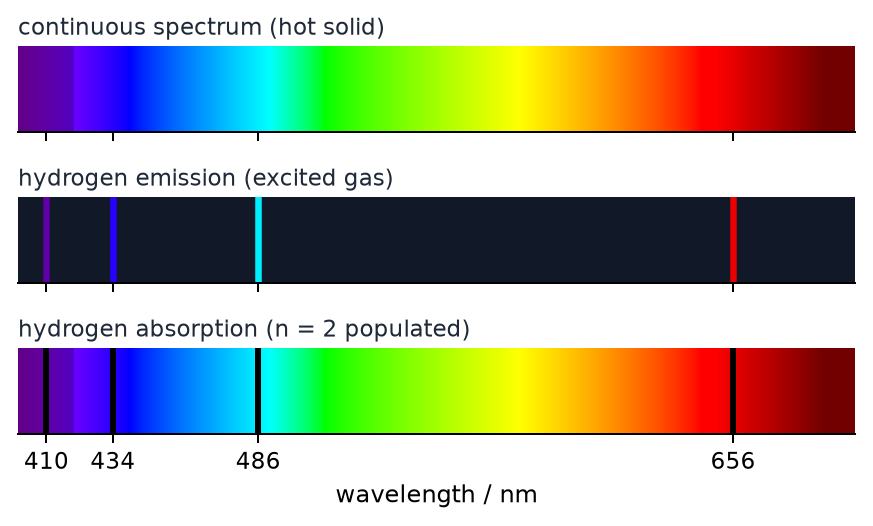
Why might a listed emission line be weak or missing in absorption from the same species?
Dificuldade 1/5 · Moedas 100 + pequeno bônus na primeira conclusão hoje
Corresponding transition energies match, but populations, excitation, ionisation, density and broadening affect which lines are prominent.
Find photon energy from the level difference
- In the single-photon transition model, an electron moving from a higher to a lower allowed energy emits a photon with $E_\gamma=E_\mathrm{upper}-E_\mathrm{lower}=hf$. A downward arrow on an energy diagram therefore means a positive emitted photon energy. For invented levels at −5.0 and −2.0 eV, the downward transition releases 3.0 eV, not −3.0 eV and not 7.0 eV.
- For bound-to-bound absorption, the photon must match the separation of an allowed transition and an atom must begin in its lower state. A 3.0 eV photon can excite the invented atom from −5.0 to −2.0 eV. It cannot leave the electron part-way between those levels in this model. Real transition probabilities and line widths add detail, so the simple arrow model is a starting point rather than a complete prediction of line brightness.
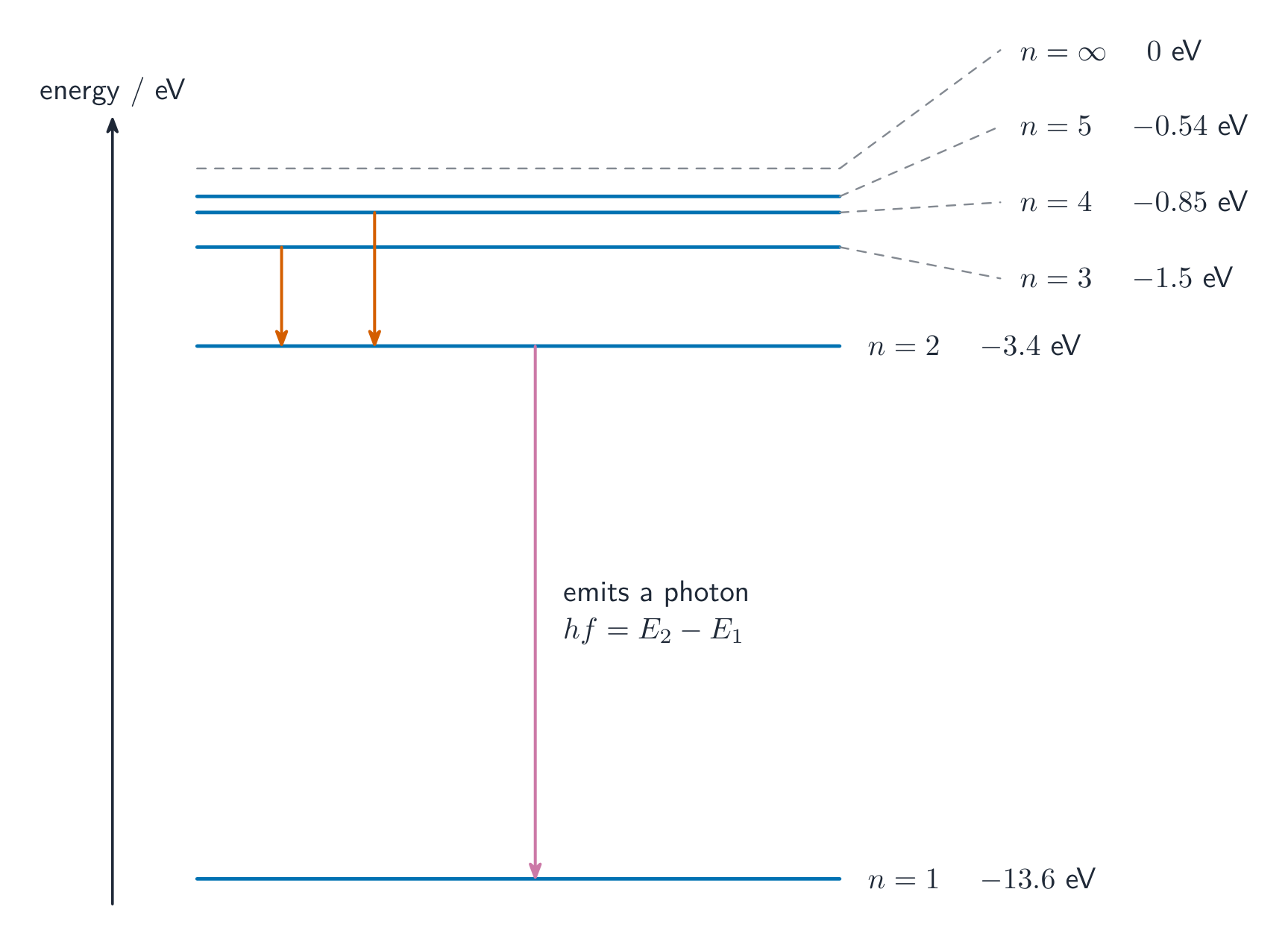
Invented levels are −5.0 and −2.0 eV. Find emitted photon energy for the downward transition.
Dificuldade 2/5 · Moedas 140 + pequeno bônus na primeira conclusão hoje
Eγ = Eupper − Elower = −2.0 − (−5.0) = +3.0 eV. The negative level reference does not give a negative photon.
Keep electronvolts and joules separate
- Use $E_\gamma=hf=hc/\lambda$ with consistent units. With $h=6.63\times10^{-34}$ J s, $c=3.00\times10^8\ \dfrac{\mathrm m}{\mathrm s}$ and an invented photon wavelength of 434 nm, convert wavelength to $434\times10^{-9}$ m. Photon energy is $4.583\times10^{-19}$ J. Dividing by $1.60\times10^{-19}$ J per eV gives 2.864 eV. Dividing by $h$ instead gives frequency, not energy in eV.
- For a 3.0 eV photon, convert first to $4.80\times10^{-19}$ J and obtain $f=7.24\times10^{14}$ Hz. A larger level drop means a higher frequency and a shorter wavelength. Check whether your wavelength lies in the expected part of the spectrum. Rounded energy levels and rounded constants can give a value such as 658 nm for a transition commonly listed near 656 nm; do not silently treat a rounded calculation as an exact measured wavelength.
Use h = 6.63 × 10⁻³⁴ J s, c = 3.00 × 10⁸ m/s and 1 eV = 1.60 × 10⁻¹⁹ J. Find photon energy in eV for 434 nm.
Dificuldade 2/5 · Moedas 140 + pequeno bônus na primeira conclusão hoje
Convert λ = 434 nm = 434 × 10⁻⁹ m. Then E = hc/λ = (6.63 × 10⁻³⁴)(3.00 × 10⁸)/(434 × 10⁻⁹) = 4.58295 × 10⁻¹⁹ J. Divide by 1.60 × 10⁻¹⁹ J/eV to obtain 2.86434 eV. Dividing by h instead would give frequency.
An invented transition emits 3.0 eV. Use 1 eV = 1.60 × 10⁻¹⁹ J and h = 6.63 × 10⁻³⁴ J s. Find frequency in units of 10¹⁴ Hz.
Dificuldade 2/5 · Moedas 140 + pequeno bônus na primeira conclusão hoje
Convert E = 3.0 eV = 3.0 × 1.60 × 10⁻¹⁹ = 4.80 × 10⁻¹⁹ J. Then f = E/h = (4.80 × 10⁻¹⁹)/(6.63 × 10⁻³⁴) = 7.23982 × 10¹⁴ Hz. Enter 7.23982 in the requested units. Dividing an eV number by h in J s without conversion is inconsistent.
Separate excitation from ionisation
- Negative bound-state energy refers to a chosen zero, usually the separated electron and ion at rest in the model. It does not mean negative emitted light energy. If an invented atom starts at −5.0 eV, at least 5.0 eV is needed to reach the continuum threshold. A 3.0 eV photon may excite it to a bound level at −2.0 eV; a 6.0 eV photon can instead ionise it, with approximately 1.0 eV left as kinetic energy when recoil is neglected.
- Therefore “only exact level-gap photons can ever be absorbed” is too broad. It describes idealised bound-to-bound lines, not absorption into a continuum. Ground-state hydrogen has an ionisation threshold of about 13.6 eV; hydrogen already excited to −3.40 eV needs only about 3.40 eV to ionise. Always specify the initial level. A free electron's allowed kinetic energies are not restricted to the same discrete bound-state list.
An invented atom starts at −5.0 eV. It absorbs a 6.0 eV photon and ionises; neglect recoil. Find the freed electron’s kinetic energy.
Dificuldade 2/5 · Moedas 140 + pequeno bônus na primeira conclusão hoje
Five electronvolts reach the continuum threshold; the remaining 1.0 eV becomes kinetic energy. A continuum absorption need not equal another bound-level gap.
Distinguish possible lines from one cascade
- For four distinct levels labelled 1 to 4, there are six different pairs: 4→3, 4→2, 4→1, 3→2, 3→1 and 2→1. If all these transitions are allowed and suitable upper populations exist across a sample, six photon energies can be possible. With equally spaced levels, different pairs can share an energy, so the number of distinct lines need not equal the number of pairs.
- One electron starting at level 4 cannot emit all six photons in a single descent. It may jump directly to level 1 and emit one photon, or follow a cascade with at most three downward transitions through four levels. The sum of energies in that cascade equals the initial-to-final energy difference. For invented levels −5.0, −2.0 and −.50 eV, the three pair gaps are 3.0, 1.5 and 4.5 eV. A two-step cascade emits 1.5 plus 3.0 eV instead of a single 4.5 eV photon.
Four ordered levels have all six pair transitions allowed, with different gaps. What is the maximum number of photons one electron can emit in a single descent from level 4 to level 1?
Dificuldade 2/5 · Moedas 140 + pequeno bônus na primeira conclusão hoje
The longest descent is 4→3→2→1: three photons. Six possible sample lines do not mean six emissions from one electron in one descent.
Identify composition using a pattern
- Compare several measured line positions with laboratory reference spectra on the same wavelength scale. An identified sodium pattern near 589 nm in solar absorption supports sodium in the line-forming material. A single apparent colour or one approximate line can be ambiguous because different transitions may lie close together. Establish calibration and possible Doppler shifts before deciding that an apparent displacement means a different element.
- Line strength does not directly equal abundance without a model of temperature, ionisation and excitation. Conversely, a weak or missing line does not prove an element is absent. A star's spectrum can combine emission, absorption and a continuum from different regions. The atomic energy model explains why line positions carry chemical information; interpreting a real spectrum also needs the physical conditions and the instrument's resolution.
Which is the most defensible identification of an element in a spectrum?
Dificuldade 1/5 · Moedas 100 + pequeno bônus na primeira conclusão hoje
A multi-line pattern is stronger evidence than a single ambiguous feature. Doppler shifts, populations and instrumental resolution affect interpretation.
Test a proposed level assignment with invented data
- Suppose invented spectral features occur at 2.0 and 3.0 eV, while a model has levels at −6.0, −4.0 and −1.0 eV. Its pair gaps are 2.0, 3.0 and 5.0 eV. The first two features are compatible with that level set, and a 5.0 eV line is another possible transition to investigate. Compatibility supports the model but does not establish that the sample has only those three levels or that every possible line must be visible.
- A proposed 4.0 eV bound-to-bound line is not explained by those three levels. Check measurement uncertainty, a different species, an omitted level or a different radiation process before changing the numerical answer. Draw labelled arrows and conserve total energy. For an experiment, use approved sources and viewing methods; do not look directly at intense lamps, lasers or the Sun to obtain a spectrum.
Invented levels are −6.0, −4.0 and −1.0 eV. In addition to 2.0 and 3.0 eV gaps, find the third possible pair gap.
Dificuldade 2/5 · Moedas 140 + pequeno bônus na primeira conclusão hoje
The remaining gap is −1 − (−6) = 5 eV. A proposed 4 eV bound-to-bound feature is not explained by just these three levels.
Explain the atom from separate kinds of evidence
- Link the scattering apparatus to counts and the counts to a concentrated massive nucleus. Read $A$, $Z$, neutron number and electron count separately. Then use line positions as evidence for discrete energy separations rather than pretending scattering alone established the quantum model. For each transition, identify initial and final levels, photon direction, positive gap, unit conversion, frequency and wavelength as needed.
- Check the boundaries of the claim. Distinguish an isotope from an ion, bound-state excitation from ionisation, and one electron's cascade from all possible transitions across a sample. Population and line-width effects limit claims about absorption or brightness. Use invented level data only as model examples. A clear explanation says what each measurement supports and what additional information is needed, rather than collecting the names of three atomic models.
AHL: calculate head-on closest approach
- For an alpha particle approaching a much heavier positive nucleus head-on, use a stationary-target, purely electric model. Initial kinetic energy at effectively infinite separation becomes electric potential energy at the turning point: $K=kQq/d$, so $d=kQq/K$. Here alpha charge is $q=+2e$ and target charge $Q=Ze$. The distance is centre to centre; it is not the radius of the atom or automatically the radius of the nucleus.
- With invented $K=4.0$ MeV on gold, $Z=79$, $k=8.99\times10^9\ \dfrac{\mathrm{N\,m^2}}{\mathrm{C^2}}$ and $e=1.60\times10^{-19}$ C, convert energy to $6.40\times10^{-13}$ J. The turning distance is $5.68\times10^{-14}$ m. Doubling $K$ halves this distance; halving target charge at fixed energy also halves it. An off-centre approach has angular motion and cannot use the same head-on stopping picture without further analysis.
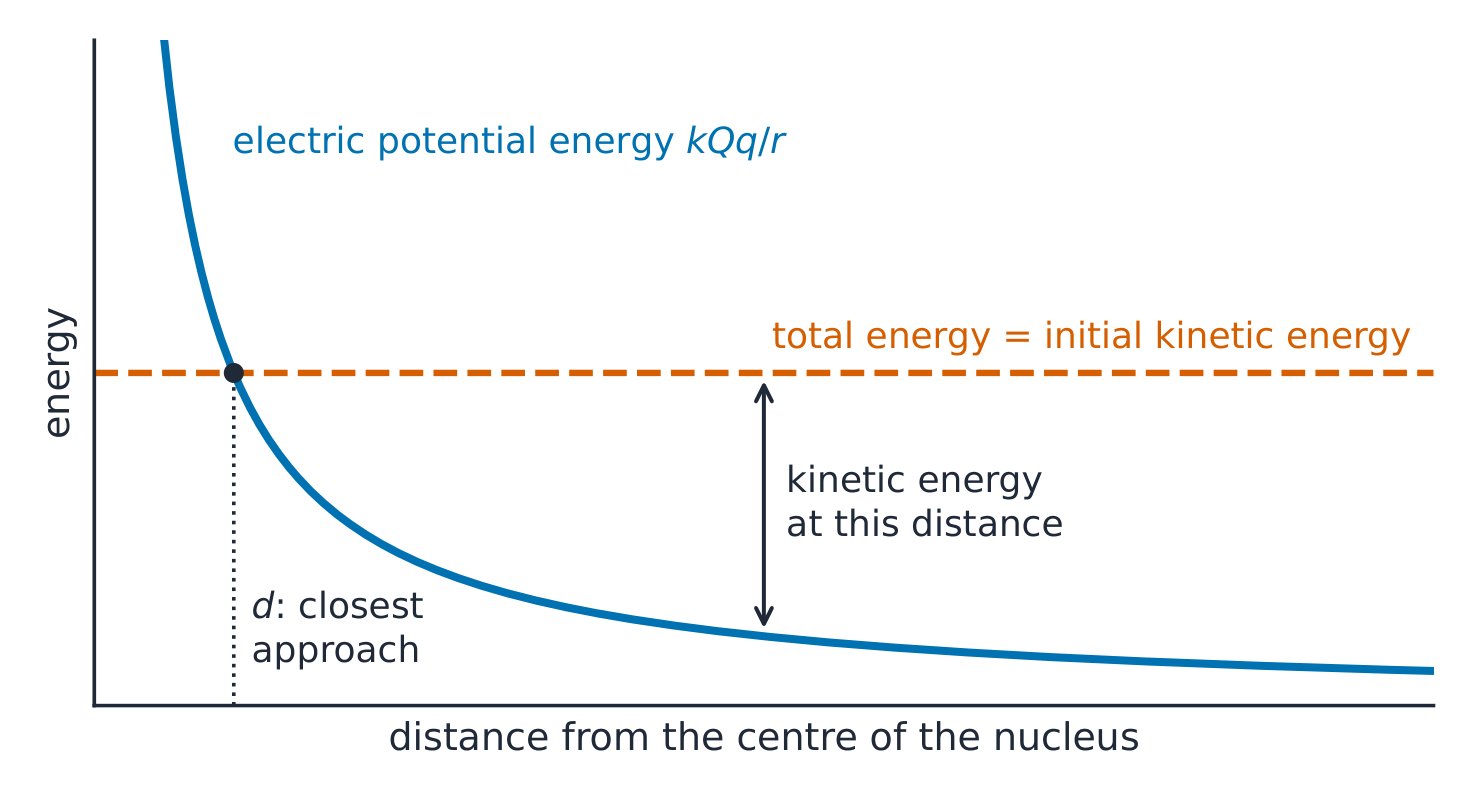
Use k = 8.99 × 10⁹ N m²/C² and e = 1.60 × 10⁻¹⁹ C. An invented 4.0 MeV alpha approaches gold, Z = 79, head-on with negligible recoil. Find electric-model turning distance in fm.
Dificuldade 2/5 · Moedas 140 + pequeno bônus na primeira conclusão hoje
d = k(79e)(2e)/K with K = 6.40 × 10⁻¹³ J gives 5.68168 × 10⁻¹⁴ m = 56.82 fm. This is a centre-to-centre distance within an electric fixed-target model.
AHL: treat scattering departures as evidence to interpret
- If the electric point-charge model fits measurements while the probe turns well outside the nucleus, the turning distance supplies an upper scale for nuclear extent. It is not a measurement of the surface itself. Alpha particles also have finite size, and target recoil is only approximately negligible. State these assumptions before equating a centre-to-centre approach distance to a nuclear radius.
- At greater probe energies, finite nuclear charge extent and short-range nuclear interactions can make scattering depart from the simple Rutherford prediction. The deviation is not universally a downward count change, nor does an alpha particle have to be imagined as touching a hard ball. Interpreting the onset needs a scattering model, probe energy, target and geometry. In a simple contact-scale estimate the relevant separation is approximately the sum of target and alpha radii, rather than the target radius alone.
What can justify interpreting a high-energy departure from Rutherford scattering?
Dificuldade 1/5 · Moedas 100 + pequeno bônus na primeira conclusão hoje
Departures depend on the geometry and interactions. A finite alpha probe may respond near a separation comparable to the sum of radii, not the target radius alone.
AHL: extract radius from a cube-root graph
- The empirical nuclear-size model is $R=R_0A^{1/3}$, with $R_0\approx1.20$ fm in the stated model and $1\ \mathrm{fm}=10^{-15}$ m. Aluminium-27 gives $R=1.20\times3=3.60$ fm. An invented nucleus with $A=216$ has radius 7.20 fm, twice the aluminium value even though its nucleon number is eight times greater.
- Plotting $R$ against $A$ gives a curve, while plotting $R$ against $A^{1/3}$ gives a straight-line trend with gradient $R_0$. This is an approximate description of nuclear sizes, not an exact law for every light isotope or a claim that all nuclei have sharply defined spherical surfaces. Check whether supplied size means radius or diameter. Comparing that empirical radius with a much greater electric turning distance illustrates why a low-energy alpha may never probe the nuclear surface.
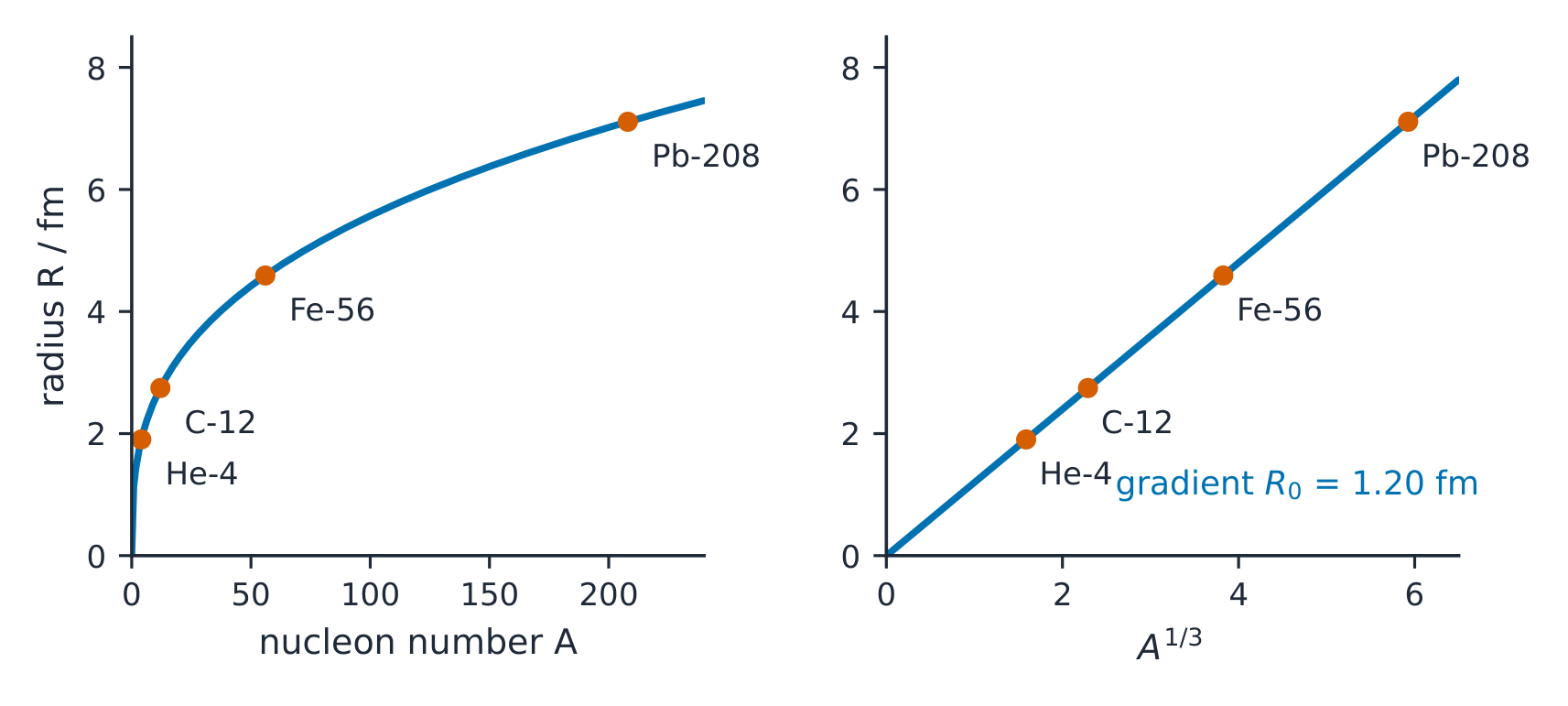
Using R = 1.20 A^(1/3) fm, find aluminium-27 radius.
Dificuldade 2/5 · Moedas 140 + pequeno bônus na primeira conclusão hoje
The cube root of 27 is 3, giving 3.60 fm. An A = 216 nucleus is twice this radius, not eight times it, in the same approximate model.
AHL: derive the approximate nuclear density
- Approximate nuclear mass as $Am_u$ and volume as $\tfrac43\pi R^3$. Substituting $R=R_0A^{1/3}$ gives $\rho=3m_u/(4\pi R_0^3)$: $A$ cancels. With $m_u=1.66\times10^{-27}$ kg and $R_0=1.20\times10^{-15}$ m, density is $2.29\times10^{17}\ \dfrac{\mathrm{kg}}{\mathrm{m^3}}$. The cube-root size relation is what makes the approximate density independent of nucleon number.
- Do not call this exactly equal for every nucleus. Binding energy changes mass slightly, and actual charge/matter distributions and shapes add detail. A notional 5 cm³ sample at this density would have mass about $1.15\times10^{12}$ kg; this is a dimensional illustration, not a claim that a stable spoonful of isolated nuclear matter can be stored on a desk. Ordinary atoms have far lower bulk density because nuclei occupy only a tiny part of their volume.
Use mᵤ = 1.66 × 10⁻²⁷ kg and R₀ = 1.20 × 10⁻¹⁵ m. Find 3mᵤ/(4πR₀³) in units of 10¹⁷ kg/m³.
Dificuldade 2/5 · Moedas 140 + pequeno bônus na primeira conclusão hoje
ρ = 3mᵤ/(4πR₀³) = 3(1.66 × 10⁻²⁷)/[4π(1.20 × 10⁻¹⁵)³] = 2.29338 × 10¹⁷ kg/m³. Enter 2.29338 in the requested units. A cancels because mass is Amᵤ and volume is (4π/3)R₀³A; real nuclear structure limits exact equality.
AHL: use Bohr quantisation within its model
- Bohr assumes stationary circular electron orbits in which no energy is radiated, with quantised angular momentum $mvr=nh/(2\pi)$. Combining this imposed rule with electric centripetal force gives allowed radii $r_n=n^2r_1$ and, for hydrogen, energies $E_n=-13.6/n^2$ eV. The rule is a model postulate; classical circular acceleration alone would not explain a stable atom.
- From $v=nh/(2\pi mr)$ and $r_2=4r_1$, the speed ratio is $v_2/v_1=2/4=1/2$. At $r_1=5.3\times10^{-11}$ m, $m_e=9.11\times10^{-31}$ kg and $h=6.63\times10^{-34}$ J s, the ground-orbit speed estimate is $2.19\times10^6\ \dfrac{\mathrm m}{\mathrm s}$. The drawn four-wavelength ring illustrates the later standing-wave consistency condition $2\pi r=n\lambda$; it is not a photograph of an electron travelling along a wavy track.
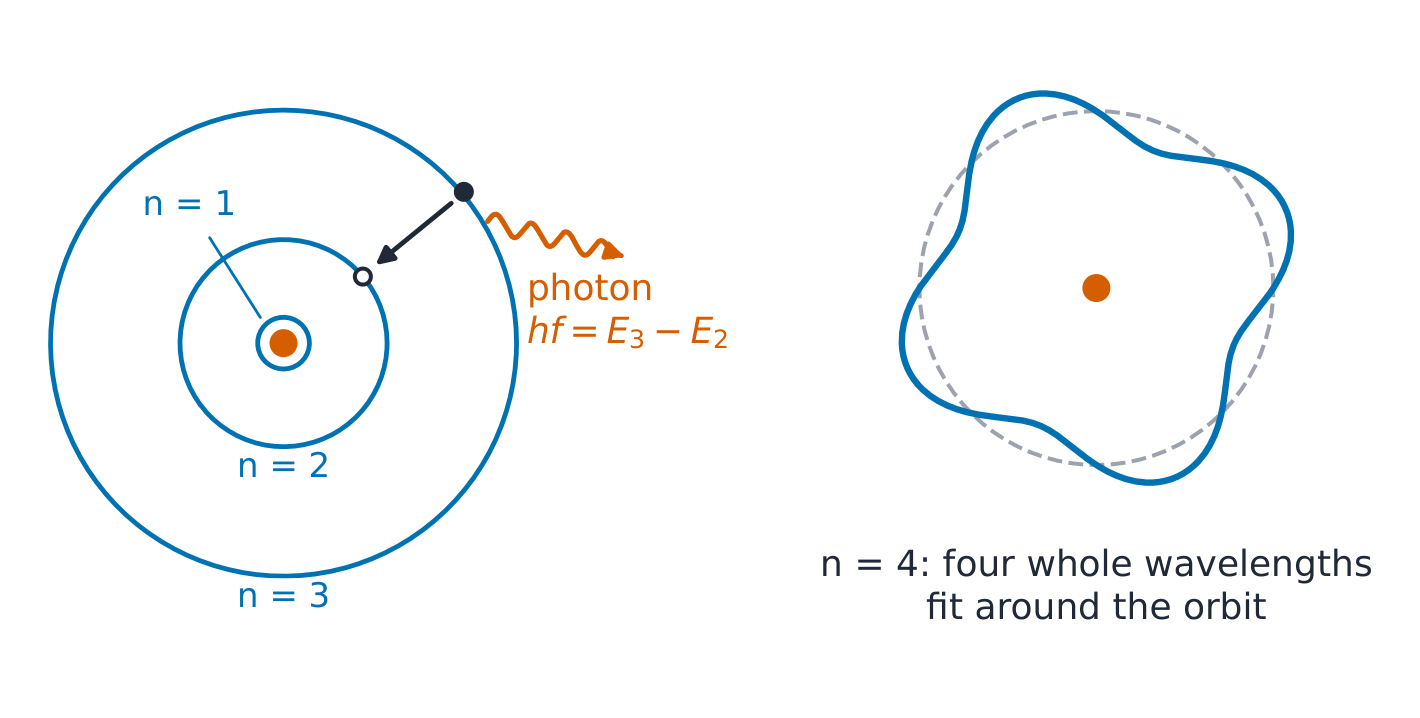
For Bohr orbits mvr = nh/(2π), r₂ = 4r₁. Find v₂/v₁.
Dificuldade 2/5 · Moedas 140 + pequeno bônus na primeira conclusão hoje
v₂/v₁ = (n₂/n₁)(r₁/r₂) = 2/4 = .5. Higher n does not by itself imply greater speed because the radius changes too.
AHL: calculate a hydrogen line and state the limits
- For hydrogen $n=4$ to $n=2$, the model gives $\Delta E=13.6(1/4-1/16)=2.55$ eV. With the supplied rounded constants this is $4.08\times10^{-19}$ J and wavelength $4.875\times10^{-7}$ m, about 488 nm. The measured line is commonly listed near 486 nm; the small difference comes from the rounded model constants used here, rather than a change of photon sign. The final bound level remains at negative energy while the emitted photon has positive energy.
- The hydrogen-like model extends to one-electron ions with the nuclear-charge factor included; the hydrogen-specific −13.6 eV coefficient must not be applied unchanged to every ion. Bohr's model does not give a complete account of transition strengths, fine structure or many-electron spectra. Modern quantum states are not definite classical electron orbits. Relate its successful approximate energy predictions to observations while keeping these limits separate from the scattering evidence for a nucleus.
Explain what scattering, nuclide notation and atomic spectra establish. Include a photon calculation, ionisation and possible sample lines versus one cascade.
Separate the evidence for a nuclear centre from evidence for energy levels, and state what the simple transition model leaves unresolved.
Hydrogen En = −13.6/n² eV. With h = 6.63 × 10⁻³⁴ J s, c = 3.00 × 10⁸ m/s and 1 eV = 1.60 × 10⁻¹⁹ J, find the n = 4 to 2 wavelength in nm.
Dificuldade 2/5 · Moedas 140 + pequeno bônus na primeira conclusão hoje
E₄ = −13.6/16 = −0.85 eV and E₂ = −13.6/4 = −3.40 eV. The photon gap is E₄ − E₂ = −0.85 − (−3.40) = 2.55 eV = 4.08 × 10⁻¹⁹ J. Then λ = hc/E = (6.63 × 10⁻³⁴)(3.00 × 10⁸)/(4.08 × 10⁻¹⁹) = 4.875 × 10⁻⁷ m = 487.5 nm ≈ 488 nm. Distinguish this rounded-constant calculation from the measured line near 486 nm.
Which statement correctly limits the quoted Bohr energy formula?
Dificuldade 1/5 · Moedas 100 + pequeno bônus na primeira conclusão hoje
The historical model predicts approximate hydrogen energies but does not fully explain many-electron spectra, line strengths or modern quantum states.