Photons and the photoelectric effect
Introduzido| English | Significado |
|---|---|
| photon/ˈfəʊtɒn/ | fóton |
| work function/wɜːk ˈfʌŋkʃn/ | função trabalho |
What would explain this observation?
- Bright low-frequency light can fail to eject electrons while dim higher-frequency light succeeds. Photon 光子 energy depends on frequency, not intensity alone.
Build the model
- A photon has energy proportional to frequency.
- The work function 逸出功 is the minimum energy needed to release an electron from a surface.
- Above threshold, excess photon energy can become electron kinetic energy.
- photon: A quantum of electromagnetic radiation.
- work function: Minimum surface energy needed to release an electron.

At fixed above-threshold frequency, increasing intensity mainly increases what?
Dificuldade 1/5 · Moedas 100 + pequeno bônus na primeira conclusão hoje
Photon energy depends only on frequency (E = hf), so raising intensity at fixed frequency adds more photons, each unchanged. More photons above threshold liberate more electrons per second; the work function is a property of the surface.
Match each technical term to its precise meaning.
Dificuldade 2/5 · Moedas 140 + pequeno bônus na primeira conclusão hoje
Use the definitions to distinguish related quantities and processes.
Choose evidence that can test it
- Use photon energy = Planck constant × frequency.
- Maximum kinetic energy = photon energy - work function.
- Increasing intensity at fixed frequency increases photon arrival rate, not individual photon energy.
In the lab: Read axes carefully on a stopping-potential or kinetic-energy graph. Identify threshold frequency from the zero-energy intercept. State the metal and experimental conditions because work function is material-specific.
Which two habits make the investigation or model in this case more defensible?
Dificuldade 2/5 · Moedas 140 + pequeno bônus na primeira conclusão hoje
Stating the conditions and assumptions lets others repeat the work exactly, and recording the supporting evidence lets them check the conclusion. Hiding disagreeing results removes the evidence that could challenge a wrong conclusion, and one measurement can never establish a wider claim.
Work from known quantities
- Known: photon energy is 5.0 electronvolts and work function is 2.0 electronvolts.
- Maximum kinetic energy = photon energy - work function = 5.0 - 2.0 = 3.0 electronvolts.
- A 1.5 electronvolt photon cannot cause emission from that surface in this model.
Your turn: Photon energy is 4.8 eV and work function 2.1 eV. Find maximum kinetic energy.
More photons, or more energy per photon?
A 5 eV photon and a 2 eV work function allow a maximum kinetic energy of 3 eV. Compare photon number with photon energy, including 1.5 eV photons that cannot cause emission from this surface.
Photon energy is 4.8 eV and work function 2.1 eV. Find maximum kinetic energy.
Dificuldade 2/5 · Moedas 140 + pequeno bônus na primeira conclusão hoje
The result is 2.7 eV. Known: photon energy 4.8 eV; work function 2.1 eV. Use maximum kinetic energy = photon energy - work function. KE max = 4.8 - 2.1 = 2.7 eV. A photon below 2.1 eV does not release an electron in this elementary single-photon model.
Check the conclusion and its limits
- Electrons do not accumulate many sub-threshold photons in the elementary single-photon model.
- Do not confuse photon number with photon energy.
Not true: Doubling light intensity doubles each photon energy at fixed frequency. Intensity is energy transferred per unit area per unit time. At fixed frequency, doubling it doubles photon arrival rate per area, not photon energy. With unchanged single-photon emission efficiency and complete collection, saturation current doubles while maximum electron energy stays fixed.
- A photon has energy proportional to frequency.
- Use photon energy = Planck constant × frequency.
- Watch for: electrons do not accumulate many sub-threshold photons in the elementary single-photon model.
Doubling light intensity doubles each photon energy at fixed frequency.
Dificuldade 1/5 · Moedas 100 + pequeno bônus na primeira conclusão hoje
Intensity is energy transferred per unit area per unit time. At fixed frequency, doubling it doubles photon arrival rate per area, not photon energy. With unchanged single-photon emission efficiency and complete collection, saturation current doubles while maximum electron energy stays fixed.
A quantum of electromagnetic radiation: write the technical term.
Dificuldade 1/5 · Moedas 100 + pequeno bônus na primeira conclusão hoje
photon means A quantum of electromagnetic radiation.
Write from the data: find the maximum kinetic energy
- A photon has energy 6.0 electronvolts and the work function is 2.4 electronvolts.
- Find the maximum kinetic energy. Doubling the intensity does not double each photon's energy.
A photon has energy 6.0 electronvolts and the work function is 2.4 electronvolts. What is the maximum kinetic energy of an emitted electron, and why does doubling the intensity not double that energy?
Kmax = Eγ − Φ = 6.0 − 2.4 = 3.6 eV. At fixed frequency and illuminated area, doubling intensity doubles photon arrival rate, while each photon still has energy hf. The maximum electron energy therefore stays 3.6 eV.
Photons of energy 6.0 eV strike a metal with work function 2.4 eV. What is the maximum kinetic energy of an emitted electron?
Dificuldade 1/5 · Moedas 100 + pequeno bônus na primeira conclusão hoje
6.0 minus 2.4 is 3.6 electronvolts. Other options — 2.7 electronvolts (the lesson example's result for a 4.8 electronvolt photon and a 2.1 electronvolt work function); 6.0 electronvolts (the photon energy).
AHL: define the photoelectric experiment before generalising
- A clean negatively charged metal plate can discharge under suitable ultraviolet light because electrons leave its surface. An ordinary bright red lamp may fail because individual photons have too little energy, rather than because red light carries no energy. The elementary experiment concerns single-photon external photoemission, with a specified surface and negligible heating or other discharge mechanisms. Brightness affects the emission rate when emission is allowed; it is inaccurate to say that brightness never matters.
- The vacuum photocell in this figure collects emitted electrons at an anode. Do not describe every light-sensitive device as this apparatus: solar cells absorb energy in a semiconductor and collect carriers through the material. The common idea is light transferring energy to electrons, but the structure and energy barriers differ. State whether the observation is electron emission, current through a semiconductor, or an electroscope's charge loss before selecting an equation.

Which statement distinguishes the vacuum photoelectric apparatus from a solar cell?
Dificuldade 1/5 · Moedas 100 + pequeno bônus na primeira conclusão hoje
Both involve light transferring energy to electrons, but external photoemission and a semiconductor photovoltaic device have different structures and energy barriers.
AHL: separate intensity, photon rate and photon energy
- Intensity is energy transferred per unit area per unit time. For monochromatic light at a fixed frequency, each photon has energy $hf$, so photon arrival rate per unit area is intensity divided by $hf$. Doubling intensity at fixed frequency doubles that rate. It does not double the energy of each photon. Changing frequency while holding intensity fixed changes photon energy and photon rate in opposite ways.
- Above threshold, a constant emission efficiency and complete collection make saturation photocurrent proportional to the photon arrival rate on the illuminated area. Therefore a doubled rate can double the saturation current under these controlled conditions. At a different collecting voltage, space-charge effects, incomplete collection or surface changes can alter the measured relation. Photon number is not itself intensity, and one incident photon does not guarantee one collected electron. Distinguish the source rate, absorption, electron emission and electrical collection.
An invented monochromatic beam has intensity .80 W/m² and photon energy 4.0 × 10⁻¹⁹ J. Find photon arrival rate per square metre in units of 10¹⁸ photons/(m² s).
Dificuldade 2/5 · Moedas 140 + pequeno bônus na primeira conclusão hoje
Rate per area = intensity/(energy per photon) = .80/(4.0 × 10⁻¹⁹) = 2.0 × 10¹⁸ photons/(m² s). Intensity is energy flux, not a raw photon count.
AHL: apply a threshold without inventing negative kinetic energy
- In the elementary single-photon model, a photon supplies energy $hf$ to one electron. The work function $\Phi$ is the minimum surface escape energy, and the most energetic emitted electrons have $K_{\mathrm{max}}=hf-\Phi$. Threshold is $f_0=\Phi/h$ and threshold wavelength is $\lambda_0=hc/\Phi$. If $hf<\Phi$, the conclusion is no single-photon emission, rather than an emitted electron with negative kinetic energy.
- For an invented surface assigned $\Phi=2.30$ eV, the threshold frequency is $5.55\times10^{14}$ Hz and wavelength is about 540 nm using $h=6.63\times10^{-34}$ J s, $c=3.00\times10^8\ \dfrac{\mathrm m}{\mathrm s}$ and $1\ \mathrm{eV}=1.60\times10^{-19}$ J. Wavelengths shorter than this can exceed threshold. Work function depends on the actual surface, including its condition, so a problem's assigned value should not be treated as a universal constant for every sample of that metal.
An invented surface has Φ = 2.30 eV. Use e = 1.60 × 10⁻¹⁹ C and h = 6.63 × 10⁻³⁴ J s. Find threshold frequency in units of 10¹⁴ Hz.
Dificuldade 2/5 · Moedas 140 + pequeno bônus na primeira conclusão hoje
f₀ = Φ/h = (2.30 × 1.60 × 10⁻¹⁹)/(6.63 × 10⁻³⁴) = 5.55 × 10¹⁴ Hz. Below threshold the elementary model gives no emitted electron, not negative emitted kinetic energy.
AHL: explain the evidence within the single-photon model
- The threshold, the absence of a measurable accumulation delay in ordinary experiments, and the frequency dependence of maximum electron energy challenge the classical continuous-energy accumulation account. Photon absorption supplies an energy packet without requiring a dim beam to charge up an electron gradually over a long period. Dim light can still give very few emission events, so a low counting rate is different from an intrinsic energy-accumulation delay.
- The statement that an electron can never absorb energy from more than one photon is too broad. Multiphoton photoemission has been observed under specialised conditions. This unit's ordinary threshold calculations assume the elementary single-photon regime; they are not claims about arbitrarily intense fields. The quantum model explains the specified observations without discarding the interference and diffraction evidence for wave behaviour.
What limits the statement that sub-threshold photons cannot release an electron?
Dificuldade 1/5 · Moedas 100 + pequeno bônus na primeira conclusão hoje
The elementary model is the correct scope for these threshold calculations. Intense/specialised multiphoton processes and heating are not covered by its simple threshold statement.
AHL: calculate electron energy and speed consistently
- For the invented 2.30 eV surface illuminated at 400 nm, photon energy is 3.1078 eV. Thus $K_{\mathrm{max}}=.8078$ eV, or $1.2925\times10^{-19}$ J. The classical maximum speed is $\sqrt{2K_{\mathrm{max}}/m_e}=5.33\times10^5\ \dfrac{\mathrm m}{\mathrm s}$ with $m_e=9.11\times10^{-31}$ kg. Keep unrounded photon energy until the final answer, and convert to joules before using mass in kilograms.
- The equation gives the maximum rather than every emitted electron's energy: electrons can begin in different states and lose energy before reaching the surface. A brighter beam of the same frequency does not shift this ideal maximum. If the assigned work function is larger than the photon energy, do not take the square root of a negative number and report a speed. For much greater electron energies, the classical speed formula also requires its own validity check.
For an invented Φ = 2.30 eV surface, 400 nm photons arrive. Use h = 6.63 × 10⁻³⁴ J s, c = 3.00 × 10⁸ m/s and 1 eV = 1.60 × 10⁻¹⁹ J. Find maximum electron energy in eV.
Dificuldade 2/5 · Moedas 140 + pequeno bônus na primeira conclusão hoje
Convert λ = 400 nm = 4.00 × 10⁻⁷ m. Eγ = hc/λ = (6.63 × 10⁻³⁴)(3.00 × 10⁸)/(4.00 × 10⁻⁷) = 4.9725 × 10⁻¹⁹ J. Divide by 1.60 × 10⁻¹⁹ J/eV to get 3.1078125 eV. Then Kmax = 3.1078125 − 2.30 = 0.8078125 eV. Keep the unrounded photon energy before subtraction; convert electron energy to J before calculating classical speed.
AHL: read the kinetic-energy graph with its units
- Plotting $K_{\mathrm{max}}$ in joules against frequency in hertz gives gradient $h$, frequency-axis intercept $f_0$ and an extrapolated energy-axis intercept $-\Phi$. Different assigned work functions give parallel lines with different thresholds. The dashed extensions below zero energy are a graphical extrapolation, not observed photoelectrons travelling with negative kinetic energy.
- If the vertical energy unit is eV instead, the numerical gradient is $h/e$ in eV s, rather than $h$ expressed in J s. Likewise, an axis scaled in multiples of $10^{14}$ Hz needs that factor when extracting a slope. For invented points at $6.0\times10^{14}$ and $8.0\times10^{14}$ Hz, a kinetic-energy increase of $1.326\times10^{-19}$ J gives slope $6.63\times10^{-34}$ J s. Use differences between well-separated fitted points rather than assuming the line passes through the origin.
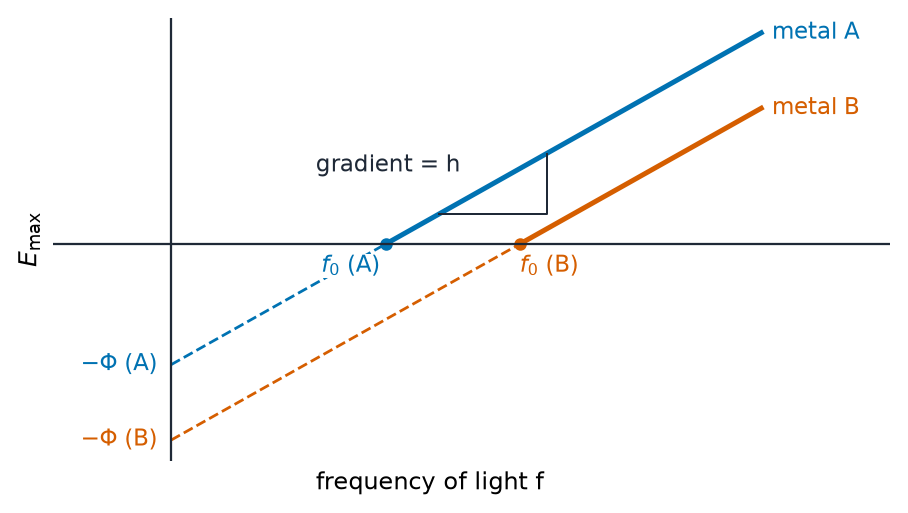
Invented kinetic energy increases by 1.326 × 10⁻¹⁹ J over a frequency increase 2.0 × 10¹⁴ Hz. Find the gradient in units of 10⁻³⁴ J s.
Dificuldade 2/5 · Moedas 140 + pequeno bônus na primeira conclusão hoje
Gradient = ΔK/Δf = (1.326 × 10⁻¹⁹)/(2.0 × 10¹⁴) = 6.63 × 10⁻³⁴ J s = h. Enter 6.63 in the requested units. If the energy axis were in eV, its numerical slope would instead be h/e with the appropriate energy unit.
AHL: distinguish stopping potential from a current plateau
- Make the collecting anode negative relative to the emitting cathode so emitted electrons must lose kinetic energy. The positive stopping-potential magnitude $V_s$ satisfies $eV_s=K_{\mathrm{max}}$. In the previous example it is .8078 V, while the anode-potential intercept is −.8078 V. Do not change the sign of electron energy simply because the applied retarding potential is negative.
- The saturation plateau at sufficiently positive anode potential means essentially all emitted electrons are collected. Brighter light at the same frequency raises that plateau but leaves the ideal stopping intercept unchanged. A higher-frequency curve has a larger stopping magnitude if the surface is unchanged; its current height also needs photon rate and efficiency information. In this illustrative graph the third curve's height is chosen, not a universal prediction of frequency. Real measurements can require contact-potential, background-current and surface corrections.
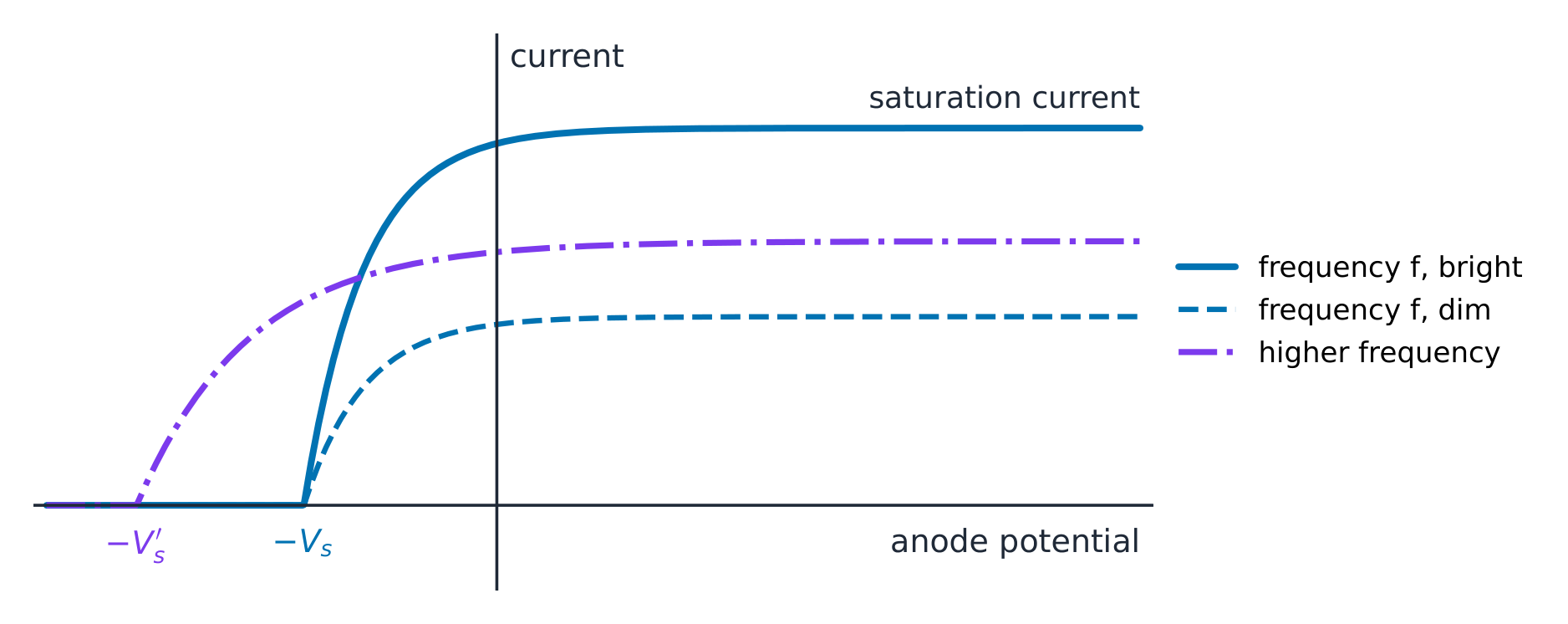
An invented photoelectron maximum energy is .8078 eV. Find the positive stopping-potential magnitude.
Dificuldade 2/5 · Moedas 140 + pequeno bônus na primeira conclusão hoje
eVs = Kmax, so the same numerical energy in eV gives Vs = .8078 V. The anode-potential intercept relative to cathode is negative, −.8078 V.
AHL: extract Planck's constant from a fitted trend
- Combining the photoelectric and stopping relations gives $V_s=(h/e)f-\Phi/e$. With a fixed surface, plot stopping magnitude against frequency and fit its trend. The gradient in V per Hz is $h/e$; multiply it by $e$ to recover $h$ in J s. The fitted intercept contains the work function and possible experimental offsets, so a line through the origin is generally unjustified. Compare photon energies above threshold and use consistent voltage polarity.
- In an invented dataset, stopping magnitude rises by .829 V over $2.0\times10^{14}$ Hz. The slope is $4.145\times10^{-15}$ V s, giving $h\approx6.63\times10^{-34}$ J s. Repeated readings help estimate scatter, but a systematic frequency calibration or contact-potential offset needs separate consideration. This is the measurement principle associated with Millikan's photoelectric work, rather than a claim that these invented readings are his data.
Invented stopping magnitude rises by .829 V over 2.0 × 10¹⁴ Hz. Use e = 1.60 × 10⁻¹⁹ C. Find h in units of 10⁻³⁴ J s.
Dificuldade 2/5 · Moedas 140 + pequeno bônus na primeira conclusão hoje
Gradient = ΔVs/Δf = 0.829/(2.0 × 10¹⁴) = 4.145 × 10⁻¹⁵ V s = h/e. Hence h = e × gradient = (1.60 × 10⁻¹⁹)(4.145 × 10⁻¹⁵) = 6.632 × 10⁻³⁴ J s. Enter 6.632 in the requested units. A fitted offset need not be zero.
AHL: use momentum for a matter wavelength
- De Broglie's relation is $\lambda=h/p$. For a massive particle moving non-relativistically, $p=mv$, so the familiar form $\lambda=h/(mv)$ applies. For an electron accelerated from rest through a positive voltage magnitude $V$, the classical energy equation gives $p=\sqrt{2m_e eV}$ and $\lambda=h/\sqrt{2m_e eV}$. These substitutions are not valid at every possible accelerating voltage.
- For an invented 150 V electron beam, momentum is $6.61\times10^{-24}\ \dfrac{\mathrm{kg\,m}}{\mathrm s}$ and wavelength is $1.00\times10^{-10}$ m. Quadrupling accelerating voltage doubles classical momentum and halves wavelength. For high-energy nuclear-scattering electrons use the appropriate relativistic momentum, or a wavelength supplied by the question; do not insert a classical speed that exceeds light speed. A photon also obeys $p=h/\lambda=E/c$ in vacuum despite having zero rest mass.
An invented electron accelerates classically from rest through 150 V. Use h = 6.63 × 10⁻³⁴ J s, mₑ = 9.11 × 10⁻³¹ kg and e = 1.60 × 10⁻¹⁹ C. Find wavelength in pm.
Dificuldade 2/5 · Moedas 140 + pequeno bônus na primeira conclusão hoje
p = √(2mₑeV) = √[2(9.11 × 10⁻³¹)(1.60 × 10⁻¹⁹)(150)] = 6.61272 × 10⁻²⁴ kg m/s. Then λ = h/p = (6.63 × 10⁻³⁴)/(6.61272 × 10⁻²⁴) ≈ 1.00261 × 10⁻¹⁰ m = 100.261 pm. Retain the unrounded momentum in division. The classical substitution must not be used blindly for high-energy nuclear probes.
Find momentum of an invented 500 nm photon in vacuum. Use h = 6.63 × 10⁻³⁴ J s.
Dificuldade 2/5 · Moedas 140 + pequeno bônus na primeira conclusão hoje
p = h/λ = (6.63 × 10⁻³⁴)/(500 × 10⁻⁹) = 1.326 × 10⁻²⁷ kg m/s. Zero rest mass does not imply zero photon momentum.
AHL: compare particles under a stated control
- At equal non-relativistic kinetic energy $K$, wavelength is $h/\sqrt{2mK}$. An electron therefore has a longer wavelength than a proton at the same $K$ by $\sqrt{m_p/m_e}\approx42.8$ for $m_p=1.67\times10^{-27}$ kg. At equal speed instead, the wavelength ratio would involve the full mass ratio, so the words “same kinetic energy” are essential.
- A .058 kg tennis ball at 50 m/s has formal wavelength about $2.29\times10^{-34}$ m. This is far too small for appreciable doorway diffraction in an ordinary experiment, and maintaining macroscopic coherence adds further obstacles. Do not turn this into “everyday matter fundamentally has no wave description”. The useful conclusion is about observability in the specified geometry. Compare wavelength with the aperture or structural spacing before deciding whether a diffraction effect can be resolved.
An electron and proton have equal non-relativistic kinetic energy. With mₑ = 9.11 × 10⁻³¹ kg and mₚ = 1.67 × 10⁻²⁷ kg, find λₑ/λₚ.
Dificuldade 2/5 · Moedas 140 + pequeno bônus na primeira conclusão hoje
At equal K, λ ∝ 1/√m, so the ratio is √(mₚ/mₑ) ≈ 42.82. At equal speed the comparison would be different.
AHL: connect crystal structure to electron rings
- Accelerated electrons passing through a thin polycrystalline graphite layer can produce rings on a fluorescent screen. Regular atomic planes provide coherent scattering, while many crystal orientations turn the possible diffraction directions into rings. A suitably oriented single crystal can instead give discrete spots. The pattern therefore depends on the specimen as well as on the wave nature of the beam.
- At the same crystal spacings and screen geometry, greater accelerating voltage gives greater momentum and shorter de Broglie wavelength. In the usual small-angle, non-relativistic ring model, ring size scales approximately as $1/\sqrt V$. Increasing voltage by a factor of four approximately halves ring diameter, rather than reducing it by four. Individual electron detections are localised, while many events build the diffraction pattern; a weak beam does not require electrons to arrive simultaneously to show the distribution.
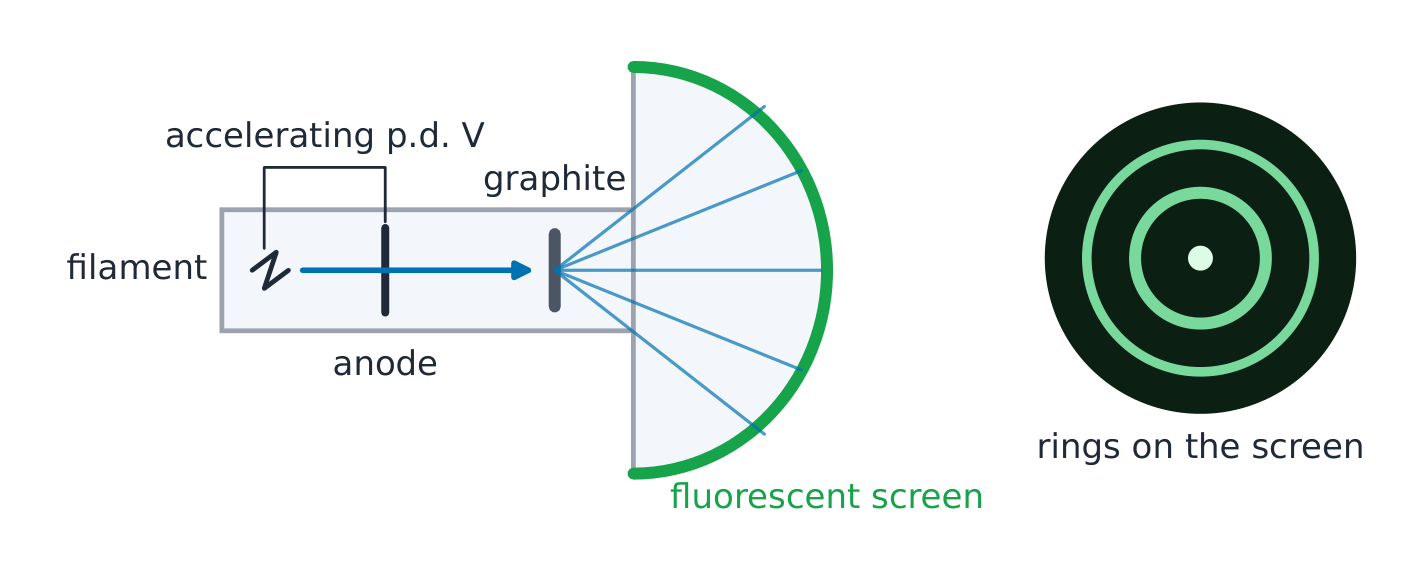
In a fixed small-angle electron-diffraction setup, accelerating voltage increases by four in the non-relativistic model. Find new ring diameter divided by old diameter.
Dificuldade 2/5 · Moedas 140 + pequeno bônus na primeira conclusão hoje
Wavelength and small-angle ring diameter scale as 1/√V. Quadrupling V halves the diameter, rather than dividing it by four.
AHL: state the model behind a nuclear-size estimate
- A simplified estimate may supply $\sin\theta\approx\lambda/D$ for a first diffraction minimum. If invented probe wavelength is $3.0\times10^{-15}$ m and the minimum is at 30°, this model gives $D\approx6.0\times10^{-15}$ m. Use the diameter named by the model; confusing it with radius gives a factor-of-two error. At 35°, retain the sine rather than replacing the angle by a degree number or treating it as a small radian angle.
- This is a scale estimate, not a universal exact first-minimum rule for every nuclear shape or charge distribution. More detailed scattering uses momentum transfer and a nuclear form factor, with a geometry-dependent coefficient. Electrons avoid the strong interaction of an alpha probe but still respond to the nuclear electric field. The plotted curve is illustrative, not measured carbon data; its minimum alone does not establish every feature of the nucleus or justify a classical high-energy electron momentum.
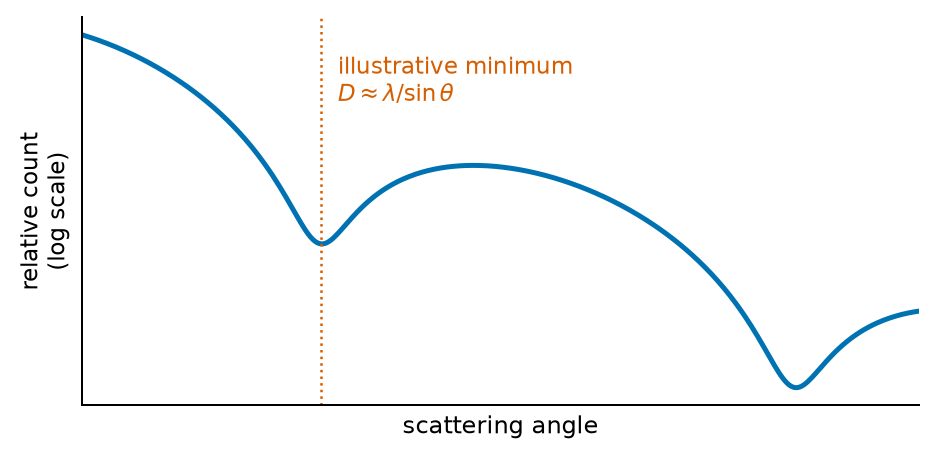
Use the stated approximate D ≈ λ/sinθ model. An invented electron wavelength is 3.0 fm and the first minimum is 30°. Find estimated diameter in fm.
Dificuldade 2/5 · Moedas 140 + pequeno bônus na primeira conclusão hoje
D ≈ 3.0/sin30° = 6.0 fm. This is a supplied simplified size model; exact nuclear scattering depends on momentum transfer and the charge distribution.
AHL: conserve photon and electron energy and momentum
- In the elementary Compton model, an incident photon scatters from an electron initially at rest and treated as free, or with binding effects negligible. Conserve total energy and vector momentum. A nonzero scattering angle transfers some photon energy to electron recoil, so the outgoing photon has smaller energy and longer wavelength. The photon still travels at $c$ between interactions in vacuum; it loses energy by changing frequency, not by slowing like a thrown ball.
- The relation is $\lambda_f-\lambda_i=[h/(m_ec)](1-\cos\theta)$, where $\theta$ is the photon deflection angle from its original direction. It is not the electron recoil angle. The electron mass in the coefficient and initial-rest assumption matter: the same simple expression cannot be applied unchanged to any moving target particle. At zero angle the shift is zero; a genuinely deflected photon has a positive shift in this model.
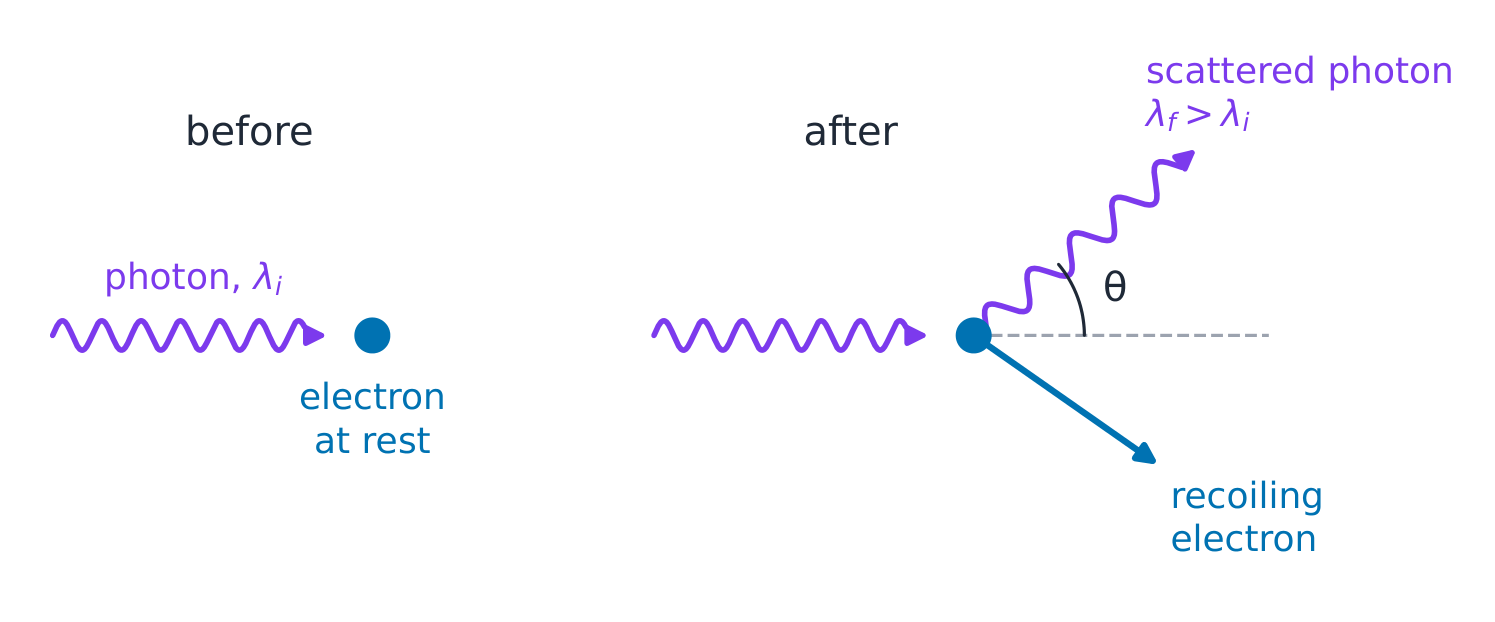
AHL: calculate a Compton shift before comparing energies
- With the given constants, $h/(m_ec)=2.426\times10^{-12}$ m. For an invented incident wavelength $5.0\times10^{-12}$ m and photon deflection 60°, the shift is half this value, $1.213\times10^{-12}$ m, so $\lambda_f=6.213\times10^{-12}$ m. Calculate the positive shift first and add it. Subtracting it would incorrectly give a photon more energy after recoil from an initially resting free electron.
- The maximum shift occurs at 180° and equals $2h/(m_ec)=4.852\times10^{-12}$ m. At fixed angle its absolute value is independent of incident wavelength in this model, but the fractional change is not. Relative to 500 nm visible light, even that maximum is only about $9.70\times10^{-6}$; this makes it difficult to resolve in an ordinary visible-light demonstration, rather than fundamentally impossible to detect. Electron recoil kinetic energy is $hc/\lambda_i-hc/\lambda_f$, with unrounded wavelengths used to avoid cancellation errors.
An invented 5.0 pm photon scatters 60° from a resting free electron. Take h/(mₑc) = 2.426 pm. Find outgoing wavelength in pm.
Dificuldade 2/5 · Moedas 140 + pequeno bônus na primeira conclusão hoje
Δλ = 2.426(1 − cos60°) = 1.213 pm. Add this positive shift to 5.0 pm: λf = 6.213 pm. θ is the photon angle, not electron recoil angle.
AHL: choose evidence and assumptions for each calculation
- Photoelectric observations require an energy packet and a surface escape threshold in the elementary model. Compton scattering adds a quantitative momentum-transfer test, while wave interference and diffraction remain necessary evidence. A localised screen event and a many-event interference distribution are compatible quantum observations; it is misleading to say an electron literally switches between being only a classical ball and only a classical wave.
- Before calculating, name the surface or target, frequency or wavelength, photon flux control, collection conditions and initial particle state. Use the maximum photoelectron energy for stopping potential, the correct energy units for a slope, and momentum appropriate to the speed regime for matter wavelengths. Mark an approximate diffraction size relation as a model. For Compton scattering, conserve both energy and vector momentum, distinguish absolute from fractional shift, and keep the initially resting free-electron assumption explicit.
Explain photoelectric observations, matter-wave diffraction and Compton scattering with the assumptions, units and evidence that distinguish their models.
A correct formula is insufficient if its surface, collection, momentum or target assumptions do not describe the apparatus.