DNA, protein synthesis and evidence
Introduzido| English | Significado |
|---|---|
| transcription/trænˈskrɪpʃn/ | transcrição |
| translation/trænˈsleɪʃn/ | tradução |
What would explain this observation?
- A change in DNA can affect a protein, but not every DNA change changes the amino-acid sequence. The effect depends on the sequence and how it is used.
Build the model
- DNA stores information in a base sequence.
- Complementary base pairing supports copying.
- During gene expression, transcription 转录 makes RNA and translation 翻译 uses codons to assemble an amino-acid sequence.
- transcription: Formation of RNA using a DNA template.
- translation: Formation of a polypeptide using an mRNA sequence.

Which change can leave the amino-acid sequence unchanged?
Dificuldade 1/5 · Moedas 100 + pequeno bônus na primeira conclusão hoje
The genetic code is degenerate: several codons can specify the same amino acid, so a substitution that produces a synonymous codon leaves the sequence unchanged. Deleting or inserting one base shifts the reading frame and changes every downstream codon.
Match each technical term to its precise meaning.
Dificuldade 2/5 · Moedas 140 + pequeno bônus na primeira conclusão hoje
Use the definitions to distinguish related quantities and processes.
Choose evidence that can test it
- A codon comprises three bases.
- The genetic code is degenerate: more than one codon can specify the same amino acid.
- A substitution can therefore be silent, while insertions or deletions can shift the reading frame.
In the lab: Keep DNA template, coding DNA and mRNA distinct. State the strand used and write sequences in the required direction. Use a codon table for mRNA, not an unexplained DNA triplet.
Which two habits make the investigation or model in this case more defensible?
Dificuldade 2/5 · Moedas 140 + pequeno bônus na primeira conclusão hoje
Stating the conditions and assumptions lets others repeat the work exactly, and recording the supporting evidence lets them check the conclusion. Hiding disagreeing results removes the evidence that could challenge a wrong conclusion, and one measurement can never establish a wider claim.
Work from known quantities
- Known: an mRNA coding region contains 90 bases, including one stop codon.
- Codons = bases/3 = 90/3 = 30.
- A stop codon does not encode an amino acid, so the peptide contains 29 amino acids under this stated model.
Your turn: A coding mRNA segment has 63 bases including a stop codon. Find peptide length.
Three bases per codon; the stop adds no amino acid
Group the lesson's 90 bases into 30 codons and see why including one terminal stop gives 29 amino acids. Compare a length that excludes the stop.
A coding mRNA segment has 63 bases including a stop codon. Find peptide length.
Dificuldade 2/5 · Moedas 140 + pequeno bônus na primeira conclusão hoje
The result is 20 amino acids. Known: 63 coding bases including one stop codon. Codons = bases/3 = 63/3 = 21. The stop codon encodes no amino acid, so peptide length = 21 - 1 = 20 amino acids. This follows the same stated model as the worked case.
Check the conclusion and its limits
- The number of bases is not automatically the number of amino acids.
- Real genes include regulatory regions and, in eukaryotes, often introns; a whole gene length is not a peptide-length calculation.
Not true: Each DNA base encodes one complete amino acid. Amino acids are encoded by triplets of bases (codons), not by single bases. Three bases specify one amino acid, and a stop codon specifies none.
- DNA stores information in a base sequence.
- A codon comprises three bases.
- Watch for: the number of bases is not automatically the number of amino acids.
Each DNA base encodes one complete amino acid.
Dificuldade 1/5 · Moedas 100 + pequeno bônus na primeira conclusão hoje
Amino acids are encoded by triplets of bases (codons), not by single bases. Three bases specify one amino acid, and a stop codon specifies none.
Formation of RNA using a DNA template: write the technical term.
Dificuldade 1/5 · Moedas 100 + pequeno bônus na primeira conclusão hoje
transcription means Formation of RNA using a DNA template.
Write from a coding segment rather than a whole gene
- In the original written case, an mRNA coding segment contains 72 bases, including one terminal stop codon. It has $72/3=24$ codons and produces $24-1=23$ amino acids in the stated model. The earlier 63-base case gives 20 amino acids, not 23. Stop codons do not add an amino acid.
- This route develops A1.2 Nucleic acids: the nucleotide structure, covalent backbone, complementary strands and sequence information that make copying and expression possible. All new sequences and numerical datasets are invented teaching examples. State whether a question concerns one strand, a complete double-stranded molecule or a translated coding segment before calculating.
An mRNA coding region has 72 bases, including one stop codon. How many amino acids does the peptide contain under this model, and why can a substitution be silent?
72 divided by 3 is 24 codons. Removing the stop codon leaves 23 amino acids.
The written case has a complete coding mRNA segment of 72 bases, including one terminal stop codon. How many amino acids are translated?
Dificuldade 1/5 · Moedas 100 + pequeno bônus na primeira conclusão hoje
72/3 = 24 codons; one is stop, so 23 amino acids. This is the 72-base written case; the earlier 63-base case gives 20.
Draw a nucleotide with the right connections
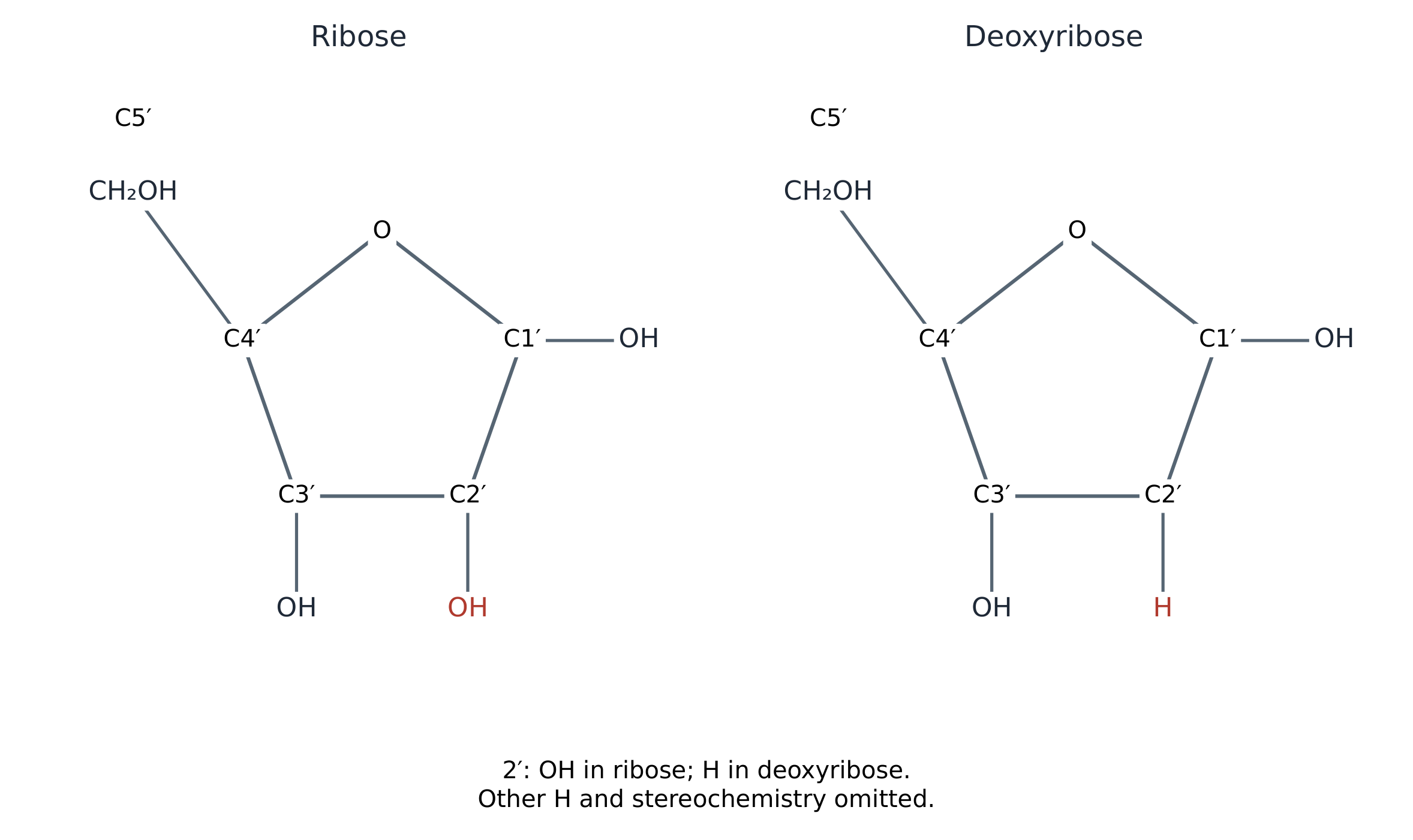
- A nucleotide contains a phosphate group, a five-carbon pentose sugar and a nitrogen-containing base. A simplified diagram can use a circle, pentagon and rectangle respectively. Attach the base to the sugar and the phosphate to the sugar. Adenine alone is a base, not a complete nucleotide; the base is not a link inserted between successive sugars and phosphates.
- DNA uses deoxyribose and the bases A, T, C and G; RNA uses ribose and A, U, C and G. Compare the sugar's 2′ position: ribose has an –OH group while deoxyribose has H there. Deoxyribose still contains oxygen elsewhere. The prime mark distinguishes sugar-carbon numbering from numbering in the base.
Which simplified nucleotide connection is correct?
Dificuldade 1/5 · Moedas 100 + pequeno bônus na primeira conclusão hoje
A nucleotide contains all three components. The base projects from the sugar, while repeated sugar–phosphate links form the backbone.
Build a continuous covalent strand
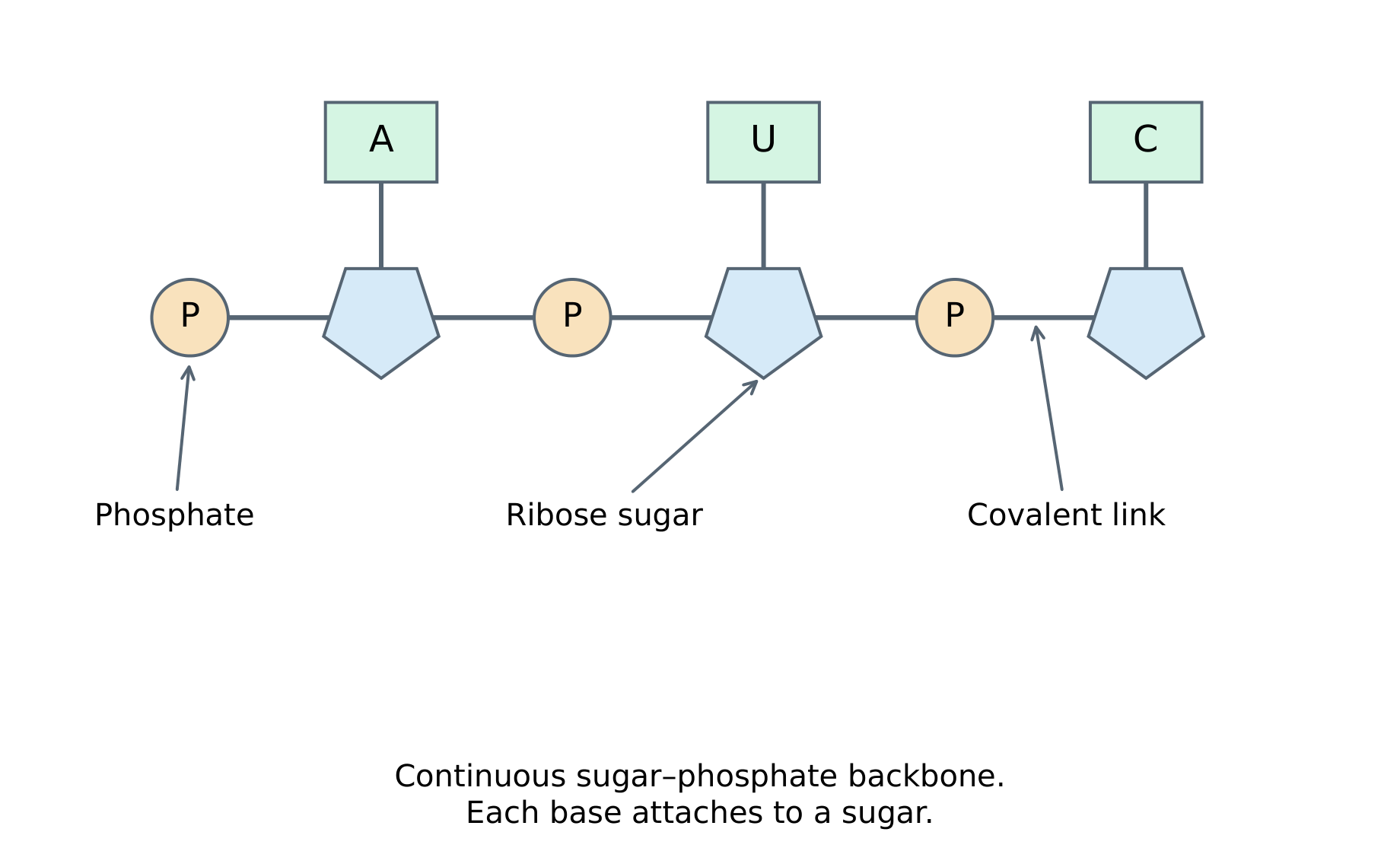
- Nucleotides form a polymer with a repeating sugar–phosphate backbone and bases projecting from the sugars. Covalent phosphodiester links hold that backbone together. Hydrogen bonding between paired bases has another position and role; it is not what joins successive nucleotides along the backbone. Preserve that distinction when drawing an RNA chain or a DNA ladder.
- In a simple linear condensation-counting model, six separate units need five new links to form one chain: generally $n-1$ links. This is a classroom connectivity model. Cellular synthesis uses activated nucleotide substrates, so one should not infer every biochemical reactant and product from that simplified water-releasing condensation drawing. Hydrolysing backbone links also differs from separating paired strands.
Pair the bases across two opposing strands
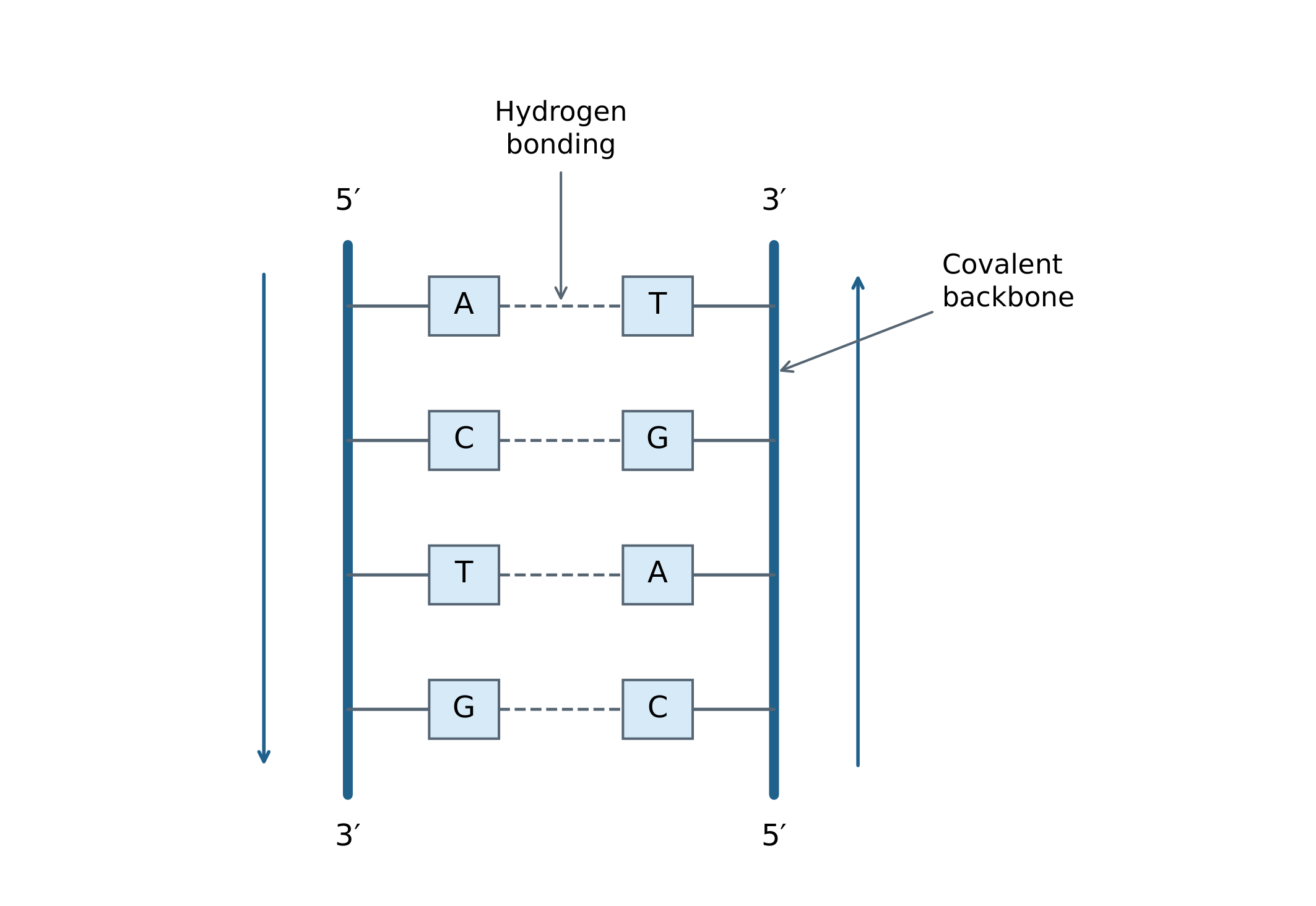
- In ordinary DNA, two polynucleotide strands form a double helix, with sugar–phosphate backbones outside and paired bases inside. A pairs with T and C with G. The strands run in opposite directions: they are antiparallel. A flat ladder can represent the pairing without showing the full twist, provided it identifies the different bonds and opposing strand directions.
- For an invented strand A–T–G–C–G–A, the aligned paired bases are T–A–C–G–C–T. Complementary means matching by the pairing rule, not an identical sequence. Replication uses each existing strand as a template for a complementary new strand; enzymes and checking processes also matter, so base pairing does not make copying errors impossible.
Count both strands before using a percentage
- An invented double-stranded DNA molecule has 800 base pairs, hence 1600 individual nucleotides. If 28% contain adenine, $N_A=0.28\times1600=448$. There are also 448 thymine nucleotides. Together these account for 56%; the remaining 44% splits equally into 22% cytosine and 22% guanine, giving 352 of each.
- Check the total: $448+448+352+352=1600$, or 448 A–T pairs plus 352 C–G pairs equals 800 pairs. These complementary totals apply across the whole ordinary double-stranded molecule. An individual strand need not have equal A and T, and the whole molecule need not have all four bases at 25%. Mixing pairs with single nucleotides creates a factor-of-two error.
An invented ordinary double-stranded DNA molecule has 800 base pairs and adenine makes up 28% of all nucleotides. How many guanine nucleotides are present?
Dificuldade 2/5 · Moedas 140 + pequeno bônus na primeira conclusão hoje
There are 1600 nucleotides. A and T together make up 56%, leaving 44% for C and G equally. Guanine is 22% of 1600 = 352. Do not take 22% of just 800 base pairs.
Compare RNA roles with DNA information storage
- DNA is the genetic material of living organisms in this course. RNA also has essential roles: messenger RNA provides a sequence used in protein synthesis, transfer RNA helps match amino acids to codons, and ribosomal RNA is part of the ribosome's structure and function. Some viruses have RNA genomes; that does not alter the course's distinction between viruses and living organisms.
- RNA is typically one strand in cells but can fold so that complementary regions pair. “Single-stranded” does not mean permanently straight or incapable of hydrogen bonding. Typical cellular DNA and RNA arrangements are useful comparisons, rather than rules covering every viral genome or a claim that every mature cell retains nuclear DNA.
Keep copying, transcription and translation distinct
- Replication produces DNA using DNA templates. Transcription produces RNA using a DNA template: template A directs RNA U, template T directs RNA A, and C pairs with G. The coding DNA strand matches the transcript's corresponding sequence except that DNA uses T where RNA uses U. A question must identify which DNA strand it gives.
- Translation reads mRNA codons to build a polypeptide. A codon is three mRNA bases; a codon table is therefore read using RNA rather than an unexplained DNA triplet. The three processes involve different products and machinery. Copying a genome is not the same event as making a transcript or assembling a protein.
Follow an explicitly identified coding sequence
- Use the invented coding DNA segment ATG–GAA–TTC–TAA. Its corresponding mRNA segment is AUG–GAA–UUC–UAA. Given AUG = methionine, GAA = glutamate, UUC = phenylalanine and UAA = stop, the model peptide has three amino acids. The fourth codon signals termination rather than adding a fourth amino acid.
- For the aligned DNA template TAC–CTT–AAG–ATT, complementary transcription gives the same mRNA segment. Do not simply replace T with U in a template strand; that shortcut applies to the corresponding coding strand. State the strand identity and the sequence direction requested. AHL work below develops why writing an independent strand can also require reversing its displayed order.
For the coding DNA segment ATG–GAA–TTC–TAA, which is the corresponding mRNA segment?
Dificuldade 1/5 · Moedas 100 + pequeno bônus na primeira conclusão hoje
The coding DNA matches the corresponding transcript except T becomes U. The complementary template is a different strand; copying its displayed sequence without pairing would give the wrong transcript.
State the assumptions behind a peptide-length calculation
- A complete coding mRNA segment with 90 bases, one initiating codon and one terminal stop has $90/3=30$ codons and $30-1=29$ amino acids in the stated model. For 63 bases, the count is $63/3-1=20$. The initiating codon contributes an amino acid; the stop does not. These calculations describe the translated segment before any stated processing of its polypeptide.
- A whole gene's DNA length cannot automatically be divided by three. Regulatory regions, introns and untranslated regions may be included, and a supplied fragment might not span an entire coding region. The assumptions are part of the answer: without knowing what the counted bases represent, a numerical length alone does not determine peptide length.
A complete coding mRNA segment contains 96 bases, beginning with the initiating codon and including one terminal stop. No introns or untranslated regions are included. How many amino acids are translated?
Dificuldade 2/5 · Moedas 140 + pequeno bônus na primeira conclusão hoje
96/3 = 32 codons. Subtract one for the terminal stop, which encodes no amino acid: 31. The initiating codon contributes an amino acid in this model.
Explain degeneracy without saying the code is ambiguous
- GAA and GAG both specify glutamate in the standard code. Different codons can therefore specify the same amino acid: the code is degenerate. A substitution from GAA to GAG can be silent with respect to amino-acid sequence. That does not mean every substitution is silent, or that one codon is freely interpreted as several different amino acids in the same standard context.
- An insertion or deletion not divisible by three inside a translated coding region can change the reading frame downstream. Removing exactly three bases need not shift the later frame, although the amino-acid sequence can still change. Position, regulation and the type of change matter. A sequence alteration is not automatically harmful, beneficial or visible in a phenotype.
Count sequence possibilities on one defined strand
- With four possible bases at each of six specified positions, there are $4^6=4096$ possible sequences in this simple model. At four positions there are $4^4=256$; adding one position multiplies the count by four. Sequence variation gives a small alphabet a large information capacity, without requiring a different chemical backbone for each message.
- Once one strand is specified, its ordinary complement is determined. It is not a second independent set of four choices at every paired position. A particular finite molecule has finite capacity, and not every mathematically possible sequence would form a functional gene. A count of possibilities is not a count of viable organisms or useful proteins.
Each of six specified positions on one defined DNA strand can contain any of four bases. How many sequences are possible in this simple model?
Dificuldade 2/5 · Moedas 140 + pequeno bônus na primeira conclusão hoje
Four independent choices at each of six positions give 4⁶ = 4096. Once that strand is specified, its ordinary complementary strand is determined rather than independently chosen.
Connect shared coding rules to ancestry and evidence
- Codons generally have the same meanings across living organisms, with some known variations. This broad conservation supports common ancestry of information-processing systems. A shared code does not mean identical DNA: two organisms can use the same codon meanings while carrying different sequences and producing different proteins.
- In an explanation or drawing, check the level of organization: a base is part of a nucleotide, nucleotides form strands, paired strands form ordinary DNA, and a particular expressed region can specify a product. Keep complementary pairing separate from codon meaning and keep a molecule's structure separate from evidence for its biological role.
AHL: Follow the ends when writing an independent strand
- The 5′ and 3′ labels refer to sugar-carbon positions. A backbone connects the 3′ position of one sugar through phosphate to the next sugar's 5′ position. For 5′–ATGCGA–3′, the aligned complement is 3′–TACGCT–5′. Written independently in the conventional 5′-to-3′ direction, that complement is 5′–TCGCAT–3′. Complementing and reversing are separate operations.
- DNA and RNA polymerases extend the new strand at its 3′ end, producing a 5′-to-3′ sequence while reading the template in the opposite direction. The ribosome also reads mRNA codons 5′ to 3′, during a different process. A sequence answer needs labelled ends; a correct set of bases written in the wrong requested direction is not the requested strand.
AHL: Explain pair width and packaging
- Adenine and guanine are double-ring purines; cytosine and thymine are single-ring pyrimidines, as is RNA's uracil. Each standard DNA pair combines a purine and pyrimidine, helping maintain a consistent helix width. Two purines would be too wide and two pyrimidines too narrow in the ordinary model. Base pairing also needs the appropriate chemical interactions, not width alone.
- In a eukaryotic nucleosome, DNA wraps around an eight-histone core, with linker DNA connecting neighbouring units. A linker-associated histone is not a ninth member of that core. Packaging organizes long DNA and influences access. In a molecular viewer, distinguish protein from DNA and rotate the structure; one two-dimensional view can hide connections and components.
AHL: Follow labelled components through the phage experiment
- In the Hershey–Chase experiment, separate phage preparations labelled DNA with phosphorus-32 and sulfur-containing proteins with sulfur-35. After attachment and infection began, blending detached much external coat; centrifugation separated bacteria in a pellet from detached material in the supernatant. Much DNA-associated label remained with bacteria, while much protein-associated label was outside.
- DNA-associated material also contributed to progeny phage. The findings supported DNA's role in directing reproduction, rather than the bulk external coat. They did not show that every labelled molecule entered, that phages lack proteins or that attachment proteins have no role. This is historical evidence to interpret, not a classroom procedure using radioisotopes.
AHL: Explain how the different locations of phosphorus-32 and sulfur-35 labels supported a role for DNA in phage reproduction. State a limit of the conclusion.
Component tracing links the experimental separation to a biological inference, with appropriate limits.
AHL: Test a composition prediction without inventing sequence evidence
- A strict repeating four-base model with equal proportions predicts 25% each of A, T, C and G. An invented sample X has A = T = 30%, C = G = 20%; sample Y has A = T = 21%, C = G = 29%. Both preserve complementary totals while contradicting universal equal proportions. Chargaff's historical findings similarly showed compositional variation between biological sources.
- A reliable counterexample can reject a universal equal-proportion prediction. A sample with four 25% values would fit that prediction but would not establish a repeating order or prove the universal claim. Composition describes totals, not the sequence along a strand. A molecular model should explain the evidence it actually addresses rather than treating every compatible observation as a unique proof.
Explain why replication copies DNA rather than making RNA
- Growth, tissue replacement and reproduction require genetic information to pass to new cells or descendants. Replication builds DNA using DNA templates before it is distributed. Transcription instead makes RNA for gene expression; moving chromosomes during division does not itself synthesize new strands.
- High copying accuracy preserves sequences, but errors can escape correction and contribute to mutations. The intended copy is not a newly designed sequence adapted to what the cell “needs”. Identify the material made and the template used before describing a process simply as copying.
Use complementary bases to explain semi-conservative copying
- An exposed DNA template A–C–G–T–T–A pairs with newly incorporated T–G–C–A–A–T. A pairs with T and C with G; these aligned sequences are complementary, rather than identical. A second copy using the complementary sequence can recover the original sequence. DNA products use thymine, not uracil.
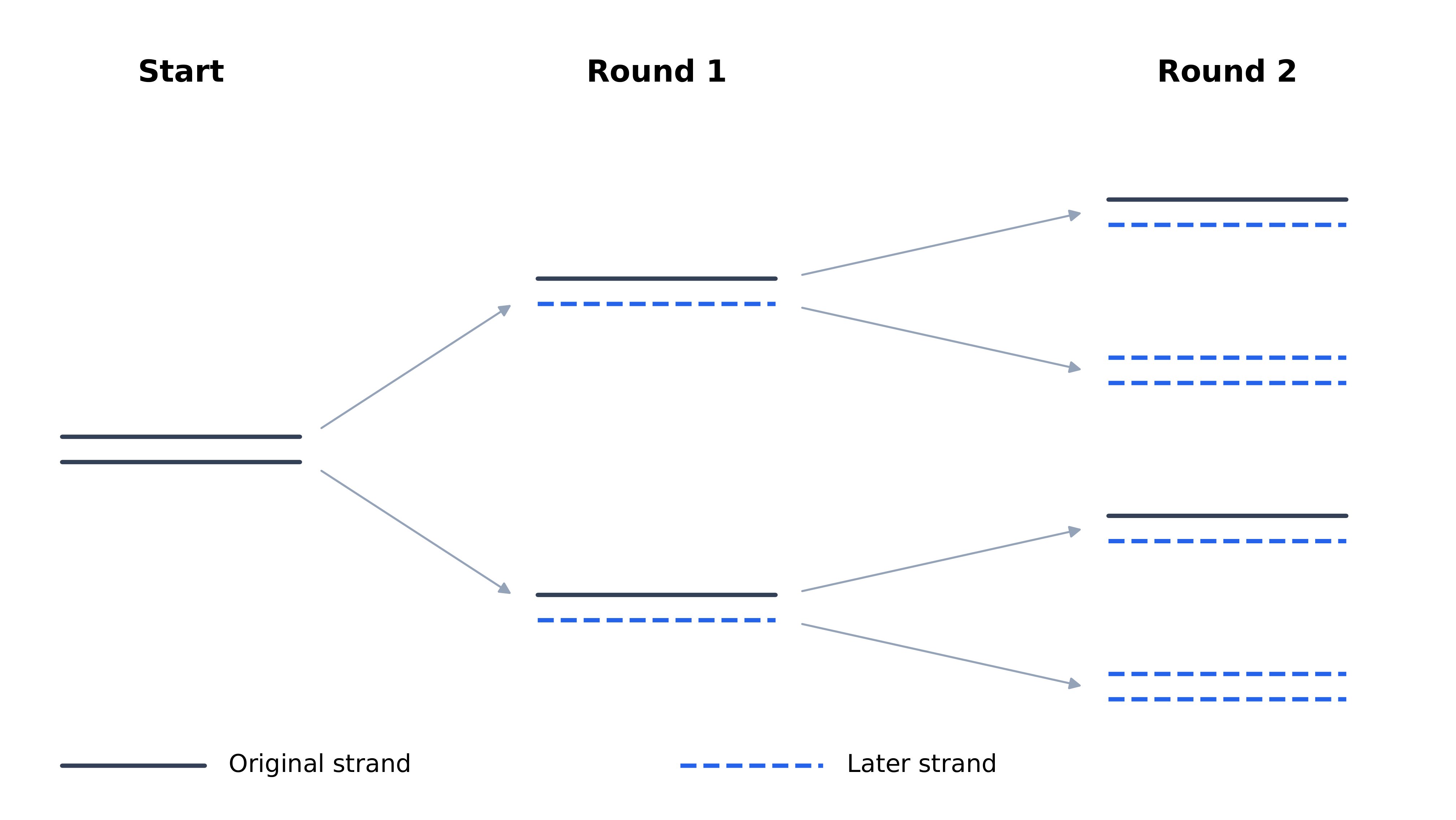
- Semi-conservative replication gives each daughter double helix one parental strand and one new strand. It does not retain an intact parental double helix beside a wholly new one, or make every strand a patchwork of original and new pieces. The diagram distinguishes the original strands from later products without relying on colour alone.
Count original strands and molecules with different denominators
- Start with one double helix containing two labelled original strands; use unlabelled material in all complete copying rounds with no strand loss or label exchange. After three rounds, eight double helices exist, but only two contain an original strand: 25% of molecules.
- Those eight molecules contain sixteen individual strands, of which two are original: 12.5% of strands. A new strand can become a template in a later round without becoming an original labelled strand. Always name whether the count concerns double helices, all strands or molecules containing original material.
An invented semi-conservative model starts with one double helix containing two labelled original strands. Five complete rounds use only unlabelled material, without original-strand loss or exchange. What percentage of resulting molecules contain an original strand?
Dificuldade 2/5 · Moedas 140 + pequeno bônus na primeira conclusão hoje
Five rounds give 2⁵ = 32 double helices; two contain the original strands. 2/32 × 100 = 6.25%. The percentage of individual strands is instead 2/64 × 100 = 3.125%.
Connect a copying model with density evidence
- Meselson and Stahl's original study grew bacteria with heavy nitrogen, then supplied light nitrogen. Caesium-chloride density-gradient centrifugation showed intermediate-density DNA after one generation, followed by intermediate and light components. Heavy nitrogen was a stable isotope, not a radioactive tracer.
- These results support conserved parental contributions to daughter molecules, while the authors qualified what their measurements established about molecular subunits. A strand model explains and predicts the observations; its drawing is not a photograph of enzymes working. Density separation here is distinct from gel separation of fragment lengths.
Separate template opening from backbone construction
- Helicase unwinds and separates paired strands by disrupting hydrogen bonds between bases, normally preserving each covalent sugar–phosphate backbone. Intact ordered templates allow complementary pairing with available DNA nucleotides.
- DNA polymerase catalyses construction of a new covalent backbone using the template and building material. “DNA splits and copies itself” omits the two enzyme roles and confuses bonds between bases with bonds along a strand. Opening a template is not the same operation as synthesizing or ligating DNA.
Follow the three PCR stages and name the ingredients
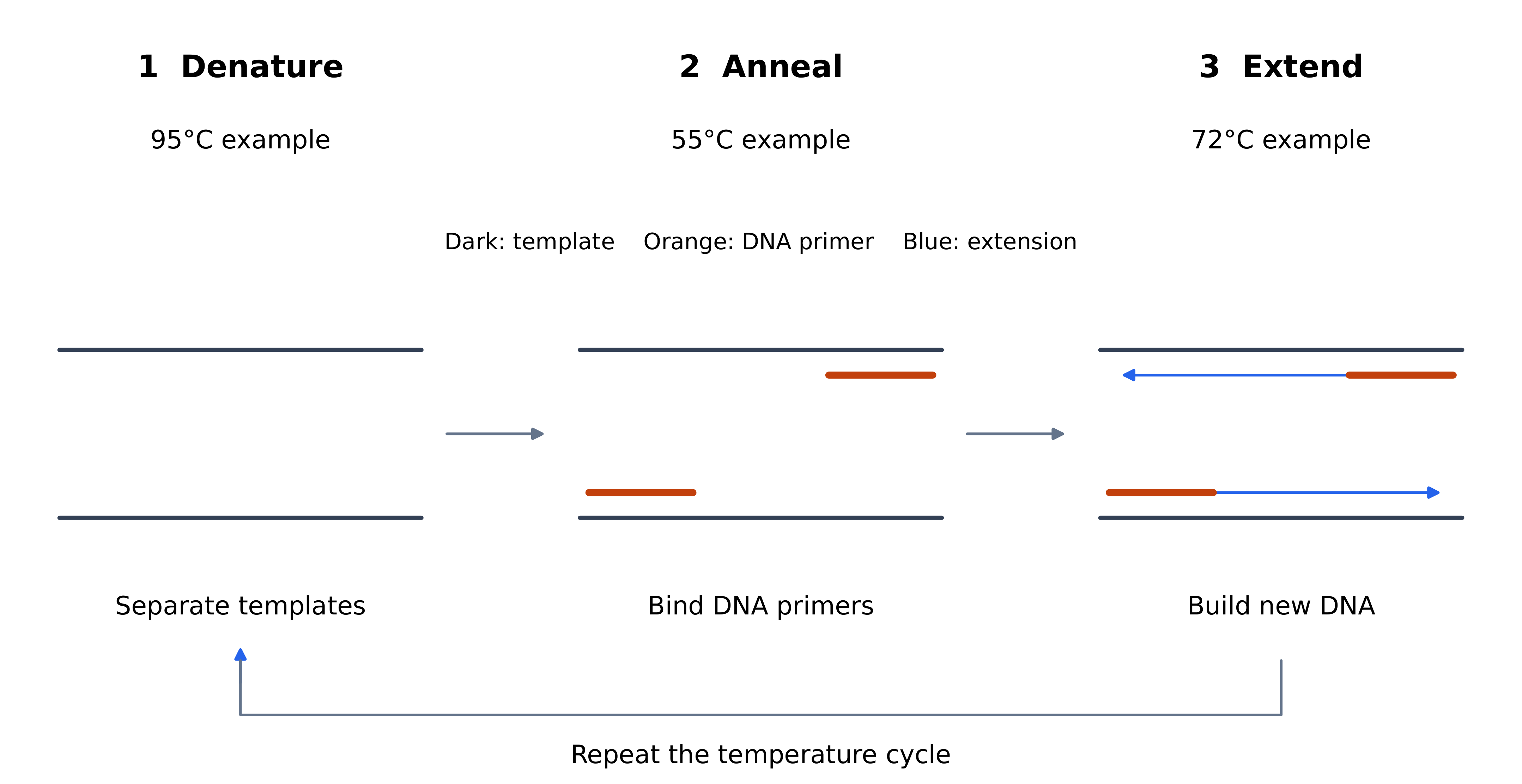
- PCR amplifies a selected DNA region outside cells using template, two suitable DNA primers, nucleotides, thermostable polymerase and an appropriate buffer. Heating separates templates; cooling permits primer annealing; extension builds new DNA. Primers flank the target on opposite templates and help determine what region is copied.
- An illustrative Taq cycle uses about 95°C, 55°C and 72°C for those stages. Manufacturer guidance explains protocol-dependent conditions: one setting does not suit every primer/enzyme. PCR uses heat rather than helicase for separation, and thermostability avoids replacing the enzyme after every cycle.
Use ideal doubling without promising experimental yield
- If five defined target molecules are copied once per cycle, ten ideal complete cycles give 5 × 1,024 = 5,120 targets. Five further ideal cycles multiply the current number by 32, rather than adding five copies. State the starting count and complete-cycle count.
- Real amplification can be inefficient, produce unintended products and reach reagent limits. Early products from longer templates do not all have both ends defined by primer sites. The equation is a stated ideal target-copy model, not an exact inventory of all early products or indefinite laboratory doubling.
In a stated ideal target-copy model, three defined DNA targets double once per complete PCR cycle. Calculate target copies after eight cycles.
Dificuldade 2/5 · Moedas 140 + pequeno bônus na primeira conclusão hoje
3 × 2⁸ = 3 × 256 = 768 target copies. This assumes ideal complete doubling and is not a guaranteed experimental yield or an exact early-product inventory.
Read a DNA gel using charge and a size ladder
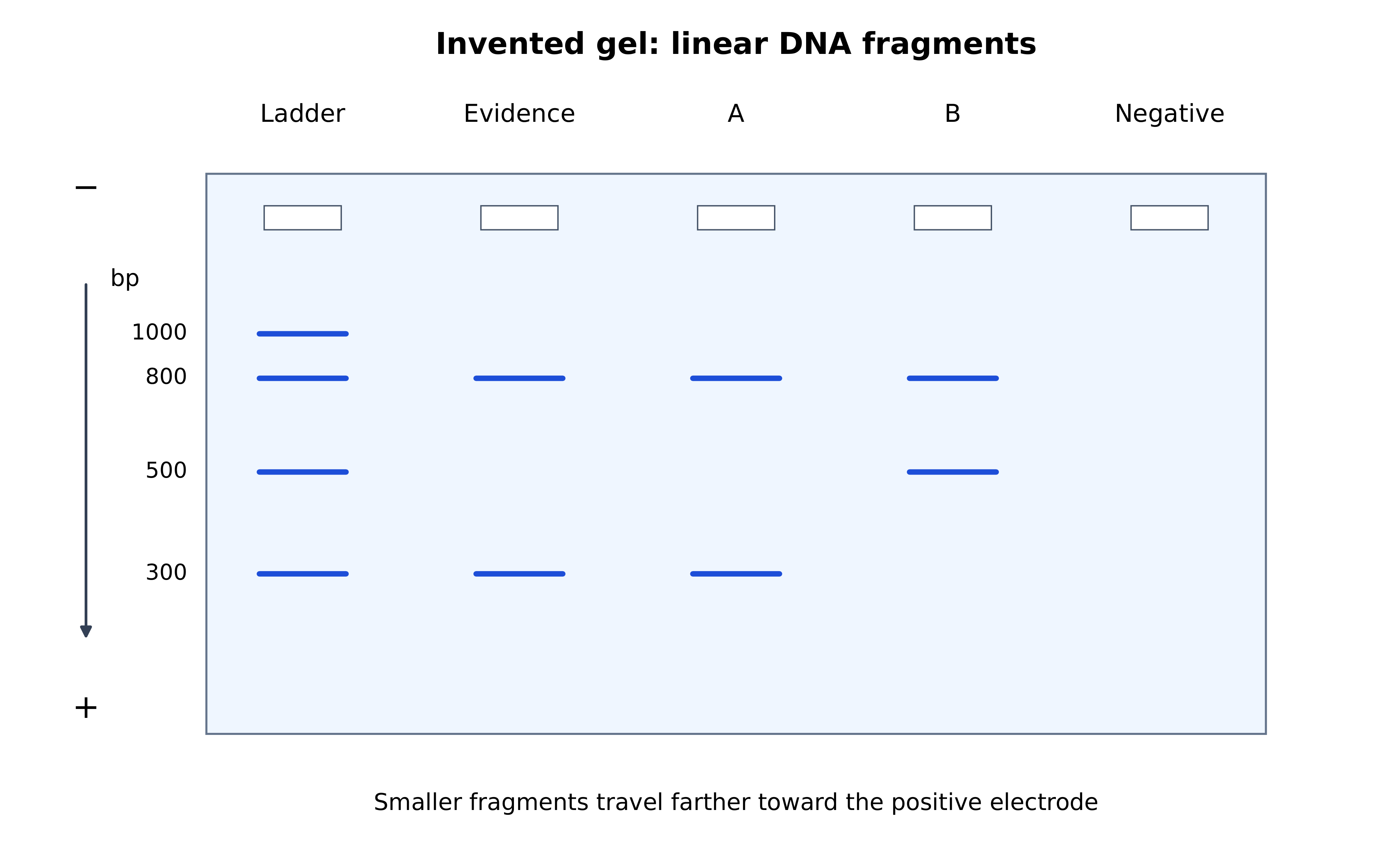
- DNA's phosphate backbone is negatively charged, so suitable gel electrophoresis moves it from wells near the negative electrode towards the positive electrode. For comparable linear double-stranded fragments, smaller fragments generally travel farther in the same run. A visible band contains many similar-sized fragments, not one visible molecule.
- The invented evidence lane below matches A at 800 and 300 base pairs; B has 800 and 500. One shared 800-base-pair band does not match the whole pattern. Compare a known size ladder; migration distance is not simply proportional to base-pair length, and circular or supercoiled DNA needs extra care beyond the linear-fragment model.
Which interpretation fits a suitable gel run of comparable linear double-stranded DNA fragments?
Dificuldade 1/5 · Moedas 100 + pequeno bônus na primeira conclusão hoje
The negative phosphate backbone explains motion towards the positive electrode; the gel sieves fragments. Use a size ladder and appropriate calibration rather than a universal linear-distance rule.
Interpret positive and negative controls before claiming absence
- A negative amplification control contains reagents without intended template. A target-sized band raises concern about contamination or unintended amplification; it is not another matching person. A positive control tests whether a known suitable template yields the expected product.
- If every sample and the positive control are blank, the procedure may have failed: it does not show that nobody has DNA. Clean controls support interpretation without eliminating every handling error. PCR supplies copies; gel separation displays sizes; neither alone establishes an entire person's identity.
Every sample lane and a known positive control have no visible product. Which conclusion is justified first?
Dificuldade 1/5 · Moedas 100 + pequeno bônus na primeira conclusão hoje
A positive control should establish that a known suitable template can yield the expected product. A failed control undermines interpretation of blank sample lanes.
Test inherited alleles at every stated marker
- In an invented two-marker example, a mother has alleles 12/14 and 7/9; a child has 14/16 and 9/12. Under the simple autosomal inheritance model, the other parent must supply 16 at marker one and 12 at marker two. These are allele labels, not the gel's base-pair lengths.
- Candidate A, with 16/18 and 10/12, is consistent at both markers. Candidate B, with 20/22 and 10/12, fails at marker one, assuming correct samples and no relevant mutation. Consistency at two markers does not prove paternity; allele frequencies, relatedness, more suitable markers and quality controls affect discrimination.
In the invented inheritance example, the mother is 12/14 and 7/9, and the child is 14/16 and 9/12 at two markers. Which alleles must the other parent supply under the simple model?
Dificuldade 1/5 · Moedas 100 + pequeno bônus na primeira conclusão hoje
The maternal matches can be 14 and 9, leaving 16 and 12 required from the other parent. Candidate consistency at these two markers is not proof of paternity.
Keep profile evidence separate from a complete event history
- Equal fragment size does not establish identical sequence throughout a fragment; one marker match is weak evidence of unique origin. A reliable multi-marker match can support a DNA contribution, without by itself establishing when, how or why material arrived. Identical twins also challenge a simplistic one-profile–one-identity claim.
- Mixtures, contamination, degradation, missing alleles and secondary transfer complicate interpretation. NIST explains these limits. Record provenance and handling and evaluate other evidence; repeating a contaminated sample is not independent corroboration, and band number alone cannot supply a universal false-match probability.
Explain the chain from copying to an evidence claim
- Start with complementary templates and distinct enzyme roles. For a numerical model, label molecules versus strands and state complete rounds or cycles. For PCR, distinguish amplification from gel separation; use controls and the ladder before comparing selected markers.
- In inheritance, check every marker and identify the required parental allele under the stated model. In a trace comparison, distinguish support for a contribution from proof of an event. A larger DNA yield, matching band or clean control answers a limited question rather than proving every later conclusion.
Explain how DNA can be copied and compared from a small sample, then evaluate the claim that a matching pair of gel bands proves who committed an offence.
A defensible interpretation follows each laboratory and inferential step without turning a limited match into a complete causal account.
AHL: Extend only the growing three-prime end
- The 5′ and 3′ labels refer to positions in deoxyribose. Antiparallel templates have opposite orientations; polymerase extends an existing new strand at its free 3′ end, joining an incoming nucleotide to build the covalent backbone. New DNA always grows 5′ to 3′ while the template is followed in the opposite direction.
- For a template written 3′-ACGTTA-5′, the aligned product is 5′-TGCAAT-3′. If asked to reverse the displayed orientation, reverse the letters as well as the labels. Simply swapping end labels leaves a different sequence. Polymerase does not switch to 3′-to-5′ synthesis on the opposite side of a fork.
AHL: A template is written 3′-ACGTTA-5′. Write only the aligned new DNA sequence in the requested 5′-to-3′ direction, without end labels.
Dificuldade 1/5 · Moedas 100 + pequeno bônus na primeira conclusão hoje
Complement A with T and C with G while preserving the requested aligned orientation: 5′-TGCAAT-3′. Polymerase adds at the new strand’s 3′ end.
AHL: Use fork motion to distinguish leading and lagging strands
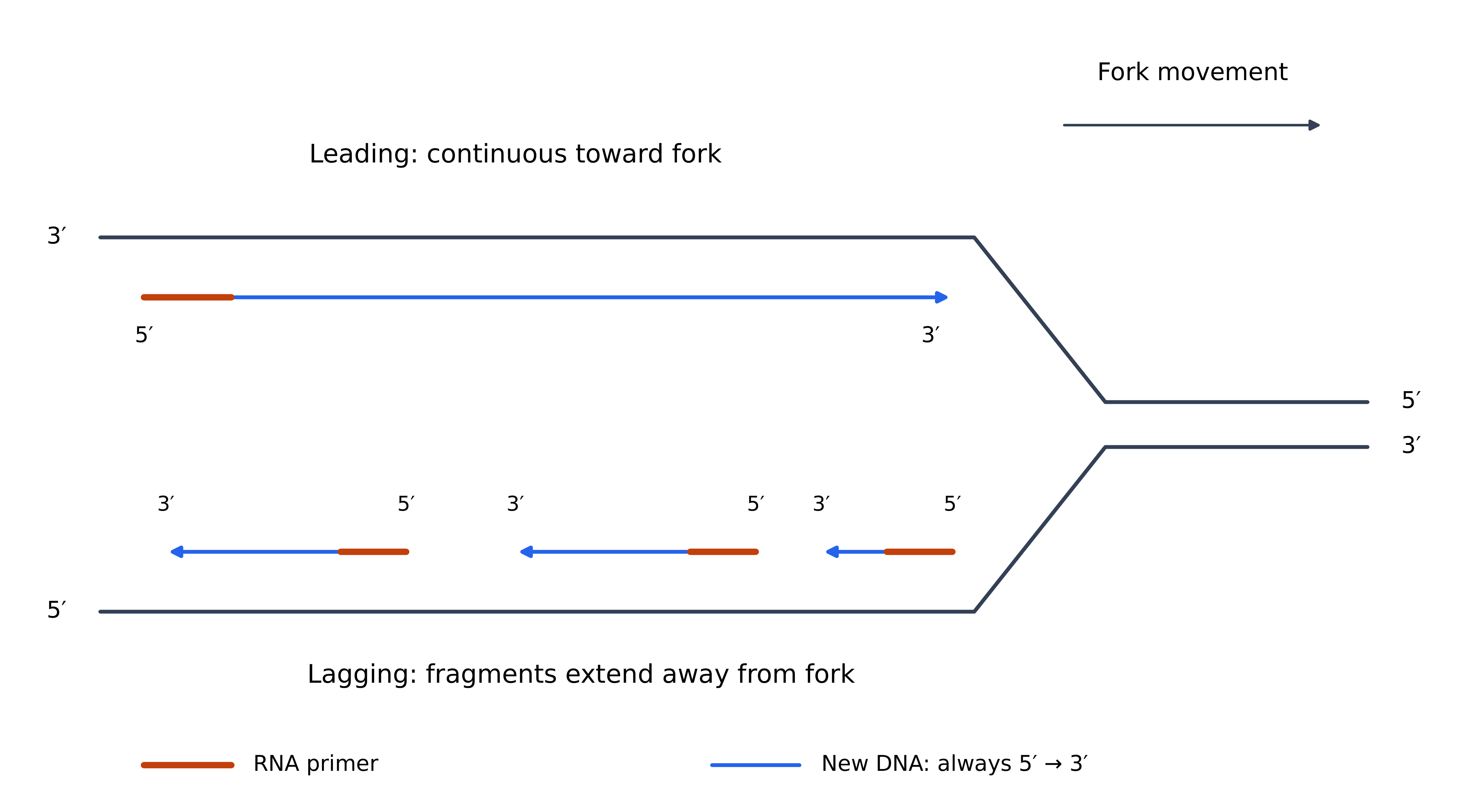
- At this right-moving fork, the template running 3′ to 5′ towards the fork permits continuous leading-strand synthesis towards the opening region. The opposite template requires short Okazaki fragments synthesized away from the fork, still 5′ to 3′. New fragments begin as more template is exposed.
- Primase supplies RNA primers, providing starting ends for extension. In the simplified one-fork model, one leading initiation and six lagging fragments require seven primers. Later fragments begin nearer the advancing fork. Leading/lagging depend on the chosen fork, rather than always meaning the upper/lower strand in any drawing.
AHL: A simplified single-fork model has one leading-strand initiation and six Okazaki fragments, each requiring one RNA primer. How many primers are needed for these stated initiations?
Dificuldade 2/5 · Moedas 140 + pequeno bônus na primeira conclusão hoje
1 + 6 = 7 primers for the specified one-fork model. Both leading and lagging DNA grow 5′ to 3′; the difference is initiation frequency and direction relative to fork motion.
AHL: Assign each prokaryotic enzyme its own job
- In this prokaryotic model, primase makes RNA primers, polymerase III extends DNA, and polymerase I removes primer material and replaces it with DNA. Ligase seals remaining nicks in the backbone. These exact polymerase names should not be applied universally to eukaryotic replication.
- Six adjacent processed Okazaki fragments have five joins between them; ligase seals those joins rather than supplying all replacement nucleotides. The completed daughter backbone is continuous. Cellular primers here are RNA, while standard PCR supplies DNA primers; cells open templates with helicase, whereas PCR heats them apart.
AHL: Proofread the new terminal nucleotide without changing the template
- If a template C is paired with a newly added terminal A, polymerase III proofreading can remove the wrong terminal nucleotide and permit incorporation of G. The ordered template is preserved, rather than changed to match the mistake. Removal is distinct from helicase opening or ligase sealing.
- Proofreading's terminal removal activity does not reverse the 5′-to-3′ direction of subsequent synthesis. It reduces errors without guaranteeing mutation-free copying; other repair mechanisms also exist. Name the substrate, wrong base and correction before claiming that a particular enzyme repairs every possible kind of DNA damage.
AHL: A template C is paired with a newly added terminal A. What does the proofreading model require?
Dificuldade 1/5 · Moedas 100 + pequeno bônus na primeira conclusão hoje
Proofreading corrects a terminal mismatch in newly made DNA. Removal does not reverse the direction of later synthesis, and ligase seals nicks rather than copying the whole strand.
Distinguish a reusable template from the material being made
- Transcription makes RNA from a DNA template; translation uses mRNA information to assemble a polypeptide. DNA is not converted into protein, and RNA nucleotides do not become amino acids. Some genes make functional RNAs, including rRNA and tRNA, rather than polypeptides.
- Transcription normally preserves the DNA sequence while drawing on available RNA nucleotides. Long-lived non-dividing cells can therefore keep making RNA and proteins without duplicating the whole genome for division. Template reuse does not guarantee immunity from damage or mutation, and a new chain may still need folding or processing before it functions.
Build complementary RNA and interpret the specified frame
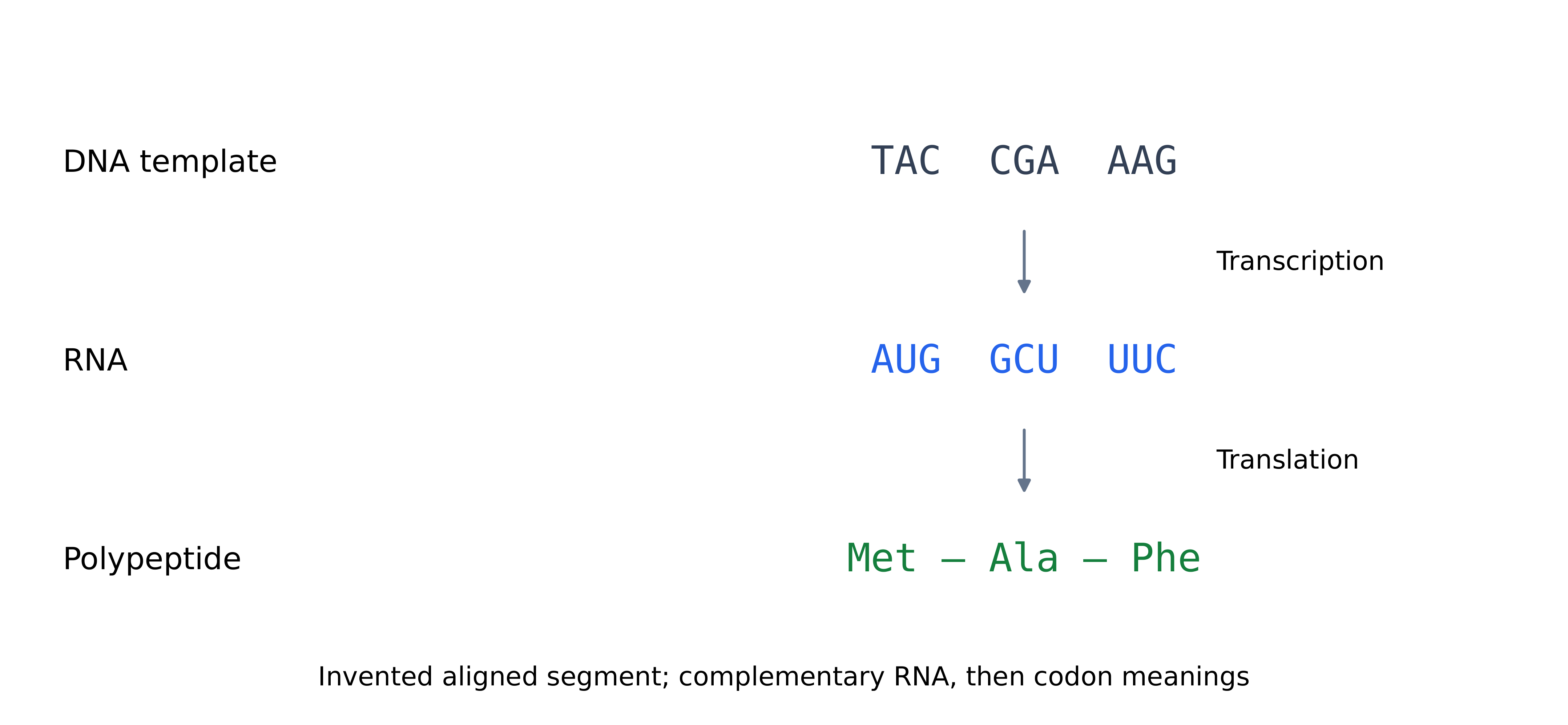
- RNA polymerase exposes a short DNA region, uses one template and joins complementary RNA nucleotides into a covalent backbone. DNA A pairs with RNA U, T with A, C with G and G with C. Hydrogen bonds involved in pairing differ from the covalent bonds along the new RNA; DNA can pair again as RNA separates.
- For the aligned invented template TAC CGA AAG, the RNA is AUG GCU UUC. In the stated frame these codons specify Met–Ala–Phe. Use mRNA codons in a genetic-code table, rather than unchanged template triplets or tRNA anticodons. A sequence without an identified strand or frame is insufficient for an unqualified translation.
An invented aligned DNA template segment is TAC CCG AAA. Write the complementary RNA sequence without spaces, using RNA bases.
Dificuldade 1/5 · Moedas 100 + pequeno bônus na primeira conclusão hoje
T→A, A→U, C→G and G→C give AUG GGC UUU. The ordered DNA template is reused; RNA nucleotides come from available building material.
Test gene presence, transcription and protein production separately
- A beta cell and a neuron can share most of their genome while using different genes. Regulation of transcription changes whether an mRNA is available; later processing, translation and degradation can also change protein abundance. Specialization need not require removing every unused gene.
- If both cells contain a gene but only one has detectable RNA and protein, the pattern is consistent with different expression. It does not prove gene absence in the other cell or locate the precise control step alone. Check measurement sensitivity, sampling time and the distinct DNA, RNA and protein observations.
Explain why tRNA is an adaptor rather than a codon table
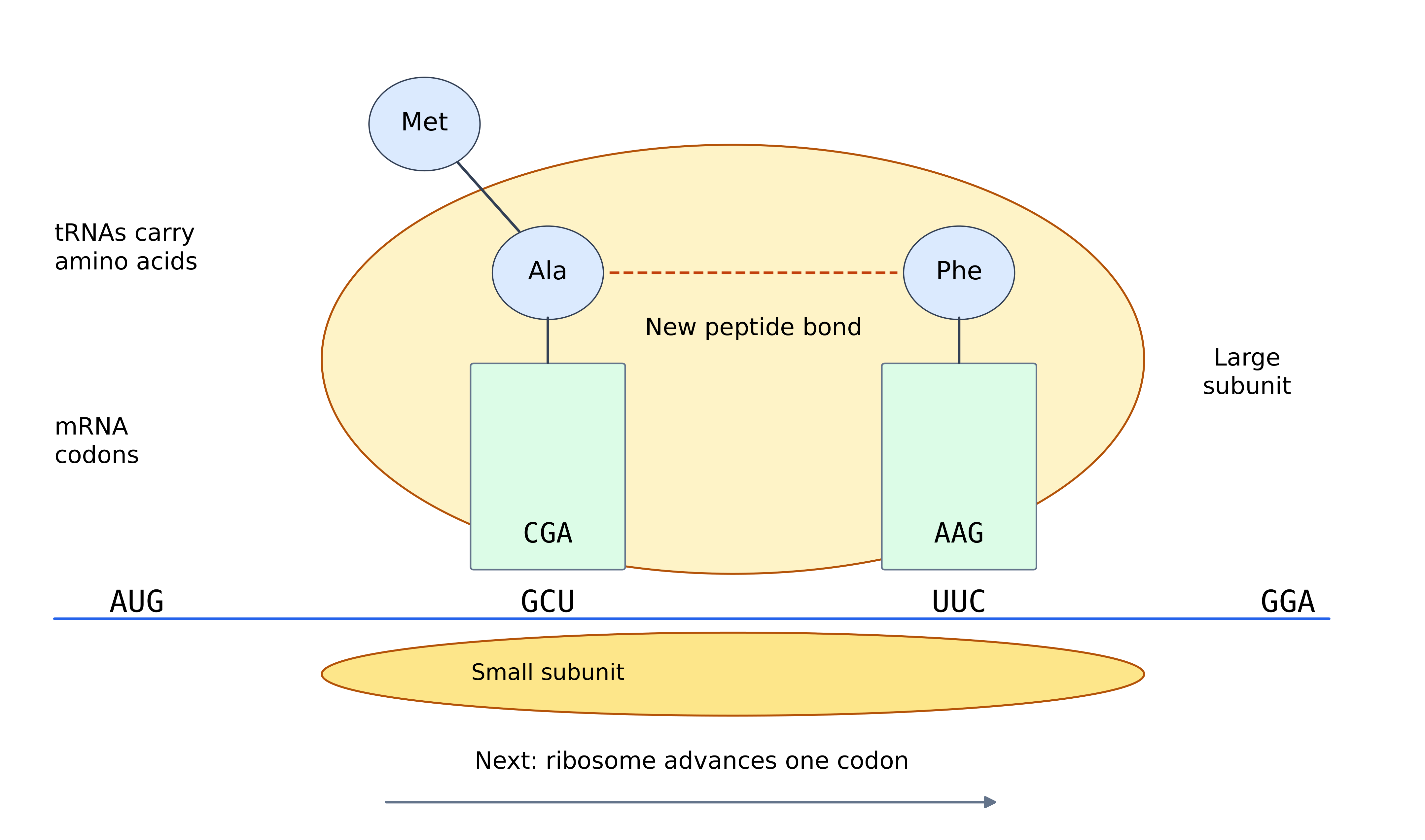
- The small ribosomal subunit helps position mRNA, while the large subunit participates in linking amino acids. A charged tRNA carries an amino acid at a site separate from its anticodon. Anticodon–codon pairing connects the message to the amino acid brought by that tRNA.
- For aligned codons GCU and UUC, complementary anticodons are CGA and AAG, carrying Ala and Phe when correctly charged. Correct tRNA charging matters: base pairing does not itself read an amino-acid name. Two tRNAs can participate in chain transfer at once; the growing chain is not released into solution after every residue.
Apply degeneracy without making a codon ambiguous
- Four bases give four one-base signals, sixteen two-base combinations and sixty-four triplets. The standard code uses several codons for many amino acids: GCU and GCC both specify alanine. Degeneracy means several codons can share one meaning, rather than each codon choosing arbitrarily among several amino acids.
- UAA, UAG and UGA are standard stop signals with no amino acid; AUG specifies methionine and can initiate translation in a suitable context. The code is nearly universal with documented exceptions. NCBI's tables use DNA-style T for U by convention and distinguish standard from alternative codes.
There are four RNA base types and three positions in a codon. How many distinct triplets are possible when all positions can contain any base?
Dificuldade 2/5 · Moedas 140 + pequeno bônus na primeira conclusão hoje
4 × 4 × 4 = 64. This is the number of possible codons, not the number of different standard amino acids; several codons share meanings and three standard signals are stops.
Count residues and peptide bonds only within a defined coding region
- In the invented coding message AUG GCC UAC GAG UGA, read from the stated start: Met–Ala–Tyr–Glu, then stop. Five codons give four amino acids and three peptide bonds in the initial linear chain. Stop is an instruction to terminate, not an extra residue named stop.
- A separate 120-nucleotide coding region, including one terminal stop and excluding untranslated regions, gives 40 codons, 39 amino acids and 38 peptide bonds. Full gene length, introns, untranslated RNA, caps and tails cannot simply be inserted into that calculation. A mature processed protein may have a different length from its translated precursor.
An invented complete coding region contains 126 nucleotides including one terminal stop, with no untranslated sequence in the count. How many peptide bonds are in the initial single linear chain before processing?
Dificuldade 2/5 · Moedas 140 + pequeno bônus na primeira conclusão hoje
126/3 = 42 codons; one stop leaves 41 amino acids, giving 41 − 1 = 40 peptide bonds. Count residues before bonds and exclude any later processing.
Using the supplied standard-code meanings, translate AUG GCC UAC GAG UGA from its stated start.
Dificuldade 1/5 · Moedas 100 + pequeno bônus na primeira conclusão hoje
AUG, GCC, UAC and GAG specify four residues; UGA is a termination signal. The standard table is read with mRNA codons, not anticodons.
Follow matching, chain transfer and translocation
- An incoming charged tRNA pairs with the next codon while another tRNA carries the growing chain. Peptide-bond formation transfers that chain onto the incoming amino acid. The ribosome then advances by one codon relative to mRNA, positioning the chain-carrying tRNA for the next transfer.
- The uncharged tRNA can leave and be recharged; repetition extends the chain in message order. Neither the mRNA nor tRNA is permanently turned into the peptide. Adding one residue to an existing linear chain adds one peptide bond, while termination releases the product through machinery recognizing a stop signal.
Connect a substitution with a qualified protein effect
- GCU → GCC is synonymous in the standard code; UUC → UAC changes Phe to Tyr; a substitution creating a premature stop may shorten a product. Effects depend on position, sequence, regulation and protein function. An unchanged amino-acid sequence does not prove every possible cellular effect is unchanged.
- In the sickle beta-globin variant, coding DNA GAG → GTG corresponds to mRNA GAG → GUG and Glu → Val, conventionally position six in the mature chain. The changed side-chain properties favour deoxygenated HbS polymer formation. Coriell's characterized DNA sample record identifies that substitution; naming mutation alone is not a full mechanism.
Regroup a frameshift instead of guessing the final product
- From the invented message AUG GCU UUC GGA UAA, delete base four and regroup from the same start. The displayed result is AUG CUU UCG GAU AA: Met–Leu–Ser–Asp from the complete codons, with two bases left. There is no stop among those four complete codons, so downstream sequence is needed to determine the full product.
- Insertions or deletions not divisible by three can shift a coding frame. This does not require every later amino acid to change or an immediate stop. Removing three bases avoids a sustained frame shift, but a deletion across a codon boundary can still change the junction codon. State the location and exact regrouping before predicting an effect.
After the stated base-four deletion, an invented displayed message groups as AUG CUU UCG GAU AA. How many complete codons are present in this displayed segment?
Dificuldade 2/5 · Moedas 140 + pequeno bônus na primeira conclusão hoje
Four complete codons are present, plus two leftover bases. The four specify Met–Leu–Ser–Asp, with no displayed stop; downstream sequence is needed to infer the full translated product.
Explain protein output through evidence at several stages
- Identify DNA template, RNA product, frame and code before giving an amino-acid sequence. Explain the adaptor, bond formation and ribosome movement rather than treating bases as converted amino acids. For numerical counts, distinguish initial chain, mature product and the stated coding region.
- For a mutation or an expression comparison, examine DNA, RNA and protein separately. A changed sequence, missing transcript or low protein signal can support different explanations. Explain the measured molecular change and its plausible consequence without claiming that every mutation is harmful or that one observation establishes every control step.
Two cells retain the same gene, but only one has detectable mRNA and protein. Explain the information pathway and limits of that observation, then distinguish a synonymous substitution from a coding frameshift.
Separate the molecular information steps from the measurements used to infer their activity.
AHL: State message direction and polypeptide direction differently
- RNA polymerase follows template DNA 3′ to 5′ and extends RNA 5′ to 3′ at its growing 3′ end. For template 3′-TAC CGA AAG-5′, RNA is 5′-AUG GCU UUC-3′ and coding DNA 5′-ATG GCT TTC-3′. A template supplied in the other orientation needs an antiparallel complement and reversal to report RNA 5′ to 3′.
- The ribosome reads mRNA 5′ to 3′, but a polypeptide has amino and carboxyl ends rather than sugar 5′/3′ ends. Amino acids are added at the chain's carboxyl end, giving amino-to-carboxyl synthesis. For codon 5′-GCU-3′, the aligned anticodon is 3′-CGA-5′; writing that anticodon 5′ to 3′ gives AGC.
AHL: A codon is 5′-GCU-3′ and its aligned anticodon is 3′-CGA-5′. Write only that anticodon sequence in the requested 5′-to-3′ direction.
Dificuldade 1/5 · Moedas 100 + pequeno bônus na primeira conclusão hoje
Reverse the written aligned anticodon to report it 5′ to 3′: AGC. Swapping end labels without reversing letters would give the wrong orientation.
AHL: Give non-coding DNA a specific role
- Promoter-associated sequences help position and regulate transcription machinery, often through transcription-factor binding. A promoter need not be translated to function. Regulatory DNA, introns, telomeres and genes for functional RNAs illustrate different roles of DNA that does not encode a polypeptide sequence.
- Introns can be transcribed before removal; some retained exonic sequence is untranslated. “Non-coding” therefore means neither universally useless nor universally untranscribed. The template strand of a protein-coding gene is another usage of “non-coding strand”; do not confuse that relational name with a claim that the strand contains no information.
AHL: Process a primary transcript without editing the gene
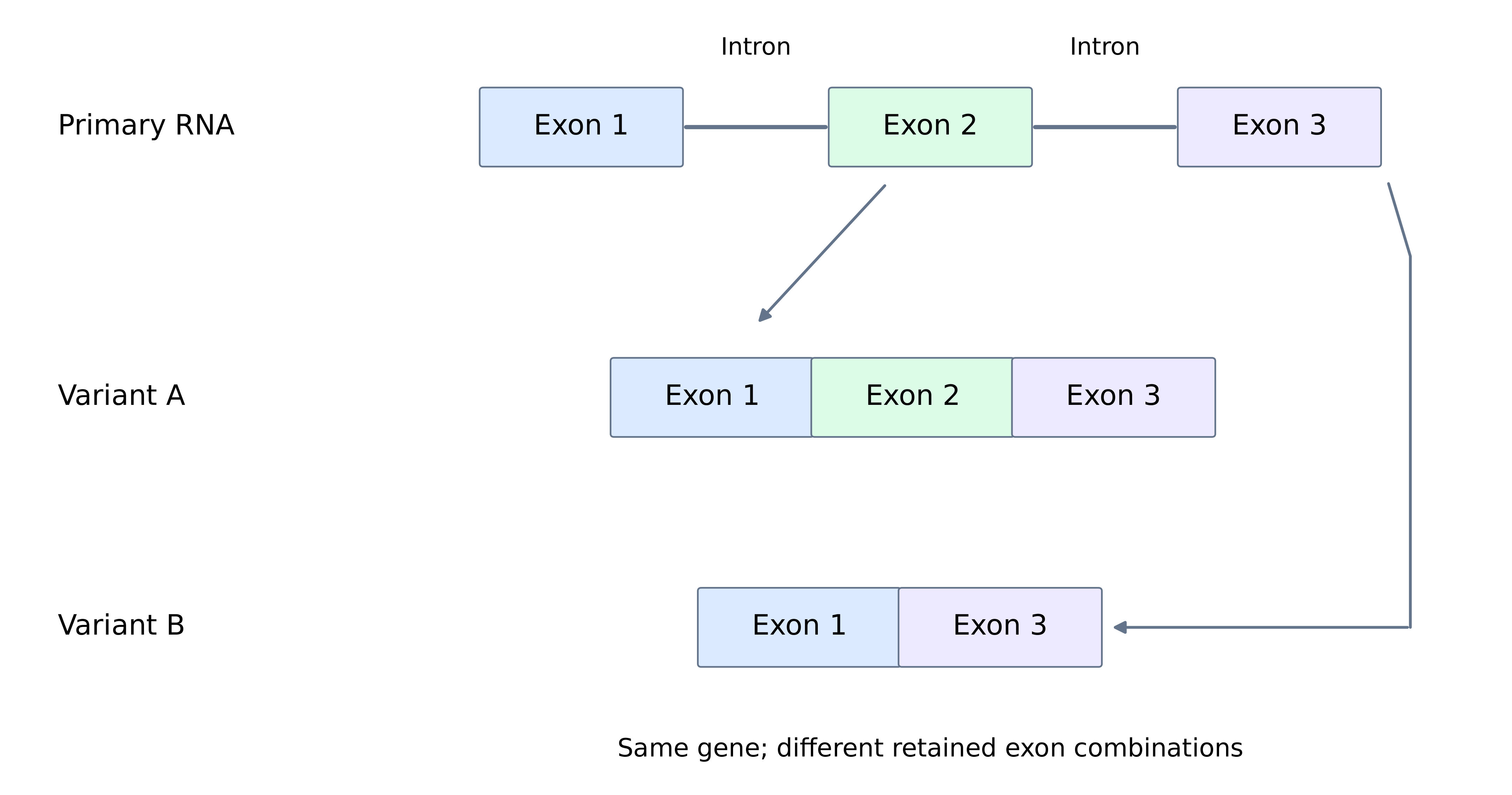
- In typical eukaryotic protein-coding transcripts, splicing removes introns and joins retained exons. A modified 5′ cap and an added 3′ polyA tail support RNA handling and stability. Untranslated regions remain; cap and tail are not simply translated into extra amino acids or all copied from one long coding region in DNA.
- Alternative splicing can retain different compatible exon combinations in their appropriate order, producing different messages from one gene. It is not arbitrary exon shuffling or proof of two-to-the-number-of-exons functional proteins. The DNA remains unchanged; splicing acts on RNA before translation, not by cutting introns out of a completed protein.
AHL: Calculate transcript, retained coding sequence and initial peptide separately
- In an invented frame-compatible model, coding exons contain 120, 90 and 180 nucleotides and introns contain 210 and 150. The stated primary-transcript segment totals 750. Retaining all exons leaves 390 coding nucleotides; skipping the middle exon leaves 300.
- With the same start and one terminal stop in each retained in-frame coding sequence, initial products contain 129 and 99 amino acids. The difference is thirty residues, rather than ninety amino acids. These counts exclude untranslated regions, caps and tails; alternative splicing cannot be counted reliably without the supplied frame and retained-sequence assumptions.
AHL: In the invented in-frame splicing model, retained coding messages contain 390 and 300 nucleotides, each including one terminal stop. Find the difference in initial amino-acid counts.
Dificuldade 2/5 · Moedas 140 + pequeno bônus na primeira conclusão hoje
390/3 − 1 = 129 and 300/3 − 1 = 99; difference = 30 amino acids. A 90-nucleotide difference is not a 90-residue difference.
AHL: Place the initiator and elongating tRNAs in their sites
- In the simplified eukaryotic cap-dependent initiation model, the small subunit and initiator tRNA associate with mRNA and locate a suitable start; the large subunit joins. The initiator tRNA occupies P, establishing the frame. It is the exception to a careless rule that every tRNA first enters A.
- During elongation, the A site receives charged tRNA and P holds the chain before transfer. Bond formation transfers the chain to the A-site amino acid; one-codon movement shifts it to P and the uncharged tRNA towards E and exit. A stop codon is recognized by termination factors, not a charged tRNA carrying stop as an amino acid.
AHL: Follow insulin processing on the protein substrate
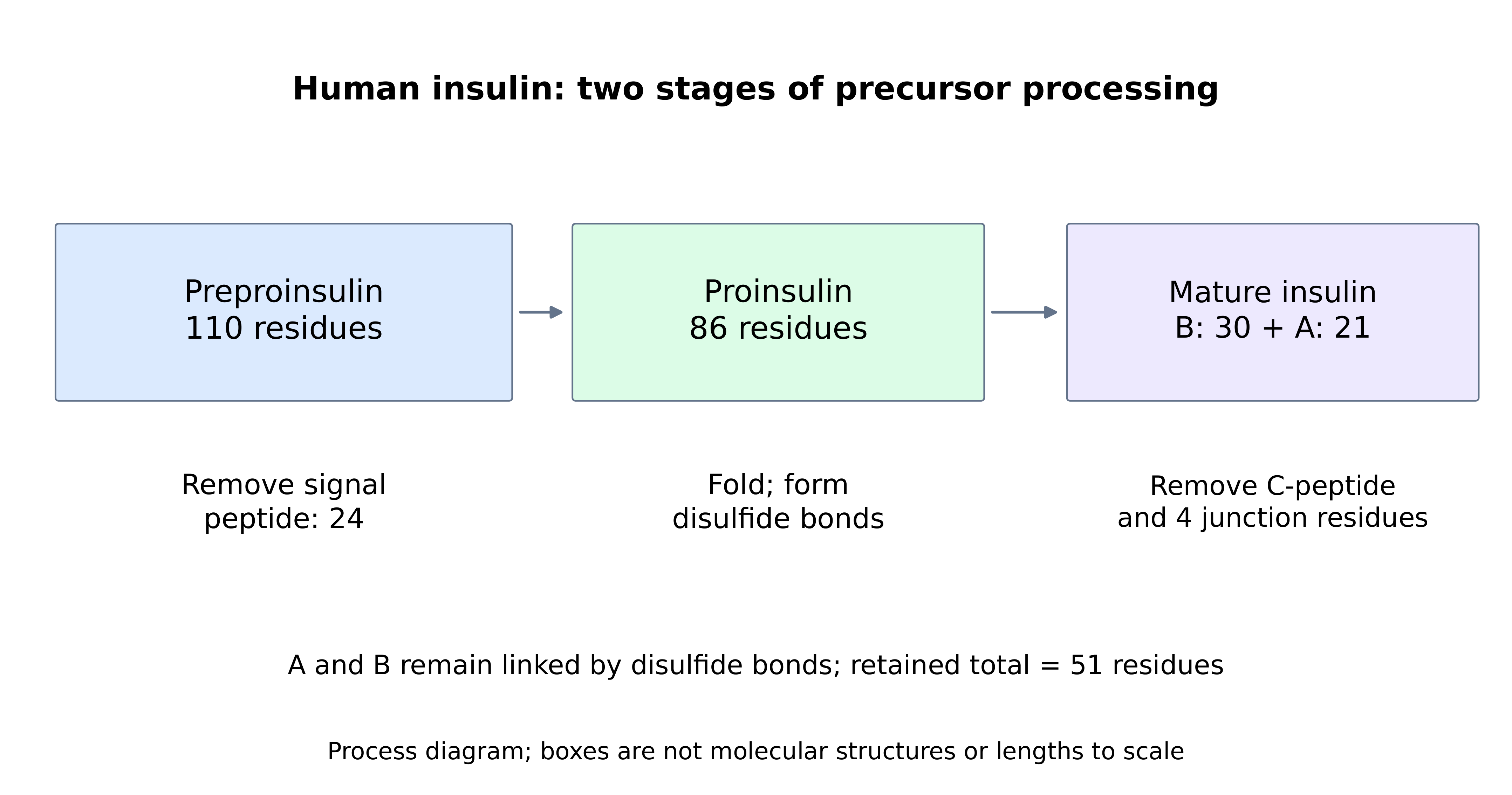
- Human preproinsulin has 110 residues. Removing its 24-residue signal yields proinsulin with 86; folding and disulfide formation precede later connecting-region processing. Mature insulin retains a 30-residue B chain and 21-residue A chain, totaling 51, joined by disulfide bonds. PDBe describes these precursor stages.
- The 35 residues removed from proinsulin comprise the 31-residue C-peptide plus four basic junction residues, not a 35-residue C-peptide. Reactome distinguishes cleavage and trimming. Proteolytic processing acts on protein, while splicing acts on RNA; neither shortens the underlying DNA gene each time a product is made. Other proteins may need folding, chemical modification or assembly, rather than exactly this insulin route.
AHL: Human proinsulin contains 86 residues; mature insulin retains 30 in B and 21 in A. How many residues are removed during this later processing?
Dificuldade 2/5 · Moedas 140 + pequeno bônus na primeira conclusão hoje
86 − (30 + 21) = 35 residues removed. This includes the 31-residue C-peptide plus four basic junction residues, rather than a 35-residue C-peptide.
AHL: Explain turnover even when protein abundance stays constant
- Proteasomes degrade appropriate damaged, misfolded or unneeded proteins into smaller peptides; further breakdown can recover amino acids for new synthesis. Other degradation pathways also exist. Recycling building blocks does not preserve the original protein function or remove the need for messages, ribosomes and energy.
- In an invented pool, synthesis of 120 molecules per hour and degradation of 80 give net gain 40, assuming no other fluxes. Equal synthesis and degradation at 200 each would maintain a steady pool while replacing molecules. A constant amount is not evidence of no turnover; proteasomes neither splice RNA nor proofread DNA.
AHL: An invented protein pool remains constant while synthesis and degradation each proceed at 200 molecules per hour. Which inference fits?
Dificuldade 1/5 · Moedas 100 + pequeno bônus na primeira conclusão hoje
Net change is synthesis minus degradation: zero here. A steady stock does not imply zero flux, and protein degradation differs from RNA splicing and DNA copying.
Distinguish a lasting sequence change from damage or altered expression
- A mutation is an established change in DNA base sequence that can pass to descendant cells. Damage can be repaired back to the original sequence without leaving a lasting mutation. A change in transcription activity without a sequence change is another process, even if protein output changes.
- Substitutions replace bases, insertions add them and deletions remove them. Identify whether the question concerns one gene or a larger chromosome change, and whether a coding, regulatory or processing-related region is affected. Deliberately targeted gene editing also needs evaluation of the actual resulting sequence and biological effect.
Compare three substitutions within one stated frame
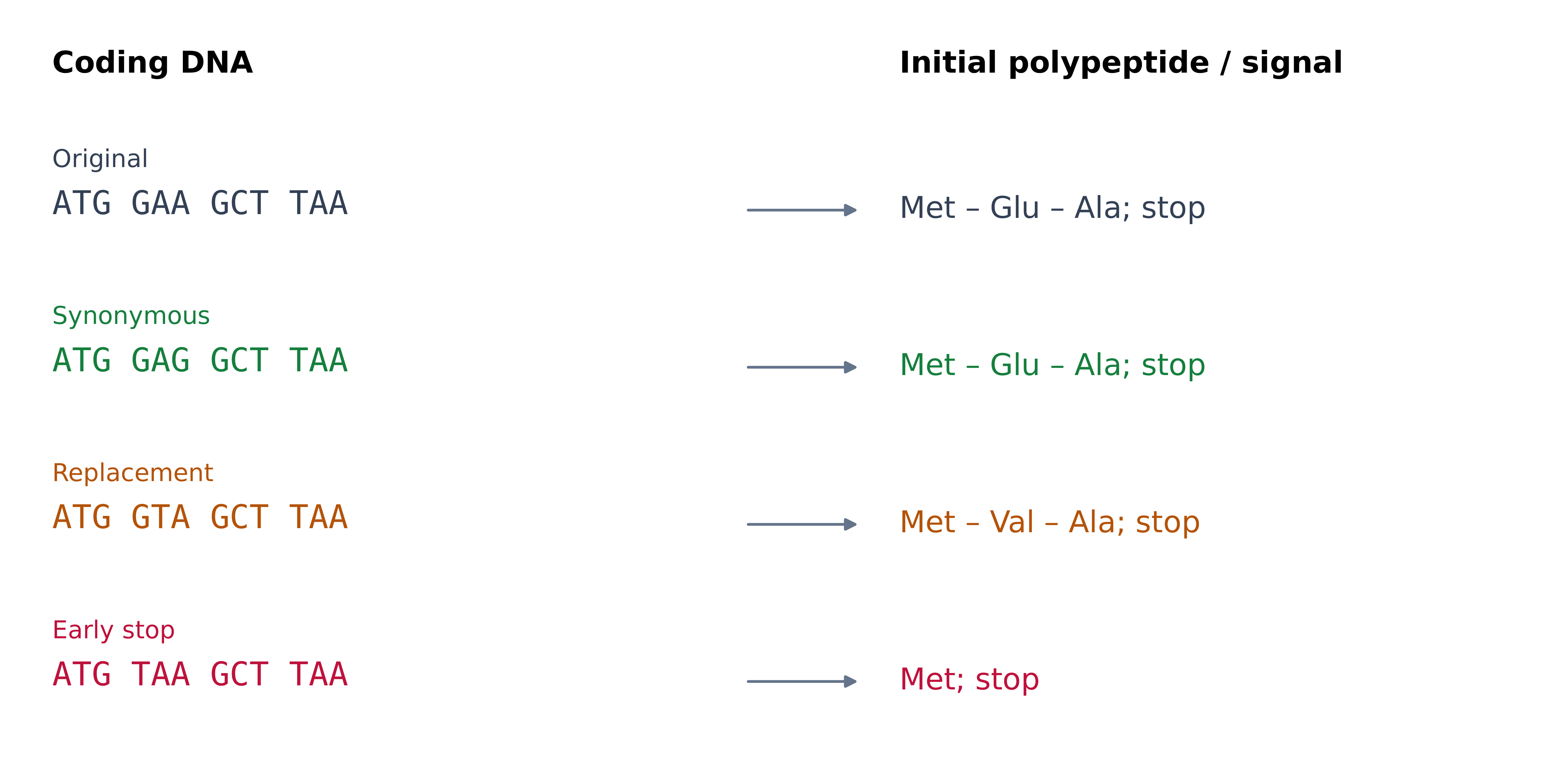
- In an invented coding sequence ATG GAA GCT TAA, the message AUG GAA GCU UAA gives Met–Glu–Ala, then stop. Changing the second coding triplet GAA to GAG retains Glu; GTA gives RNA GUA and Val; TAA gives RNA UAA and earlier termination. None of these simple substitutions changes the downstream frame by itself.
- Synonymous describes an unchanged amino acid, rather than proving all expression effects are unchanged. A replacement may affect charge, folding or a binding site, but need not be harmful. An early stop can shorten a chain and may also affect detectable RNA or protein abundance. A population SNP describes variation at one nucleotide position, not automatically a disease-causing variant.
In the stated coding frame, GAA is replaced by GAG, GTA or TAA. Which of those simple single-base substitutions shifts the downstream reading frame by changing sequence length?
Dificuldade 1/5 · Moedas 100 + pequeno bônus na primeira conclusão hoje
The substitutions can preserve Glu, replace it with Val or introduce stop, respectively. Those different meanings do not make a simple equal-length substitution an insertion/deletion frameshift.
Check an insertion or deletion at the actual junction
- Deleting base four from AUGGAAGCUUAA gives AUG AAG CUU AA when regrouped from the same start: Met–Lys–Leu and two remaining bases. The displayed original stop is no longer a complete stop in this frame; downstream sequence is needed to predict the full product. A frameshift need not alter every later amino acid or stop translation immediately.
- Removing the complete GAA codon instead gives AUG GCU UAA, retaining the downstream frame but losing Glu. A three-base deletion across a boundary can change the joined codon too. Non-coding changes can matter through transcription or splicing, so preserved coding sequence or frame does not guarantee normal expression or function.
Separate a mutagen's effect from an observed mutant fraction
- Replication and repair errors can arise spontaneously. Some chemicals and radiation increase mutation frequency under stated conditions: ultraviolet light can damage neighbouring pyrimidines, ionizing radiation can damage DNA directly or through reactive products, and some tobacco-smoke metabolites can bind DNA. Damage may be repaired, kill a cell or become a lasting sequence change.
- In an invented final sample, 24 resistant colonies among 12,000 viable colonies give a fraction of 0.002, or 0.20%. This is an observed phenotype fraction, not automatically a mutation rate per copying event. Match growth conditions, generations, exposure and detection; differential survival and multiplication can change the final fraction.
An invented final sample has 24 resistant colonies among 12,000 viable colonies. Find the observed resistant percentage.
Dificuldade 2/5 · Moedas 140 + pequeno bônus na primeira conclusão hoje
24/12,000 = 0.002; multiplying by 100 gives 0.20%. This is the final phenotype fraction, not directly a mutation-event rate because growth, survival and selection can affect it.
Explain random mutation without requiring equal probabilities everywhere
- Mutations are not normally directed to the exact beneficial base because an organism needs it. Resistant variants can exist before antibiotic exposure; selection removes susceptible competitors and increases resistant representation. Higher resistance after exposure does not show that the drug instructed the required mutation.
- Random with respect to need does not mean equal probability at every position: hotspots, repair and exposure can bias changes. Independent cultures can have very different resistant counts because an early mutation leaves many descendants. Interpret such variation with controls and growth/survival models rather than converting final counts directly into event rates.
Follow the changed cell lineage before predicting inheritance
- A somatic mutation can spread through mitosis into a patch of descendant cells, producing mosaicism. A change confined to skin cells does not enter gametes in ordinary sexual reproduction. A germ-cell-lineage change can reach an offspring only if an affected gamete contributes to fertilization; not every germline change is transmitted.
- A change present at fertilization can reach many tissues, while a later embryonic change may reach only some lineages. Somatic changes affecting growth, repair or survival can contribute to cancer, but one change is not automatically sufficient. Harmful, beneficial and neutral describe effects in context, independently of whether a mutation is somatic or inherited.
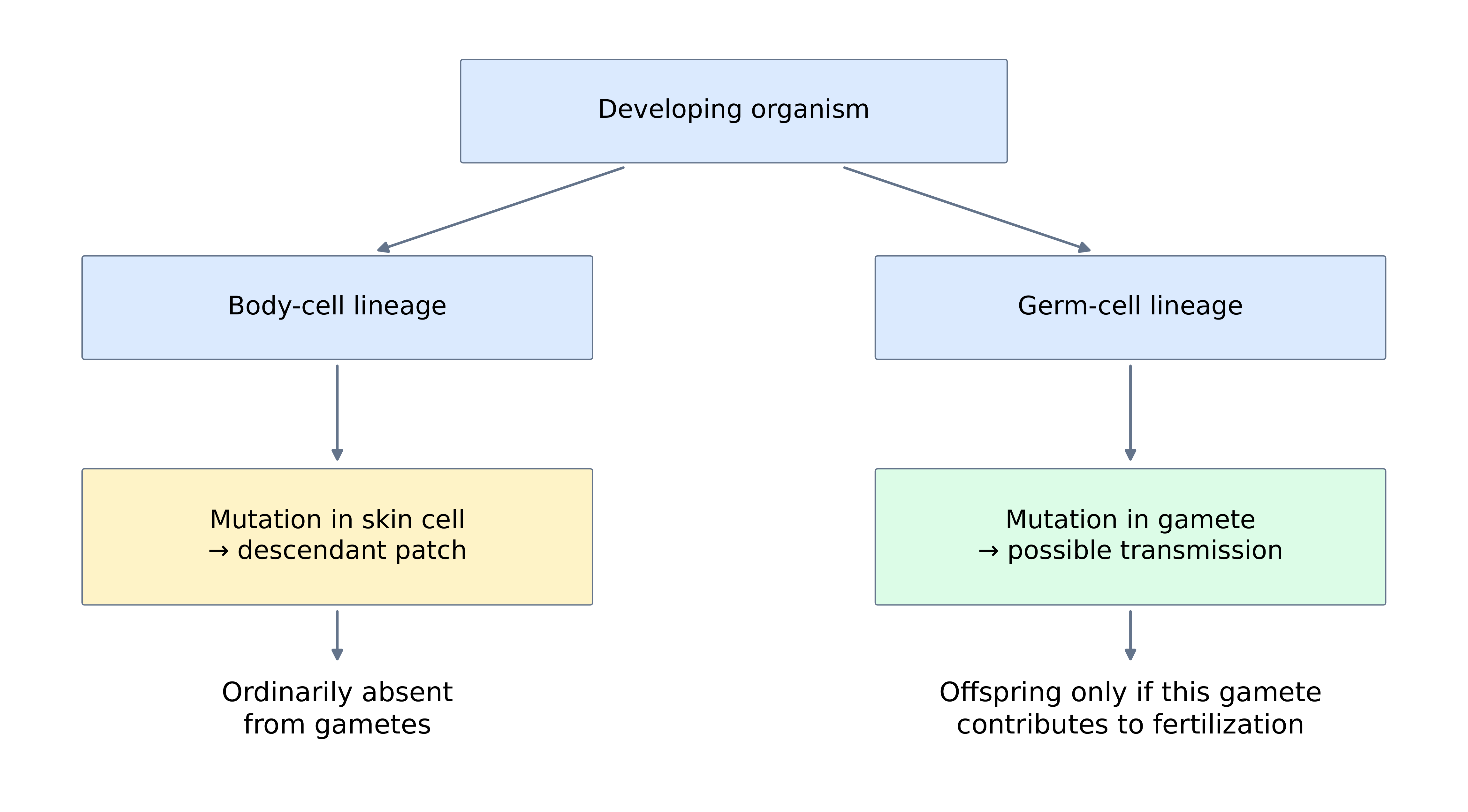
Which condition permits a new germ-cell-lineage mutation to pass through ordinary sexual reproduction to an offspring?
Dificuldade 1/5 · Moedas 100 + pequeno bônus na primeira conclusão hoje
Transmission depends on the lineage entering a contributing gamete. Somatic mitotic inheritance within a body is different from inheritance by offspring.
Separate new alleles from shuffled combinations and changing frequencies
- Mutation supplies new sequence variants; recombination and sexual reproduction rearrange existing alleles. Selection changes frequencies through differences in reproductive success, while drift can change them through chance. These processes contribute differently rather than all being synonyms for useful mutation.
- A resistance variant can help under drug exposure and have a cost without it. Many variants have no detectable fitness effect in a particular setting, and no fixed harmful/beneficial percentage applies everywhere. For sexual-generation evolution, a new variant must enter inherited population variation; an individual's need does not create its sequence on demand.
Evaluate a genetic-test claim using effect size and missing information
- In an invented report, risk rises from two to four per 1,000: a twofold final risk and a 100% relative increase, but an absolute increase of two per 1,000, or 0.2 percentage points. Neither description means every carrier develops the condition. A detected variant, statistical association and individual prediction are distinct claims.
- Ask which variants were tested, whether evidence fits the relevant population, and how other genes and environment affect the outcome. A negative limited panel does not exclude every relevant variant. Connect a sequence change with RNA/protein evidence and context; avoid turning a molecular label or one percentage into a complete diagnosis or guaranteed future trait.
An invented genetic-risk report changes estimated risk from two to four per 1,000. Find the absolute increase in percentage points.
Dificuldade 2/5 · Moedas 140 + pequeno bônus na primeira conclusão hoje
2/1,000 = 0.2% and 4/1,000 = 0.4%; difference = 0.2 percentage points. The relative increase is 100%, a different comparison.
A student claims antibiotic exposure makes a bacterium invent a needed mutation, every changed gene causes disease, and any mutation in one person will be inherited. Evaluate all three claims using evidence and lineage.
Cause, molecular effect, selection and inheritance are different questions and require different observations.
AHL: Use knockout and rescue to test a gene's contribution
- An inoperative gene can be compared with functional wild type and a restored-gene line. In an invented uptake assay, means of 100, 28 and 92 units per hour give a 72% knockout reduction relative to wild type and substantial rescue. Knockout libraries make such functional investigations systematic across many genes.
- Rescue supports a contribution without proving direct nutrient binding: the gene could regulate another process or support cellular energy. Use independent lines, matched background/environment and variation estimates. A normal-looking knockout may reflect compensation, an untested condition or an insensitive measurement; distinguish complete inactivation from reduced expression.
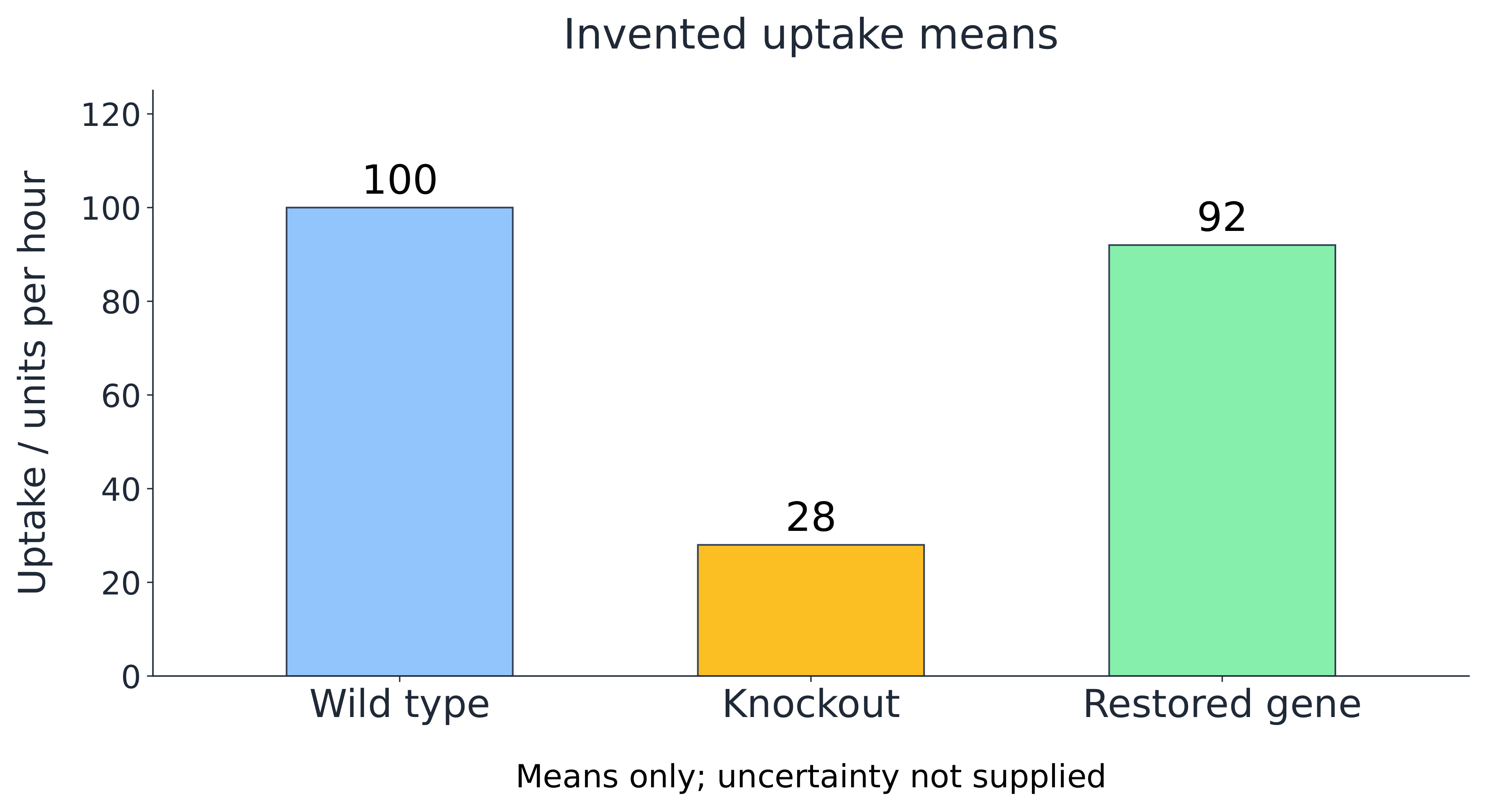
AHL: In an invented matched assay, wild-type uptake is 100 units per hour and knockout uptake 28. Calculate percentage reduction relative to wild type.
Dificuldade 2/5 · Moedas 140 + pequeno bônus na primeira conclusão hoje
(100 − 28)/100 × 100 = 72%. Restoration towards 100 supports a contribution but does not alone show that the gene product directly binds the nutrient.
AHL: Separate guide recognition, cutting and repaired outcome
- In the simplified CRISPR-Cas9 model, guide RNA helps recognize complementary target DNA next to a suitable PAM; Cas9 cuts DNA strands. Cellular repair determines the resulting sequence. A cut is not automatically a precise desired edit or a gene knockout: an in-frame change may retain function, while a regulatory target can change expression without deleting coding DNA.
- Verify the target sequence, affected alleles/cells, possible unintended sites and persistent biological function. Molecular editing and useful organism-level outcomes are different endpoints. A targeted design does not alone establish complete specificity, safety or efficacy; controls and direct sequence/function measurements are needed.
AHL: A guide directs Cas9 to cut a chosen site. What additional evidence is needed before claiming the intended functional edit?
Dificuldade 1/5 · Moedas 100 + pequeno bônus na primeira conclusão hoje
Recognition, cutting, repair and functional outcome are distinct. Repair can generate different sequences, and a targeted molecular event does not by itself establish the intended whole-cell outcome.
AHL: Read a defined clinical endpoint with its actual denominator
- In a 2024 single-group exa-cel study, patients' blood stem/progenitor cells were edited outside the body at an erythroid-specific BCL11A enhancer and returned after conditioning. The approach reactivated fetal-haemoglobin production; it did not directly repair the sickle HBB substitution.
- Forty-four patients were treated, but thirty had sufficient follow-up for the primary endpoint; twenty-nine of those thirty were free from severe vaso-occlusive crises for at least twelve consecutive months, about 96.7%. This dated result is a defined observed benefit, not proof of lifelong cure or zero risk. Insufficient follow-up is not automatically success or failure; follow-up, harms and study design constrain interpretation.
AHL: In the cited 2024 study, 29 of 30 patients with sufficient follow-up met the defined primary endpoint; 44 had been treated overall. Calculate the percentage among the evaluable 30.
Dificuldade 2/5 · Moedas 140 + pequeno bônus na primeira conclusão hoje
29/30 × 100 ≈ 96.7%, reported as about 97%. Use the endpoint denominator, and do not count patients without sufficient follow-up automatically as successes or failures.
AHL: Make an ethical argument about a named application
- Editing a person's somatic cells differs from editing a lineage whose changes might pass to future offspring. Consider expected benefit, uncertain harm, consent, fair access, effects on future people and treatment versus selecting preferred traits. Animal experiments also require welfare consideration and alternatives.
- State who benefits, who bears risk and what evidence or safeguards would change the judgement. Technical feasibility does not supply permission for every use, and international cooperation addresses differences in ethical views and regulation. Evaluate the proposed application rather than assuming all gene editing has one identical moral or legal status.
AHL: Treat conservation as a hypothesis about constraint
- Similar sequences across lineages can reflect purifying selection against harmful changes, a lower local mutation rate or little divergence time. Conservation does not prove that mutations never occurred. Compare equivalent regions and suitable neutral references, then combine sequence evidence with functional tests.
- In an invented ungapped alignment, ACGTACGT and ACGTTCGT match at seven of eight positions: 87.5% identity. A short perfect match would not show that change is impossible, and one difference does not identify a trait. DNA may change while its encoded amino acid remains conserved through degeneracy; specify which sequence level was compared.
AHL: An invented ungapped alignment compares ACGTACGT with ACGTTCGT. Calculate percentage identical positions.
Dificuldade 2/5 · Moedas 140 + pequeno bônus na primeira conclusão hoje
Seven of eight positions match: 7/8 × 100 = 87.5%. Similarity alone does not prove an absence of mutations or establish the particular function of the differing position.