Origins of cells: evidence and limits
Introduzido| English | Significado |
|---|---|
| endosymbiosis/ˌendəʊˌsɪmbaɪˈəʊsɪs/ | endossimbiose |
| inference/ˈɪnfərəns/ | inferência |
What would explain this observation?
- Mitochondria have their own DNA and divide within cells. These features invite an evolutionary explanation that can be tested against other evidence.
Build the model
- The endosymbiotic model explains mitochondria and chloroplasts as descendants of bacteria living within another cell lineage.
- Double membranes, ribosomes, DNA and division provide several lines of evidence.
- This model is distinct from a complete explanation for the origin of the first life.
- endosymbiosis 内共生: One organism living within another in an evolutionary association.
- inference 推论: An explanation drawn from observations and reasoning.

Which observation is relevant evidence for mitochondrial endosymbiosis?
Dificuldade 1/5 · Moedas 100 + pequeno bônus na primeira conclusão hoje
Mitochondria carrying their own DNA - bacterial-style, with their own ribosomes - is exactly what an engulfed-bacterium origin predicts. Equal cell sizes or a nucleus in every organelle are not observations and would not test the model.
Match each technical term to its precise meaning.
Dificuldade 2/5 · Moedas 140 + pequeno bônus na primeira conclusão hoje
Use the definitions to distinguish related quantities and processes.
Choose evidence that can test it
- Independent observations strengthen a model when they make a consistent prediction.
- Similarity is evidence to evaluate alongside ancestry, sequence comparisons and alternative explanations, rather than proof from one feature.
In the lab: Use attributed micrographs and sequence data. Separate observations from inferences in a table. Check whether each comparison concerns a mitochondrion, chloroplast, bacterial cell or eukaryotic nucleus.
Which two habits make the investigation or model in this case more defensible?
Dificuldade 2/5 · Moedas 140 + pequeno bônus na primeira conclusão hoje
Stating the conditions and assumptions lets others repeat the work exactly, and recording the supporting evidence lets them check the conclusion. Hiding disagreeing results removes the evidence that could challenge a wrong conclusion, and one measurement can never establish a wider claim.
Work from known quantities
- Known: 18 of 24 compared sequence sites are identical.
- Identity = 18/24 × 100 = 75%.
- Identity across this short alignment cannot alone date an evolutionary split or establish that one organism is the direct ancestor of another.
Your turn: 21 of 28 compared sites match. Calculate percentage identity.
Count identical sites, then test what the percentage means
Reproduce the lesson's 18 identical sites out of 24, giving 75% identity. Edit toy aligned columns or duplicate them to separate a percentage calculation from independent evidence about evolutionary history.
21 of 28 compared sites match. Calculate percentage identity.
Dificuldade 2/5 · Moedas 140 + pequeno bônus na primeira conclusão hoje
The result is 75 %. Known: 21 of 28 sites match. Use percentage identity = matches / sites x 100. Identity = 21/28 x 100 = 75%. A short-alignment percentage cannot by itself date a split or prove direct ancestry.
Check the conclusion and its limits
- The endosymbiotic model does not say that every organelle arose from an engulfed bacterium.
- A laboratory model of early chemistry is not a recreation of the whole historical event.
Not true: One matching sequence proves the complete origin of life. One sequence match is one piece of evidence about one locus. Origins models rest on many independent lines - DNA, ribosomes, membranes, biochemistry - not a single comparison.
- The endosymbiotic model explains mitochondria and chloroplasts as descendants of bacteria living within another cell lineage.
- Independent observations strengthen a model when they make a consistent prediction.
- Watch for: the endosymbiotic model does not say that every organelle arose from an engulfed bacterium.
One matching sequence proves the complete origin of life.
Dificuldade 1/5 · Moedas 100 + pequeno bônus na primeira conclusão hoje
One sequence match is one piece of evidence about one locus. Origins models rest on many independent lines - DNA, ribosomes, membranes, biochemistry - not a single comparison.
One organism living within another in an evolutionary association: write the technical term.
Dificuldade 1/5 · Moedas 100 + pequeno bônus na primeira conclusão hoje
endosymbiosis means One organism living within another in an evolutionary association.
16 of 20 compared sequence sites are identical. What is the percentage identity, and what can that short alignment not prove by itself?
Percentage identity = matches / compared sites × 100 = 16/20 × 100 = 80%. Similarity is evidence to weigh, not a finished family tree.
The written case compares 20 aligned sequence sites, with 16 matches. What is the percentage identity?
Dificuldade 1/5 · Moedas 100 + pequeno bônus na primeira conclusão hoje
16/20 × 100 = 80%. This alignment percentage does not by itself date an evolutionary split or prove a complete origin-of-life history.
Write from a similarity without claiming a complete history
- In the original written case, 16 of 20 compared sequence sites match, giving $16/20\times100=80\%$ identity. This measures agreement in that alignment. It does not supply an evolutionary rate, a calibrated divergence time or a demonstration that one sampled organism is the direct ancestor of another. The earlier 21-of-28 comparison gives 75% instead.
- This expanded route teaches the HL-only A2.1 origins-of-cells unit; there is no SL copy. It connects chemical building blocks, compartments, catalysis and inherited information. All new numerical data below are invented teaching examples. Endosymbiosis explains a later stage of cellular history, after cell lineages already existed, so the wider origin question needs additional evidence.
Reconstruct an environment rather than assuming one gas recipe
- Early Earth had little free molecular oxygen compared with today's atmosphere and consequently little protective ozone. More ultraviolet radiation could reach exposed surface settings. Heat, electrical discharges, light and chemical gradients offered possible energy inputs. Atmospheric composition and local conditions varied through time; a proposed mixture is a reconstruction to test, not a direct sample of the entire ancient planet.
- “Organic compound” does not mean that an organism must have produced it. Carbon compounds can form abiotically under suitable conditions. A testable hypothesis connects a proposed environment and energy input to particular chemical products. Demonstrating a possible reaction under one controlled set of conditions does not establish every step of the historical route to the first cells.
Identify the interacting capacities a cell needs
- A cellular system must exchange matter and energy, maintain internal organization and carry inherited information through its lineage. Catalysis allows reactions to proceed adequately; replication preserves information with some variation; self-assembly organizes components; compartmentalization can keep useful interacting molecules together. These capacities must operate together rather than appearing only as unrelated ingredients in different containers.
- A membrane bubble alone does not provide heredity or metabolism. A copying molecule in solution does not automatically form a regulated compartment. A virus has hereditary information but relies on host cellular machinery and energy for reproduction; it is not classified as a living cell here. “Self-sustaining” means maintaining an integrated system under suitable conditions, not being isolated from all external resources.
Distinguish current cell division from the historical origin problem
- Present-day cells arise from pre-existing cells. Division produces new cells, and fusion can combine existing cells, as in fertilization. That observation explains how current cell lineages continue, while abiogenesis concerns the earlier transition from non-living chemistry to evolving cellular systems. The two questions address different stages. Abiogenesis is not a claim that modern fully formed organisms routinely appear in sterile food or mud.
- Growth or movement alone cannot diagnose cellular life: crystals grow and fire spreads without cellular organization. An origin model needs a mechanism that connects inherited variation to differences in reproductive success under particular conditions. Molecules do not deliberately seek progress, and a plausible sequence of steps must be tested rather than assumed because its endpoint resembles modern biology.
Trace what the spark-discharge apparatus models
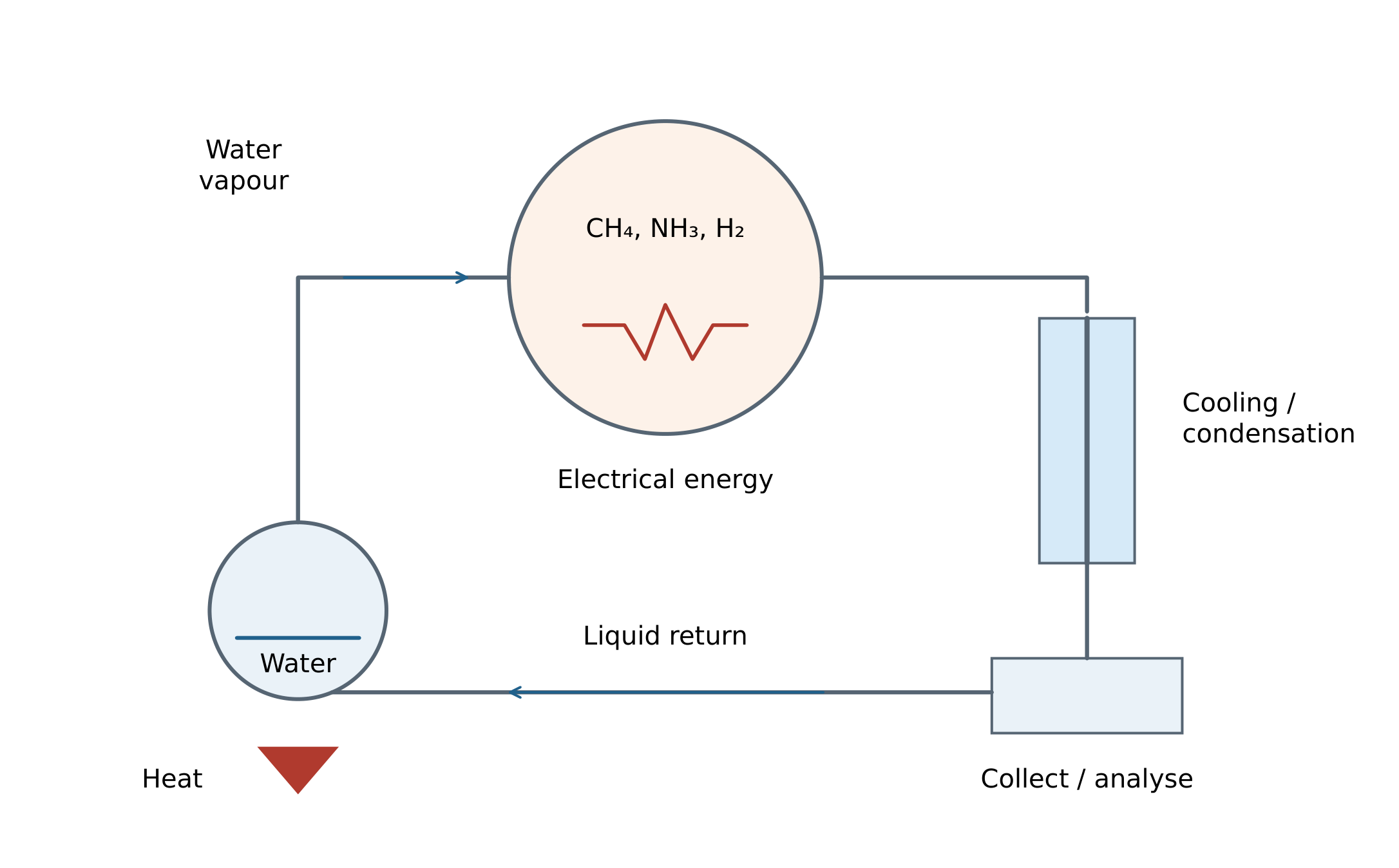
- In Miller's 1953 report, boiled water supplied vapour to a circulating methane, ammonia and hydrogen system exposed to an electrical discharge. Cooling returned condensed material to the liquid phase, where products could accumulate. Chemical analysis identified amino acids among the products. The apparatus tested selected possible chemical conditions rather than reproducing a complete early planet.
- The observation supports abiotic building-block synthesis under those tested conditions. It does not show that living cells formed or identify a complete route from simple reactants to heredity, membranes and metabolism. The assumed gas mixture limits application to other environments. A model can answer a useful chemical question while leaving the broader origin problem unresolved.
Design controls that distinguish synthesis from contamination
- In a new model investigation, compare an energy-input treatment with a matched no-energy control, check starting materials and analytical blanks, and use procedures that exclude biological contamination. Identify products using appropriate standards and more than appearance alone. Repetition tests consistency, while changing the gas mixture tests whether the proposed route depends on those specific reactants.
- Invented measurements of a particular product are 10.0 arbitrary concentration units after energy input and 2.0 in a matched control: the observed difference is 8.0 units. It is not evidence that 10 living cells formed, nor automatic proof of which reaction produced the difference. The method must justify comparability, analytical specificity and any correction for background.
Invented product concentrations are 10.0 arbitrary units in an energy-input treatment and 2.0 in its matched no-energy control. What is the observed difference?
Dificuldade 2/5 · Moedas 140 + pequeno bônus na primeira conclusão hoje
Subtract the control value: 10.0 − 2.0 = 8.0 units. This is a product concentration difference, not a count of cells or a complete demonstration of a chemical mechanism.
Explain how a boundary can assemble
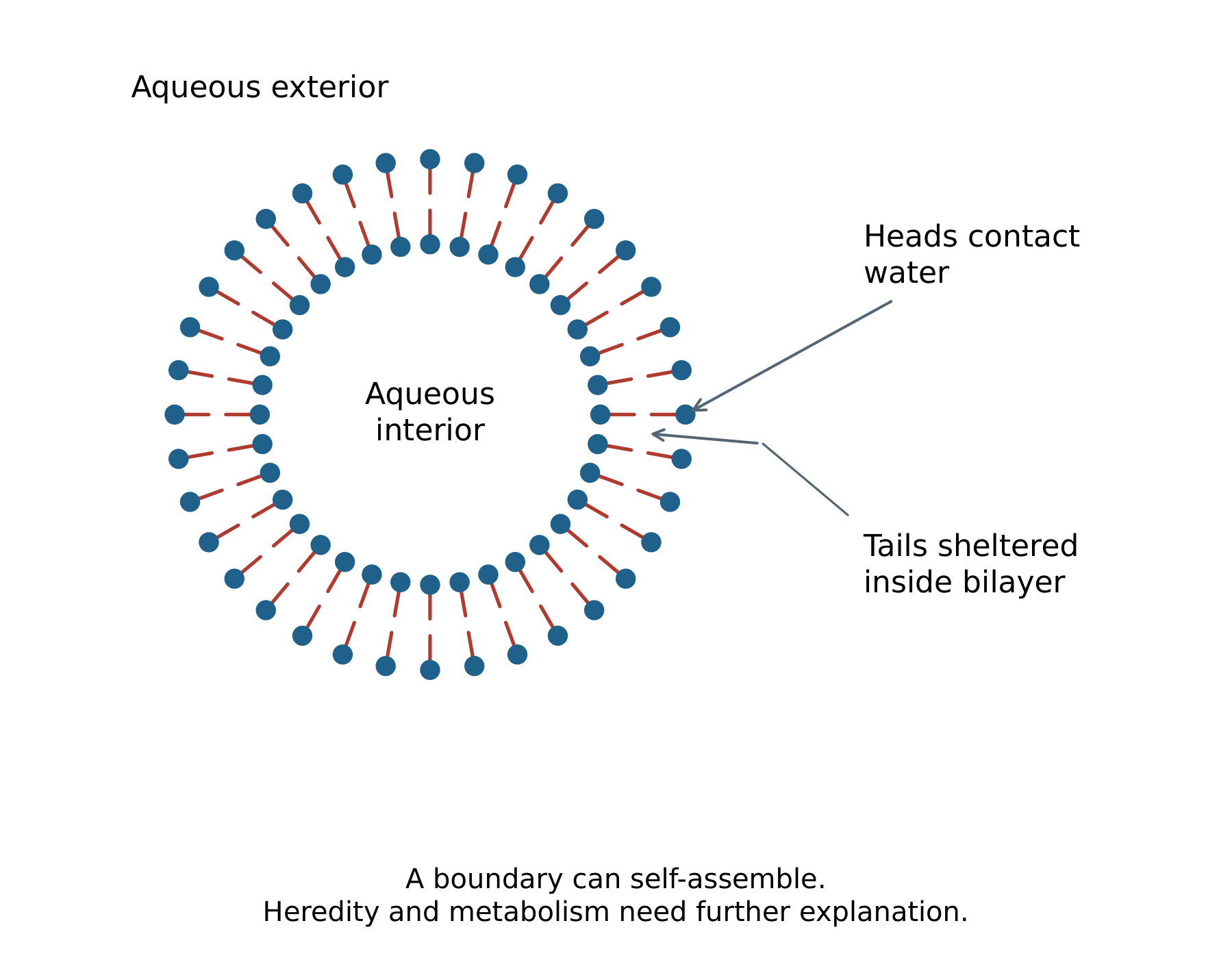
- Suitable amphipathic molecules have water-interacting heads and water-avoiding tails. In appropriate aqueous conditions, fatty acids can aggregate into bilayers and closed vesicles. Heads contact water on both sides; tails are sheltered within the membrane. Interactions among components can organize this structure without a pre-existing cell individually placing every molecule.
- A boundary can retain catalysts and reactants, permitting internal concentrations and conditions to differ from the surroundings. It also needs appropriate exchange: an impermeable box cannot obtain new resources or remove wastes, while excessive leakage loses useful contents. Assembly depends on molecular structure, concentration, pH and dissolved ions. One vesicle observation does not establish every early membrane's composition or prove that the compartment is alive.
Connect RNA information with catalytic activity
- The RNA-world hypothesis proposes an early stage in which RNA had central roles in information storage and catalysis. RNA sequences can carry information and provide templates for complementary copying. Some folded RNA molecules, called ribozymes, catalyse reactions. Ribosomal RNA contributes to peptide-bond formation in modern translation, so RNA catalysis is biologically relevant as well as experimentally observable.
- These roles make a dual-function system plausible; they do not mean every RNA molecule copies itself without help. Models still need workable nucleotide supply, polymer formation, sufficiently accurate copying, stability and connections to compartments. A laboratory reaction addressing one requirement leaves other requirements to be investigated. Keep a supported molecular capability distinct from a complete self-sustaining cell.
Evidence that some RNAs catalyse reactions establishes that every RNA molecule can copy itself and maintain a living cell without assistance.
Dificuldade 1/5 · Moedas 100 + pequeno bônus na primeira conclusão hoje
RNA can store sequence information, provide a template, and in some cases catalyse reactions. A complete model still needs substrate supply, copying, stability, exchange and connections to compartments. One capability does not establish the whole integrated system.
Place LUCA after an earlier origin interval
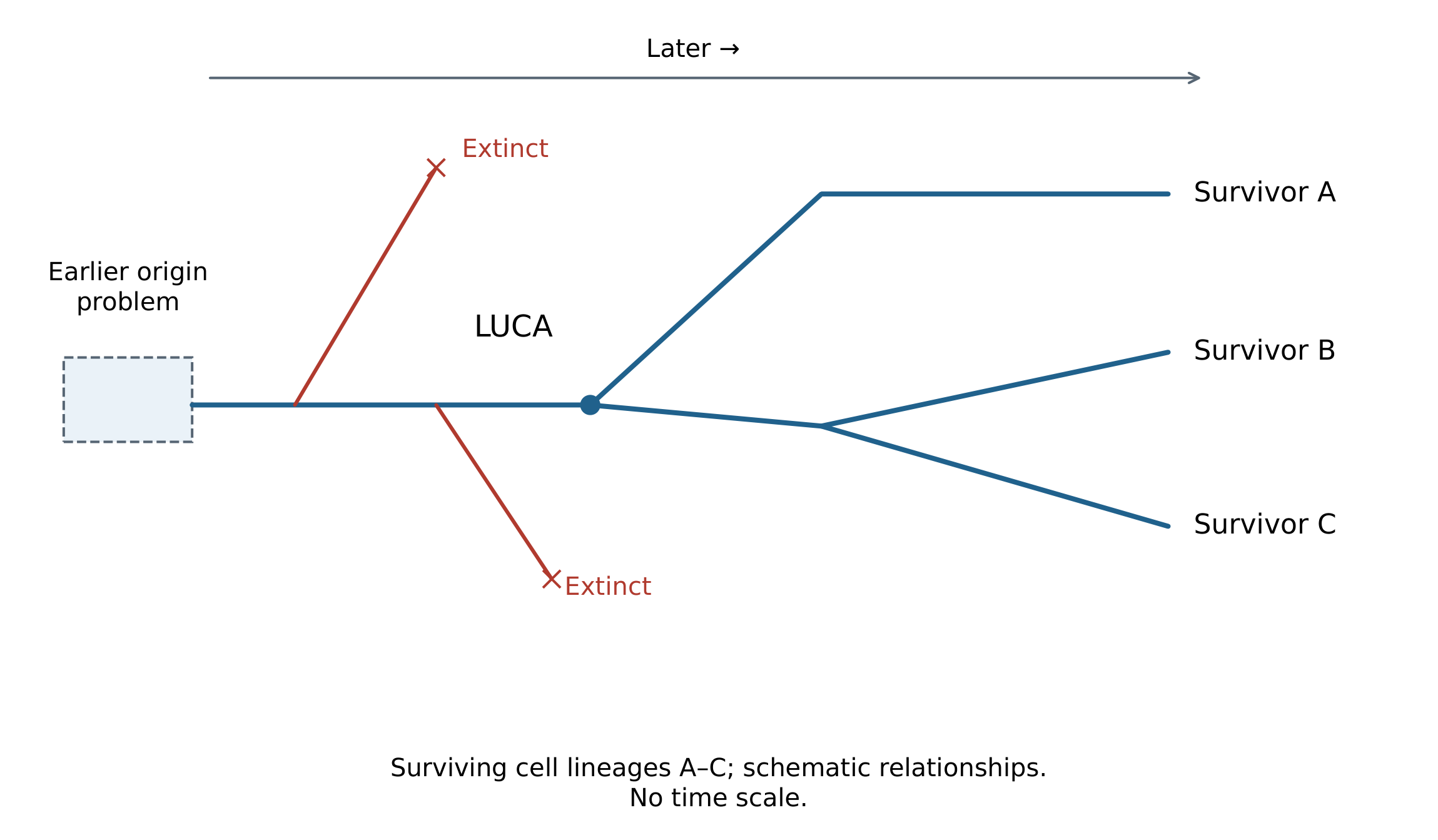
- The last universal common ancestor, LUCA, is the ancestral lineage shared by all present-day cellular life. It need not be the first living system or the only lineage alive at its time. Earlier and contemporary branches could have become extinct without surviving descendants. The ancestry of surviving lineages does not demonstrate that only one chemical origin was possible.
- The broadly conserved genetic code and shared genes involved in fundamental information processing support common ancestry. Compare several genes and many organisms rather than relying on one superficial similarity. Gene transfer, gene loss, different evolutionary rates and uncertainties in reconstruction complicate the inference. Recognizing these limits helps frame a testable explanation; it does not make the evidence uninformative.
Calculate sequence identity without inventing a date
- In invented alignments, 18 matches among 24 comparable sites gives $18/24\times100=75\%$ identity; 21 among 28 also gives 75%. Equal percentages from different lengths do not imply that the evidence has identical precision or that the alignments represent the same evolutionary history. State which sites and sequences were compared.
- Percentage identity alone supplies neither a calibrated change rate nor a correction for repeated changes at the same site. It cannot date LUCA or prove a direct ancestor–descendant relationship between the sampled organisms. A molecular-clock analysis needs an explicit model, relationships and external calibration, with uncertainty in those assumptions carried into its interpretation.
An invented alignment has 21 matching sites among 28 comparable sites. Find percentage identity.
Dificuldade 2/5 · Moedas 140 + pequeno bônus na primeira conclusão hoje
21/28 × 100 = 75%. Identity describes that alignment; dating a divergence also needs rates, relationships, calibrations and a suitable model.
Separate the age of evidence from an exact origin date
- Fossils and chemical traces can establish that life existed by a particular time when their biological origin and geological context are secure. The earliest preserved and discovered evidence need not mark the first life: older rocks can be destroyed or altered, and early systems may leave little recognizable trace. Thus evidence of presence usually provides a minimum age for life's existence.
- Rock ages can be constrained by radiometric methods and stratigraphic relationships, but the surrounding material's date is not automatically the formation date of every object within it. Later fluids, contamination and deformation require evaluation. A cell-like shape or carbon-isotope pattern also needs testing against non-biological explanations and its geological context.
Read a long interval on a short timeline
- An invented interval from 3.8 to 3.2 billion years ago lasts $(3.8-3.2)\times1000=600$ million years. A second interval from 3.6 to 3.3 lasts 300 million years, half as long. These are calculations with hypothetical endpoints, not proposed dates for life's origin or LUCA.
- A tiny distance on a printed timeline can therefore conceal enormous time for change. A branching diagram without a time scale shows relationships rather than measured durations. Do not treat equal drawn branch lengths as proof of equal ages, and do not confuse an estimated divergence time with the age of the oldest fossil currently available.
A hypothetical interval extends from 3.8 to 3.2 billion years ago. Find its duration in millions of years.
Dificuldade 2/5 · Moedas 140 + pequeno bônus na primeira conclusão hoje
The elapsed time is 0.6 billion years. Multiplying by 1000 gives 600 million years. These invented endpoints are not claims about the actual origin date.
Evaluate a hydrothermal-setting hypothesis
- Water–rock interactions in hydrothermal systems can create chemical and proton gradients. Mineral surfaces and pores may concentrate substances or support reactions, while gradients could provide energy. A useful hypothesis identifies which conditions support which chemical processes; saying only that vents are warm does not explain catalysis, copying or compartment formation.
- Ancient deposits and genomic reconstructions offer different evidence. Structures and chemistry in a deposit may support life in an ancient vent environment, subject to biological and geological checks. Reconstructions from surviving genes are model-based inferences about ancestral capacities. Neither alone proves the unique location of the first life, and shared assumptions should not be counted twice as independent confirmation.
Keep the biological question matched to the evidence
- Endosymbiotic evidence concerns later eukaryotic organization: bacterial ancestry of mitochondria and chloroplasts is supported by their DNA, ribosomes, division and wider molecular comparisons. Bacteria and a host lineage already existed in the proposed association. This explains a later relationship among cells, rather than the first transition from chemistry to cellular life.
- Evaluate an origins claim by stating the observation, the inference it supports and a specific remaining requirement. An amino acid supports a synthesis claim; a vesicle supports a compartment-formation claim; conserved sequences support ancestry. A fuller origin model must connect these capacities in a system capable of maintaining itself and evolving through inherited differences.
An experiment detects amino acids and another produces vesicles. Explain what each observation supports and why the two observations do not yet demonstrate a complete origin of living cells.
Evaluate what the evidence actually tests and name the next requirement rather than treating a component as a complete living system.