Seu plano de estudos · Continuar · Revisar →
Statement + 嘛 (obviously / you know)
IntroduzidoSua posição salva fica neste navegador. Retomar não conclui a lição nem responde às perguntas.
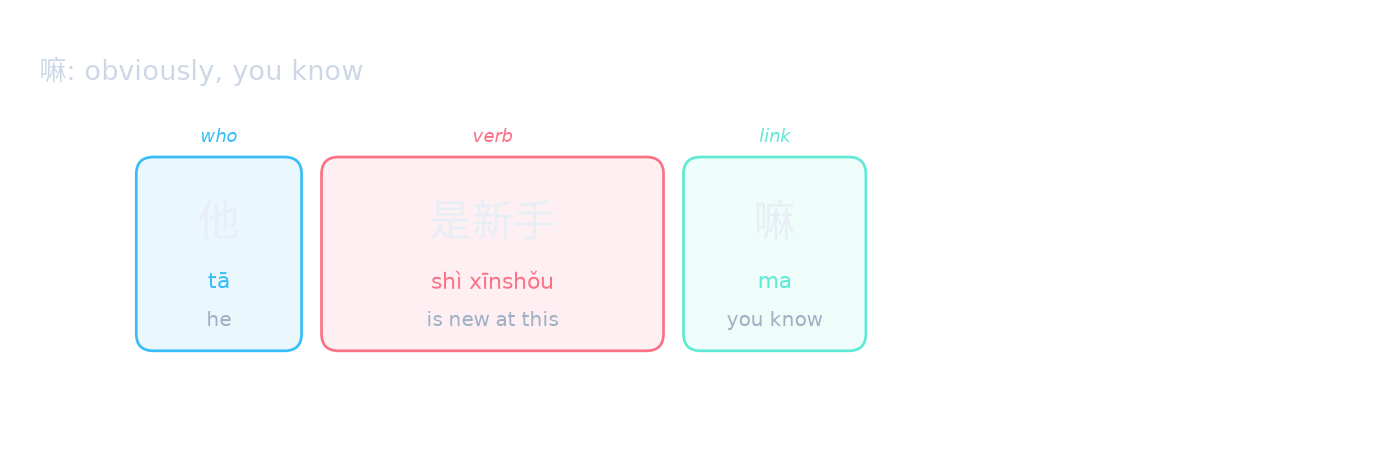
He's new, you know
- A new colleague makes a small mistake, and your boss frowns. You say: he他is是new at this新手(you know)嘛,slowly慢慢then / just就can / will会(completed / change)了。 — "He's new, you know. He'll get the hang of it."
- Goal: use (you know)嘛 at the end of a statement to present something as obvious ("you know, of course"), and keep it apart from yes/no question particle吗 and (and …? / softener)呢.
Statement + (you know)嘛 = it's obvious, you know
- Statement + (you know)嘛: the speaker thinks the point is clear and expects the listener to agree. It is a statement, not a question.
- this这very很simple简单(you know)嘛。 — "It's easy, you know." I / me我already at an earlier time早就variant of 说说(experienced)过(you know)嘛! — "I told you so!"
he他is是new at this新手(you know)嘛。
Your friend thinks the homework is hard. Disagree, you think it's obvious: 这很简单____。
Dificuldade 1/5 · Moedas 100 + pequeno bônus na primeira conclusão hoje
Statement + 嘛 = it's obvious, you know.
Friendly or impatient
- With a reason, it explains and calms: 别着急(you know)嘛,time时间still / also还early早。 — "Don't worry, there's still time."
- With a complaint it can sound impatient: I / me我all / both都variant of 说说(completed / change)了三遍(completed / change)了(you know)嘛! — "I've already said it three times!" Your tone decides.
Your friend says 别着急嘛,时间还早. What is your friend doing?
Dificuldade 1/5 · Moedas 100 + pequeno bônus na primeira conclusão hoje
嘛 presents the point as obvious; with a reason it reassures.
嘛 always sounds friendly.
Dificuldade 1/5 · Moedas 100 + pequeno bônus na primeira conclusão hoje
With a complaint (我都说了三遍了嘛!) it can sound impatient.
(you know)嘛, yes/no question particle吗 or (and …? / softener)呢?
- yes/no question particle吗 asks a yes/no question: this这very很simple简单yes/no question particle吗? — "Is this easy?" (you know)嘛 says it's obvious: this这very很simple简单(you know)嘛。 — "It's easy, you know."
- (and …? / softener)呢 asks back: you你to feel / think觉得(and …? / softener)呢? — "What do you think?" Same sound (ma) for yes/no question particle吗 and (you know)嘛, so listen to the intonation: rising = yes/no question particle吗.
You really want to know if the test is difficult. Which sentence do you use?
Dificuldade 1/5 · Moedas 100 + pequeno bônus na primeira conclusão hoje
A yes/no question takes 吗. 嘛 states the point as obvious.
Match each sentence to what it does.
Dificuldade 2/5 · Moedas 140 + pequeno bônus na primeira conclusão hoje
嘛 states; 吗 asks yes/no; 呢 asks back.
Recap
- Statement + (you know)嘛 = obviously, you know (expects agreement); friendly or impatient depending on tone.
- yes/no question particle吗 = yes/no question; (and …? / softener)呢 = "and you? / what about …?".
Read the full reference: HSK 5 grammar — Particles.
Your younger cousin is nervous before a piano exam. Reassure them with two sentences ending in 嘛.
Your answer need not copy the model. A partner or teacher must hear the spoken response to comment on pronunciation.