Seu plano de estudos · Continuar · Revisar →
Complemento de direção 来 / 去 (HSK 4)
IntroduzidoSua posição salva fica neste navegador. Retomar não conclui a lição nem responde às perguntas.
Bring it in, take it out
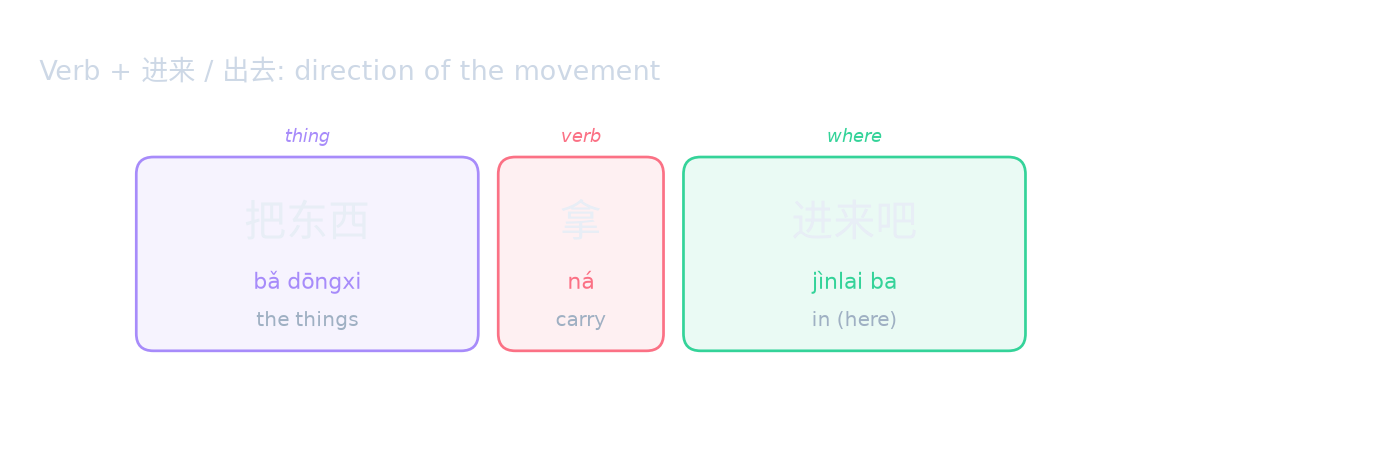
- You ask your brother to carry the shopping bags from the car into the kitchen.
- (把: marks the object)把thing; stuff东西took拿to come in进来(suggestion)吧。 — "Bring the things in."
Verb + direction + (towards me)来 / to go去
- Verb + on; above; last (week)上/under; below; next (week)下/to enter; to come in进/out出/to go back; to return回/(experienced)过/to rise起 + (towards me)来/to go去 shows how an action moves: took拿to come in进来, walk走to go out出去, to run跑to return回来, to stand站(recall)起来.
- (towards me)来 = towards the speaker; to go去 = away from the speaker.
he他out of从the classroom教室(inside)里walk走come out出来了。
You are inside. Ask a friend: “Bring the chairs in.” 把椅子搬进____吧。
Dificuldade 1/5 · Moedas 100 + pequeno bônus na primeira conclusão hoje
Towards the speaker: 进来.
Where the place and object go
- A place goes before (towards me)来/to go去: he他to enter走进the classroom教室(towards me)来(completed / change)了。 — "He walked into the classroom."
- A thing can go before (towards me)来/to go去 or after the whole complement: to take out拿出a一(measure word)本book书(towards me)来 / took拿come out出来a一(measure word)本book书.
he他took拿out出a一(measure word)本book书(towards me)来。
Build: “He took a book out.”
Dificuldade 3/5 · Moedas 200 + pequeno bônus na primeira conclusão hoje
Verb + 出 + object + 来.
Place before (towards me)来 / to go去
- to enter走进the classroom教室(towards me)来, not to enter走进(towards me)来the classroom教室: a place never follows (towards me)来 / to go去.
- Pick (towards me)来 or to go去 by where the speaker is: inside the room → to come in进来; outside → to go in进去.
Which sentence is correct?
Dificuldade 1/5 · Moedas 100 + pequeno bônus na primeira conclusão hoje
他走进教室来了 is right: with a place word, the place goes between 进 and 来 (走进 + 教室 + 来).
Abstract meanings
- think想(recall)起来 = remember: I我think想(recall)起来(completed / change)了! — "I've remembered!"
- to look at; to watch; to read看come out出来 = make out, notice: I我to look at; to watch; to read看come out出来he他not不happy; glad高兴 — "I could tell he wasn't happy."
I我think想(recall)起来了!
我看出来他不高兴 means “I could tell he was unhappy.”
Dificuldade 1/5 · Moedas 100 + pequeno bônus na primeira conclusão hoje
True. 看出来 means “can tell, make out” from what you see: 我看出来他不高兴 “I could tell he was unhappy.”
Recap
- Verb + direction + (towards me)来/to go去 = movement towards / away from the speaker: took拿to come in进来, walk走to go out出去.
- A place goes before (towards me)来/to go去; abstract uses: think想(recall)起来, to look at; to watch; to read看come out出来.
Read the full reference: HSK 4 grammar — Complements.
You ask your brother to carry the shopping bags from the car into the kitchen. Close the examples. Say a Mandarin response, then write it in Chinese. Explain briefly in English what the lesson’s pattern adds. Compare with the model, then change one detail and try again.
This is supported productive practice. Compare meaning and structure; your answer need not copy the model. A partner or teacher must hear the spoken response to comment on pronunciation.