Seu plano de estudos · Continuar · Revisar →
究竟 (exatamente / no mundo)
IntroduzidoSua posição salva fica neste navegador. Retomar não conclui a lição nem responde às perguntas.
A pergunta que todos fazem
- Um reportagem sobre uma luz misteriosa no céu termina com uma pergunta.
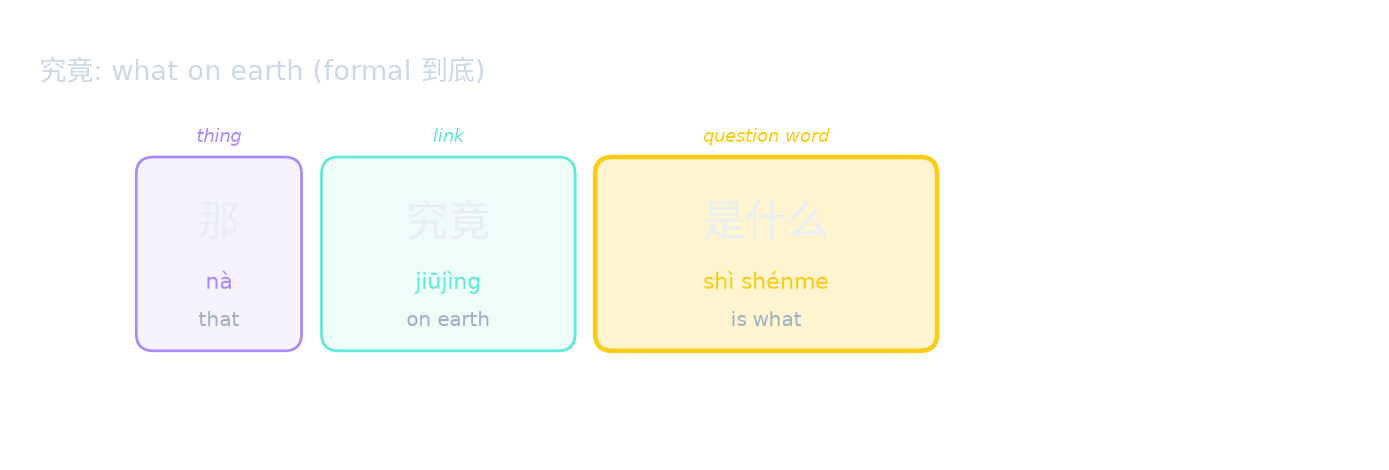
- that那exactly究竟is是what什么? — "O que foi exatamente?"
exactly究竟 = exatamente, ao todo (mais formal)
- exactly究竟 funciona como in the end到底 em perguntas, mas soa mais sério e escrito.
- Exige palavra interrogativa ou A-not-A: exactly究竟why?为什么? exactly究竟去不去?
the problem问题exactly究竟lies在where哪儿?
Complete a formal question: “What exactly is the reason?” 原因____是什么?
Dificuldade 1/5 · Moedas 100 + pequeno bônus na primeira conclusão hoje
究竟 + question word.
Em relatórios e discussões
- the accident's事故(modifier / structural particle)的cause原因exactly究竟is是what什么? — "O que causou exatamente o acidente?"
- we / us我们exactly究竟should应该how / why怎么to do; to make做? — "O que devemos fazer exatamente?"
the accident's事故的cause原因exactly究竟is是what什么?
Build: “What exactly should we do?”
Dificuldade 3/5 · Moedas 200 + pequeno bônus na primeira conclusão hoje
Subject + 究竟 + question.
Mesmas regras que in the end到底
- Sem (yes/no ?)吗: you你exactly究竟to agree同意not不to agree同意?, não you你exactly究竟to agree同意(yes/no ?)吗?
- Coloque exactly究竟 depois do tópico e antes da parte da pergunta: cause原因exactly究竟is是what什么?
Which question is correct?
Dificuldade 1/5 · Moedas 100 + pequeno bônus na primeira conclusão hoje
究竟 needs A-not-A or a question word.
exactly究竟 versus in the end到底
- Em perguntas são intercambiáveis; exactly究竟 é mais formal e calmo.
- in the end到底 tem usos extras em afirmações (in the end到底still还是come来(completed / change)了 — "por fim ele veio"); exactly究竟 raramente faz isso.
he他in the end到底still还是come来了。
究竟 sounds more formal than 到底.
Dificuldade 1/5 · Moedas 100 + pequeno bônus na primeira conclusão hoje
It suits reports and serious discussion.
Resumo
- exactly究竟 + pergunta = exatamente / ao todo, mais formal que in the end到底.
- Exige palavra interrogativa ou A-not-A, nunca (yes/no ?)吗; in the end到底 também funciona em afirmações.
Leia a referência completa: Gramática HSK 4 — Advérbios.
A news report on a mysterious light in the sky ends with one question. Close the examples. Say a Mandarin response, then write it in Chinese. Explain briefly in English what the lesson’s pattern adds. Compare with the model, then change one detail and try again.
This is supported productive practice. Compare meaning and structure; your answer need not copy the model. A partner or teacher must hear the spoken response to comment on pronunciation.