Superposição eletrostática, fluxo e condutores
Introduzido| English | Significado |
|---|---|
| superposition/ˌsuːpəpəˈzɪʃn/ | superposição |
| induced charge/ɪnˈdjuːst tʃɑːdʒ/ | carga induzida |
| equilibrium/ˌiːkwɪˈlɪbrɪəm/ | equilíbrio |
Zero field, 30 volts
- A charged conducting shell has zero electric field inside its metal, yet the metal sits at 30 V relative to infinity.
- GRE electrostatics tests vector superposition 叠加, flux, induced charges 感应电荷 on conductors, image charges and capacitors.
Superpose vectors, not magnitudes
- $\mathbf E = \sum \dfrac{Q_i(\mathbf r - \mathbf r_i)}{4\pi\varepsilon_0|\mathbf r - \mathbf r_i|^3}$. Forces of 3 N right and 4 N up combine to 5 N, not 7 N. Use symmetry first: components that cancel in pairs need no calculation.
- Potential is a scalar sum $V = \sum \dfrac{Q_i}{4\pi\varepsilon_0 r_i}$, which is easier, but $V = 0$ does not mean $\mathbf E = 0$.
Adding the magnitudes of perpendicular forces (3 N + 4 N = 7 N) is the classic slip; resolve into components.
Two perpendicular fields of 6 N/C and 8 N/C act at a point. Resultant magnitude in N/C?
Dificuldade 2/5 · Moedas 140 + pequeno bônus na primeira conclusão hoje
Perpendicular fields add as vectors: $\sqrt{6^2 + 8^2} = 10$ N/C.
Flux through an open plane
- Gauss's law is for closed surfaces. A point charge beside an infinite plane sends half its flux through it: $\Phi = \dfrac{q}{2\varepsilon_0}$, independent of distance. A charge at the centre of a cube sends $\dfrac{q}{6\varepsilon_0}$ through each face.
The flux of a point charge $q$ through an infinite plane near it is
Dificuldade 1/5 · Moedas 100 + pequeno bônus na primeira conclusão hoje
The plane subtends half the full solid angle.
A 6.0 nC charge sits at the centre of a cube. Flux through one face, in units of nC/$\varepsilon_0$?
Dificuldade 2/5 · Moedas 140 + pequeno bônus na primeira conclusão hoje
By symmetry each of the six faces gets $q/6\varepsilon_0 = 1$ nC$/\varepsilon_0$.
Conductors and induced charge
- In equilibrium 平衡, $\mathbf E = 0$ inside the metal and the whole conductor is at one potential.
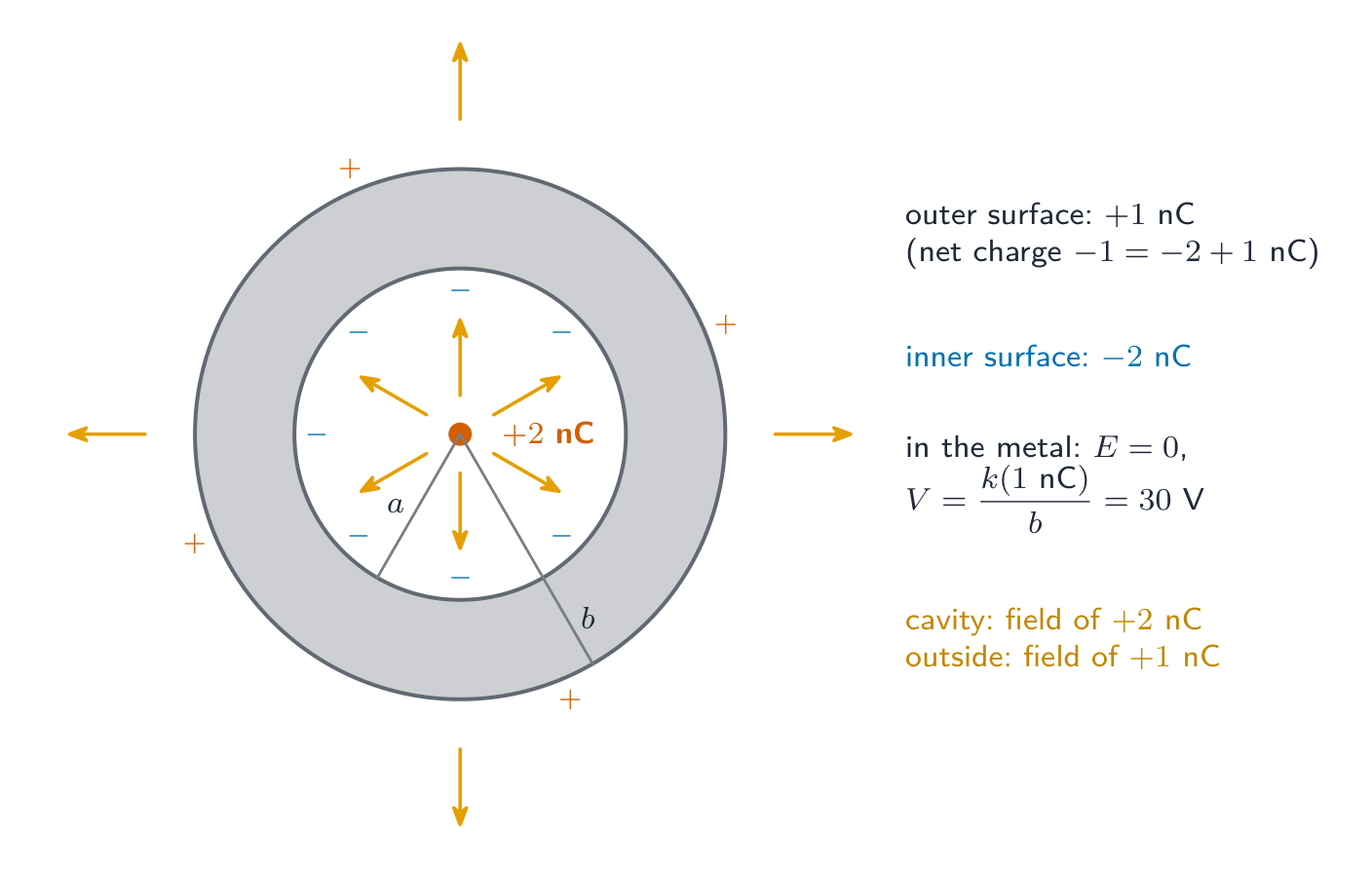
- Charge $Q$ at the centre of a shell (radii $a < b$, net charge $q$): inner surface $-Q$, outer surface $q + Q$, outside field as for $Q + q$ at the centre.
$Q = +2$ nC, $q = -1$ nC, $b = 0.30$ m. Inner surface $-2$ nC, outer $+1$ nC. Metal potential $= \dfrac{9\times10^9 \times 1\times10^{-9}}{0.30} = 30$ V; field in the metal 0.
$Q = +3$ nC at the centre, shell net charge $+1$ nC, outer radius 0.20 m. Potential of the metal in V?
Dificuldade 2/5 · Moedas 140 + pequeno bônus na primeira conclusão hoje
$9\times10^9 \times 4\times10^{-9}/0.2$.
Charge on the inner surface of that shell, in nC?
Dificuldade 2/5 · Moedas 140 + pequeno bônus na primeira conclusão hoje
Cancels the enclosed +3 nC.
The potential inside a charged conductor is constant, but need not be zero.
Dificuldade 1/5 · Moedas 100 + pequeno bônus na primeira conclusão hoje
True. Zero field inside means no potential difference between points, so the potential is the same everywhere inside, here 30 V, not necessarily zero.
Three regions and image charges
- Cavity ($r < a$): $E = \dfrac{Q}{4\pi\varepsilon_0r^2}$. Metal: $E = 0$. Outside ($r > b$): $E = \dfrac{Q + q}{4\pi\varepsilon_0r^2}$. $V$ is continuous everywhere; $E$ jumps at each charged surface.
- A charge $q$ a distance $d$ from a large grounded conducting plane behaves, on its own side, as if a charge $-q$ sat at its mirror image. So it is pulled toward the plane with force $\dfrac{q^2}{4\pi\varepsilon_0(2d)^2}$: the distance is $2d$, not $d$.
Qual campo?
Use a carga interna correta em cada região de uma casca.
A charge is moved from 2 cm to 1 cm from a large grounded metal plate. By what factor does the force on it grow?
Dificuldade 2/5 · Moedas 140 + pequeno bônus na primeira conclusão hoje
$F \propto 1/(2d)^2$: halving $d$ multiplies the force by 4.
Capacitors
- Parallel plates: $C = \dfrac{\varepsilon_0A}{d}$; filling the gap with a dielectric multiplies $C$ by $\kappa$. Stored energy $U = \tfrac12CV^2 = \dfrac{Q^2}{2C}$.
- Ask what is held fixed. Isolated capacitor ($Q$ fixed): increasing $d$ lowers $C$, raises $V$ and raises $U$, because you do work pulling the plates apart. Connected to a battery ($V$ fixed): increasing $d$ lowers $Q$ and $U$.
A capacitor stays connected to a 12 V battery while a dielectric with $\kappa = 3$ fills the gap. Factor change in stored energy?
Dificuldade 2/5 · Moedas 140 + pequeno bônus na primeira conclusão hoje
$V$ fixed, $C$ triples, so $U = \tfrac12CV^2$ triples.
Worked GRE question: a charge near a grounded plane
A point charge $q$ is held a distance $d$ from a large grounded conducting plane. The force on it is
- (A) zero
- (B) $\dfrac{q^2}{4\pi\varepsilon_0d^2}$, away from the plane
- (C) $\dfrac{q^2}{4\pi\varepsilon_0d^2}$, toward the plane
- (D) $\dfrac{q^2}{16\pi\varepsilon_0d^2}$, toward the plane
- (E) $\dfrac{q^2}{16\pi\varepsilon_0d^2}$, away from the plane
Fast route. Image $-q$ at distance $2d$: attractive force $\dfrac{q^2}{4\pi\varepsilon_0(2d)^2} = \dfrac{q^2}{16\pi\varepsilon_0d^2}$. Answer (D).
Traps. (C) uses $d$ instead of $2d$. (A) thinks a neutral plane exerts no force; induced charge always attracts.
Worked GRE question: pulling the plates apart
A charged parallel-plate capacitor is disconnected from its battery. The plate separation is then doubled. The stored energy
- (A) is quartered
- (B) is halved
- (C) is unchanged
- (D) doubles
- (E) quadruples
Fast route. $Q$ is fixed and $C$ halves, so $U = Q^2/2C$ doubles. Answer (D). The extra energy is the work done against the plates' attraction.
Traps. (B) uses $U = \tfrac12CV^2$ with $V$ held fixed, which is the battery-connected case.
Common errors
- Adding field magnitudes. Add vectors, by components.
- Zero field means zero potential. In a conductor $E = 0$ but $V$ is constant, often not zero.
- Using $d$ for an image force. The image is $2d$ away.
- Not asking what is fixed in a capacitor change: charge (isolated) or voltage (battery).
Recap
- Add field vectors by components; potentials add as scalars.
- Half the flux of a point charge passes through an infinite plane; a sixth through each cube face.
- Conductor: $E = 0$ inside, constant (not zero) potential; inner surface carries $-Q$.
- Grounded plane: image $-q$ at $2d$. Capacitor: $C = \kappa\varepsilon_0A/d$, $U = Q^2/2C = \tfrac12CV^2$.
- induced charge: Charge that gathers on a conductor’s surface because of nearby charges.
- superposition: Adding the fields of separate charges as vectors to get the total field.