Potência de circuito, indução e movimento de partículas carregadas
Introduzido| English | Significado |
|---|---|
| impedance/ɪmˈpiːdəns/ | impedância |
| diode/ˈdaɪəʊd/ | diodo |
| velocity selector/vəˈlɒsɪti sɪˈlektə/ | seletor de velocidade |
Not every resistor sees the battery
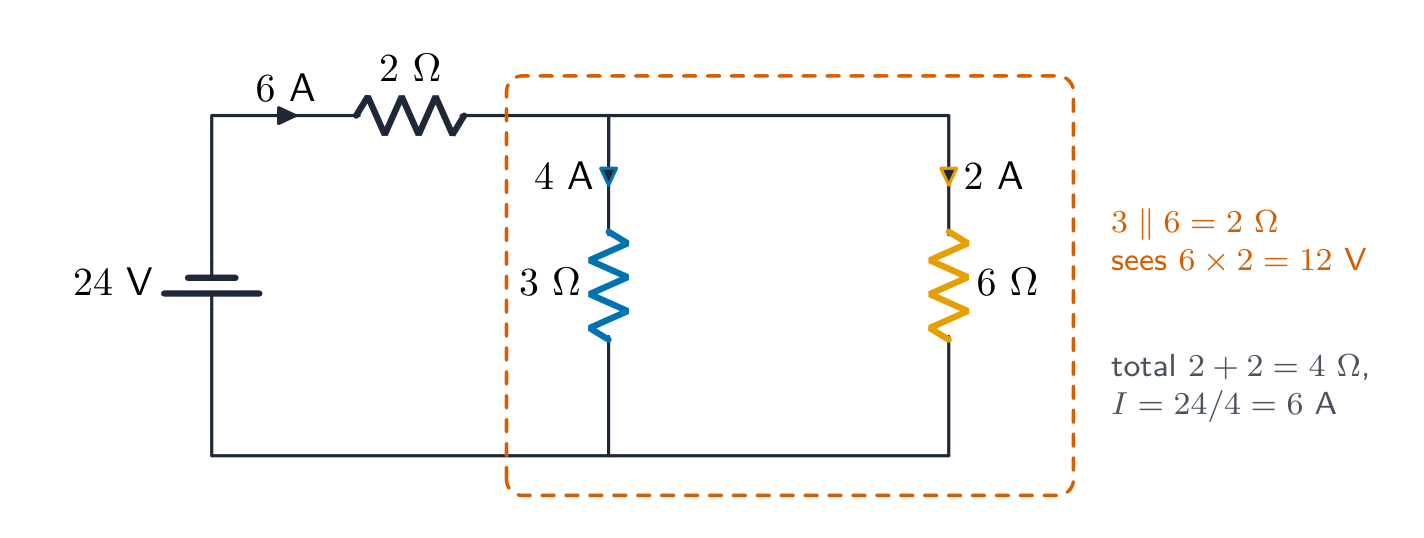
- A 24 V battery drives a 2 Ω resistor in series with 3 Ω and 6 Ω in parallel. The parallel pair sees only 12 V; the series resistor takes the rest.
- GRE circuits and magnetism questions test network reduction, internal resistance and maximum power, AC power and resonance, Faraday's law and charged-particle motion.
Reduce, then expand
- Series resistances add; parallel conductances add ($\tfrac1R = \tfrac1{R_1} + \tfrac1{R_2}$, so two in parallel give $\tfrac{R_1R_2}{R_1 + R_2}$). $3 \parallel 6 = 2$ Ω, total 4 Ω, current 6 A, branch voltage 12 V, branch currents 4 A and 2 A.
- Check: currents into the node sum (4 + 2 = 6); voltages round each loop sum (12 + 12 = 24). A real battery with internal resistance $r$ gives terminal voltage $\mathcal E - Ir$; a load takes the most power when $R = r$.
12 V source, 2 Ω in series with 6 Ω ∥ 3 Ω. Current through the 6 Ω resistor in A?
Dificuldade 2/5 · Moedas 140 + pequeno bônus na primeira conclusão hoje
Total 4 Ω, 3 A, branch voltage 6 V.
A 9.0 V battery with internal resistance 0.5 Ω delivers 2.0 A. Terminal voltage in V?
Dificuldade 2/5 · Moedas 140 + pequeno bônus na primeira conclusão hoje
$V = \mathcal E - Ir = 9.0 - 2.0 \times 0.5 = 8.0$ V.
AC power and resonance
- $I_{\text{rms}} = I_{\max}/\sqrt2$. Average power $P = I_{\text{rms}}^2R = V_{\text{rms}}I_{\text{rms}}\cos\varphi$; ideal $L$ and $C$ dissipate nothing on average. A single ideal diode 二极管 gives half-wave rectification, not full-wave.
- Series RLC impedance 阻抗: $|Z| = \sqrt{R^2 + (\omega L - 1/\omega C)^2}$. At $\omega_0 = 1/\sqrt{LC}$ the reactances cancel, $Z = R$, and the current and power are largest.
A sinusoidal current with peak 2 A flows through 10 Ω. Average power in W?
Dificuldade 2/5 · Moedas 140 + pequeno bônus na primeira conclusão hoje
$I_{\text{rms}}^2 R = 2 \times 10$.
Resonant angular frequency of a series circuit with $L = 0.1$ H and $C = 10$ μF, in rad/s?
Dificuldade 2/5 · Moedas 140 + pequeno bônus na primeira conclusão hoje
$\omega_0 = 1/\sqrt{LC} = 1/\sqrt{10^{-6}} = 1000$ rad/s.
Faraday's law
- $\Phi = BA\cos\theta$ with $\theta$ from the normal. $\mathcal E = -N\,d\Phi/dt$; current opposes the change in flux, not the field.
- 100 turns, 0.020 m², field rising 0.030 T in 0.10 s: $|\mathcal E| = 100 \times 0.020 \times 0.3 = 0.60$ V. Centre of a loop: $B = \mu_0I/(2R)$, times $N$ for a coil.
A 50-turn coil of area 0.04 m² sees a perpendicular field rise by 0.5 T in 0.2 s. Average emf in V?
Dificuldade 2/5 · Moedas 140 + pequeno bônus na primeira conclusão hoje
Faraday's law: $\varepsilon = NA\,\Delta B/\Delta t = 50 \times 0.04 \times 0.5/0.2 = 5$ V.
Charges in magnetic fields
- $|q|vB = mv^2/r$: $r = \dfrac{mv}{|q|B}$, $\omega_c = \dfrac{|q|B}{m}$, independent of speed. Deuterons and alpha particles both have half the proton's $\omega_c$.
- Velocity selector 速度选择器: undeflected when $qE = qvB$, so $v = E/B$ (forces opposite). $E = 6000$ V/m, $B = 0.20$ T: $v = 3\times10^4$ m/s. Followed by a field region, this makes a mass spectrometer: equal speeds, so $r \propto m/q$.
Frequência ciclotrônica comparada à de um próton
Use ω = |q|B/m para comparar partículas em um único campo.
In the same magnetic field, an alpha particle's cyclotron frequency compared with a proton's is
Dificuldade 1/5 · Moedas 100 + pequeno bônus na primeira conclusão hoje
Twice the charge, four times the mass.
A velocity selector with $E = 3000$ V/m and $B = 0.15$ T passes particles at $2\times10^4$ m/s undeflected.
Dificuldade 1/5 · Moedas 100 + pequeno bônus na primeira conclusão hoje
Particles pass undeflected when $qE = qvB$, that is $v = E/B = 3000/0.15 = 2\times10^4$ m/s.
After a velocity selector, singly charged ions of mass 20 u and 22 u enter the same field. Ratio of their orbit radii $r_{22}/r_{20}$ (one decimal place)?
Dificuldade 2/5 · Moedas 140 + pequeno bônus na primeira conclusão hoje
Same speed and charge, so $r \propto m$: $22/20 = 1.1$.
Worked GRE question: maximum power to a load
A battery of emf 12 V and internal resistance 2 Ω is connected to a variable resistor $R$. The greatest power the resistor can receive is
- (A) 6 W
- (B) 12 W
- (C) 18 W
- (D) 36 W
- (E) 72 W
Fast route. Maximum when $R = r = 2$ Ω: $I = 12/4 = 3$ A, $P = 3^2 \times 2 = 18$ W. Answer (C). Half of the battery's 36 W is lost inside it.
Traps. (E) is $\mathcal E^2/r$, the short-circuit power dissipated inside the battery. (D) is the total power at $R = r$, counting the internal loss.
Worked GRE question: tuning a circuit
A series circuit has $L = 10$ mH, $C = 1.0$ μF and $R = 5$ Ω. The current is largest at a frequency of about
- (A) 160 Hz
- (B) 1.6 kHz
- (C) 10 kHz
- (D) 16 kHz
- (E) 100 kHz
Fast route. $\omega_0 = 1/\sqrt{LC} = 1/\sqrt{10^{-8}} = 10^4$ rad/s, so $f_0 = \omega_0/2\pi \approx 1.6$ kHz. Answer (B). $R$ sets the height and width of the peak, not its position.
Traps. (C) forgets to divide $\omega$ by $2\pi$.
Common errors
- Giving every resistor the full battery voltage. Reduce the network, then expand.
- Halving AC power twice. $P = I_{\text{rms}}^2R$ already includes the average.
- Mixing $\omega$ and $f$. $f = \omega/2\pi$.
- Angle in $BA\cos\theta$ from the plane. It is measured from the normal.
Recap
- Reduce the network, then find each branch's own voltage and current; maximum power when $R = r$.
- $P = I_{\text{rms}}^2R$; resonance $\omega_0 = 1/\sqrt{LC}$, $Z = R$.
- $\mathcal E = -N\,d\Phi/dt$; $r = mv/|q|B$; $\omega_c = |q|B/m$; selector $v = E/B$.
- impedance: The complex ratio of voltage to current in an AC circuit element.
- diode: A component that lets current flow in one direction only.
- velocity selector: Crossed electric and magnetic fields that let through only particles with v = E/B.