The biology of behaviour
Introduzido| English | Significado |
|---|---|
| neuron/ˈnjuːrɒn/ | neurônio |
| synapse/ˈsɪnæps/ | sinapse |
| neurotransmitters/ˈnjuːrətrænsmɪtəz/ | neurotransmissores |
| central nervous system/ˈsentrəl ˈnɜːvəs ˈsɪstəm/ | sistema nervoso central |
| peripheral nervous system/pəˈrɪfərəl ˈnɜːvəs ˈsɪstəm/ | sistema nervoso periférico |
| cerebral cortex/ˈserɪbrəl ˈkɔːteks/ | córtex cerebral |
| sleep/sliːp/ | sono |
| REM sleep/rem sliːp/ | sono REM |
An iron rod through the brain, 1848
- In September 1848 a railway foreman named Phineas Gage was packing explosive powder into a rock when it went off. A metre-long iron rod shot up through his left cheek and out of the top of his head. He survived, but his doctor reported that his personality changed: friends said he was "no longer Gage".
- Gage's case suggested that parts of the brain are linked to behaviour. Behaviour depends on the nervous system: each neuron 神经元 passes signals to others across a synapse 突触, using chemical neurotransmitters 神经递质.
Which part of Phineas Gage's brain was damaged?
Dificuldade 1/5 · Moedas 100 + pequeno bônus na primeira conclusão hoje
Linked to planning and self-control.
How neurons communicate
- A signal travels electrically along a neuron. At a chemical synapse it triggers the release of neurotransmitters, which act on receptors of the next cell.
- Whether the next cell fires depends on the receptors and on many other inputs at once.
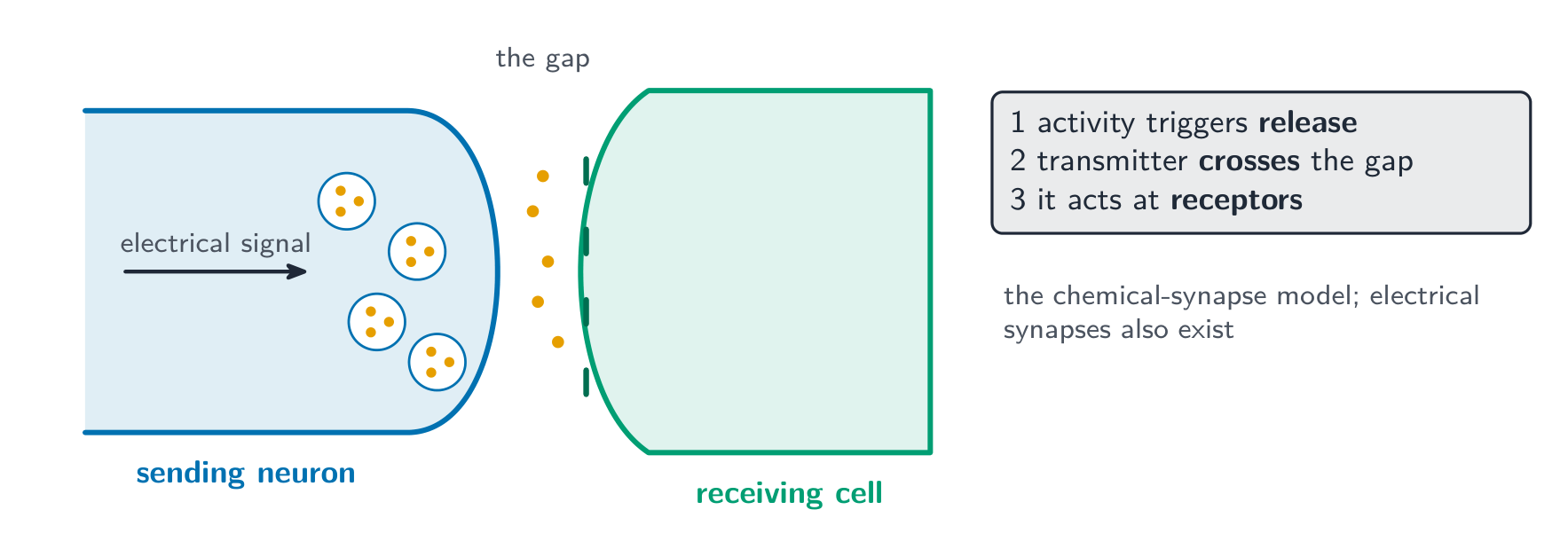
What crosses a chemical synapse?
Dificuldade 1/5 · Moedas 100 + pequeno bônus na primeira conclusão hoje
They act on receptors.
Two parts of the nervous system
- The central nervous system 中枢神经系统 is the brain and spinal cord. The peripheral nervous system 周围神经系统 connects them to the muscles, organs and senses.
- In a reflex, such as pulling a hand from a hot pan, the spinal cord sends a quick reply before the brain feels the pain.
Match each part to its system.
Dificuldade 2/5 · Moedas 140 + pequeno bônus na primeira conclusão hoje
Brain and spinal cord are central.
In a reflex, the spinal cord can send a reply before the brain feels pain.
Dificuldade 1/5 · Moedas 100 + pequeno bônus na primeira conclusão hoje
A quick protective response.
The cortex and its lobes
- The cerebral cortex 大脑皮层 has four lobes. The frontal lobe is linked to planning and self-control — the area Gage damaged; the occipital lobe to vision.
- Complex behaviour uses many areas working together, not one "centre".
Which lobe is linked to vision?
Dificuldade 1/5 · Moedas 100 + pequeno bônus na primeira conclusão hoje
At the back of the brain.
Worked example: what can Gage's case show?
- Evidence: a frontal-lobe injury was followed by a reported change in behaviour.
- What it supports: the frontal lobe is involved in personality and self-control.
- Limits: it is one case; reports were written years later and some details were exaggerated; Gage later held a job driving coaches in Chile, suggesting some recovery. A single case suggests a link — it does not prove that one region controls personality.
What limits the evidence from Gage's case?
Dificuldade 2/5 · Moedas 140 + pequeno bônus na primeira conclusão hoje
A single case suggests, it does not prove.
Sleep
- Sleep 睡眠 cycles through stages roughly every 90 minutes in adults. REM sleep 快速眼动睡眠 brings rapid eye movements and often vivid dreams.
- The 90 minutes is an average; cycles vary between people and through the night.
One brain area rarely "controls" a behaviour alone. Damage to an area shows it is involved, not that it does the job by itself. Say "is linked to" or "is involved in".
Brain damage to an area proves that area alone controls a behaviour.
Dificuldade 1/5 · Moedas 100 + pequeno bônus na primeira conclusão hoje
It shows involvement.
Neurons signal electrically and pass messages chemically across synapses. The central and peripheral nervous systems work together, cortical lobes are linked to different functions, and case studies like Gage's suggest links that need wider evidence.
Explain, in four sentences, what happens when you touch a hot pan, using neuron, synapse, spinal cord and brain.
Input, synapse, output.