Notes, instructions and checking
Introduzido| English | Significado |
|---|---|
| abbreviate/əˈbriːvɪeɪt/ | abreviar |
| following instructions/ˈfɒləʊɪŋ ɪnˈstrʌkʃnz/ | seguir instruções |
| clarifying/ˈklærɪfaɪɪŋ/ | esclarecer |
Short notes need complete meaning
- Goal: take short notes from spoken instructions that keep every action, its order and its conditions, then check them by restating.
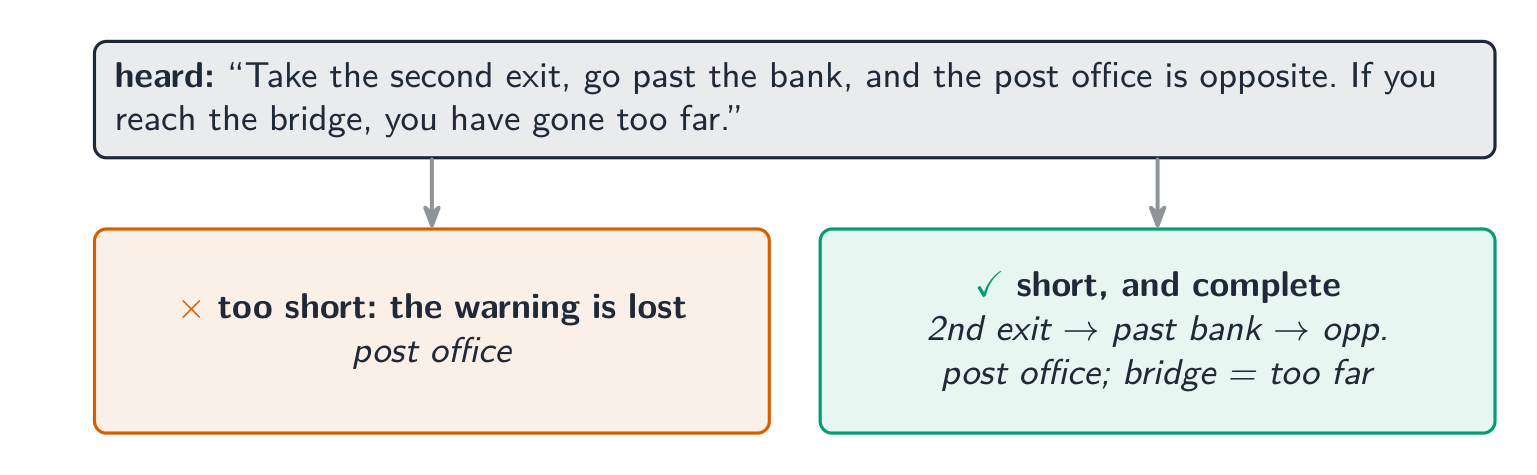
- You hear a route ending with “if you reach the bridge, you have gone too far”. A note containing only “post office” loses the stopping condition.
- Record the steps and warning: “2nd exit → past bank → opposite post office; bridge = too far”. Shorter writing is useful when the action remains clear.
Choose and abbreviate
- Abbreviate 缩写 names or familiar words consistently. Keep important dates, room numbers, negatives, conditions and relationships; not every verb or preposition is unimportant.
- An arrow can show “then” or “leads to”. Decide its meaning in your notes and check that you can reconstruct the instruction later.
A small set of note symbols (use the same ones every time)
- → then / leads to · = means / is · ≠ is not · ✗ not / no · ? not sure, check later
- b4 before · w/ with · w/o without · approx. about · Mon, Tue, Thu… days · rm room · info information
Which specific details should these short listening notes preserve? Choose all that apply.
Dificuldade 2/5 · Moedas 140 + pequeno bônus na primeira conclusão hoje
Dates, room numbers and names may be needed for the task. Record them selectively, together with important negatives and conditions, rather than copying every article and preposition.
Which symbol would you use in notes for "leads to" or "then"?
Dificuldade 1/5 · Moedas 100 + pequeno bônus na primeira conclusão hoje
An arrow can represent then or leads to in these notes. Keep its meaning consistent; other notation is possible in a different note system.
Your note says "rm 12 → 3 ?". What should you do after the talk?
Dificuldade 1/5 · Moedas 100 + pequeno bônus na primeira conclusão hoje
A question mark is a reminder to check an uncertain detail later, for example by asking the speaker or a classmate. It lets you keep listening instead of stopping.
Keep the permission condition
- “Send the plan, then wait for approval before booking” is not “send, then book”. Writing “submit → approval → book” preserves the missing permission step.
- Separate times by their role. A submission deadline does not become a briefing start time unless the speaker actually says so.
- You hear: “Please send me your own copy of the plan by Thursday at four. Don’t book the lab yet: wait until I’ve approved the plan, and then book it online. Oh, and the briefing is on Friday, but I’ll confirm the time later.”
- Notes:
own copy → me, Thu 16:00·✗ book yet; wait approval → book online·briefing Fri, time ? - Restate: “So I send my own copy by Thursday at four, book the lab online only after you approve it, and you’ll tell us the briefing time?”
- The notes keep the order (send → approval → book), the negative (✗ book yet) and the unknown (time ?). The restatement lets the speaker correct anything before you act.
In the lab instruction, what do you know about the briefing?
Dificuldade 1/5 · Moedas 100 + pequeno bônus na primeira conclusão hoje
The speaker says "the briefing is on Friday, but I'll confirm the time later". Thursday at four is the deadline for sending the plan, a different time with a different role.
Follow a required sequence
- Following instructions 遵循指令 means carrying out the specified actions and conditions. If the task requires one step before another, reversing them does not meet that instruction.
- Listen for “first”, “before”, “after” and “only if”. If a room is occupied and you are told to wait at the desk, another room is not automatically an authorised alternative.
If an instruction requires one step before another, reversing those steps still meets the instruction.
Dificuldade 1/5 · Moedas 100 + pequeno bônus na primeira conclusão hoje
A required sequence must be preserved. Listen for first, then, before, after and any permission condition.
Clarify and restate
- Clarifying 澄清 checks an uncertain detail: “Sorry, did you say fifteen or fifty?” A specific question is useful when the uncertainty is specific; a broader explanation may be needed otherwise.
- Restate both parts of an instruction: “So the report is due on Thursday and we submit it online.” Invite correction; restating alone does not prove that you understood everything.
You did not catch a number. Which is the strongest thing to say?
Dificuldade 1/5 · Moedas 100 + pequeno bônus na primeira conclusão hoje
One specific detail, with the two possibilities named. It is quick to answer and shows you were following.
Your teacher says the report deadline moves to Thursday and must be submitted online. Write one sentence restating that to confirm you understood.
Dificuldade 3/5 · Moedas 200 + pequeno bônus na primeira conclusão hoje
Example: "So the report is due on Thursday and we submit it online." Both facts, in your own words.
Short notes must keep the required action, order and condition. Ask about a missing start time rather than substituting a nearby deadline.