Past perfect — the past before the past · Past perfect — o passado antes do passado
Which happened first?
- The past perfect is for an action that happened before another past action.
- When I arrived, the train had already left.
- It puts two past events in order.
By the time I reached the station, the train had started its own adventure.
Qual aconteceu primeiro?
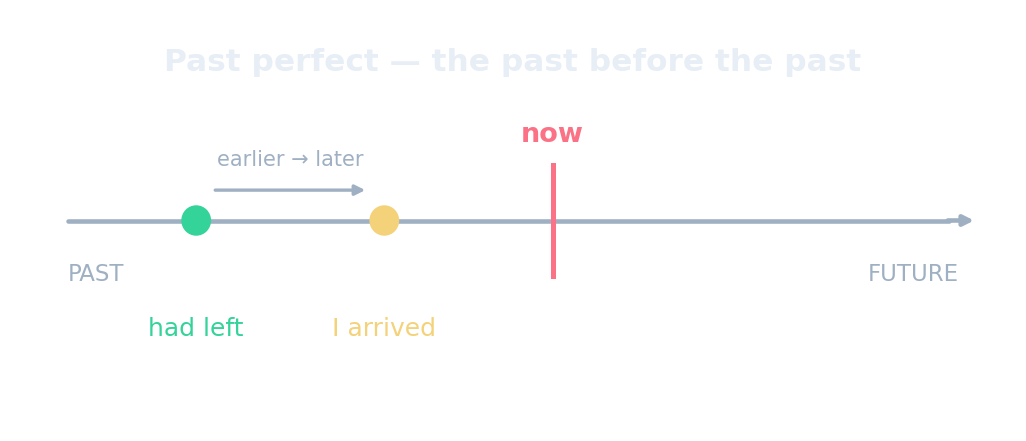
- O past perfect é para uma ação que aconteceu antes de outra ação passada.
- When I arrived, the train had already left.
- Coloca dois eventos passados em ordem.
By the time I reached the station, the train had started its own adventure.
Form: had + past participle
- had + past participle, the same for every subject.
- I had finished. She had gone. They had eaten.
- Short form: I'd, she'd, they'd.
Forma: had + past participle
- had + past participle, o mesmo para todo sujeito.
- I had finished. She had gone. They had eaten.
- Forma abreviada: I'd, she'd, they'd.
Complete: When we got home, the guests had already ___ (leave).
had + past participle: leave → left. · had + particípio passado: leave → left.
Which happened first?
- The earlier action → past perfect (had done).
- The later action → past simple (did).
- The film had started when we arrived. (started first)
Qual aconteceu primeiro?
- A ação anterior → past perfect (had done).
- A ação posterior → past simple (did).
- The film had started when we arrived. (started first)
Two past events, in order · Dois eventos no passado, em ordem
The earlier action takes the past perfect; the later one takes the past simple. · A ação anterior recebe o past perfect; a posterior recebe o past simple.
Which happened FIRST? “When I arrived, the train had left.” · Qual aconteceu PRIMEIRO? “When I arrived, the train had left.”
“had left” (past perfect) is the earlier action — it happened first. · “had left” (past perfect) é a ação anterior — aconteceu primeiro.
Does the past perfect show the EARLIER of two past actions? · O past perfect indica a ação ANTERIOR entre duas ações passadas?
Yes — past perfect (had + p.p.) = the action that happened first. · Sim — past perfect (had + p.p.) = a ação que aconteceu primeiro.
Translate into English: 我到的时候,火车已经开走了。 · Traduza para o inglês: 我到的时候,火车已经开走了。
Earlier action → past perfect: “When I arrived, the train had left.” · Ação anterior → past perfect: “When I arrived, the train had left.”
When you need it
- Use it when the order matters or could be confusing.
- A simple story in order can stay in the past simple.
Quando você precisa dele
- Use-o quando a ordem importar ou puder ser confusa.
- Uma história simples em ordem pode ficar no past simple.
Common mistakes
- ❌ After he had left, I had cleaned the room. → only the earlier action takes had.
- ❌ I had seen this film. (no other past event) → ✓ I have seen this film.
- by the time + past simple → the other action usually takes the past perfect.
Erros comuns
- ❌ After he had left, I had cleaned the room. → apenas a ação anterior leva had.
- ❌ I had seen this film. (nenhum outro evento passado) → ✓ I have seen this film.
- by the time + past simple → a outra ação geralmente leva o past perfect.
By the time we arrived, the film ___ .
The start came before our arrival — earlier of two past events → past perfect. · O início veio antes da nossa chegada — anterior entre dois eventos passados → past perfect.
Two past actions told in the order they happened — do you NEED the past perfect? · Duas ações passadas contadas na ordem em que aconteceram — você PRECISA do past perfect?
No — in-order stories use the past simple. The past perfect is for jumping back. · Não — histórias em ordem usam o past simple. O past perfect é para voltar no tempo.
- Past perfect = had + past participle = the past before the past.
- Earlier action → past perfect; later action → past simple.
- Use it when the order of two past events matters.
- Past perfect = had + past participle = o passado antes do passado.
- Ação anterior → past perfect; ação posterior → past simple.
- Use-o quando a ordem de dois eventos passados importar.
Write one sentence about two past events, using the past perfect for the one that happened first. · Escreva uma frase sobre dois eventos passados, usando o past perfect para o que aconteceu primeiro.
Example: “The class had started when I arrived.” · Exemplo: “The class had started when I arrived.”