Modal verbs — can, should, must · Verbos modais — can, should, must
Modal verbs — little helpers
- Modal verbs add meaning: ability, advice, obligation.
- can, could, should, must, have to.
- They are followed by the base verb (no to, no -s).
You should sleep; your alarm clock is ready for tomorrow.
Verbos modais — pequenos auxiliares
- Verbos modais adicionam significado: habilidade, conselho, obrigação.
- can, could, should, must, have to.
- Eles são seguidos pelo verbo na forma base (sem to, sem -s).
You should sleep; your alarm clock is ready for tomorrow.
can / could — ability & requests
- can = ability or possibility: I can swim.
- could = past ability, or a polite request: She could read at four. Could you help me?
- After can / could, use the base verb: can swim (not can to swim).
can / could — habilidade e pedidos
- can = habilidade ou possibilidade: I can swim.
- could = habilidade no passado ou um pedido educado: She could read at four. Could you help me?
- Após can / could, use o verbo na forma base: can swim (não can to swim).
Which sentence is correct? · Qual frase está correta?
A modal is followed by the base verb (no “to”, no -ing): “can swim”. · Um modal é seguido pelo verbo base (sem “to”, sem -ing): “can swim”.
should — advice
- should = advice, "it's a good idea": You should see a doctor.
- Negative shouldn't = "it's not a good idea": You shouldn't eat so late.
- It is softer and gentler than must.
should — conselho
- should = conselho, "é uma boa ideia": You should see a doctor.
- Negativo shouldn't = "não é uma boa ideia": You shouldn't eat so late.
- É mais suave e gentil do que must.
Give advice: You ___ see a doctor. (use one modal verb) · Dê um conselho: You ___ see a doctor. (use um verbo modal)
Advice → should: “You should see a doctor.” · Conselho → should: “You should see a doctor.”
Translate into English: 你应该去看医生。 · Traduza para inglês: 你应该去看医生。
Advice → should + base verb: “You should see a doctor.” · Conselho → should + verbo base: “You should see a doctor.”
must / have to — obligation
- must and have to = "it's necessary": You must wear a seatbelt. I have to get up early.
- mustn't = it's forbidden: You mustn't smoke here.
- don't have to = it's not necessary: You don't have to come.
must / have to — obrigação
- must e have to = "é necessário": You must wear a seatbelt. I have to get up early.
- mustn't = é proibido: You mustn't smoke here.
- don't have to = não é necessário: You don't have to come.
What does the modal do? · O que o modal faz?
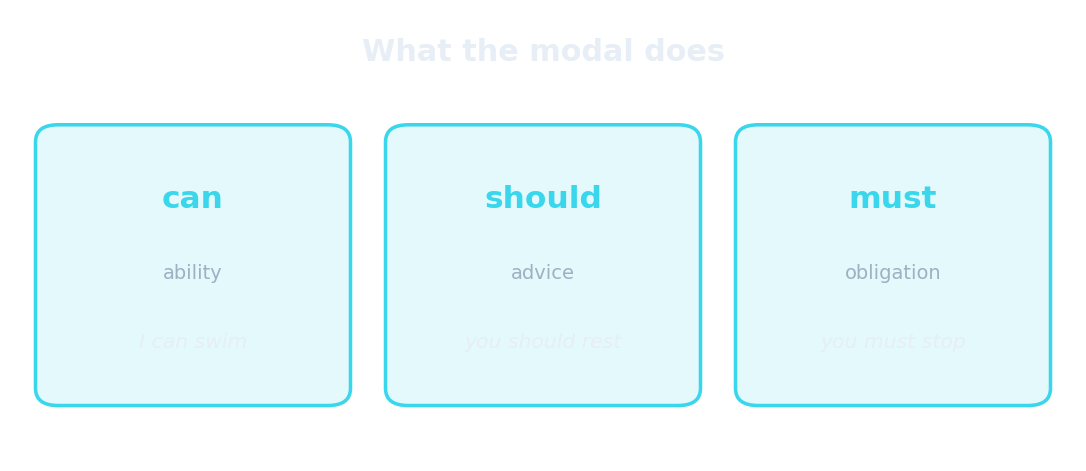
can = ability; should = advice; must / have to = obligation. · can = habilidade; should = conselho; must / have to = obrigação.
“You mustn't smoke here.” — Does this mean it is forbidden? · “You mustn't smoke here.” — Isso significa que é proibido?
mustn't = it is forbidden. (don't have to = not necessary — different!) · mustn't = é proibido. (don't have to = não é necessário — diferente!)
Common mistakes
- ❌ You must to go. → ✓ You must go. — modals never take to.
- ❌ She musts study. → ✓ She must study. — modals never take -s.
- Careful: mustn't = not allowed; don't have to = not necessary. Opposite meanings!
Erros comuns
- ❌ You must to go. → ✓ You must go. — modais nunca levam to.
- ❌ She musts study. → ✓ She must study. — modais nunca levam -s.
- Cuidado: mustn't = não permitido; don't have to = não necessário. Significados opostos!
Match each sentence to its meaning. · Combine cada frase ao seu significado.
mustn't forbids; don't have to means it's optional; should advises; must requires. · mustn't proíbe; don't have to significa que é opcional; should aconselha; must exige.
Complete with the past of “must”: Yesterday I ___ work late. · Complete com o passado de “must”: Yesterday I ___ work late.
must has no past form — use had to. · must não tem forma no passado — use had to.
- Modals + base verb (no to, no -s).
- can / could = ability & requests; should = advice.
- must / have to = necessary; mustn't = forbidden ≠ don't have to = not necessary.
- Modais + verbo na forma base (sem to, sem -s).
- can / could = ability & requests; should = advice.
- must / have to = necessary; mustn't = forbidden ≠ don't have to = not necessary.
A friend is tired and stressed. Write one sentence of advice using “should”. · Um amigo está cansado e estressado. Escreva uma frase de conselho usando “should”.
Example: “You should go to bed early and relax.” · Exemplo: “You should go to bed early and relax.”