Countable and uncountable nouns · Substantivos contáveis e incontáveis
Two kinds of nouns
- Countable nouns can be counted: one book, two books.
- Uncountable nouns can't: water, music, money (no plural).
- This changes which words we use with them.
I have some homework and much optimism.
Dois tipos de substantivos
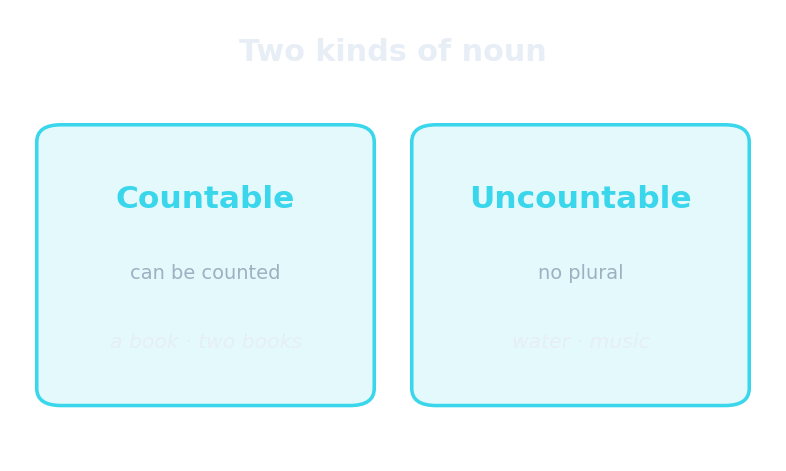
- Contáveis podem ser contados: one book, two books.
- Incontáveis não podem: water, music, money (sem plural).
- Isso muda quais palavras usamos com eles.
I have some homework and much optimism.
Countable vs uncountable
- Countable: a / an + singular, or a number + plural → a car, three cars.
- Uncountable: no a / an, no plural → water (not a water, not waters).
- Uncountable nouns take a singular verb: The news is good.
Contável vs incontável
- Contável: a / an + singular, ou número + plural → a car, three cars.
- Incontável: sem a / an, sem plural → water (não a water, não waters).
- Substantivos incontáveis levam verbo singular: The news is good.
Sort the nouns — countable or uncountable? · Classifique os substantivos — contável ou incontável?
Countable nouns can be counted and have a plural; uncountable nouns cannot. · Substantivos contáveis podem ser contados e têm plural; incontáveis não podem.
Which phrase is correct? · Qual expressão está correta?
“water” is uncountable — no plural and no number: “some water”. · “water” é incontável — sem plural e sem número: “some water”.
some / any
- some = a few / a little, in positive sentences: There are some eggs.
- any = in negatives and questions: There isn't any milk. Any questions?
- Use some for polite offers: Would you like some tea?
some / any
- some = alguns / um pouco, em frases positivas: There are some eggs.
- any = em negativas e perguntas: There isn't any milk. Any questions?
- Use some para ofertas educadas: Would you like some tea?
Complete the negative: There isn't ___ milk in the fridge. · Complete a negativa: There isn't ___ milk in the fridge.
Negatives use “any”: There isn't any milk. · Negativas usam “any”: There isn't any milk.
Translate into English: 我需要一些水。 · Traduza para inglês: 我需要一些水。
Uncountable + positive → some water: “I need some water.” · Incontável + positivo → some water: “I need some water.”
much / many / a lot of
- many + countable plural: many people.
- much + uncountable (mostly negatives / questions): much time.
- a lot of works with both, and is best in positives: a lot of friends.
much / many / a lot of
- many + plural contável: many people.
- much + incontável (na maioria das negativas / perguntas): much time.
- a lot of funciona com ambos, e é melhor em positivas: a lot of friends.
Choose the correct word: There are ___ people here. · Escolha a palavra correta: There are ___ people here.
“people” is countable plural → use “many”. · “people” é plural contável → use “many”.
Common mistakes
- ❌ informations / homeworks / advices → ✓ information / homework / advice — never plural.
- ❌ a bread → ✓ a piece of bread — count with a unit word.
- ❌ How much apples? → ✓ How many apples? — countable → many.
Erros comuns
- ❌ informations / homeworks / advices → ✓ information / homework / advice — nunca no plural.
- ❌ a bread → ✓ a piece of bread — conte com uma palavra de unidade.
- ❌ How much apples? → ✓ How many apples? → contáveis → many.
Match the unit to its noun. · Combine a unidade ao seu substantivo.
Uncountable nouns are counted through a unit: a slice / glass / cup / bar of … · Substantivos incontáveis são contados através de uma unidade: fatia / copo / xícara / barra de …
Which sentence is correct? · Qual frase está correta?
information is uncountable — no plural, no a / an. · information é incontável — sem plural, sem a / an.
- Countable = can count (a car, cars); uncountable = can't (water, music).
- some (positive) / any (negatives, questions).
- many + countable, much + uncountable, a lot of + both.
- Contável = pode contar (a car, cars); incontável = não pode (water, music).
- some (positivas) / any (negativas, perguntas).
- many + contável, much + incontável, a lot of + ambos.
Write one sentence about what is in your fridge, using “some” or “any” correctly. · Escreva uma frase sobre o que há na sua geladeira, usando “some” ou “any” corretamente.
Example: “There are some eggs and some milk in my fridge.” · Exemplo: “There are some eggs and some milk in my fridge.”