Externalities and intervention
Introduzido| English | Significado |
|---|---|
| externality/ekˈstɜːnælɪti/ | externalidade |
| subsidy/ˈsʌbsɪdi/ | subsídio |
Beijing's air, January 2013
- On 12 January 2013, some air monitors in Beijing showed fine-dust (PM2.5) readings near 900 micrograms per cubic metre — over 30 times the health guideline of the time. Factories, power stations and cars did not pay for the harm their smoke did to people's lungs.
- When a cost falls on people outside a deal, the market gets the amount wrong.
Externalities
- An externality 外部性 is a cost or benefit that falls on a third party — someone who is neither the buyer nor the seller.
- Negative: noise, smoke, traffic jams. Positive: a neighbour's beautiful garden, a vaccinated classmate.
Which are negative externalities?
Dificuldade 2/5 · Moedas 140 + pequeno bônus na primeira conclusão hoje
Rent is a private cost.
Why markets get it wrong
- A firm looks only at its own costs. If harm to others is free for the firm, it produces too much of the harmful good.
- If a benefit to others brings the firm no income, it produces too little of the useful good.
A good creates external costs. Without government action, the market will produce
Dificuldade 1/5 · Moedas 100 + pequeno bônus na primeira conclusão hoje
The firm ignores the harm.
Worked example: night deliveries
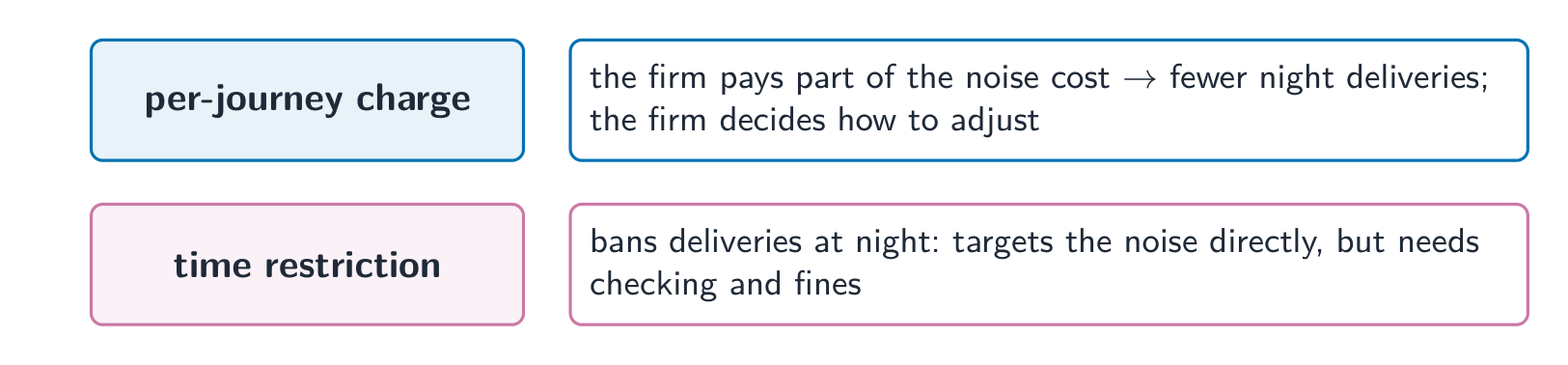
A supermarket's night delivery saves it 50 yuan per trip. Each trip wakes local residents, a harm they value at 80 yuan.
- Firm's view: the trip is worth 50 yuan to it, so it makes the trip.
- Society's view: benefit 50, harm 80 — each trip makes society 30 yuan worse off.
- A tax of 80 yuan per trip makes the firm pay for the harm; the trip now loses it 30 yuan, so it stops. A ban would work too.
A trip saves a firm 40 yuan and causes 70 yuan of harm to others. By how much does each trip lower society's welfare?
Dificuldade 2/5 · Moedas 140 + pequeno bônus na primeira conclusão hoje
70 − 40.
Tools against negative externalities
- Taxes, laws (a night-time noise ban), and pollution permits.
- A tax raises the price and cuts the quantity; a law sets a limit directly.
Tools for positive externalities
- A subsidy 补贴 is a payment from the government that lowers a producer's costs or a consumer's price.
- Subsidies for electric delivery vans, vaccinations or school meals increase use of goods that help others.
Match each problem to a suitable tool.
Dificuldade 2/5 · Moedas 140 + pequeno bônus na primeira conclusão hoje
Discourage harm, encourage benefit.
A subsidy lowers producers' costs and increases output.
Dificuldade 1/5 · Moedas 100 + pequeno bônus na primeira conclusão hoje
Supply shifts right.
An externality is not just any cost. The delivery firm's fuel bill is a private cost it already pays. Only the harm to the residents — who are not part of the deal — is external.
A firm's fuel bill is an external cost.
Dificuldade 1/5 · Moedas 100 + pequeno bônus na primeira conclusão hoje
It is a private cost.
Externalities are costs or benefits to third parties. Without action, markets overproduce goods with external costs and underproduce goods with external benefits. Taxes, regulation and permits deal with the first; subsidies and free provision with the second.
Explain why the market produced too much air pollution in Beijing in 2013, and assess one way the government could reduce it.
Externalities in context.