Mixed provision and the free-rider problem
Introduzido| English | Significado |
|---|---|
| non-rivalry/nɒn ˈraɪvəlri/ | não rivalidade |
| free rider/friː ˈraɪdə/ | free rider |
Who pays for a lighthouse?
- Every ship passing a lighthouse is guided by its light, whether its owner paid or not. Since 1514, Trinity House has run England's lighthouses, paid for by "light dues" charged to ships when they use the ports.
- Some goods cannot be sold one at a time like bread.
Public goods
- A public good has two features. Non-rivalry 非竞争性: one person's use does not reduce what others get. Non-excludability: people who do not pay cannot be stopped from using it.
- Street lighting, flood defences and national defence are examples.
Which features describe a public good?
Dificuldade 2/5 · Moedas 140 + pequeno bônus na primeira conclusão hoje
Two defining features.
Which is closest to a public good?
Dificuldade 1/5 · Moedas 100 + pequeno bônus na primeira conclusão hoje
Everyone behind the defences is protected.
The free-rider problem
- A free rider 搭便车者 enjoys a good without paying for it.
- If everyone hopes others will pay, a private firm cannot earn enough, and the good is not provided at all.
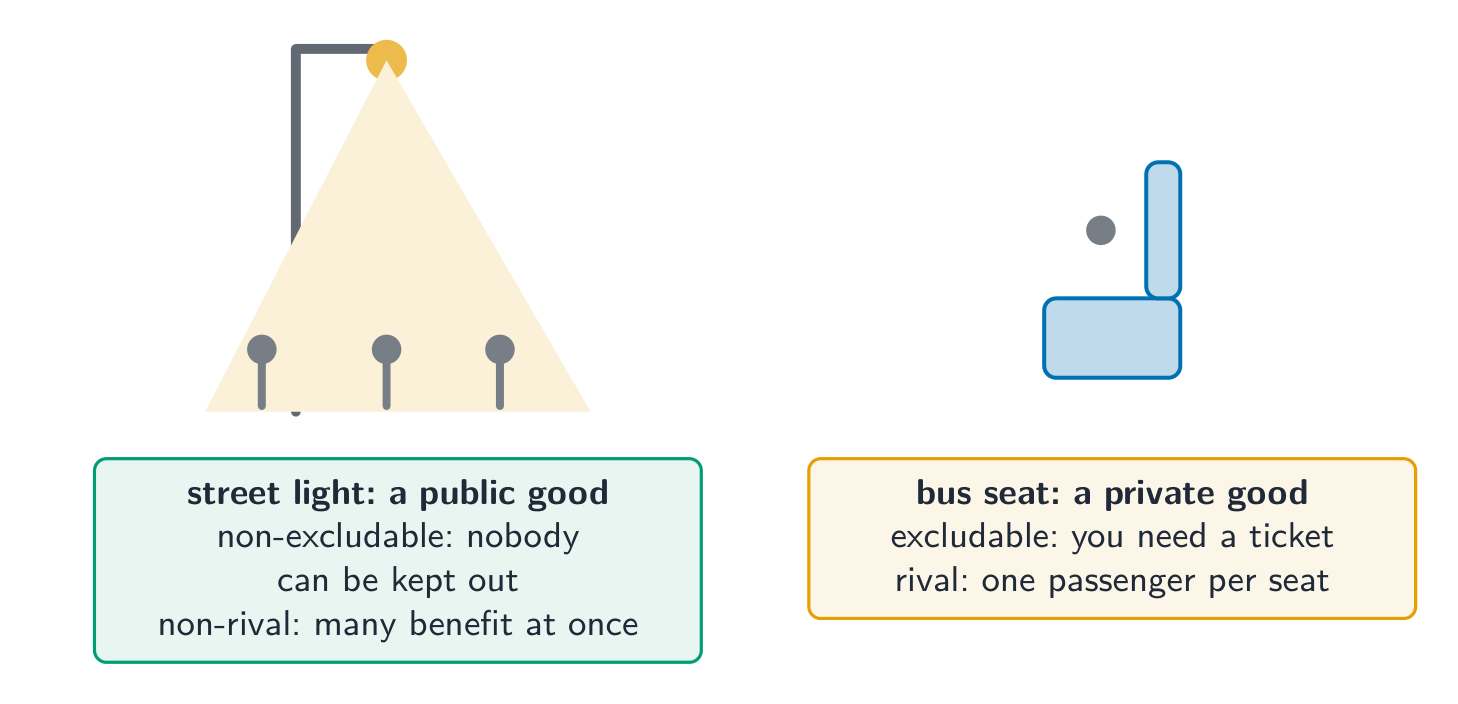
Why might a private firm not supply street lighting?
Dificuldade 1/5 · Moedas 100 + pequeno bônus na primeira conclusão hoje
The free-rider problem.
Worked example: street lights
A street has 100 households. Each values street lights at 30 yuan a year. The lights cost 2000 yuan a year.
- Total value: $100 \times 30 = 3000$ yuan, more than the cost. The lights are worth having.
- Private sale: each household hopes the others pay. Few pay, and the firm cannot cover 2000 yuan.
- Public provision: a local tax of 20 yuan per household raises 2000 yuan, and everyone gains 10 yuan.
50 households each value a park at 40 yuan a year. The park costs 1500 yuan a year. By how much does total value exceed cost?
Dificuldade 2/5 · Moedas 140 + pequeno bônus na primeira conclusão hoje
2000 − 1500.
Mixed provision
- Most economies are mixed: the government provides public goods, and private firms provide most other goods.
- Some goods are provided by both: state and private schools, public parks and private gyms.
In a mixed economy, both the state and private firms provide goods.
Dificuldade 1/5 · Moedas 100 + pequeno bônus na primeira conclusão hoje
Schools, hospitals, parks and gyms.
Why governments also provide other goods
- Health care and education have external benefits, so they would be underused if sold only privately.
- Governments also provide them for fairness, so poorer families can get them.
"Public good" does not mean any good the government provides. State schools are rival (a full class has no room) and excludable. They are merit goods with external benefits, not public goods.
A state school is a public good.
Dificuldade 1/5 · Moedas 100 + pequeno bônus na primeira conclusão hoje
Places are rival and excludable.
Public goods are non-rival and non-excludable, so free riders stop private firms from supplying them. Governments provide them from taxes. In a mixed economy the state also provides goods with external benefits, such as health care and education.
Explain why lighthouses are hard to provide through a normal market, and how they have been paid for.
Public goods.